
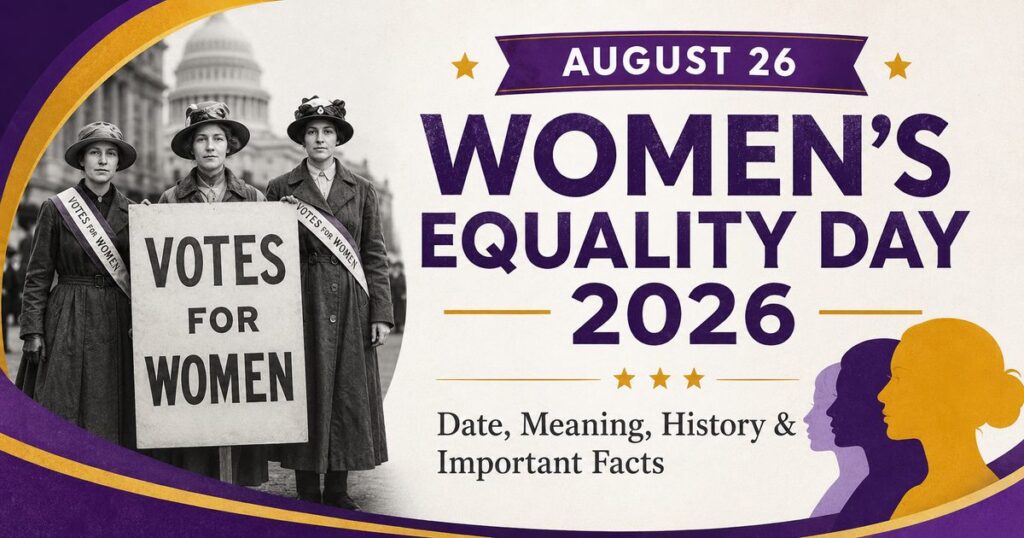
Women’s Equality Day 2026 will be observed on Wednesday, August 26, across the United States. The observance marks the certification of the 19th Amendment and continues to recognize the ongoing pursuit of equal rights and opportunities for women in American life. Every year on this date, communities, schools, workplaces, and civic organizations pause to reflect on how far the movement for equality has come — and how far it still has to go.
| Detail | Information |
|---|---|
| Date | Wednesday, August 26, 2026 |
| Country | United States |
| Type | National observance |
| Main purpose | Recognizing women’s voting rights and equality |
| Related amendment | 19th Amendment |
| Federal holiday | No |
Women’s Equality Day falls on the same calendar date every year — August 26 — regardless of the day of the week it lands on. In 2026, that date happens to be a Wednesday, right in the middle of the work and school week, which tends to shift how the day is marked: fewer long-weekend events, more workplace recognitions, classroom lessons, and social media campaigns.
Women’s Equality Day 2026 Countdown
Quick answer for search engines: As of today, Women’s Equality Day 2026 is coming up on Wednesday, August 26, 2026.
What Is Women’s Equality Day?
Women’s Equality Day is a national observance, not a federal holiday, that commemorates the certification of the 19th Amendment to the U.S. Constitution, which prohibited denying citizens the right to vote based on sex. Beyond that historical anchor, the day has grown into a broader annual reflection on equality across several dimensions:
- Voting rights — honoring the legal milestone of 1920 while acknowledging it wasn’t the finish line for all women
- Equal opportunity — pay equity, access to education, and career advancement
- General equality — social, legal, and cultural fairness between genders
It’s best understood as a hybrid of commemoration and awareness day. It commemorates a specific historical event (certification of the amendment) while also functioning as a call to action on unfinished business — pay gaps, representation in leadership, and access to opportunity. It is not framed as a festive celebration in the way a national holiday might be; it’s more reflective and civic in tone, similar to observances like Juneteenth or Constitution Day.
Why Is Women’s Equality Day Celebrated on August 26?
The date traces back to a sequence of events in 1920:
- June 4, 1919 — Congress passed the 19th Amendment and sent it to the states for ratification.
- August 18, 1920 — Tennessee became the 36th state to ratify the amendment, providing the three-fourths majority of states required for it to become law.
- August 26, 1920 — U.S. Secretary of State Bainbridge Colby signed the official proclamation certifying the amendment, making it part of the Constitution.
August 26 was chosen as the commemorative date specifically because it marks that final certification — the moment the amendment officially took legal effect nationwide, rather than the date of the last state ratification a week earlier.
History of Women’s Equality Day
The early women’s-rights movement
The organized push for women’s rights in the U.S. is often traced to the 1848 Seneca Falls Convention in New York, where activists including Elizabeth Cady Stanton and Lucretia Mott drafted the Declaration of Sentiments, calling for expanded rights for women, including suffrage.
The campaign for women’s suffrage
Over the following decades, suffragists built state-by-state campaigns, organized marches, lobbied lawmakers, and endured arrest and public backlash. Leaders such as Susan B. Anthony, Alice Paul, Ida B. Wells, and Carrie Chapman Catt each shaped different strategic wings of the movement, from legislative lobbying to direct public protest.
Passage and ratification of the 19th Amendment
After Congress passed the amendment in 1919, it required ratification by three-fourths of the states. That threshold was reached in August 1920, and the amendment was certified into law on August 26 of that year.
The Women’s Strike for Equality in 1970
On the 50th anniversary of certification, tens of thousands of women marched in New York City and other cities nationwide in the Women’s Strike for Equality, demanding equal opportunity in employment, education, and reproductive rights. The event significantly raised the visibility of second-wave feminism.
Bella Abzug and the creation of Women’s Equality Day
In 1973, U.S. Representative Bella Abzug introduced a joint resolution in Congress designating August 26 as Women’s Equality Day. The resolution passed, and it has been marked annually since, typically through a presidential proclamation.
How the observance developed after 1973
Since its formal designation, Women’s Equality Day has been recognized through presidential proclamations, congressional statements, museum programming, workplace initiatives, and educational events. It has become a recurring touchpoint each August for discussions on gender equity in the workplace and beyond.
Did the 19th Amendment Give Every Woman Equal Voting Access?
This is one of the most historically important nuances of Women’s Equality Day, and it’s worth stating clearly: no, not immediately, and not equally.
The 19th Amendment prohibited the denial of voting rights on the basis of sex. However, it did not override other discriminatory barriers already in place. In practice:
- Many Black women, particularly in the South, continued to face poll taxes, literacy tests, intimidation, and other Jim Crow–era barriers that had long suppressed Black voters generally.
- Native American women were largely excluded, since Native Americans were not uniformly granted U.S. citizenship until the Indian Citizenship Act of 1924 — and even then, many states continued to bar Native voters for decades.
- Asian American women were affected by immigration and naturalization laws that denied citizenship to many Asian immigrants until the mid-20th century.
- Latina women, especially in the Southwest, also faced literacy tests and language-based barriers to voting.
Full legal enforcement of voting rights for all women did not arrive until the Voting Rights Act of 1965, and even then, barriers to access have continued to surface in various forms. Acknowledging this is central to an accurate account of the 19th Amendment’s legacy — it was a major milestone, not a complete resolution.
Why Women’s Equality Day Still Matters
The observance today extends well beyond its 1920 origin point, touching on:
- Civic participation — encouraging voter registration and turnout, especially among younger women
- Educational opportunity — access to higher education and STEM fields
- Workplace fairness — pay equity and parental leave policies
- Leadership and representation — the presence of women in elected office, corporate boardrooms, and executive roles
- Recognition of overlooked women — spotlighting the contributions of women of color and other historically marginalized groups whose roles in the suffrage and equality movements were minimized for decades
- Continued discussion of equal rights — ongoing legal and cultural conversations about gender equity
Is Women’s Equality Day a Federal Holiday?
No. Women’s Equality Day is a national observance, not a federal holiday. That distinction matters practically:
- Federal offices remain open and operate on a normal schedule.
- Schools and businesses are not required to close.
- There is no mandated day off, unlike holidays such as Independence Day or Thanksgiving.
- Recognition instead comes through local programs, workplace initiatives, educational events, and public proclamations, rather than a nationwide shutdown of institutions.
Women’s Equality Day Facts
- Women’s Equality Day is observed every year on August 26.
- It commemorates the certification of the 19th Amendment in 1920.
- The amendment was certified by Secretary of State Bainbridge Colby.
- Tennessee’s ratification on August 18, 1920, provided the deciding vote among the states.
- Congress designated the day in 1973 through a resolution introduced by Representative Bella Abzug.
- It is not a federal holiday, so offices, schools, and businesses stay open.
- The 1970 Women’s Strike for Equality helped inspire the day’s eventual creation.
- The 19th Amendment barred sex-based voting discrimination but did not end all voting barriers for women of color.
- Full voting access for many women of color wasn’t secured until the Voting Rights Act of 1965.
- The day is often marked with proclamations, panel discussions, and workplace equity programs rather than parades.
- It differs from International Women’s Day (March 8), which has a global rather than U.S.-specific focus.
- The 19th Amendment is on permanent public display at the National Archives in Washington, D.C.
Women’s Equality Day 2026 Events
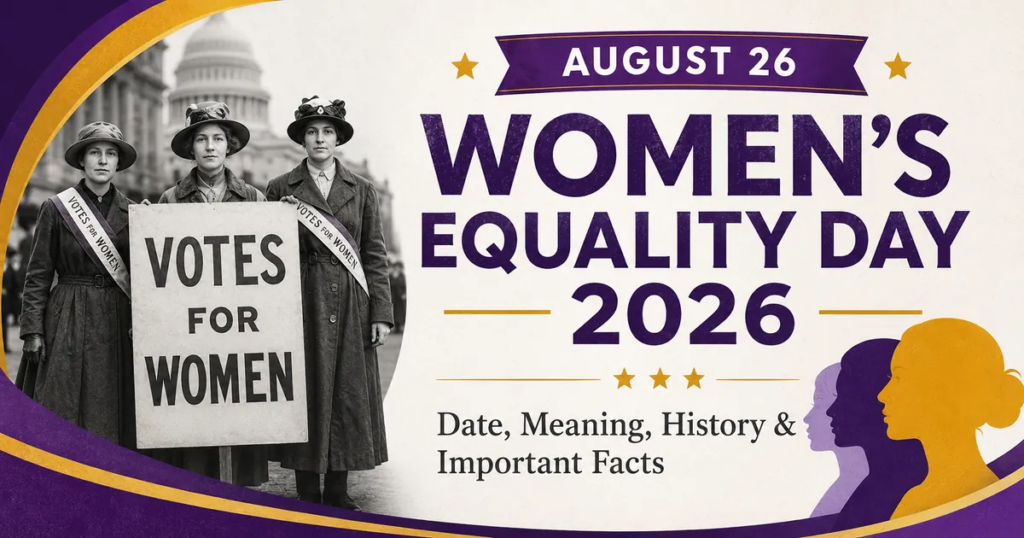
Event details below are illustrative categories — confirm and update with verified local listings closer to August 26, 2026.
Washington, D.C.
Expect commemorative programming near the National Archives and Capitol Hill, along with panel discussions hosted by civic and women’s rights organizations.
Seneca Falls, New York
As the birthplace of the 1848 women’s rights convention, Seneca Falls typically hosts commemorative events through the National Women’s Hall of Fame and related local institutions.
Museums and historical sites
Museums with women’s history collections often run special exhibits, lectures, or extended hours around August 26.
Virtual programs
Many advocacy and civic organizations host webinars, livestreamed panels, and social media campaigns, making participation accessible regardless of location.
A Notable 2026 Historical Update
Visitors to the National Archives Rotunda in Washington, D.C. can view the 19th Amendment as part of the museum’s permanent Charters of Freedom display, alongside the Declaration of Independence, the Constitution, and the Bill of Rights — giving the public ongoing, in-person access to the actual certified document behind the observance.
Frequently Asked Questions
When is Women’s Equality Day 2026? Women’s Equality Day 2026 is on Wednesday, August 26, 2026.
What day of the week is Women’s Equality Day 2026? It falls on a Wednesday in 2026.
Why is Women’s Equality Day on August 26? August 26 marks the date in 1920 when the 19th Amendment was officially certified by the Secretary of State, making it part of the U.S. Constitution.
What does Women’s Equality Day celebrate? It commemorates the certification of women’s constitutional right to vote and serves as a broader reflection on ongoing efforts toward equal rights and opportunity.
Is Women’s Equality Day a federal holiday? No. It’s a national observance, and federal offices, schools, and businesses operate on a normal schedule.
Who created Women’s Equality Day? Representative Bella Abzug introduced the congressional resolution that established the observance in 1973.
What is the connection between Women’s Equality Day and the 19th Amendment? The day directly commemorates the 19th Amendment’s certification on August 26, 1920, which prohibited denying voting rights based on sex.
When did American women receive the right to vote? The 19th Amendment was ratified and certified in August 1920, though many women of color continued to face voting barriers for decades afterward.
Are schools and businesses closed? No, since it is not a federal holiday, schools and businesses generally remain open.
How is Women’s Equality Day different from International Women’s Day? Women’s Equality Day (August 26) is a U.S.-specific observance tied to the 19th Amendment, while International Women’s Day (March 8) is a global observance focused on women’s achievements and rights worldwide.