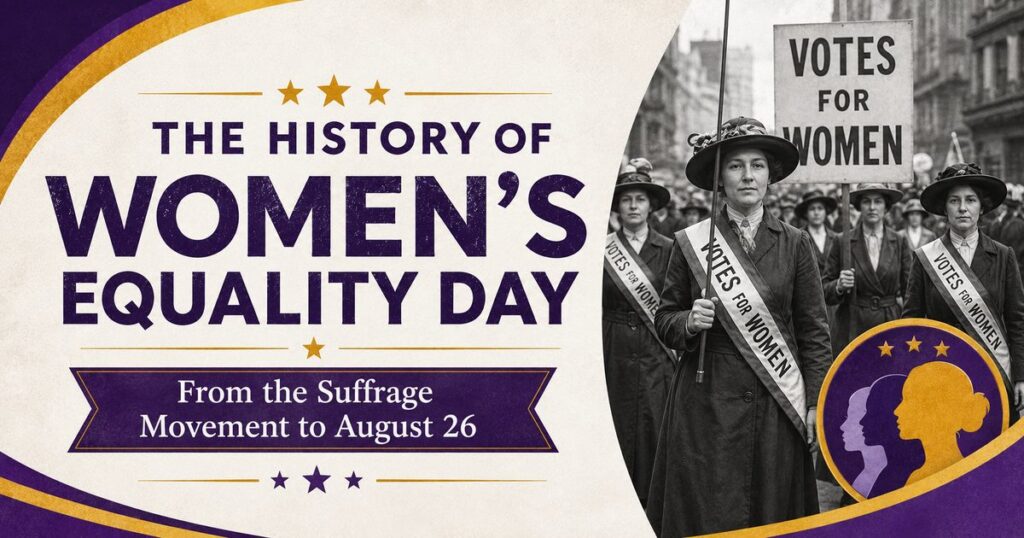
Women’s Equality Day didn’t start as a single event. It grew out of more than seventy years of organizing, marching, petitioning, and protest — a movement that stretched from a small gathering in upstate New York in 1848 to a congressional resolution signed into law in 1973. Understanding that full arc is the best way to understand what Women’s Equality Day 2026 is actually about.
History of Women’s Equality Day at a Glance
| Year | Event |
|---|---|
| 1848 | Seneca Falls Convention |
| 1878 | Federal suffrage amendment first introduced in Congress |
| 1913 | Major suffrage procession in Washington, D.C. |
| 1917 | White House picketing by the National Woman’s Party begins |
| 1919 | 19th Amendment passed by Congress |
| August 18, 1920 | Tennessee becomes the deciding ratifying state |
| August 26, 1920 | Official certification of the 19th Amendment |
| August 26, 1970 | Women’s Strike for Equality |
| 1971 | Bella Abzug introduces her first Women’s Equality Day resolution |
| 1973 | Congress officially designates August 26 as Women’s Equality Day |
More than 5,000 suffragists took part in the 1913 Washington, D.C. procession, organized by Alice Paul and Lucy Burns the day before Woodrow Wilson’s presidential inauguration. Four years later, the National Woman’s Party began the first organized picketing of the White House, a tactic that had never before been used against a sitting U.S. president.
Women’s Rights Before the Suffrage Movement
Before the organized suffrage movement took shape, American women in the early-to-mid 19th century faced sweeping legal restrictions. Under the doctrine of coverture, a married woman’s legal identity was largely absorbed into her husband’s: she typically could not own property in her own name, keep her own wages, sign contracts, or gain custody of her children in a divorce. Higher education was largely closed to women, professional careers in law, medicine, and the ministry were effectively off-limits, and women had no formal voice in the political process that governed their lives. These conditions set the stage for the first organized calls for change.
The Seneca Falls Convention and the Declaration of Sentiments
The Seneca Falls Convention, held July 19–20, 1848, in Seneca Falls, New York, is widely regarded as the launching point of the organized women’s rights movement in the United States. It was organized primarily by Elizabeth Cady Stanton and Lucretia Mott, along with a small group of local organizers, following their shared frustration after being barred from full participation at an international anti-slavery convention years earlier.
At the convention, attendees drafted and debated the Declaration of Sentiments, modeled on the Declaration of Independence, which laid out a list of grievances and demands, including property rights, access to education and employment, and — most controversially at the time — the right to vote. The voting-rights resolution was the only one that did not pass unanimously, reflecting how radical the idea seemed even to many reform-minded attendees.
The long-term importance of Seneca Falls lies in its role as a founding document and founding moment: it gave the emerging movement a shared platform and a specific set of demands that activists would spend the next seven decades pursuing.
How the Women’s Suffrage Movement Grew
Lectures, petitions and newspapers
In the decades following Seneca Falls, suffragists built their movement through public lectures, state and federal petition drives, and dedicated newspapers that carried movement news and arguments to a wider public.
State-level voting campaigns
Rather than waiting solely on a federal amendment, activists pursued state-by-state campaigns. Wyoming Territory granted women the vote in 1869, and other Western states and territories followed over subsequent decades, gradually building political momentum for a national solution.
Parades and public demonstrations
By the early 20th century, suffragists shifted toward large, highly visible public demonstrations. The 1913 Woman Suffrage Procession in Washington, D.C. — deliberately scheduled for the day before a presidential inauguration — was the most prominent example, drawing thousands of marchers and national press attention.
White House protests and civil disobedience
Starting in January 1917, the National Woman’s Party organized the “Silent Sentinels,” suffragists who picketed outside the White House gates holding banners demanding the vote. Many picketers were arrested, and some, including Alice Paul, were imprisoned and subjected to force-feeding after going on hunger strikes — treatment that generated public sympathy and added political pressure for reform.
Important Women in the Suffrage Movement
The suffrage movement was never led by a single person; it was a decades-long coalition of activists with different strategies, priorities, and backgrounds.
- Susan B. Anthony — A leading strategist and organizer who co-founded the National Woman Suffrage Association and was arrested for voting illegally in 1872. Her final public speech, delivered at her 86th birthday celebration in 1906, closed with the words “Failure is impossible.”
- Elizabeth Cady Stanton — Co-organizer of the Seneca Falls Convention and principal author of the Declaration of Sentiments; a lifelong writer and strategist for the movement.
- Sojourner Truth — A formerly enslaved abolitionist and women’s rights advocate whose 1851 address to the Ohio Women’s Rights Convention remains one of the era’s most cited speeches connecting the fights against slavery and for women’s rights.
- Ida B. Wells — A journalist and anti-lynching crusader who also organized Black suffragists and refused to march at the back of the segregated 1913 Washington procession, insisting on marching with her state’s delegation.
- Mary Church Terrell — Co-founder of the National Association of Colored Women, who campaigned for both suffrage and civil rights and argued that Black women faced a “double burden” of racial and gender discrimination.
- Alice Paul — Organizer of the 1913 procession and founder of the National Woman’s Party, who led the White House picketing campaign and later authored the Equal Rights Amendment in 1923.
- Lucy Burns — Co-organizer of the 1913 procession alongside Alice Paul and a leading figure in the National Woman’s Party’s more confrontational tactics.
- Carrie Chapman Catt — President of the National American Woman Suffrage Association who developed the “Winning Plan,” a coordinated state-and-federal strategy credited with helping secure the final push for ratification.
- Zitkala-Ša — A Yankton Dakota Sioux writer and activist who supported suffrage while also campaigning specifically for Native American citizenship and voting rights, work that helped lead to the Indian Citizenship Act of 1924.
- Mabel Ping-Hua Lee — A Chinese-born suffragist who, at sixteen, rode at the head of a 1912 New York City suffrage parade, even though she herself remained barred from U.S. citizenship and voting under the Chinese Exclusion Act.
The Long Road to the 19th Amendment
Introduction of the federal amendment
A federal women’s suffrage amendment was first introduced in Congress in 1878, more than four decades before it would finally become law.
Congressional approval in 1919
After years of renewed lobbying, public pressure, and the visible sacrifices of imprisoned picketers, Congress passed the amendment in 1919 and sent it to the states for ratification.
The state ratification campaign
Ratification required approval from three-fourths of all state legislatures — a state-by-state campaign that stretched across more than a year and required intense, coordinated lobbying in statehouses nationwide.
Tennessee’s deciding vote
On August 18, 1920, Tennessee became the 36th state to ratify the amendment, providing the exact number of states needed to meet the constitutional threshold.
Certification on August 26, 1920
Eight days later, on August 26, 1920, U.S. Secretary of State Bainbridge Colby signed the official proclamation certifying the amendment as part of the U.S. Constitution — the date that would eventually give Women’s Equality Day its name.
What the 19th Amendment Did — and Did Not Do
The 19th Amendment’s constitutional language is short and specific: it prohibits denying or restricting the right to vote “on account of sex.” What it did was remove sex as a legal basis for disenfranchisement at the federal level.
What it did not do was override every other mechanism states used to restrict voting. In the years and decades that followed:
- Many Black women, especially in the South, continued to face poll taxes, literacy tests, and intimidation tied to Jim Crow-era voter suppression that had long targeted Black voters generally.
- Native American women, along with Native American men, were largely excluded, since most Native Americans were not granted U.S. citizenship until the Indian Citizenship Act of 1924, and some states continued to bar Native voters afterward.
- Many Asian American women, including suffrage activists themselves, remained barred from citizenship and voting under exclusionary immigration laws that weren’t fully repealed until the 1940s and 1950s.
- Latina women, particularly in the Southwest, also encountered literacy tests and language-based barriers.
Continued campaigns for full and equal voting access carried on for decades after 1920, culminating in landmark legislation such as the Voting Rights Act of 1965, which targeted the discriminatory state and local practices that had persisted long after the 19th Amendment’s certification.
From Suffrage Day to Women’s Equality Day
August 26 commemorations evolved over time — from early anniversary observances of suffrage itself into a broader annual call for full legal and social equality.
Early August 26 commemorations
In the years following 1920, suffrage organizations and their successors held periodic anniversary events on or near August 26, though there was no formal national designation for decades.
The Women’s Strike for Equality in 1970
On the 50th anniversary of certification, tens of thousands of women marched in New York City and other cities as part of the Women’s Strike for Equality, organized in part by feminist leader Betty Friedan. The strike called for equal opportunity in employment and education and helped push the idea of an annual equality-focused observance into the mainstream.
Bella Abzug’s congressional campaign
U.S. Representative Bella Abzug introduced a resolution in Congress in 1971 to formally designate August 26 as Women’s Equality Day, building directly on the momentum generated by the 1970 strike.
Public Law 93-105 in 1973
Congress passed the joint resolution in 1973, officially establishing Women’s Equality Day as a recurring national observance.
Presidential proclamations and annual observance
Since 1973, U.S. presidents have issued proclamations nearly every year recognizing August 26 as Women’s Equality Day, typically highlighting both the historical milestone of 1920 and ongoing priorities related to gender equity.
How Women’s Equality Day Has Changed Over Time
What began as a commemoration centered narrowly on voting rights has broadened considerably. Modern observances of the day frequently touch on:
- Voter participation and civic engagement
- Workplace pay equity and employment protections
- Access to education, particularly in fields where women remain underrepresented
- Leadership and representation in government, business, and other institutions
- Broader civil rights issues connected to gender equality
- Deliberate recognition of the diverse experiences of women across racial, ethnic, and economic lines — a corrective to earlier commemorations that often centered white suffragists almost exclusively
Common Misconceptions About Women’s Equality Day
“The 19th Amendment gave every woman immediate voting access.” Not accurate. It removed sex as a legal barrier to voting, but many women of color continued to face other legal and social barriers for decades afterward.
“August 26 was the ratification date.” Not quite. Tennessee’s ratification, which met the required three-fourths threshold, happened on August 18, 1920. August 26 marks the date the amendment was officially certified into law.
“Women’s Equality Day is a federal holiday.” It isn’t. It’s a national observance; federal offices, schools, and most businesses operate on a normal schedule.
“The movement was led by one person.” The suffrage and equality movements involved thousands of organizers across generations, regions, and backgrounds, with differing strategies and priorities — not a single leader or a single organization.
“Women’s equality began and ended with voting rights.” Voting rights were a foundational milestone, not a complete resolution. The broader push for equal opportunity in education, employment, and civic life has continued well beyond 1920.
Historical Places Connected to Women’s Equality Day
- Women’s Rights National Historical Park — Located in Seneca Falls, New York, this National Park Service site preserves the location of the 1848 convention and tells the story of the movement’s founding moment.
- Belmont-Paul Women’s Equality National Monument — A historic house on Capitol Hill in Washington, D.C. that served as headquarters for the National Woman’s Party for decades and today operates as a museum dedicated to the suffrage and equal rights movements.
- National Archives Museum — Home to the permanent Charters of Freedom display in Washington, D.C., where the certified 19th Amendment is on public view alongside the Declaration of Independence, the Constitution, and the Bill of Rights.
- Sites connected to individual suffrage leaders — Including preserved homes and historical markers associated with figures such as Susan B. Anthony in Rochester, New York.
- State and local women’s-history landmarks — Many states maintain their own historical markers, museums, and archives documenting local suffrage campaigns and figures.
Frequently Asked Questions
When did Women’s Equality Day begin? It was officially designated by Congress in 1973, though it commemorates the 19th Amendment’s certification in 1920.
Who established Women’s Equality Day? U.S. Representative Bella Abzug led the congressional effort that formally established the observance.
Why was August 26 selected? August 26 is the date in 1920 when the 19th Amendment was officially certified by the Secretary of State, making it part of the Constitution.
When was the 19th Amendment ratified? It reached the required three-fourths threshold of state ratifications on August 18, 1920, when Tennessee became the deciding state.
When was it officially certified? The official certification was signed on August 26, 1920.
Who was Bella Abzug? Bella Abzug was a U.S. Representative from New York known for her advocacy on women’s rights, who introduced the resolution that created Women’s Equality Day.
What happened during the Women’s Strike for Equality? On August 26, 1970, tens of thousands of women marched in cities across the U.S. to call for equal opportunity in employment and education, marking the 50th anniversary of certification.
Did all women gain unrestricted voting access in 1920? No. Many Black, Native American, Asian American, and Latina women continued to face legal and social barriers to voting for decades after the amendment’s certification.
What colors represented the suffrage movement? In the United States, purple, white, and gold were most closely associated with the National Woman’s Party, while gold alone traced back to Kansas suffrage campaigns in the 1860s.
Where can visitors learn about women’s suffrage history? The Women’s Rights National Historical Park in Seneca Falls, the Belmont-Paul Women’s Equality National Monument in Washington, D.C., and the National Archives Museum are among the most prominent sites.