
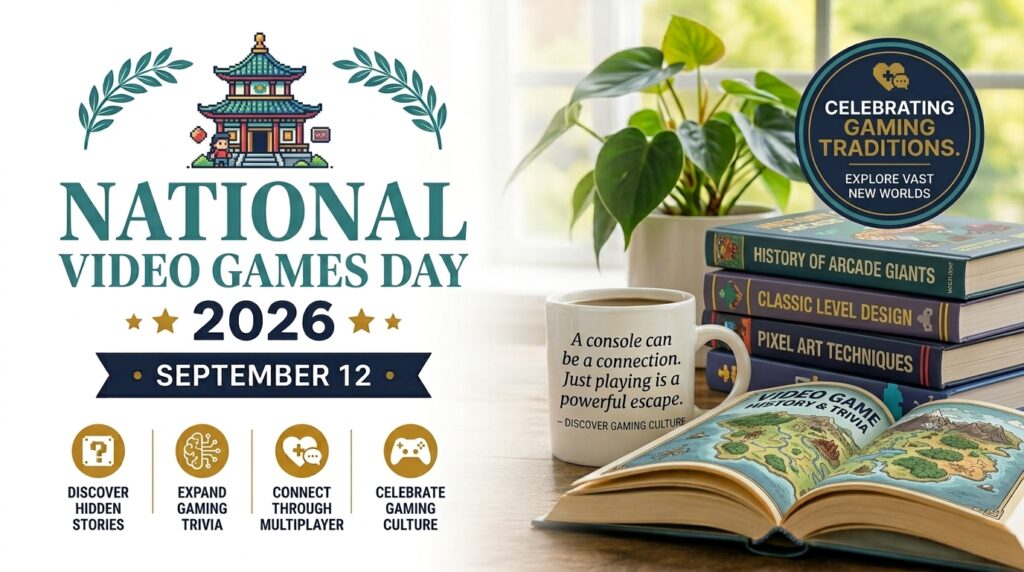
National Video Games Day 2026 is observed on Saturday, September 12, 2026. It’s an informal, culture-focused observance that celebrates video games, gaming history, influential developers, iconic characters, and the communities that have grown up around games over the past seven decades. This guide covers the real, well-documented history of video games, the surprisingly murky origin of the observance itself, gaming milestones, iconic franchises and characters, trivia, quotes, and ways to celebrate.
Looking for more September observances? Check our September 2026 holidays calendar or browse our full list of culture and entertainment days.
When Is National Video Games Day 2026?
National Video Games Day 2026 falls on Saturday, September 12, 2026. It’s an annual, informal observance rather than a federal or government holiday, celebrated by gamers, retailers, and gaming communities across the country and beyond.
What Is National Video Games Day?
National Video Games Day celebrates video games as both an entertainment medium and a major cultural and technological force. Gaming today spans consoles, PCs, mobile devices, and handhelds, and it encompasses far more than simply playing — including game development, esports, live streaming, modding, interactive storytelling, digital art and music, and large online communities built around specific games and genres. The day gives players, developers, and fans a shared occasion to reflect on how far the medium has come.
What Was the First Video Game Ever Made?
Why Is There No Single Simple Answer?
The answer depends heavily on how “video game” is defined. Different milestones are cited depending on whether the focus is on early electronic games, computer-based games with graphical displays, or the first commercially sold arcade or home video game.
Tennis for Two
In 1958, physicist William Higinbotham created Tennis for Two, an interactive tennis simulation displayed on an oscilloscope at Brookhaven National Laboratory, designed as a visitor attraction. Players used simple controllers to hit a ball back and forth, and it’s frequently cited as one of the earliest interactive electronic games with a visual display, though it wasn’t built for commercial release.
Spacewar!
In the early 1960s, programmers at MIT, including Steve Russell, developed Spacewar!, a two-player space combat game running on a large computer with a vector display. It’s widely regarded as one of the most influential early computer games and helped inspire the first commercial arcade video game.
Pong and the Rise of Commercial Video Games
Pong, released by Atari in 1972, became one of the earliest hugely successful commercial arcade video games, helping kick off the arcade industry as a mainstream business. It’s important not to call Pong “the first video game” outright — it was one of the first wildly successful commercial video games, but computer and electronic game history stretches back well over a decade earlier.
A Brief History of Video Games
1950s — Experimental Electronic Games
Early interactive electronic entertainment, including Tennis for Two, emerged largely from university and government research labs rather than commercial products.
1960s — Computer Games
Games like Spacewar! spread across university mainframe computers, building an early culture of programmer-created games long before a commercial industry existed.
1970s — Arcades Take Off
Pong’s commercial success in 1972 helped launch the arcade industry, and early home consoles like the Magnavox Odyssey brought interactive games into living rooms for the first time.
1980s — Home Consoles and Iconic Characters
Consoles like the Atari 2600 and later the Nintendo Entertainment System drove home gaming’s growth, introducing now-iconic characters such as Mario and Donkey Kong to a mass audience.
1990s — 3D Gaming and CD-ROMs
The 1990s brought 3D graphics, CD-based games with more storage for audio and video, and intensified competition between console makers, alongside PC gaming’s steady growth.
2000s — Online Gaming
Broadband internet enabled online multiplayer at scale, along with the rise of MMOs, digital distribution platforms, and services like Xbox Live that connected players directly online.
2010s — Mobile, Streaming and Digital Distribution
Smartphone gaming and app stores dramatically expanded the gaming audience, while platforms like Twitch built a new streaming culture around watching games being played, and free-to-play models and esports grew rapidly.
2020s — Current Gaming Landscape
Today’s landscape includes cloud gaming, cross-platform play between consoles and PC, subscription-based game libraries, virtual reality, and continued growth in esports and online gaming communities.
Major Milestones in Video Game History
| Era | Milestone |
|---|---|
| 1950s | Early interactive electronic games, including Tennis for Two |
| 1960s | Computer games such as Spacewar! spread across university computers |
| 1970s | Commercial arcade gaming expands with Pong and early consoles |
| 1980s | Home consoles and iconic franchises like Mario grow rapidly |
| 1990s | 3D graphics and CD-ROM gaming expand genre possibilities |
| 2000s | Online multiplayer and digital distribution become mainstream |
| 2010s | Mobile gaming, streaming, and esports grow rapidly |
| 2020s | Cloud gaming, cross-platform play, VR, and subscription services |
Most Influential Video Game Consoles
Atari 2600
One of the first widely successful home consoles, helping establish the cartridge-based gaming model in the late 1970s.
Nintendo Entertainment System
Helped revive the home console market in North America in the mid-1980s and introduced several franchises still popular today.
Super Nintendo Entertainment System
Expanded on the NES’s success with more advanced graphics and sound, becoming a defining console of the early 1990s.
PlayStation
Introduced CD-based gaming to a mass audience in the mid-1990s and helped popularize 3D gaming.
Nintendo 64
Brought 3D platforming and multiplayer console gaming further into the mainstream in the late 1990s.
PlayStation 2
Became one of the best-selling consoles of all time, supporting a huge library across multiple console generations of relevance.
Xbox
Introduced Xbox Live, helping establish online console multiplayer as a mainstream feature in the early 2000s.
Modern PlayStation, Xbox and Nintendo Platforms
Today’s consoles emphasize digital libraries, cross-platform play, subscription services, and increasingly powerful graphics hardware.
Iconic Video Games and Gaming Franchises
Widely recognized and culturally significant franchises include Super Mario, The Legend of Zelda, Pokémon, Minecraft, Grand Theft Auto, The Sims, Halo, Final Fantasy, Sonic the Hedgehog, Doom, and Tetris. This isn’t an objective ranking — it’s a snapshot of franchises that have had an outsized influence on gaming culture and the broader entertainment industry over multiple decades.
Famous Video Game Characters
- Mario — Nintendo’s mascot, first appearing in the early 1980s and remaining one of the most recognizable characters in entertainment.
- Link — the recurring hero of The Legend of Zelda series.
- Pikachu — the most recognizable character from the Pokémon franchise.
- Sonic — Sega’s mascot, known for high-speed platforming gameplay.
- Lara Croft — the protagonist of the Tomb Raider series, one of gaming’s most recognizable action heroines.
- Master Chief — the protagonist of the Halo franchise, closely associated with Xbox.
- Pac-Man — one of the earliest and most enduring arcade game icons.
- Kirby — Nintendo’s pink, shape-shifting platforming character.
- Donkey Kong — introduced in the early 1980s and closely tied to Mario’s origin story.
Fun Video Game Trivia
Q: What was Tennis for Two? A: An interactive tennis simulation created by physicist William Higinbotham in 1958, often cited as one of the earliest interactive electronic games with a visual display.
Q: What was Spacewar!? A: A pioneering two-player space combat game developed by MIT programmers in the early 1960s, widely influential in early computer gaming culture.
Q: Why is Pong historically important? A: It became one of the earliest commercially successful arcade video games, helping launch the arcade gaming industry in the 1970s.
Q: Which console helped popularize home video games? A: The Magnavox Odyssey, released in 1972, was the first home video game console, followed soon after by the widely successful Atari 2600.
Q: What is a “speedrun”? A: A speedrun is an attempt to complete a video game, or a specific section of one, as quickly as possible, often following highly optimized strategies developed by dedicated communities.
Why Are Video Games Important to Popular Culture?
Video games now influence music, film and television, fashion, and internet culture broadly. Esports competitions fill arenas and draw large online audiences, streaming platforms have turned watching games into a mainstream form of entertainment, and online communities built around specific games generate fan art, mods, and highly active social spaces. Gaming conventions and interactive storytelling techniques pioneered in games have also influenced other entertainment media well beyond gaming itself.
How to Celebrate National Video Games Day 2026
Play a Classic Game
Revisit a game from an earlier console generation you haven’t played in years.
Try a New Genre
If you usually play action games, try a strategy, puzzle, or simulation title instead.
Host a Gaming Night
Invite friends or family over for a multiplayer session.
Explore Gaming History
Play a historically significant game, like an early Mario or Zelda title, or watch a documentary about the industry’s development.
Visit a Gaming Museum or Arcade
Where available, check out a retro arcade or gaming history exhibit near you.
Support an Indie Developer
Try a game from an independent studio rather than only major releases.
Share Your Favorite Game
Post a favorite gaming memory or recommendation on social media.
National Video Games Day 2026 Activities for Kids and Families
- Family multiplayer game night — choose a game everyone can play together.
- Retro game challenge — try an older game as a family and compare it to modern titles.
- Gaming trivia quiz — test knowledge of gaming history and characters.
- Design your own game character — a simple drawing or writing activity.
- Create a board-game version of a video game — a creative offline adaptation project.
- Learn basic game development — try a beginner-friendly, kid-oriented coding tool.
- Make pixel-art designs — a simple, accessible art activity inspired by retro game graphics.
Not all games are appropriate for every age — check age ratings and content descriptions before choosing a game for younger family members.
Iconic Video Game Quotes
Inspirational Video Game Quotes
“It’s dangerous to go alone! Take this.” — a famous line from The Legend of Zelda, widely referenced throughout gaming culture.
Funny Gaming Quotes
“War. War never changes.” — the recurring opening line of the Fallout series.
Original National Video Games Day 2026 Messages
“Every great gaming memory starts with one more level.”
“Press start, choose your adventure, and enjoy the journey.”
Keep in-game quotations brief, verify their exact wording before sharing, and clearly separate original messages written for this observance from lines taken directly from a specific game.
National Video Games Day 2026 Social Media Ideas
- Share the first video game you remember playing.
- Post a photo of your favorite gaming character or franchise.
- Share a retro gaming screenshot or photo of an old console.
- Ask followers to name their favorite console of all time.
- Create a simple gaming trivia poll.
- Share a favorite multiplayer gaming memory.
Use hashtags naturally, such as #NationalVideoGamesDay #VideoGamesDay #Gaming #Gamers #GamingCulture, without stuffing a single post with too many.
Video Game Genres to Explore
- Action — fast-paced gameplay focused on combat or physical challenges, like Doom.
- Adventure — story-driven exploration and puzzle-solving, like The Legend of Zelda.
- Role-Playing Games — character progression and often expansive worlds, like Final Fantasy.
- Strategy — tactical planning and resource management, like classic real-time strategy titles.
- Simulation — recreating real or fictional systems, like The Sims.
- Sports — games based on real-world sports and athletics.
- Racing — competitive driving games, from arcade-style to realistic simulations.
- Puzzle — logic and pattern-based gameplay, like Tetris.
- Horror — games designed to create tension and fear through atmosphere and storytelling.
- Platformers — jumping- and movement-based gameplay across levels, like Super Mario.
National Video Games Day vs. National Video Game Day
Naming for this observance is genuinely inconsistent across the internet, and it’s worth being precise about it. According to research by the Video Game History Foundation, the earliest documented version of this observance appeared in Chase’s Calendar of Events as “Video Games Day” on July 8, 1991, associated with a figure named David Earle of “Kid Video Warriors.” By 1997, the same publication had shifted the observance to September 12 and renamed it “National Video Games Day.” Despite extensive research, the Video Game History Foundation found no documented explanation for why the date or name changed, or why September 12 specifically was chosen — it isn’t tied to a documented anniversary like a console launch or a specific game’s release, despite some third-party sites claiming otherwise.
Because of this murky history, different calendars and sites today may reference either July 8 or September 12, and may use either “National Video Games Day” or “National Video Game Day.” This article specifically covers the September 12 observance, sourced to the most widely used modern convention.
National Video Games Day 2026 Quick Facts
| Quick Fact | Details |
|---|---|
| Event | National Video Games Day 2026 |
| Date | September 12, 2026 |
| Day | Saturday |
| Category | Culture / Entertainment |
| Main Focus | Video games and gaming culture |
| Related Topics | Gaming history, consoles, esports, game development |
| Popular Activities | Playing games, gaming trivia, retro gaming, multiplayer events |
| Holiday Status | Informal observance, origin undocumented |
Frequently Asked Questions About National Video Games Day 2026
When is National Video Games Day in 2026? National Video Games Day 2026 is observed on Saturday, September 12, 2026.
What was the first video game ever made? There’s no single universally agreed answer, since it depends on the definition used. Tennis for Two (1958) is frequently cited as one of the earliest interactive electronic games, while Spacewar! (early 1960s) and Pong (1972) mark other major early milestones.
Who invented the first video game? There’s no single accepted inventor. Physicist William Higinbotham created Tennis for Two, while a team of MIT programmers, including Steve Russell, developed Spacewar! a few years later.
What was the first commercially successful video game? Pong, released by Atari in 1972, is widely recognized as one of the earliest commercially successful arcade video games.
Why do we celebrate National Video Games Day? It’s an opportunity to appreciate video games, gaming history, technological innovation, developers, players, and the broader gaming culture that’s grown around the medium.
What are some famous video game quotes? Lines like “It’s dangerous to go alone! Take this,” from The Legend of Zelda, are widely referenced, alongside original gaming-themed messages created specifically for the observance.
How can I celebrate National Video Games Day 2026? Play a favorite game, revisit a classic title, host a multiplayer session, try an indie game, explore gaming history, or share a favorite gaming memory online.
What are some good video game activities for families? Family multiplayer nights, gaming trivia, retro game challenges, character-design activities, and simple beginner game-development projects all work well.
Conclusion
National Video Games Day 2026 falls on Saturday, September 12, 2026, giving players of every generation a reason to reflect on how far gaming has come — from Tennis for Two’s oscilloscope display in 1958 to today’s cloud gaming, cross-platform play, and massive online communities. The observance’s own origin is surprisingly undocumented, but the history of gaming itself is well recorded and worth celebrating on its own terms. Whether you spend the day revisiting a childhood favorite, trying an indie title, or hosting a multiplayer night with friends, National Video Games Day is a fitting moment to appreciate a medium that blends technology, storytelling, creativity, and community in a way few others do.
Want to plan ahead for more observances like this one? Browse our 2026 holiday calendar or explore more culture and entertainment observance days on our site.