
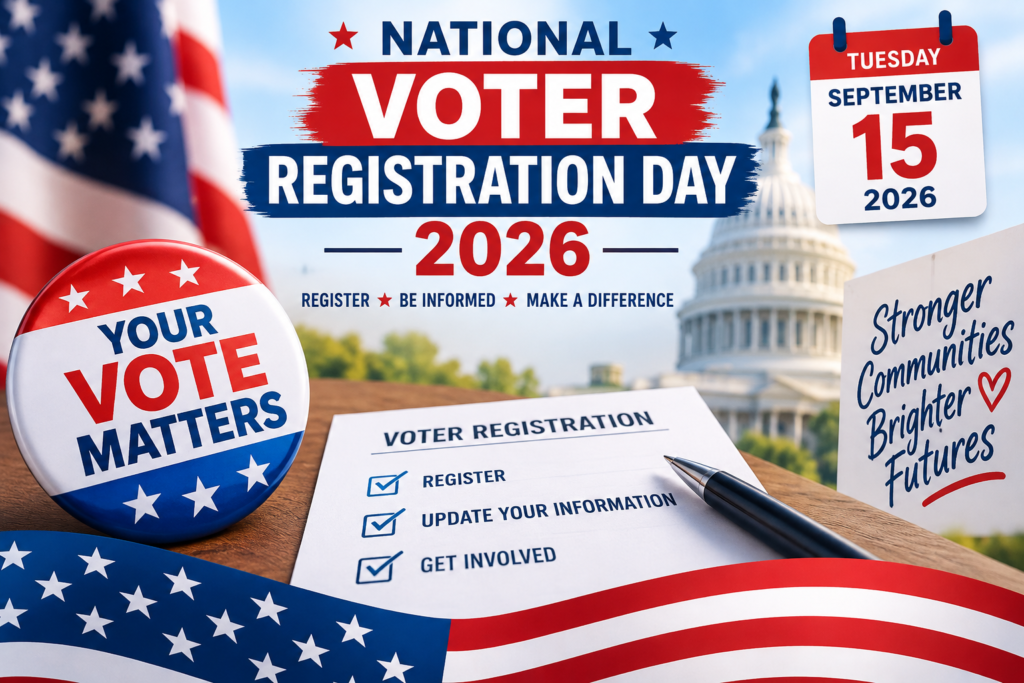
National Voter Registration Day 2026 falls on Tuesday, September 15. It’s a nonpartisan civic observance that brings election officials, nonprofits, schools, workplaces, and everyday volunteers together for one shared goal: helping eligible Americans register to vote or update their existing registration. Since it began in 2012, the day has grown into the country’s largest single-day voter registration effort, with community partners in every state.
If you’re planning content, a workplace event, or a family conversation around civic participation this September, here’s what to know about the day itself, how registration actually works, and how to take part — all without wading into partisan territory.
Quick Facts: National Voter Registration Day 2026
| Quick Fact | Details |
|---|---|
| Date | Tuesday, September 15, 2026 |
| Started | 2012 |
| Purpose | Encourage voter registration and registration updates |
| Character | Nonpartisan civic observance |
| 2026 Context | Falls during the 250th anniversary year of American independence |
| Registration rules | Vary by state |
| Registration deadlines | Vary by state — no single national deadline |
| Common hashtag | #VoteReady |
What Is National Voter Registration Day?
National Voter Registration Day is a coordinated, nonpartisan campaign focused entirely on access — making sure people know whether they’re registered, how to register if they aren’t, and how to fix outdated information such as an old address. It isn’t tied to any candidate, party, or ballot measure. Libraries, college campuses, faith communities, businesses, and local election offices typically host tables, drives, or online reminders on the day itself.
It’s worth being clear about one distinction: registering to vote is not the same as voting. The observance is about readiness — making sure the paperwork and eligibility steps are handled well before an actual election, so nothing gets in the way when it’s time to cast a ballot.
The History Behind the Day
National Voter Registration Day launched in 2012, backed by a coalition of nonpartisan civic organizations that wanted a single, visible day dedicated to registration rather than campaigning. The effort has expanded steadily since then, and organizers say more than 6.5 million Americans have registered to vote through the campaign over its history.
A few milestones along the way:
- 2012: The first National Voter Registration Day is held, drawing support from thousands of local partner organizations.
- 2014: The date is standardized, tying the observance to a consistent September slot each year going forward.
- 2020: Roughly 1.5 million people register on the day itself, one of the largest single-day totals recorded.
- 2026: The campaign leans into the 250th anniversary of the United States, framing registration as a way of “showing up” for the next chapter of the country’s democratic history, with more than 2,000 community partners signed on by mid-August.
How to Register to Vote (State by State)
Because election rules are set at the state level, there’s no single national registration process — but the general path looks similar everywhere.
1. Check your eligibility
In most states, you’ll need to be a U.S. citizen, meet your state’s age requirement, and satisfy residency rules. Some states also allow younger teens to preregister ahead of their 18th birthday, so it’s worth checking your state’s specific rules rather than assuming.
2. Find your state’s registration process
Every state and territory runs its own registration system, and the requirements — including acceptable ID and proof of residency — differ from place to place. Start with your state or county election office’s website, since it will always reflect the most current local rules.
3. Choose how you’ll register
Depending on where you live, you may be able to register online, by mail, or in person at a county clerk’s office, DMV, or registration drive. Some states also offer same-day registration on Election Day itself.
4. Double-check your information
Even if you’ve registered before, it’s worth confirming your name, address, and status are current — especially if you’ve moved, changed your legal name, or haven’t voted in a few election cycles.
5. Know your deadline
This is the part people miss most often: there is no single national voter registration deadline. Some states require registration a full month before an election, while others allow registration right up through Election Day. Always check your specific state’s cutoff rather than relying on a national date.
Updating an Existing Registration
National Voter Registration Day isn’t only for first-time registrants. It’s also a good prompt to update your registration if you’ve:
- Moved to a new address, even within the same county
- Changed your legal name
- Switched party affiliation (in states where that applies)
- Noticed outdated or incorrect information on file
- Not voted in several recent elections and aren’t sure if you’re still active
Most states let you make these updates through the same channels used for new registrations — online portals, mail-in forms, or in person.
Why the Day Matters
The observance exists to solve a fairly simple, solvable problem: a meaningful share of eligible voters aren’t registered, often for reasons that have nothing to do with interest in voting — a missed deadline, an address change that never got updated, or simply not knowing where to start. By concentrating outreach into a single, well-publicized day, organizers can:
- Put accurate registration information in front of more people at once
- Highlight state-specific deadlines before they sneak up on anyone
- Give community groups, schools, and workplaces an easy, ready-made reason to host an event
- Reinforce that registration itself is nonpartisan, even in a politically charged environment
National Voter Registration Day 2026 and America’s 250th Anniversary
The 2026 campaign lands during a symbolically significant year — the 250th anniversary of the Declaration of Independence — and organizers have tied this year’s messaging to the idea of sustaining “a democracy worth showing up for.” Framed this way, the day works well for content or events centered on civic history and participation broadly, rather than any current political fight.
Ideas for Getting Involved
In your community
- Set up an information table with links to your state’s official registration site
- Invite a local election official to answer questions
- Share your state’s specific registration deadline, since a generic date won’t help most readers
On campus
- Run a short civic education session alongside registration tables
- Pair registration drives with a broader conversation about how local and state elections work
- Offer preregistration information for students turning 18 soon
At work
- Share your state’s official registration portal in an internal newsletter
- Offer time during the day for employees to check their status
- Keep messaging strictly nonpartisan — the goal is access, not persuasion
National Voter Registration Day 2026 vs. Election Day
| National Voter Registration Day | Election Day |
|---|---|
| Focuses on registering and updating information | Focuses on casting an actual ballot |
| A nonpartisan awareness campaign | The formal election process itself |
| Falls on September 15 in 2026 | Date depends on the specific election |
| A single annual observance | Held whenever an election is scheduled |
Is National Voter Registration Day a Federal Holiday?
No. It’s a nonpartisan civic observance, not a federal public holiday — schools, government offices, and businesses operate on a normal schedule.
Frequently Asked Questions
When is National Voter Registration Day 2026? Tuesday, September 15, 2026.
How do I register to vote in my state? Start with your state or county election office’s website, which will list whether you can register online, by mail, or in person, along with what documentation you’ll need.
When did National Voter Registration Day start? It began in 2012 as a coordinated, nonpartisan campaign to make voter registration more visible and accessible nationwide.
Is it nonpartisan? Yes — the observance is built around access and readiness rather than any party or candidate.
What’s the voter registration deadline? There isn’t one nationwide deadline. Each state sets its own cutoff, and a handful allow registration through Election Day itself.
Can I check my registration status online? In most states, yes — your state election office’s website will have a lookup tool to confirm your status.
Is it a federal holiday? No, it’s a civic observance rather than an official public holiday.
The Bottom Line
National Voter Registration Day 2026 takes place on Tuesday, September 15. However you choose to mark it — hosting a table, sharing a reminder with coworkers, or simply checking your own registration — the day is really just a nudge to handle a five-minute task well before it matters. Because rules and deadlines shift from state to state, your own state or county election office will always be the most reliable place to confirm the details.
For more on U.S. civic observances and how they connect to broader traditions of community participation, explore our civic and community holidays coverage here on MemorialDay2026.com. You can also find background on the history and legal framework of registration itself via Wikipedia’s overview of National Voter Registration Day and its entry on voter registration processes in the U.S.