
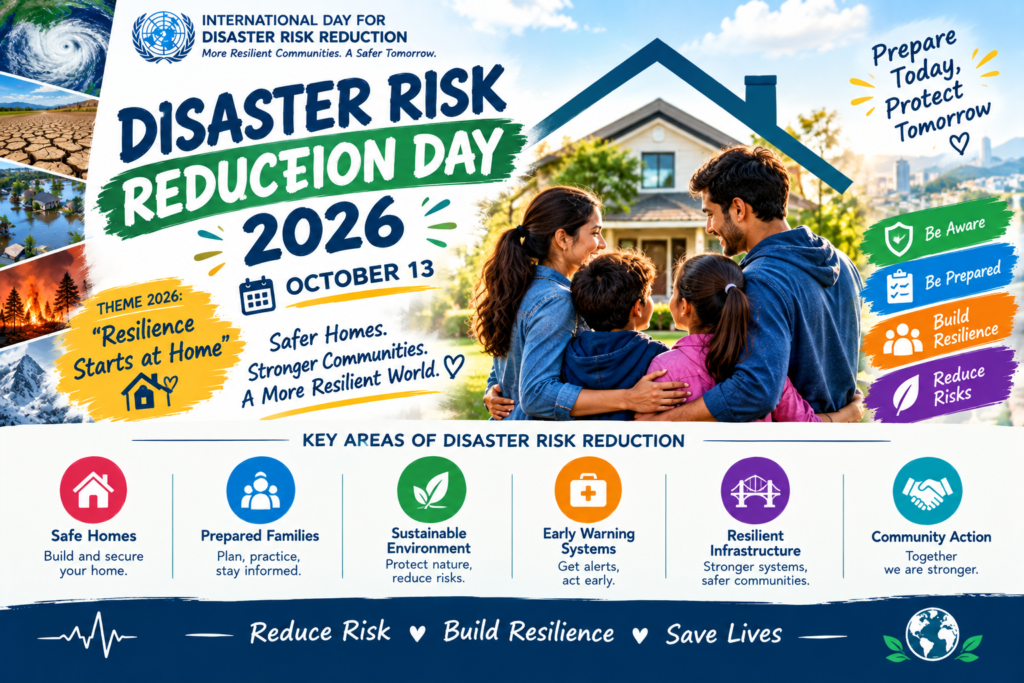
International Day for Disaster Risk Reduction 2026 is observed on Tuesday, October 13. The annual UN observance raises awareness about reducing disaster risk, strengthening preparedness and building resilient communities. It highlights the importance of understanding hazards, reducing vulnerability and taking action before disasters occur, rather than waiting to respond after the damage is already done. The official 2026 theme, announced by the United Nations Office for Disaster Risk Reduction (UNDRR), is “Resilience Starts at Home,” putting the household — where people sleep, raise families and make daily decisions — at the center of this year’s global conversation on disaster resilience. For more meaningful observances worth tracking throughout the year, MemorialDay2026.com covers a range of seasonal and awareness dates alongside its core Memorial Day content.
When Is Disaster Risk Reduction Day 2026?
International Day for Disaster Risk Reduction 2026 Date
October 13, 2026, which falls on a Tuesday this year.
Why Is Disaster Risk Reduction Day Observed on October 13?
The date traces back to a 1989 UN General Assembly resolution establishing a day to promote a global culture of risk awareness and disaster reduction. It was originally observed on the second Wednesday of October before the General Assembly fixed the date at October 13 in 2009, giving the world a consistent, unmoving date each year to focus on this issue.
| Fact | Details |
|---|---|
| Event | International Day for Disaster Risk Reduction |
| Date | October 13, 2026 |
| Day | Tuesday |
| Focus | Disaster risk reduction and resilience |
| Short name | Disaster Risk Reduction Day |
| Main organization | United Nations Office for Disaster Risk Reduction (UNDRR) |
| 2026 theme | Resilience Starts at Home |
What Is International Day for Disaster Risk Reduction?
International Day for Disaster Risk Reduction promotes awareness and action around reducing disaster risk before hazards ever become disasters, rather than focusing only on response after the fact. The observance touches on several connected concepts: the hazards themselves (earthquakes, floods, storms), the exposure of people and property to those hazards, the vulnerability that determines how much harm results, and the preparedness, prevention, mitigation and resilience measures that can reduce that harm significantly. Understanding these pieces separately is part of what makes disaster risk reduction different from simple disaster response — it’s about the choices made long before anything happens.
What Is the Disaster Risk Reduction Day 2026 Theme?
“Resilience Starts at Home”
UNDRR has confirmed the theme for the 2026 International Day for Disaster Risk Reduction as “Resilience Starts at Home.” The theme is rooted in the people-centered focus of the Sendai Framework for Disaster Risk Reduction 2015–2030, and it underscores that the home is both where disasters are most acutely felt and where resilience has to begin.
What Does the 2026 Theme Mean?
The 2026 campaign aims to raise global awareness of how central the home is to disaster risk reduction, push for stronger governance and investment in resilient housing, highlight the role the private sector can play in reducing housing-related risk, and empower households — especially those facing heightened vulnerability — to take risk-informed action to protect themselves and strengthen resilience in their communities. A few of this year’s key messages capture that focus clearly: no one should have to choose between an affordable home and a safe one, every person deserves a home that can withstand the hazards around it, and a warning that never reaches or is never acted on by a household is a warning that has failed.
Why Does the 2026 Theme Matter?
Households are the smallest unit of society, and the everyday decisions made there — how a home is built, whether warnings are understood and acted on, how prepared a family is — directly shape how well people anticipate, withstand and recover from disaster risk. That makes the home a genuinely practical starting point for governments, private-sector investment, community planning and individual action alike, rather than just a symbolic one.
Why Is Disaster Risk Reduction Important?
Protecting lives — reducing risk before disasters strike saves lives that emergency response alone cannot.
Reducing economic losses — prevention and mitigation cost far less than rebuilding after a disaster occurs.
Protecting critical infrastructure — resilient infrastructure keeps hospitals, water systems and power running when they’re needed most.
Strengthening communities — shared preparedness planning builds trust and coordination that pays off in a crisis.
Protecting vulnerable populations — reducing risk in advance particularly benefits those least able to recover from loss.
Supporting sustainable development — disasters can undo years of development progress in a matter of days.
Building resilience to climate-related hazards — as weather patterns shift, proactive risk reduction becomes more valuable, not less.
| Disaster response | Disaster risk reduction |
|---|---|
| Primarily occurs during or after an emergency | Focuses heavily on action before disasters |
| Saves lives during an event | Reduces the likelihood and impact of disasters |
| Emergency services and relief | Prevention, mitigation and preparedness |
| Short-term response | Long-term risk management |
What Is Disaster Risk Reduction?
Disaster risk reduction (DRR) is the systematic effort to prevent new disaster risks, reduce existing risks, and manage remaining risk in ways that strengthen overall resilience. It typically includes risk assessment, prevention, mitigation, preparedness, early warning, response planning, and recovery. None of these pieces work well in isolation — a strong early-warning system does little good without a household or community that knows how to act on it, for example.
What Is the Sendai Framework?
The Sendai Framework for Disaster Risk Reduction 2015–2030 is the major international agreement guiding global disaster-risk policy. Adopted in Sendai, Japan, it emphasizes understanding disaster risk, strengthening disaster risk governance, investing in disaster risk reduction for resilience, and enhancing disaster preparedness for effective response. It’s the framework the 2026 “Resilience Starts at Home” theme is explicitly rooted in, particularly its people-centered approach to reducing risk.
What Causes Disasters?
It’s worth being precise here: hazards don’t automatically become disasters. A disaster happens when a hazard combines with exposure, vulnerability and insufficient capacity to cope — in short, hazard + exposure + vulnerability + limited capacity leads to disaster risk.
Natural hazards include earthquakes, floods, cyclones, tsunamis, droughts, landslides, wildfires and extreme heat.
Human-caused and technological hazards include industrial accidents, chemical incidents, infrastructure failures and environmental degradation.
This distinction matters because it shifts the conversation from treating disasters as unavoidable acts of nature toward recognizing how much of the outcome depends on preparation, planning and the resilience already built into homes and communities.
How Can We Reduce Disaster Risk?
- Identify local hazards specific to your region.
- Assess vulnerabilities in homes, infrastructure and community systems.
- Strengthen buildings and infrastructure to withstand known hazards.
- Improve early-warning systems so alerts actually reach and are understood by households.
- Protect natural ecosystems that buffer against flooding, storms and erosion.
- Create emergency plans at the household, school and community level.
- Conduct disaster drills so plans become habits rather than theory.
- Improve public awareness of local risks and appropriate responses.
- Invest in resilient infrastructure, including housing.
- Include vulnerable communities directly in planning, not just as an afterthought.
Disaster Preparedness Tips for Individuals and Families
Create an emergency plan that covers where to go, how to communicate, and who’s responsible for what.
Prepare an emergency kit with essentials like water, non-perishable food, a flashlight, first-aid supplies and any needed medications.
Keep emergency contacts accessible somewhere that doesn’t depend solely on a phone that might lose power or signal.
Know evacuation routes for your home, workplace and children’s school.
Monitor official warnings through reliable local emergency-management channels rather than relying on secondhand information.
Plan for children, older people and people with disabilities specifically, since standard emergency plans don’t always account for their needs.
Practice emergency drills regularly enough that they become familiar rather than stressful.
Protect important documents — IDs, insurance papers, medical records — in a waterproof, portable location.
For location-specific guidance, always check with your local emergency-management agency, since hazard types and recommended actions vary significantly by region.
Disaster Risk Reduction Day 2026 in Schools
Schools play a meaningful role in building a culture of preparedness early. Regular emergency drills, clear evacuation plans, age-appropriate disaster-awareness lessons, student emergency teams, basic first-aid awareness, and periodic school disaster-risk assessments all help students understand risk without creating unnecessary fear — and the habits formed in school often carry into how students handle preparedness as adults.
How Communities Can Reduce Disaster Risk Reduction Day 2026
Community-level action extends individual preparedness into something more durable. Community risk mapping identifies where hazards and vulnerability overlap. Local early-warning systems and evacuation planning give structure to a crisis response. Community emergency response teams provide trained local support before official responders can arrive. Protecting critical infrastructure — water, power, healthcare access — keeps essential services running. Local awareness campaigns spread practical knowledge widely, and nature-based disaster-risk reduction, like preserving wetlands or forests that buffer against flooding, adds a layer of protection that’s often overlooked. Local knowledge and genuine community participation tend to make all of these measures far more effective than top-down planning alone.
Climate Change and Disaster Risk Reduction
Climate change doesn’t cause every disaster, but it can increase the frequency or intensity of some weather and climate-related hazards, and it can alter patterns of exposure and vulnerability over time. Shifts in flooding, storm intensity, drought conditions, wildfire risk and extreme heat are all part of why disaster risk reduction has become a more urgent, ongoing priority rather than a once-a-year conversation.
Who Is Most Vulnerable to Disasters?
Vulnerability to disasters is shaped by factors including poverty, age, disability, geographic location, housing quality, access to information, access to healthcare, existing infrastructure, and conflict or displacement. It’s worth emphasizing that vulnerability is context-dependent rather than an inherent trait of any group — the same hazard can affect two households very differently depending on the resources, information and support available to each.
Disaster Risk Reduction Day 2026 Activities
- Host a disaster preparedness workshop for families or neighbors.
- Run an emergency drill at home, work or school.
- Organize a community risk-mapping exercise.
- Launch a school awareness campaign tied to the 2026 theme.
- Hold an emergency-kit demonstration.
- Offer a first-aid awareness session.
- Run a disaster preparedness poster competition for students.
- Organize a local hazard awareness walk through the neighborhood.
- Share a social media awareness campaign using this year’s theme.
- Review your own household’s resilience against local hazards.
Disaster Risk Reduction Day 2026 Facts
| Fact | Information |
|---|---|
| Date | October 13, 2026 |
| Observance | International Day for Disaster Risk Reduction |
| Focus | Reducing disaster risk and strengthening resilience |
| Framework | Sendai Framework for Disaster Risk Reduction 2015–2030 |
| 2026 theme | Resilience Starts at Home |
| Key organization | UNDRR |
International Day for Disaster Risk Reduction History
The observance traces back to 1989, when the UN General Assembly designated a day to promote global risk awareness and disaster reduction, originally observed on the second Wednesday of October during the International Decade for Natural Disaster Reduction. In 2009, the General Assembly fixed the date at October 13 going forward. Since then, disaster-risk thinking has shifted substantially — from a primary focus on emergency response toward a broader emphasis on prevention, mitigation and long-term resilience, formalized globally through the Sendai Framework for Disaster Risk Reduction 2015–2030.
Disaster Risk Reduction and the Sustainable Development Goals
Disaster risk reduction connects closely to several Sustainable Development Goals. SDG 1 (No Poverty) and SDG 2 (Zero Hunger) are both threatened when disasters wipe out livelihoods and food security. SDG 3 (Good Health and Well-Being) depends on healthcare infrastructure surviving and functioning through a crisis. SDG 9 (Industry, Innovation and Infrastructure) and SDG 11 (Sustainable Cities and Communities) both hinge on infrastructure and housing built to withstand known hazards — directly echoing this year’s home-centered theme. And SDG 13 (Climate Action) ties disaster risk reduction to the broader effort of adapting to a changing climate. You can read more about how these interconnected goals are structured on Wikipedia’s Sustainable Development Goals page.
Frequently Asked Questions
What is Disaster Risk Reduction Day? It’s an annual United Nations observance, held every October 13, that raises awareness about reducing disaster risk and building resilient homes, communities and nations.
When is Disaster Risk Reduction Day 2026? It falls on Tuesday, October 13, 2026.
What is the theme of Disaster Risk Reduction Day 2026? The official 2026 theme, announced by UNDRR, is “Resilience Starts at Home.”
Why is Disaster Risk Reduction Day celebrated? It’s celebrated to promote awareness and action toward reducing disaster risk before hazards become disasters, protecting lives, infrastructure and communities in the process.
What does disaster risk reduction mean? It refers to the systematic effort to prevent new disaster risks, reduce existing ones, and manage remaining risk through measures like assessment, prevention, mitigation, preparedness and early warning.
What are examples of disaster risk reduction? Examples include resilient building codes, early-warning systems, community risk mapping, protective natural ecosystems, emergency drills and household preparedness planning.
What is the difference between disaster preparedness and disaster risk reduction? Disaster preparedness is one component of the broader disaster risk reduction effort — it focuses specifically on being ready to respond, while disaster risk reduction also includes prevention, mitigation and long-term resilience building.
How can communities reduce disaster risk? Through risk mapping, early-warning systems, evacuation planning, community response teams, infrastructure protection and local awareness campaigns.
How can students participate in Disaster Risk Reduction Day? Students can take part in emergency drills, awareness campaigns, poster competitions and classroom lessons on hazards and preparedness.
How can families prepare for disasters? By creating an emergency plan, preparing an emergency kit, knowing evacuation routes, keeping emergency contacts accessible and practicing drills regularly.
What is the Sendai Framework? The Sendai Framework for Disaster Risk Reduction 2015–2030 is the major international agreement guiding global efforts to understand, reduce and manage disaster risk.
How does climate change affect disaster risk? It can increase the frequency or intensity of some weather and climate-related hazards and change patterns of exposure and vulnerability, making proactive disaster risk reduction more important over time.
Key Takeaways
- International Day for Disaster Risk Reduction is observed every October 13,Disaster Risk Reduction Day 2026 and in 2026 that falls on a Tuesday.
- The official 2026 theme is “Resilience Starts at Home,” rooted in the Sendai Framework’s people-centered approach.
- Disaster risk reduction includes prevention, mitigation, preparedness, early warning and long-term resilience — not just emergency response.
- Communities play a central role in identifying and reducing local risks.
- Resilient housing, strong infrastructure and effective early-warning systems all meaningfully reduce disaster impact.
- Disaster preparedness planning should account for people with different needs and levels of vulnerability.
- The Sendai Framework 2015–2030 remains the major international framework guiding global disaster risk reduction efforts.
If you want to explore the broader history of this observance, Wikipedia’s page on the International Day for Disaster Risk Reduction covers its origins and evolution since 1989.