
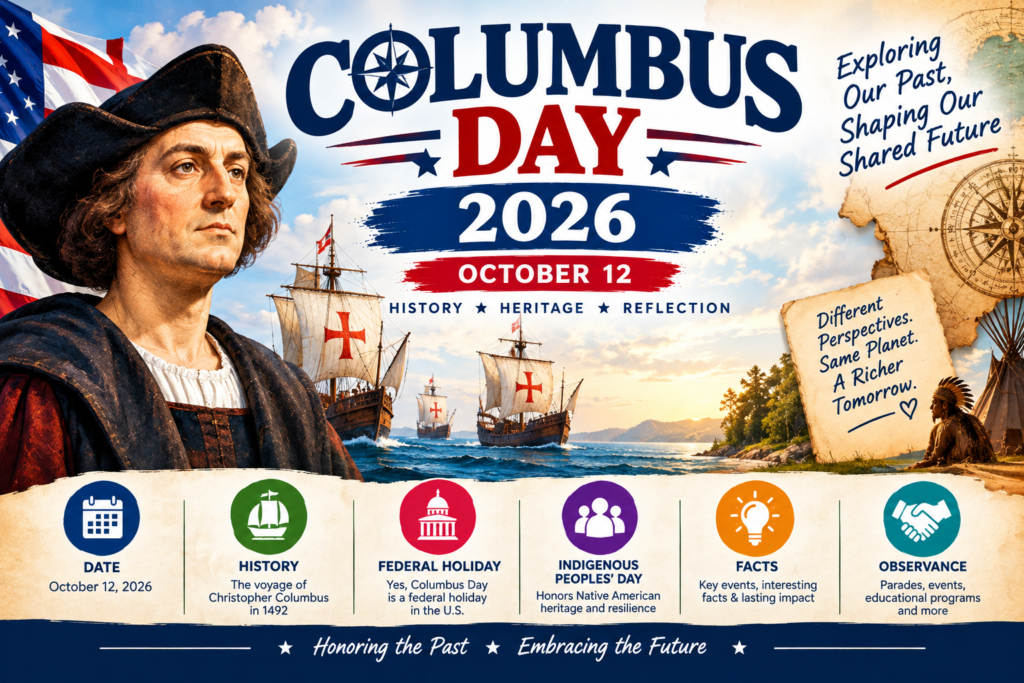
Columbus Day 2026 is Monday, October 12, 2026. It’s a U.S. federal holiday observed on the second Monday of October each year. In some states, cities, and communities, that same date is observed instead — or additionally — as Indigenous Peoples’ Day.
This article covers the 2026 date, the holiday’s federal status, its history dating back to Columbus’s 1492 voyage, how the holiday developed in the United States, the related Indigenous Peoples’ Day observance, and how the day is recognized differently across the country today.
When Is Columbus Day 2026?
Columbus Day 2026 is Monday, October 12, 2026.
| Quick Fact | Details |
|---|---|
| Date | Monday, October 12, 2026 |
| Day | Monday |
| Rule | Second Monday of October |
| Federal status | Federal holiday |
| Historical figure | Christopher Columbus |
| 1492 landing date | October 12, 1492 |
| Related observance | Indigenous Peoples’ Day |
Is Columbus Day a Federal Holiday?
Yes. Columbus Day is a U.S. federal holiday, established by law and observed on the second Monday of October.
In practical terms, that means:
- Federal employees generally receive the day off under applicable federal work schedules.
- Federal offices are typically closed.
- Private businesses are not automatically required to close.
- State and local governments can set their own observance policies.
- Some jurisdictions use the name Indigenous Peoples’ Day instead of Columbus Day for the same date.
What Is Columbus Day?
Columbus Day is a U.S. federal holiday commemorating Christopher Columbus’s 1492 voyage across the Atlantic and his arrival in the Americas. Columbus’s fleet reached the Bahamas on October 12, 1492, and that date later became associated with Columbus commemorations across the United States.
It’s worth being precise about the history here: Columbus’s voyage marked a major moment in European exploration and the colonization that followed — it did not represent the discovery of an uninhabited continent, since the Americas were already home to millions of Indigenous people at the time.
Columbus Day History
Columbus’s 1492 Voyage
Columbus sailed under the Spanish monarchy with an expedition of three ships. A sailor aboard the Pinta sighted land early on October 12, 1492, and the fleet reached an island in the Bahamas. Columbus named the island San Salvador, though it was already known by its Indigenous name, Guanahaní. The voyage initiated a new era of European exploration and expansion across the Americas.
Early Columbus Day Celebrations
The first recorded Columbus Day celebration in the United States took place in 1792, organized by the Society of St. Tammany, also known as the Columbian Order, to commemorate the 300th anniversary of the voyage.
Columbus Day Becomes a U.S. Holiday
The holiday developed gradually over more than a century:
- 1792: First recorded U.S. Columbus Day celebration.
- 1892: President Benjamin Harrison issued a proclamation encouraging observances of the 400th anniversary.
- 1907: Colorado became the first state to establish Columbus Day as a legal holiday.
- 1909: New York declared Columbus Day a holiday.
- 1934: President Franklin D. Roosevelt designated Columbus Day a national holiday.
- 1971: The federal observance moved to the second Monday in October.
Columbus Day History Timeline
| Year | Event |
|---|---|
| 1492 | Columbus’s expedition reaches the Bahamas |
| 1792 | First recorded U.S. Columbus Day celebration |
| 1892 | 400th-anniversary national observances encouraged |
| 1907 | Colorado establishes Columbus Day as a legal holiday |
| 1909 | New York establishes Columbus Day |
| 1934 | Roosevelt designates Columbus Day a national holiday |
| 1971 | Federal observance moves to the second Monday in October |
| 2026 | Columbus Day falls on October 12 |
Why Is Columbus Day Celebrated?
Historically, Columbus Day commemorated Columbus’s voyage and, as the holiday developed in the United States, became closely associated with Italian-American heritage and contributions.
Interpretations of Columbus Day differ today. Some communities continue to observe it as a commemoration of Columbus and Italian-American heritage, while others use the same date to recognize Indigenous peoples and reflect on the history and consequences of European colonization. Both perspectives are part of how October 12 is understood across the country.
What Is Indigenous Peoples’ Day?
Indigenous Peoples’ Day is an observance recognizing and honoring Indigenous peoples, their cultures, histories, and contributions. It’s observed on the second Monday of October in a number of states and local jurisdictions, sometimes in place of Columbus Day and sometimes alongside it, depending on the jurisdiction.
There’s a long history behind this recognition, including federal and state efforts over the decades to acknowledge American Indian and Alaska Native peoples, some of which grew directly out of state-level Columbus Day observances.
Columbus Day 2026 vs. Indigenous Peoples’ Day
| Feature | Columbus Day | Indigenous Peoples’ Day |
|---|---|---|
| Date in 2026 | October 12 | October 12, in jurisdictions using the second Monday of October |
| Federal status | Federal holiday | Not a federal holiday replacing Columbus Day |
| Primary historical focus | Christopher Columbus and his 1492 voyage | Indigenous peoples, cultures, and histories |
| Common observance | Federal holiday, parades, and commemorations | Cultural events, education, and Indigenous recognition |
| Use of name | Official federal designation | Used by various states and municipalities |
| National uniformity | Federal designation is consistent | State and local policies vary |
A 2025 Senate resolution noted that Columbus Day remains a federal holiday, while also noting that more than 200 municipalities and 17 states observed Indigenous Peoples’ Day on the second Monday of October. It’s worth being clear on this point: Columbus Day has not been officially replaced nationwide by Indigenous Peoples’ Day — the two names coexist depending on jurisdiction.
Why Do Some Places Observe Indigenous Peoples’ Day?
The move toward Indigenous Peoples’ Day in various states and cities reflects a broader effort to center Indigenous cultures, contributions, and history in how October 12 is marked. Native American responses to the 1992 Columbus Quincentennial, for example, included both public protests and educational events commemorating Indigenous contributions and resilience — a moment that helped accelerate momentum toward the Indigenous Peoples’ Day observance in many places.
This shift is best understood as a local and state-level decision about naming and focus, rather than a single nationwide policy change.
How Is Columbus Day Observed?
Traditional Columbus Day observances include:
- Parades
- Historical programs
- Italian-American cultural events
- School lessons
- Community ceremonies
- Museum exhibitions
- Educational programs
- Public history events
School programs, plays, and community festivities have long been part of how Columbus Day is marked in communities across the country.
How Is Indigenous Peoples’ Day Observed?
Indigenous Peoples’ Day observances typically include:
- Indigenous cultural programs
- Educational workshops
- Public talks and panels
- Art exhibitions
- Tribal cultural events
- Storytelling
- History programs
- Community gatherings
- Support for Indigenous-owned businesses
- Opportunities to learn about local Indigenous nations
Because Indigenous experiences and traditions vary widely by nation and region, these observances tend to be shaped locally rather than following one single format nationwide.
Columbus Day and Italian-American Heritage
Columbus Day became closely associated with Italian-American identity and heritage in the United States, particularly during periods when Italian immigrants and their descendants faced discrimination. Columbus societies, parades, and community organizations helped turn the holiday into a moment of pride and visibility for Italian-American communities, a connection that remains part of how many communities observe the day today.
Columbus Day Facts
- Columbus Day 2026 is Monday, October 12.
- Columbus Day is a federal holiday.
- It’s observed on the second Monday of October.
- The first recorded U.S. Columbus Day celebration occurred in 1792.
- Colorado established Columbus Day as a legal holiday in 1907.
- Franklin D. Roosevelt designated Columbus Day a national holiday in 1934.
- Since 1971, the federal observance has fallen on the second Monday of October.
- Indigenous Peoples’ Day is observed instead of, or alongside, Columbus Day in a number of jurisdictions.
Is Columbus Day a Federal Holiday in 2026?
Yes. Columbus Day is a federal holiday in 2026, falling on Monday, October 12. State and local observance can still differ, but the federal government’s official holiday schedule continues to list the holiday as Columbus Day.
Are Banks and Businesses Closed on Columbus Day?
Not universally. Here’s what typically applies:
- Federal government offices generally observe the federal holiday and close.
- Banks may follow their own holiday schedules, which often align with the federal calendar but aren’t guaranteed to.
- Stock market and financial-service schedules can differ from the federal holiday calendar.
- Private businesses decide independently whether to close.
- Schools follow their own state or district calendars, which vary.
Columbus Day 2026 Activities
Educational Activities
- Read primary historical sources about the 1492 voyage.
- Visit a museum with relevant historical exhibits.
- Study maps tracing Columbus’s voyages.
- Research the Indigenous nations native to your region.
- Compare different historical accounts and perspectives.
- Create a Columbus Day timeline as a learning exercise.
Community Activities
- Attend a historical exhibition.
- Visit a cultural center.
- Attend an Italian-American heritage event.
- Participate in a local Indigenous cultural program where publicly invited.
- Explore local history related to October 12 observances in your area.
Columbus Day 2026 Messages
Columbus Day 2026 Messages
- “Reflecting on the history of exploration and how it shaped the world we live in today.”
- “Honoring the heritage and contributions of Italian-American communities this Columbus Day.”
- “A day to look back at history with honesty and curiosity.”
Indigenous Peoples’ Day Messages
- “Honoring the cultures, histories, and resilience of Indigenous peoples today and always.”
- “Taking time to learn about the Indigenous nations who call this land home.”
- “Recognizing Indigenous contributions, past and present, on this Indigenous Peoples’ Day.”
Columbus Day 2026 vs. Indigenous Peoples’ Day 2026
| Question | Answer |
|---|---|
| Is October 12 Columbus Day? | Yes, in the federal holiday calendar for 2026. |
| Is October 12 Indigenous Peoples’ Day? | In jurisdictions that observe it on the second Monday of October, yes. |
| Is Indigenous Peoples’ Day a federal holiday? | No federal law currently replaces Columbus Day with Indigenous Peoples’ Day. |
| Can states choose a different name? | Yes, state and local governments can establish their own observances. |
| Is Columbus Day still a federal holiday in 2026? | Yes. |
Frequently Asked Questions
When is Columbus Day 2026? Columbus Day 2026 is Monday, October 12, 2026.
Why is Columbus Day celebrated? Historically, Columbus Day commemorates Christopher Columbus’s 1492 voyage and became associated with Italian-American heritage and contributions in the United States.
Is Columbus Day a federal holiday? Yes. Columbus Day is established as a federal holiday and observed on the second Monday of October.
Is Columbus Day still a federal holiday in 2026? Yes. The 2026 federal holiday schedule lists Monday, October 12, 2026, as Columbus Day.
What is Indigenous Peoples’ Day? Indigenous Peoples’ Day is an observance recognizing Indigenous peoples, cultures, histories, and contributions, observed by many states and municipalities on the same October date.
Is Indigenous Peoples’ Day the same as Columbus Day? They fall on the same date in many places, but they are not the same observance in meaning or official naming.
Does everyone celebrate Columbus Day? No. State, municipal, school, and institutional observance varies, and some jurisdictions observe Indigenous Peoples’ Day instead.
Why is Columbus Day controversial? Interpretations of Columbus’s arrival differ. Some emphasize the historical voyage and Italian-American heritage, while others focus on the effects of European colonization on Indigenous peoples. Both are genuinely held perspectives rather than a single settled conclusion.
Conclusion
Columbus Day 2026 falls on Monday, October 12. While Columbus Day remains the federal designation, many states and communities use the same October date to observe Indigenous Peoples’ Day instead. Understanding the history behind both observances offers useful context for how October 12 is recognized differently across the United States.
If you’re planning around other federal holidays this year, you can check our 2026 U.S. federal holiday calendar at MemorialDay2026.com for the full list of dates. We also cover other October observances worth knowing about, along with a broader history-focused holidays guide if you want to keep exploring dates like this one.