
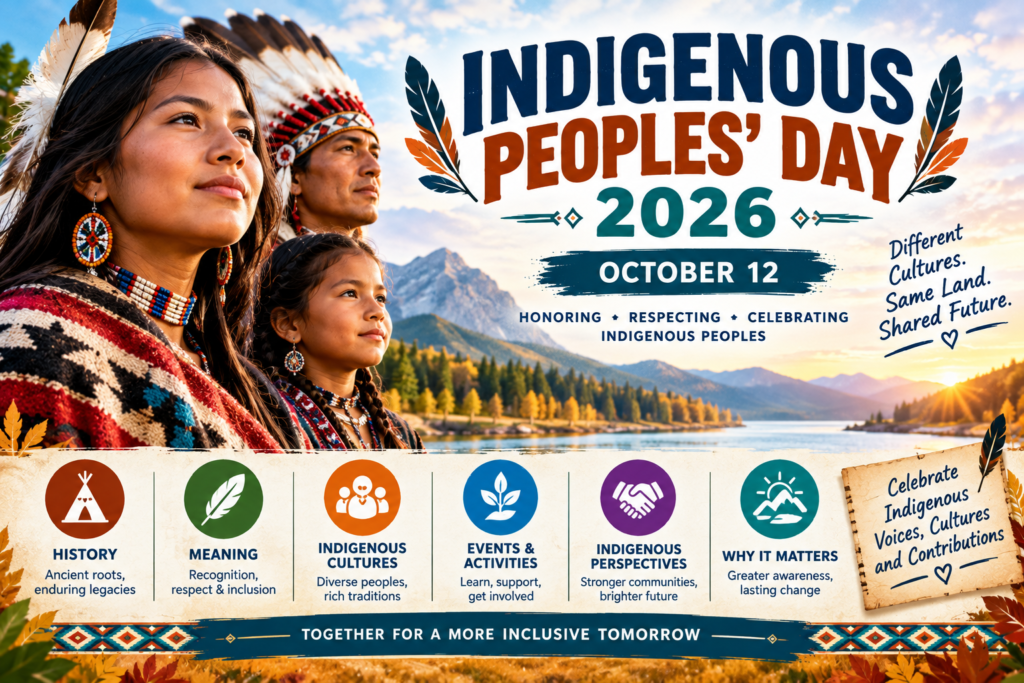
Indigenous Peoples’ Day 2026 will be observed on Monday, October 12, 2026. The observance recognizes and celebrates Indigenous peoples, their cultures, histories, communities, and contributions. Across the United States, different cities, states, schools, and organizations observe the day in different ways. It’s commonly recognized on the second Monday of October — the same calendar date on which the federal government observes Columbus Day.
Indigenous Peoples’ Day and Columbus Day are related but distinct observances, and how each is recognized varies significantly by jurisdiction.
When Is Indigenous Peoples’ Day 2026?
| Quick Fact | Details |
|---|---|
| Indigenous Peoples’ Day 2026 | Monday, October 12 |
| Frequency | Annual |
| Typical date | Second Monday of October |
| Federal holiday? | No separate nationwide federal Indigenous Peoples’ Day |
| Related observance | Columbus Day |
| Main focus | Indigenous peoples, cultures, history, and contributions |
Recognition of the date varies by jurisdiction. Some state education calendars list October 12 as Indigenous People’s Day, and several city governments list Indigenous Peoples Day on their own 2026 municipal calendars.
What Is Indigenous Peoples’ Day?
Indigenous Peoples’ Day is an observance that recognizes Indigenous peoples — their histories, cultures, contributions, and contemporary communities. It’s not a single, uniform holiday across the country; instead, it’s recognized in different ways by different cities, states, schools, and organizations, often on the second Monday of October.
The observance touches on several connected themes:
- Recognition of Indigenous peoples and nations
- Indigenous histories and cultures
- Contributions of Native communities, past and present
- Tribal sovereignty and community identity
- Education about Indigenous history
- Cultural preservation, including language revitalization
- Contemporary Indigenous communities, not just historical ones
It’s worth being precise here: Indigenous peoples in the United States are not a single, homogeneous culture. The country is home to hundreds of distinct tribal nations, each with its own languages, traditions, governance, and history.
History of Indigenous Peoples’ Day
Early Efforts to Recognize Indigenous Peoples
Recognition of American Indian and Indigenous heritage predates the modern Indigenous Peoples’ Day movement by decades. State-level American Indian observances existed as early as the early 20th century, including a 1916 observance recognized in New York — laying early groundwork for the broader recognition that would follow.
The 1977 International Context
In 1977, a United Nations conference in Geneva brought international attention to Indigenous rights and self-determination. While this was a global development rather than a U.S. policy change, it contributed to a broader international movement toward Indigenous recognition that influenced later domestic efforts.
Berkeley and the 1992 Indigenous Peoples’ Day
One of the most significant milestones in U.S. history came from Berkeley, California. The city’s council approved a proposal for Indigenous Peoples’ Day on October 22, 1991, designating 1992 as the Year of Indigenous People and organizing related educational and commemorative activities. This made Berkeley one of the earliest U.S. municipalities to formally adopt Indigenous Peoples’ Day, and 1992 — the 500th anniversary of Columbus’s voyage — became a symbolically significant year for the observance’s founding.
Growth of Indigenous Peoples’ Day Observances
Since Berkeley’s early adoption, recognition has grown steadily across:
- Cities
- Counties
- States
- Schools and school districts
- Universities
- Tribal organizations
- Cultural institutions
As of a 2025 Senate resolution, more than 200 municipalities and 17 states observed Indigenous Peoples’ Day on the second Monday of October. That figure reflects 2025 data specifically, and the number of jurisdictions recognizing the day has continued to grow in the years since Berkeley’s original 1992 adoption.
Why Is Indigenous Peoples’ Day Celebrated?
Recognizing Indigenous Cultures
The day highlights Indigenous languages, art, music, food traditions, storytelling, ceremonies, and traditional knowledge passed down across generations.
Learning Indigenous History
Indigenous Peoples’ Day provides an opportunity to learn about Indigenous histories both before and after European colonization — histories that are often underrepresented in standard education.
Recognizing Contemporary Indigenous Communities
It’s important to emphasize that Indigenous peoples are contemporary communities, not solely historical populations. Hundreds of tribal nations remain active today, with their own governments, cultural institutions, and ongoing traditions.
Supporting Cultural Preservation
The observance also supports educational programs, museums, tribal cultural centers, language revitalization efforts, and community events focused on keeping Indigenous traditions alive for future generations.
Indigenous Peoples’ Day 2026 vs. Columbus Day
| Topic | Indigenous Peoples’ Day | Columbus Day |
|---|---|---|
| Main focus | Indigenous peoples, cultures, histories, and contributions | Christopher Columbus and the historical observance associated with his 1492 voyage |
| Common date | Second Monday of October | Second Monday of October |
| 2026 date | October 12 | October 12 |
| Federal status | Not a separate federal holiday nationwide | Federal holiday |
| Recognition | Varies by jurisdiction | Federal recognition, though local forms of observance vary |
| Observance | Cultural programs, education, community events | Government closures, heritage events, and other local observances |
| Relationship | Often observed instead of or alongside Columbus Day in some places | Remains the federal holiday |
The federal government continues to recognize Columbus Day under federal law, while Indigenous Peoples’ Day is recognized separately by numerous states and municipalities. It’s inaccurate to describe this as the U.S. having “renamed” Columbus Day nationwide — recognition status genuinely varies by jurisdiction, and both names remain in active use depending on where you are.
How Is Indigenous Peoples’ Day Observed?
Cultural Events
- Powwows
- Indigenous art exhibitions
- Traditional music performances
- Storytelling events
- Cultural demonstrations
- Film screenings
Educational Programs
- School lessons on Indigenous history
- Museum programs
- Lectures and panels
- History workshops
- Book discussions
- Indigenous-authored literature
Community Events
- Community gatherings
- Public ceremonies
- Local cultural festivals
- Educational walks
- Art markets
Historical Berkeley Indigenous Peoples’ Day celebrations, for example, have included both a powwow and an Indian market — a format that’s since been echoed in cultural events held by other cities recognizing the day.
Finding Indigenous Peoples’ Day Events Near You
Because specific events and venues change year to year and vary widely by city, the most reliable way to find 2026 events near you is to check directly with:
- Local tribal cultural centers
- Your city or county government’s event calendar
- Museums with Indigenous history or art collections
- Universities with Indigenous studies programs or student organizations
- Native and Indigenous-led organizations in your area
- Local event listing services
Checking these sources directly ensures you get accurate, current details rather than relying on outdated listings.
Ways to Celebrate Indigenous Peoples’ Day 2026
- Learn about the Indigenous history of your own area.
- Visit an Indigenous cultural center or museum.
- Attend a verified Indigenous-led event.
- Read books by Indigenous authors.
- Learn about a specific local tribal nation.
- Explore Indigenous art and cultural traditions.
- Support Indigenous artists and businesses.
- Participate in educational programs available in your community.
- Teach children about Indigenous history using reliable sources.
- Learn about Indigenous languages and language revitalization efforts.
A respectful note: cultural practices and ceremonies belonging to specific Indigenous nations should never be imitated or treated as costumes or entertainment. Observing Indigenous Peoples’ Day well means learning and supporting — not appropriating.
Indigenous Peoples’ Day 2026 Quotes
- “Every nation has its own story, and Indigenous nations’ stories deserve to be heard in their own words.”
- “Culture survives when it’s practiced, taught, and passed forward — that’s the heart of Indigenous resilience.”
- “Recognizing Indigenous history isn’t just about the past. It’s about the communities thriving today.”
Indigenous Peoples’ Day 2026 Messages & Wishes
- “Wishing you a meaningful Indigenous Peoples’ Day filled with learning, respect, and appreciation.”
- “Today is an opportunity to learn about Indigenous histories, cultures, and communities.”
- “May Indigenous Peoples’ Day inspire greater understanding of the diverse cultures and histories of Indigenous peoples.”
- “Honoring the resilience, traditions, and contributions of Indigenous nations, today and always.”
- “Take a moment today to learn about the Indigenous nations whose history is tied to the land you call home.”
Indigenous Peoples’ Day 2026 Facts
- Indigenous Peoples’ Day is commonly observed on the second Monday of October.
- In 2026, it falls on October 12.
- Berkeley adopted Indigenous Peoples’ Day in connection with its 1992 Year of Indigenous People.
- Different U.S. jurisdictions use different names and observance arrangements for the same date.
- Indigenous Peoples’ Day is not a separate nationwide federal holiday.
- Some cities observe Indigenous Peoples’ Day while other jurisdictions continue to observe Columbus Day.
- Indigenous communities represent hundreds of distinct nations, cultures, and traditions.
- Indigenous Peoples’ Day focuses on history, culture, recognition, and contemporary communities.
Indigenous Peoples’ Day and Native American Heritage Month
These two observances are often confused, but they’re distinct:
Indigenous Peoples’ Day: A one-day observance, generally recognized in October.
Native American Heritage Month: A month-long federal observance held every November, recognizing American Indian and Alaska Native history, cultures, and contributions. It traces back to a 1990 proclamation by President George H.W. Bush, building on decades of earlier advocacy for formal national recognition.
Together, the two observances offer complementary opportunities — one focused on a specific day tied to the Columbus Day date, the other spanning an entire month dedicated more broadly to Native American heritage.
Indigenous Peoples’ Day 2026 in Schools
Schools have become one of the most active spaces for recognizing Indigenous Peoples’ Day, often incorporating:
- Indigenous history lessons appropriate to the grade level
- Reading and discussing Indigenous authors
- Classroom discussions on Indigenous history and contemporary issues
- Maps identifying local tribal nations and their traditional territories
- Indigenous art projects
- Age-appropriate documentaries
- Library displays featuring Indigenous voices
- Research projects on Indigenous history
- Study of local Indigenous history specific to the school’s region
How Can Teachers Celebrate Indigenous Peoples’ Day?
- Start with the Indigenous nations native to your specific region, not just a generalized national overview.
- Assign readings from Indigenous authors rather than only secondary sources.
- Invite a local Indigenous speaker if a respectful, compensated opportunity exists.
- Use primary sources where available, alongside careful historical context.
- Discuss both historical and contemporary Indigenous communities.
- Incorporate age-appropriate documentaries or short films.
- Create a classroom display highlighting local tribal history.
- Assign a research project on a specific tribal nation.
- Discuss the meaning and history of Indigenous Peoples’ Day itself.
- Connect the discussion to ongoing Indigenous issues and achievements today.
Indigenous Peoples’ Day and Indigenous History
A responsible overview of Indigenous history includes several key threads:
- Indigenous peoples and nations that existed across North America long before European colonization
- The diversity of tribal nations, languages, and governance systems
- European contact and its consequences
- Colonial expansion and its impact on Indigenous land and sovereignty
- Treaties between tribal nations and the U.S. government, many of which were later violated
- Forced removals, including events like the Trail of Tears
- Federal Indian policy and its evolution over time
- The boarding school era and its lasting impact on Indigenous communities
- Tribal sovereignty as a legal and political reality today
- Contemporary Indigenous communities, governments, and cultural life
This history is complex and, in places, contested in terms of interpretation and terminology. Readers looking to go deeper are encouraged to seek out sources produced by tribal nations and Indigenous historians directly.
Indigenous Peoples’ Day Around the United States
| Jurisdiction | 2026 Observance |
|---|---|
| Various U.S. cities | Indigenous Peoples Day listed on municipal calendars for October 12 |
| Berkeley, California | Recognized as an early adopter, having observed the day since 1992 |
| Several state education systems | State calendars recognize October 12 as Indigenous People’s Day |
| Federal government | Columbus Day remains the federal holiday on the same date |
Because recognition varies by city, county, and state, it’s worth checking your own local government or school district calendar directly for the exact designation used in your area.
Is Indigenous Peoples’ Day 2026 a Federal Holiday?
No. Indigenous Peoples’ Day is not a separate federal holiday in the United States. The federal government continues to recognize Columbus Day on the second Monday of October. That said, many states, cities, schools, and other organizations recognize Indigenous Peoples’ Day on the same date, sometimes using both names together.
Frequently Asked Questions
When is Indigenous Peoples’ Day 2026? Indigenous Peoples’ Day 2026 is Monday, October 12, 2026.
What is the difference between Columbus Day and Indigenous Peoples’ Day? They’re distinct observances with different historical and cultural focuses, although many jurisdictions observe them on the same second Monday in October.
Is Indigenous Peoples’ Day a federal holiday? No. No separate federal holiday currently replaces Columbus Day nationwide.
Why is Indigenous Peoples’ Day celebrated? It provides an opportunity to recognize Indigenous peoples, cultures, histories, and contributions — both historical and contemporary.
Who started Indigenous Peoples’ Day? There isn’t a single founder. The observance developed from broader Indigenous recognition movements and municipal adoption, with Berkeley, California, playing an important early role in 1992.
Is Indigenous Peoples’ Day the same as Native American Heritage Month? No. Indigenous Peoples’ Day is a one-day observance, while Native American Heritage Month takes place throughout November.
Do all states celebrate Indigenous Peoples’ Day? No. Recognition and naming vary significantly among states, cities, and other jurisdictions.
What can I do for Indigenous Peoples’ Day? Learn about local Indigenous history, attend Indigenous-led events, support Indigenous artists and businesses, and explore educational resources.
What date is Indigenous Peoples’ Day every year? It’s generally observed on the second Monday of October.
Conclusion
Indigenous Peoples’ Day 2026 falls on Monday, October 12 — a date recognized in different ways depending on where you live, but rooted in a shared goal of honoring Indigenous peoples, cultures, histories, and contemporary communities. Use the day as an opportunity to learn more about the Indigenous peoples, cultures, and histories connected to your own community.
If you’re planning around related October observances, you can check our companion guide to Columbus Day 2026 for the federal-holiday side of this date. We also cover Native American Heritage Month each November, and our broader culture and history observances calendar rounds up related dates worth marking throughout the year.