
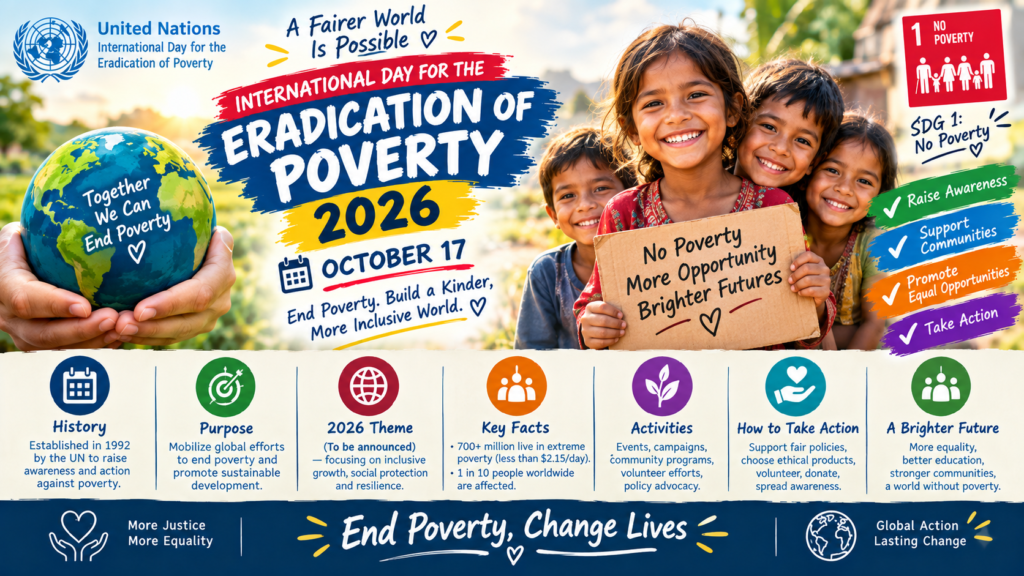
The International Day for the Eradication of Poverty 2026 will be observed on Saturday, October 17, 2026. Established by the United Nations General Assembly in 1992, the annual observance raises awareness about poverty and destitution and encourages action toward ending poverty in all its forms. Its history goes back to October 17, 1987, when more than 100,000 people gathered at the Trocadéro in Paris to honor people affected by extreme poverty, violence, and hunger.
When Is the International Day for the Eradication of Poverty 2026?
International Day for the Eradication of Poverty 2026 is Saturday, October 17, 2026.
| Quick Fact | Details |
|---|---|
| Date | October 17, 2026 |
| Day | Saturday |
| Frequency | Every year |
| Established by UN | 1992 |
| First historical observance | October 17, 1987 |
| UN Resolution | Resolution 47/196 |
| Type | International observance |
| Related SDG | SDG 1 — No Poverty |
What Is the International Day for the Eradication of Poverty?
The International Day for the Eradication of Poverty is an annual UN observance held on October 17 to raise awareness of poverty and encourage action to eradicate poverty and destitution worldwide.
Poverty, as the UN frames it, is a multidimensional issue — not just a matter of income, but something that can affect a person’s access to education, health care, housing, sanitation, food, and other basic necessities. The observance emphasizes a few core ideas:
- Poverty is connected to dignity and human rights, not just economics
- Communities and organizations have a role to play in addressing it
- People experiencing poverty should be listened to and included in solutions, not just discussed as statistics
- Poverty extends beyond income alone into nearly every dimension of daily life
History of the International Day for the Eradication of Poverty
October 17, 1987: The Beginning
The observance’s roots trace to a gathering at the Trocadéro in Paris on October 17, 1987, where more than 100,000 people came together to honor victims of extreme poverty, violence, and hunger, and to affirm that human rights must be respected for people experiencing poverty.
The Commemorative Stone
A commemorative stone was unveiled during that 1987 gathering, inscribed with a call to remember victims of poverty and to work toward a world where poverty is no longer accepted. Replicas of that stone have since been placed in other locations around the world, including at UN Headquarters in New York.
December 22, 1992: UN Recognition
Five years after the original Paris gathering, the UN General Assembly adopted Resolution 47/196 on December 22, 1992, officially designating October 17 as the International Day for the Eradication of Poverty.
First Official UN Observance
The UN’s formal designation built directly on the existing October 17 movement that had already been growing since 1987, with official UN observance of the day beginning in 1993.
What Is the Theme of the International Day for the Eradication of Poverty 2026?
At the time of writing, the United Nations has confirmed the October 17, 2026 observance date, but has not yet published a distinct official theme specifically for 2026. Rather than guess at wording that hasn’t been confirmed, it’s more useful to look at recent history for context.
2025 Theme for Historical Context
The 2025 observance focused on “Ending social and institutional maltreatment for just, peaceful and inclusive societies.” The UN’s 2025 message emphasized dignity, human rights, social protection, decent work, housing, health care, and education — themes that tend to recur across different years’ campaigns even as the specific wording changes.
International Day for the Eradication of Poverty 2026 Context
Even without a confirmed 2026 theme, several ongoing priorities remain central to how the observance is framed each year:
- SDG 1: No Poverty
- Poverty eradication as a global priority
- Social protection systems
- Human dignity
- Inequality and its structural causes
- Inclusive development
- Participation of people experiencing poverty in shaping solutions
- Sustainable development more broadly
The UN’s Third Decade for the Eradication of Poverty runs from 2018 to 2027, under the broader theme “Accelerating global actions for a world without poverty” — a framework that continues to shape how each year’s observance, including 2026, connects back to this longer-term global effort.
Why Is Poverty Eradication Important?
Poverty and Human Dignity
Poverty is closely tied to human rights and dignity — the UN’s framing of the observance treats economic hardship not just as a financial condition, but as something that can affect a person’s ability to live with basic dignity and autonomy.
Poverty and Education
Financial deprivation can directly limit access to education and learning opportunities, creating barriers that often compound across generations within the same family.
Poverty and Healthcare
Economic hardship and access to health care are closely linked in many contexts, though the specific relationship varies significantly depending on a country’s health systems and social protections.
Poverty and Housing
Adequate, safe, and secure housing is a core part of basic living conditions, and housing insecurity is one of the most visible and immediate effects of poverty.
Poverty and Employment
Decent work, fair wages, employment opportunities, social protection, and broader economic inclusion all play a role in whether people are able to move out of poverty and stay out of it.
Poverty and Inequality
Poverty and unequal access to opportunity tend to reinforce each other — unequal access to education, employment, and resources can make poverty harder to escape, while poverty itself can deepen existing inequality.
Poverty and the Sustainable Development Goals
SDG 1: No Poverty
Sustainable Development Goal 1 is simply titled “No Poverty,” and it anchors much of the global poverty-eradication agenda. It covers:
- Ending poverty in all its forms, everywhere
- Building social protection systems
- Ensuring equal access to economic resources
- Building resilience to climate-related and other shocks
- International cooperation to support poverty-reduction efforts
International Day for the Eradication of Poverty connects directly to this goal, and by extension to the broader 2030 Agenda for Sustainable Development, which frames poverty eradication as foundational to nearly every other global development target.
How Is International Poverty Eradication Day Observed?
The observance is marked by a wide range of organizations, including:
- United Nations organizations
- National governments
- NGOs and nonprofits
- Schools and universities
- Community organizations
- Faith-based organizations
- Charities
- Human rights organizations
Typical Activities
- Awareness campaigns
- Educational programs
- Community discussions
- Public forums
- Fundraising efforts
- Food-security initiatives
- Volunteer programs
- Poverty-awareness exhibitions
- Cultural events
- Human rights activities
The UN specifically invites member states and organizations to organize their own activities connected with poverty eradication and destitution each year.
Ways to Participate in International Day for the Eradication of Poverty 2026
- Learn about poverty in your own community, not just in the abstract.
- Volunteer with a reputable local organization working on poverty-related issues.
- Support food-security programs in your area.
- Donate responsibly to established, transparent organizations.
- Participate in educational events focused on poverty and its causes.
- Share verified information about poverty rather than unverified statistics.
- Support initiatives focused on education and employment access.
- Learn about social-protection programs available in your region.
- Listen to the experiences of people living in poverty directly, where appropriate opportunities exist.
- Encourage respectful, non-stigmatizing conversations about poverty.
It’s worth noting: people experiencing poverty aren’t a single homogeneous group, and they shouldn’t be portrayed as helpless. Centering dignity, participation, and lived experience is core to how this observance is meant to be approached.
International Day for the Eradication of Poverty 2026 Activities
School Activities
- Poverty-awareness presentations
- SDG 1 classroom lessons
- Research projects on poverty and its causes
- Book discussions featuring relevant literature
- Community-service projects
- Student poster campaigns
Workplace Activities
- Charity drives
- Employee volunteering programs
- Food donations
- Awareness presentations
- Partnerships with local community organizations
Community Activities
- Food banks
- Clothing drives
- Educational workshops
- Community forums
- Fundraising events
International Day for the Eradication of Poverty 2026 Facts
- The observance takes place every October 17.
- The 2026 observance falls on Saturday, October 17.
- Its history dates back to a 1987 gathering in Paris.
- The UN General Assembly formally established the day in 1992.
- The relevant resolution is Resolution 47/196.
- The day focuses on poverty and destitution worldwide.
- Participation of people experiencing poverty is a core principle of the observance.
- SDG 1 focuses on ending poverty in all its forms.
- The UN Third Decade for the Eradication of Poverty covers 2018–2027.
- The observance is not a public holiday — it’s an international awareness observance.
International Day for the Eradication of Poverty 2026 vs. World Day to Overcome Extreme Poverty
These two names are closely related and sometimes cause confusion:
- World Day to Overcome Extreme Poverty refers to the grassroots October 17 movement that began in 1987, associated with the International Movement ATD Fourth World.
- International Day for the Eradication of Poverty is the formal UN designation established in 1992, building directly on that earlier movement.
Both names are connected historically to the same October 17 date and share the same underlying purpose, even though they emerged from slightly different institutional origins.
International Day for the Eradication of Poverty 2026 and Human Rights
The observance draws a direct line between poverty, dignity, human rights, participation, and social inclusion. The original 1987 Paris gathering specifically connected extreme poverty with human rights violations, framing poverty not merely as an economic condition but as something that can prevent people from fully exercising their basic rights. The UN continues to emphasize dignity and participation as central to how the observance is marked each year.
Frequently Asked Questions
Why is Poverty Eradication Day observed? It’s observed on October 17 to raise awareness about poverty and destitution and encourage action toward their eradication.
What is the theme of the International Day for the Eradication of Poverty 2026? The UN has confirmed the October 17, 2026 observance, but a distinct official 2026 theme had not yet been published at the time of writing. The 2025 theme, “Ending social and institutional maltreatment for just, peaceful and inclusive societies,” offers useful context.
When is International Day for the Eradication of Poverty 2026? Saturday, October 17, 2026.
Who established International Poverty Eradication Day? The United Nations General Assembly established the observance through Resolution 47/196 in 1992.
Why is October 17 associated with poverty eradication? October 17 traces back to the 1987 gathering in Paris that honored people affected by extreme poverty, violence, and hunger.
Is International Day for the Eradication of Poverty a public holiday? No. It’s an international observance rather than a general public holiday.
What is the goal of Poverty Eradication Day? Its purpose is to promote awareness, dialogue, solidarity, and concrete action toward eradicating poverty and destitution.
What is SDG 1? SDG 1 is the UN Sustainable Development Goal focused on “No Poverty.”
How can people participate in Poverty Eradication Day? People can participate through education, volunteering, responsible giving, community programs, and initiatives that support dignity and inclusion.
Conclusion
The International Day for the Eradication of Poverty 2026 will take place on Saturday, October 17. Its roots go back to the 1987 Paris gathering, while the United Nations formally established the observance in 1992. The day provides an opportunity to learn about poverty, challenge stigma, recognize human dignity, and support practical efforts toward poverty reduction and inclusion.
If you’re tracking related observances this October, our World Food Day 2026 guide at MemorialDay2026.com covers the date immediately before this one, and our International Day of Rural Women 2026 article explores a closely related theme earlier in the month. You can also browse our full October 2026 events and observances calendar for everything else worth marking this month.