
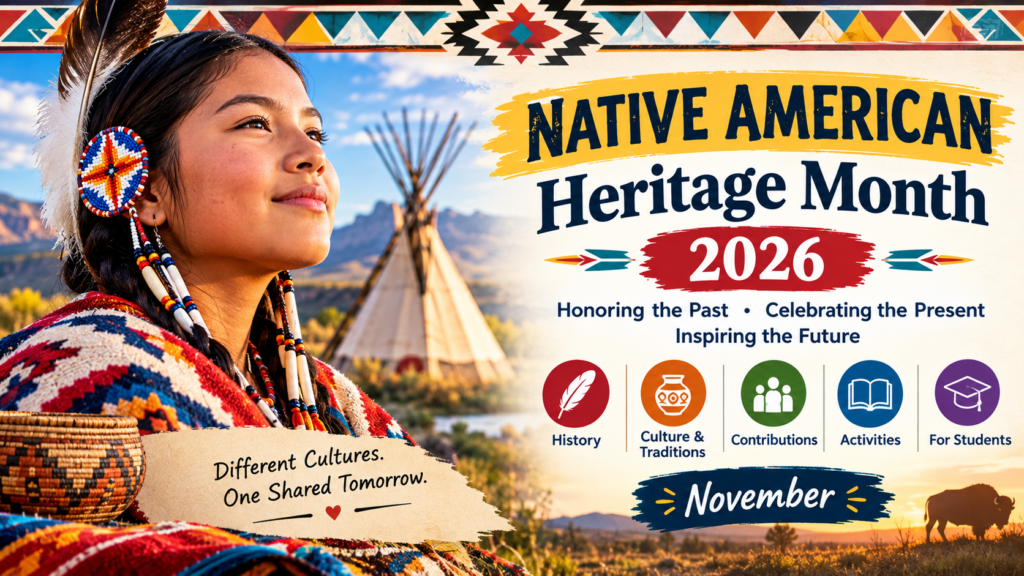
Native American Heritage Month 2026 is observed throughout November. It is a time to learn about and recognize the histories, cultures, traditions, languages, achievements, and contributions of American Indian and Alaska Native peoples. The month offers a meaningful opportunity for education, cultural recognition, and learning directly from Native communities and Native-led resources.
When Is Native American Heritage Month 2026?
- Start date: November 1, 2026
- End date: November 30, 2026
- Month: November
- Observance: Annual
- 2026 dates: Sunday, November 1 through Monday, November 30
Native American Heritage Month 2026 is observed from November 1 through November 30, 2026. The month recognizes the history, cultures, traditions, achievements, and contributions of American Indian and Alaska Native peoples.
What Is Native American Heritage Month?
Native American Heritage Month recognizes the histories and cultures of American Indian and Alaska Native peoples, Native nations, and tribal communities, along with their languages, traditions, and contributions to American society. It’s important to understand from the outset that Native peoples are not a single, homogeneous culture. There are hundreds of distinct tribal nations across the United States, each with its own history, government, language traditions, and cultural practices. The month is meant to reflect that diversity rather than flatten it into one general narrative.
Why Is Native American Heritage Month Celebrated?
- Recognizing Native American history
- Learning about diverse Native cultures
- Honoring contributions and achievements
- Increasing public understanding
- Supporting preservation of languages and traditions
- Learning about tribal sovereignty and Native nations
- Highlighting contemporary Native communities
- Encouraging respectful cultural education
The focus throughout the month should stay on genuine learning and recognition, rather than stereotypes or generalized representations of Native cultures.
History of Native American Heritage Month
Early Efforts to Recognize American Indian Heritage
Efforts to establish a dedicated day or observance recognizing American Indians date back to the early 20th century, reflecting a long-standing interest in giving Native history and culture formal national recognition.
Red Fox James and the Early Campaign
One notable historical figure connected to these early efforts is Red Fox James, a Blackfeet Indian who advocated for the creation of an American Indian Day in the early 1900s. His campaign is often cited as part of the early history behind formal recognition efforts, though it’s important to distinguish these early proposals from the eventual establishment of the modern month-long observance decades later.
National American Indian Heritage Month
Over time, recognition efforts evolved from single designated days toward a broader, month-long national observance, reflecting growing national interest in dedicating sustained attention to Native history and culture rather than a single symbolic day.
Presidential Proclamations
Presidents have issued annual proclamations recognizing November as Native American Heritage Month, a practice that has continued and reinforced the observance’s national visibility over time. This reflects an ongoing tradition of federal recognition rather than a single moment of creation by any one administration.
Native American Heritage Month and Federal Recognition
Federal recognition of Native American Heritage Month has developed through a combination of congressional legislation and resolutions, along with annual presidential proclamations. It’s worth understanding that federal recognition is distinct from the many tribal and community-specific observances that Native nations hold on their own terms throughout the year.
Is Native American Heritage Month a Federal Holiday?
No. Native American Heritage Month is a month-long observance, not a federal public holiday. Federal offices do not close throughout November because of the observance — it functions as a period of recognition and education rather than a day off.
Native American Heritage Month vs. American Indian Heritage Month
You may see this observance referred to by several different names, including:
- Native American Heritage Month
- National Native American Heritage Month
- American Indian Heritage Month
- American Indian and Alaska Native Heritage Month
Terminology can vary among government agencies, organizations, and communities, and no single label is universally preferred by every Native person or tribal nation. When writing or speaking about specific communities, it’s best to use the terminology that community itself uses.
What Does Native American Heritage Month Mean?
Preserving Culture
The month highlights ongoing efforts to preserve languages, art, music, traditional knowledge, crafts, and oral histories that have been passed down across generations.
Remembering History
It’s also a time to reflect on tribal histories, Indigenous experiences, historical events, and the complex treaties and relationships between Native nations and the U.S. government.
Recognizing Contemporary Native Communities
Native American heritage is living and contemporary, not only historical. Native nations and communities continue to shape American life today, and the month should reflect that ongoing presence rather than treating Native culture as something confined to the past.
Recognizing Contributions
Native peoples have made lasting contributions across many fields, including government, science, education, arts, literature, sports, military service, agriculture, environmental stewardship, technology, and public service.
Native American Cultures and Tribal Nations
It’s worth repeating: Native American culture is not one single culture. The United States recognizes numerous distinct tribal nations, each with its own government, history, and cultural traditions.
Tribal Nations
Each federally recognized tribal nation has its own sovereign government, history, and set of traditions, distinct from other Native nations even within the same region.
Languages
Indigenous languages in North America represent an enormously diverse linguistic landscape, with many languages belonging to entirely different language families.
Arts and Crafts
Native artistic traditions include basketry, beadwork, pottery, weaving, carving, and a thriving body of contemporary visual art created by Native artists today.
Storytelling and Oral Traditions
Oral storytelling has long served as a way to pass down history, values, and cultural knowledge across generations in many Native communities.
Food and Agricultural Traditions
Food and agricultural traditions vary significantly across tribal nations and regions, and it’s worth avoiding the assumption that any one community’s practices represent all Native peoples.
Important Native American Contributions to U.S. History
Native peoples have contributed meaningfully across numerous fields, including:
- Agriculture
- Environmental knowledge
- Military service
- Government and civic leadership
- Art and literature
- Science and education
- Sports
- Medicine and public health
- Technology and innovation
When exploring these contributions further, it’s most meaningful to look for specific people, nations, and documented examples rather than relying on broad generalizations.
How to Celebrate Native American Heritage Month 2026
Learn From Native-Led Resources
Prioritize learning directly from tribal nation websites, Native museums, Native authors, Native educators, Native cultural organizations, and other Indigenous-led educational resources.
Read Books by Native Authors
Explore Native-authored children’s books, young adult books, history, memoirs, fiction, and poetry to get a fuller picture of Native perspectives and experiences.
Visit a Native American Museum or Cultural Center
Museums and cultural centers often provide rich, community-informed educational experiences.
Attend a Native-Led Cultural Event
Public events organized by Native communities or organizations offer a respectful way to engage with living Native culture.
Learn About a Local Tribal Nation
Research the history and present-day community of a tribal nation connected to your local area.
Support Native Artists and Businesses
Purchasing from Native-owned businesses and artists helps support Native communities directly.
Watch Documentaries and Educational Programs
Look for documentaries created with Native involvement or produced by Native filmmakers for a more authentic perspective.
Classroom Activities
Teachers can incorporate Native-authored reading lists, tribal history research projects, Indigenous-language research, museum virtual tours, biography projects, geography activities, and primary-source analysis.
Native American Heritage Month 2026 Activities for Families
- Read a book by a Native author.
- Visit a Native-led museum or cultural center.
- Research the history of a local tribal nation.
- Explore Native American art created by Native artists.
- Watch an educational documentary.
- Learn about Indigenous languages.
- Discuss Native American contributions to U.S. history.
- Attend an appropriate public cultural event.
- Support Native-owned businesses and artists.
- Share educational resources rather than stereotypes.
If your family enjoys building a calendar around meaningful cultural and historical observances, our collection of celebration and heritage month guides can help you plan ahead throughout the year.
Native American Heritage Month 2026 Activities for Schools
- Native author reading day
- Biography research
- Tribal nation research project
- Indigenous language lesson
- Native American history timeline
- Museum virtual tour
- Geography project
- Primary-source research
- Native-authored literature discussion
- Guest presentation from an appropriate Native educator or cultural organization
Important Classroom Guidance
Teachers should avoid activities that involve generic “Native American costumes,” plastic or imitation cultural objects, pan-Indian stereotypes, treating sacred traditions as classroom crafts, or presenting one tribe’s customs as representative of all Native peoples. Thoughtful, community-informed activities make the observance far more meaningful for students.
Native American Heritage Month 2026 at Work
- Educational presentations
- Native-authored reading recommendations
- Employee learning sessions
- Native-led speakers or organizations
- Support for Native-owned businesses
- Museum partnerships
- Educational resource sharing
- Internal heritage-month communications
Workplaces should avoid reducing the observance to decorative themes or stereotypes, and instead focus on genuine learning opportunities for employees.
Native American Heritage Month 2026 Events
| Event Type | What to Include |
|---|---|
| Museum events | Exhibitions, lectures, and programs |
| Tribal events | Publicly announced cultural programs |
| Educational events | Talks and workshops |
| Library programs | Book discussions and presentations |
| Virtual events | Online lectures and educational sessions |
| Community events | Public cultural and educational activities |
Check with local museums, libraries, and tribal nations closer to November for confirmed 2026 event details in your area.
Native American Heritage Month 2026 Quotes
For quotations about Native history, culture, and community, it’s best to seek out properly attributed statements from verified Native authors and leaders rather than relying on unattributed quotes commonly circulated online as generic “Native American wisdom.” Looking to published works by Native writers is a more respectful and accurate way to include meaningful quotations in educational content.
Native American Heritage Month 2026 Messages & Wishes
Short Messages
- “Honoring Native American history and culture this November.”
- “Taking time this month to learn, listen, and reflect.”
Messages for Teachers
- “Thank you for bringing thoughtful, accurate education about Native history into the classroom.”
- “Your effort to teach respectfully makes a real difference for students.”
Messages for Students
- “This month is a great opportunity to learn something new about Native history and culture.”
- “Consider reading a book by a Native author this November.”
Workplace Messages
- “Our team is taking time this month to learn about Native American history and contributions.”
- “Thank you to everyone supporting Native-owned businesses and organizations this November.”
Social Media Captions
- “Learning and reflecting this Native American Heritage Month.”
- “Supporting Native voices and stories this November.”
Native American Heritage Month Facts
- It takes place every November.
- It recognizes American Indian and Alaska Native heritage.
- It is a month-long observance rather than a federal holiday.
- Native nations have distinct histories and governments.
- Native American cultures continue to evolve today.
- Numerous Indigenous languages exist in the United States.
- Native artists contribute to contemporary American culture.
- Native people have contributed to U.S. military service, science, literature, government, and other fields.
- Terminology for the observance varies among agencies and communities.
- Federal proclamations have recognized the month for decades.
Common Misconceptions About Native American Heritage
- Native Americans are not one single culture.
- Native American history did not end in the 19th century.
- Not every Native person practices the same traditions.
- Tribal nations have distinct identities.
- Cultural symbols should not automatically be treated as costumes or decorations.
- Indigenous languages and traditions are living, not just historical.
- Historical terminology and modern terminology can differ.
Native American Heritage Month vs. Indigenous Peoples’ Day
| Observance | Timing | Primary Focus |
|---|---|---|
| Native American Heritage Month | November | Native American/American Indian and Alaska Native heritage, history, and contributions |
| Indigenous Peoples’ Day | October, date varies by jurisdiction | Recognition of Indigenous peoples and histories |
| Native American Day | Varies | State/local observance where applicable |
These are related but distinct observances, each with its own scope and history. You can find more general background on Indigenous peoples of North America on Wikipedia.
Frequently Asked Questions
Why is Native American Heritage Month celebrated? It is celebrated to recognize the histories, cultures, and contributions of American Indian and Alaska Native peoples and to encourage broader public understanding and education.
When is Native American Heritage Month 2026? Native American Heritage Month 2026 is observed from November 1 through November 30, 2026.
What month is Native American Heritage Month? It is observed every November.
Is Native American Heritage Month a federal holiday? No. It is a month-long observance rather than a federal public holiday.
Who started Native American Heritage Month? Early advocacy efforts, including those associated with Red Fox James in the early 1900s, contributed to the push for recognition, and the modern month-long observance developed over time through legislation and annual presidential proclamations rather than a single founder.
What is the difference between Native American Heritage Month and American Indian Heritage Month? These are generally alternate names for the same November observance, though terminology preferences can vary among agencies, organizations, and communities.
How can I celebrate Native American Heritage Month? You can read books by Native authors, visit a Native-led museum, support Native-owned businesses, and learn about a local tribal nation’s history.
How can schools observe Native American Heritage Month? Schools can incorporate Native-authored literature, tribal history research, guest speakers from Native communities, and primary-source projects, while avoiding stereotypes or generic “costume” activities.
What are respectful ways to learn about Native American culture? Prioritize Native-led resources, tribal nation websites, Native authors, and museums or organizations run by Native communities themselves.
Are Native American cultures all the same? No. There are hundreds of distinct tribal nations in the United States, each with its own history, language traditions, government, and cultural practices.
Native American Heritage Month 2026 Quick Facts
| Fact | Answer |
|---|---|
| Date | November 1–30, 2026 |
| Month | November |
| Category | Culture / History |
| Frequency | Annual |
| Focus | Native American heritage, history, cultures, and contributions |
| Federal public holiday? | No |
| Primary audience | General public, educators, students, organizations |
| Best observation approach | Learn from Native-led and authoritative resources |
Countdown to Native American Heritage Month 2026
As of September 27, 2026, Native American Heritage Month begins in 35 days on November 1, 2026.
Conclusion
Native American Heritage Month 2026 runs throughout November, offering a meaningful opportunity to learn about Native histories, cultures, and contributions in a way that reflects their true diversity. Native communities are not a single culture frozen in the past — they are diverse, sovereign, and very much part of contemporary American life. The most respectful way to observe the month is to prioritize accurate education, Native-led voices, and genuine curiosity over stereotypes or surface-level gestures. Whether through reading, museum visits, public events, or supporting Native creators and organizations, there are many meaningful ways to take part. For more ideas on marking heritage and awareness months throughout the year, browse our full collection of observance guides.