
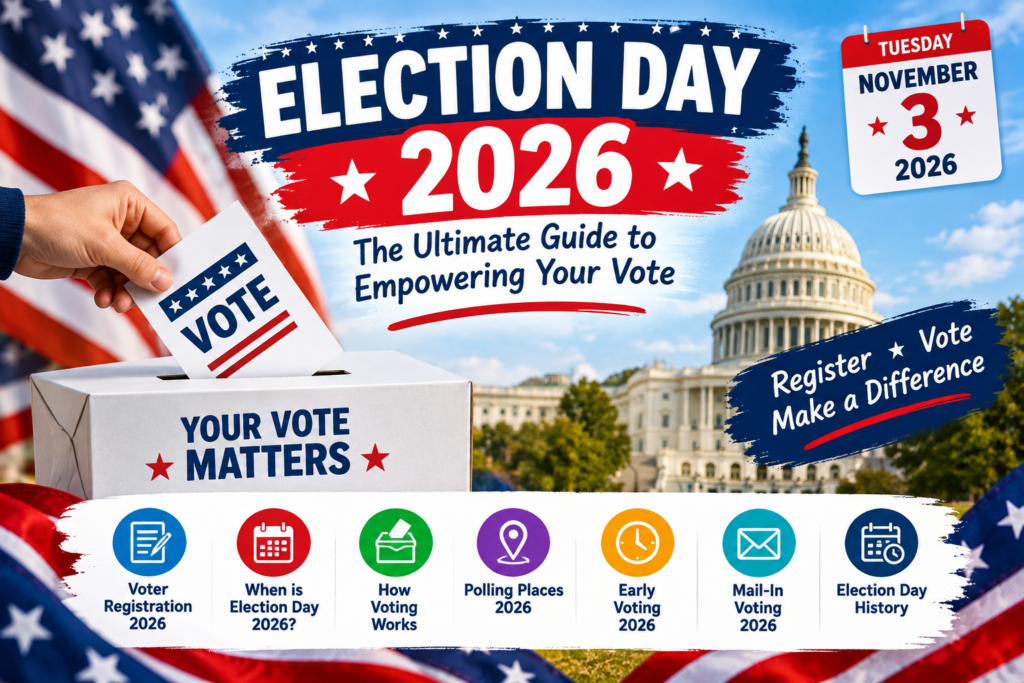
Election Day 2026 is Tuesday, November 3, 2026. It is the regularly scheduled U.S. federal general election date and falls during the 2026 midterm election cycle. Depending on where you live, you may see federal, state, and local races on your ballot — and registration deadlines, voting methods, and polling procedures all vary by state, so it’s worth checking your own state or local election authority ahead of time.
When Is Election Day 2026?
- Date: Tuesday, November 3, 2026
- Year: 2026
- Day: Tuesday
- Election type: Federal general election
- Election cycle: Midterm election year
- Next presidential election: 2028
Election Day 2026 is Tuesday, November 3, 2026. It is the regularly scheduled U.S. federal general election date and occurs during the 2026 midterm election cycle.
What Is Election Day?
Election Day is the day set aside for voters across the United States to cast ballots in federal, state, and local elections. It’s distinct from primary elections, which determine party nominees earlier in the year — Election Day itself is the general election, where the final choices are made. The reason it falls in November traces back to historical scheduling decisions tied to agricultural cycles and travel logistics, and the reason it falls on a Tuesday has its own specific history, covered further below. Not every race appears on every voter’s ballot; what you see will depend on your state, county, and district.
What Happens on Election Day?
Polling Places Open
Polling hours are set by state and local election authorities and can vary significantly depending on where you live.
Voters Cast Their Ballots
Depending on the jurisdiction, voters may use in-person voting, early voting, absentee voting, or mail voting, with the specific options available determined by state law.
Poll Workers Assist Voters
Poll workers play an important role on Election Day, including checking voter eligibility, providing ballots, operating voting equipment, assisting with procedures, and helping secure election materials.
Polls Close
Closing times vary by state and jurisdiction, so it’s important to check local polling hours ahead of time.
Ballots Are Counted
It helps to understand the distinction between ballot counting, results reporting, and official certification — these are related but separate steps, and none of them happen instantly the moment polls close.
Why Is Election Day 2026 on November 3 in 2026?
The regularly scheduled federal general election is held on the Tuesday after the first Monday in November in even-numbered years. For 2026, that works out as follows:
- November 1, 2026 → Sunday
- November 2 → Monday
- November 3 → Tuesday
That’s why Election Day falls on November 3, 2026.
Is Election Day 2026 a Presidential Election?
No. Election Day 2026 is not a presidential election. 2026 is a midterm election year. The 2026 federal elections include all 435 U.S. House seats and approximately one-third of U.S. Senate seats, along with various state and local offices that vary considerably by location.
What Are the 2026 Midterm Elections?
House of Representatives
All 435 voting House seats are regularly subject to election in 2026.
U.S. Senate
Approximately one-third of Senate seats are regularly contested in a typical election cycle, based on staggered six-year terms.
State Elections
Depending on the state, voters may also see races for governor, state legislature, attorney general, secretary of state, judges, and other statewide offices.
Local Elections
Local ballots can include mayors, city councils, school boards, county officials, local measures, bond measures, and other municipal offices.
The exact ballot depends entirely on the voter’s state, county, city, and district, so checking your specific ballot ahead of time is the best way to know what you’ll actually be voting on.
How Does Voting Work in 2026?
Step 1: Check voter registration. Registration rules and deadlines vary by state, so confirm your status well ahead of Election Day.
Step 2: Check your ballot. Voters can research which offices and measures appear on their ballot using official state or local election resources.
Step 3: Choose a voting method. Depending on state law, options may include Election Day voting, early in-person voting, absentee voting, or mail voting.
Step 4: Find your polling place. Polling locations are assigned based on residence and can change between elections, so it’s worth confirming yours each cycle.
Step 5: Check identification requirements. Voter-ID requirements vary by state, so check your specific state’s rules in advance.
Step 6: Cast your ballot. Follow the instructions provided by your local election authority, whether voting in person or by mail.
Who Can Vote in the 2026 Election?
In general, voting eligibility for federal elections requires being a U.S. citizen, meeting the applicable age requirement (typically at least 18 by Election Day), and meeting your state’s registration requirements. Residency and other legal requirements can also apply. It’s worth noting that specific registration and eligibility rules are not identical nationwide, so checking your own state’s requirements is the most reliable approach.
How to Register to Vote for Election Day 2026
Check your registration status to confirm you’re currently registered at your correct address.
Learn your state’s deadline, since registration cutoffs vary significantly by state.
Register through the appropriate election authority, typically your state or county election office.
Update your information if you moved, since an outdated address can cause registration issues.
Confirm your polling location once your registration is active.
Deadlines and procedures differ by state, so this is an area where checking official, state-specific information really matters.
Early Voting vs. Election Day Voting
| Feature | Early Voting | Election Day Voting |
|---|---|---|
| Timing | Before Nov. 3 | Nov. 3, 2026 |
| Availability | Depends on state | Available under state election rules |
| Location | Designated early-voting locations | Assigned polling location may apply |
| Registration rules | State-specific | State-specific |
| ID requirements | State-specific | State-specific |
Neither method is universally better — the right choice depends on your state’s rules and your own schedule and preferences.
How Does Mail-In and Absentee Voting Work?
Mail and absentee voting rules vary significantly by state. Some states conduct elections primarily by mail, while others require or permit absentee voting only under specific circumstances. Deadlines matter a great deal here, and ballots generally must be returned according to state-specific requirements — whether that means postmarked by a certain date or received by election officials by a set deadline.
Can You Vote by Mail in 2026?
It depends on your state. Some states offer mail voting to all registered voters, while others require a specific reason to request an absentee ballot. Check your state’s official election website for the rules that apply to you.
What Do You Need to Vote on Election Day?
- Confirm registration
- Know your polling location
- Check voting hours
- Check voter-ID requirements
- Review your sample ballot
- Bring required identification if applicable
- Follow polling-place instructions
- Ask poll workers if you need procedural assistance
What Happens After You Vote?
Ballot Counting
Election officials count valid ballots according to procedures established under state and local law.
Results Reporting
Media outlets and election authorities may report unofficial results as counting progresses on election night and in the days that follow.
Can Results Change After Election Night?
Yes. Additional ballots — including mail ballots received close to the deadline, provisional ballots, and military or overseas ballots — can continue to be counted after Election Day according to state procedures, which is why unofficial totals can shift in the days afterward.
Certification
Election results go through official canvassing and certification processes before becoming final under applicable law, which typically takes place over the days and weeks following the election.
Election Day History
Why Do Americans Vote on Tuesdays?
The choice of Tuesday dates back to 19th-century logistical considerations — it gave voters time to travel to polling places without conflicting with typical worship days or market days common at the time.
The 1845 Presidential Election Law
Congress established a nationwide, uniform date for choosing presidential electors in 1845, setting the stage for the standardized federal election calendar still used today.
Election Day and Congressional Elections
The federal election calendar eventually expanded to align congressional elections with the same November date, creating the consistent national Election Day structure familiar today.
How Election Day Has Changed
Over time, voting has evolved considerably to include early voting, absentee and mail voting, updated voting technology, modernized voter registration systems, and expanded election administration practices designed to make voting more accessible.
Election Day 2026: What Is on the Ballot?
Depending on your location, your ballot may include U.S. House races, U.S. Senate races, governor races, state legislative races, judicial elections, county offices, municipal offices, school board elections, and various ballot measures.
Your 2026 ballot will depend on where you live. Check your state or local election authority for the exact offices and measures on your ballot.
Election Day 2026 Voting Checklist
- Check voter registration
- Confirm registration deadline
- Find polling location
- Check polling hours
- Review your ballot
- Check voter-ID requirements
- Decide whether to vote early, by mail, or on Election Day
- Follow official election instructions
- Keep confirmation or receipt information where applicable
Election Day 2026 for First-Time Voters
Before Election Day
Register to vote, check your eligibility, learn where you’ll vote, and research what’s actually on your ballot ahead of time.
On Election Day
Arrive during polling hours, follow poll-worker instructions, ask questions if you’re unsure about any part of the process, and review your ballot carefully before submitting it.
After Voting
Understand that unofficial results may shift as counting continues in the days after the election, and look for official results and certification from your state or local election authority rather than relying solely on early reporting.
Election Day 2026 Activities for Students
- Learn how elections work
- Study the history of U.S. elections
- Create an election timeline
- Research state voting procedures
- Conduct a mock election
- Study the structure of Congress
- Learn how local government works
- Discuss civic participation
- Practice finding official election information
These activities work well for classrooms because they build civic knowledge without promoting or discouraging support for any particular candidate or party. If your school or community group is planning civic education activities around Election Day, our collection of observance and civic education guides can offer additional ideas for building out the rest of the year.
Election Day Facts
- Election Day 2026 is November 3.
- It is a Tuesday.
- 2026 is a midterm election year.
- It is not a presidential election.
- All 435 House seats are regularly up for election.
- Approximately one-third of Senate seats are regularly contested.
- State and local races vary by jurisdiction.
- Voting procedures differ among states.
- Polling-place locations can change.
- Voter-ID requirements vary by state.
- Early voting availability varies by state.
- Mail and absentee rules vary by state.
- Election results may continue to be reported after polls close.
- Official certification occurs after counting and canvassing procedures.
Election Day 2026 vs. Election Day 2028
| Feature | 2026 | 2028 |
|---|---|---|
| Date | November 3, 2026 | November 7, 2028 |
| Election type | Midterm | Presidential |
| President on ballot? | No | Yes |
| House elections | Yes | Yes |
| Senate elections | Yes | Yes |
| State/local races | Vary | Vary |
If you’re curious about the broader mechanics behind how U.S. elections are scheduled and structured, Wikipedia’s overview of elections in the United States is a useful general reference.
Frequently Asked Questions
When is Election Day 2026? Election Day 2026 is Tuesday, November 3, 2026.
What happens on Election Day? Polling places open, voters cast ballots through in-person, early, absentee, or mail voting depending on their state, poll workers assist with the process, and ballots are counted according to official procedures after polls close.
How does voting work? Voters generally need to register in advance, confirm their polling location or voting method, and follow their state’s specific procedures for casting a ballot, whether in person or by mail.
Is Election Day 2026 a presidential election? No. 2026 is a midterm election year, meaning the presidency is not on the ballot, though Congress and many state and local offices are.
What are the 2026 midterm elections? They include all 435 U.S. House seats, roughly one-third of U.S. Senate seats, and a wide range of state and local races that vary by location.
How do I register to vote in 2026? You can register through your state or county election office, keeping in mind that deadlines and specific requirements vary by state.
Can I vote early in 2026? In many states, yes — early voting availability and dates depend on your specific state’s election laws.
Can I vote by mail in 2026? It depends on your state. Some states allow any registered voter to vote by mail, while others require a specific reason to request an absentee ballot.
How do I find my polling place? Your polling place is typically listed through your state or county election authority’s official website, based on your registered address.
Do I need an ID to vote? Voter-ID requirements vary by state, so it’s best to check your specific state’s rules ahead of time.
What happens after polls close? Ballot counting begins, unofficial results are often reported as counting progresses, and official certification follows once canvassing procedures are complete.
When are Election Day results final? Results become official only after state and local election authorities complete their canvassing and certification processes, which can take days to weeks depending on the jurisdiction.
Election Day 2026 Quick Facts
| Fact | Answer |
|---|---|
| Date | Tuesday, November 3, 2026 |
| Country | United States |
| Election cycle | Midterm |
| Presidential election? | No |
| House elections | All 435 seats regularly up |
| Senate elections | Approximately one-third of seats |
| State/local races | Vary by jurisdiction |
| Voting rules | Vary by state |
| Polling locations | Vary by jurisdiction |
| Federal public holiday? | No nationwide federal holiday |
| Next presidential Election Day | November 7, 2028 |
Countdown to Election Day 2026
As of September 27, 2026, Election Day is 37 days away.
Election Day 2026: Tuesday, November 3, 2026.
Conclusion
Election Day 2026 falls on Tuesday, November 3, marking another important midterm election cycle rather than a presidential race. Federal, state, and local contests may all appear on your ballot depending on where you live, and voting procedures — from registration deadlines to ID requirements to mail voting rules — differ significantly by state. Whatever method you choose, checking official information from your state or local election authority is the most reliable way to make sure you’re ready to vote. And remember: election-night reporting reflects unofficial results, not final certification, so it’s normal for totals to be updated in the days that follow. For more civic and seasonal observance guides throughout the year, visit our full collection of celebration and awareness resources.