
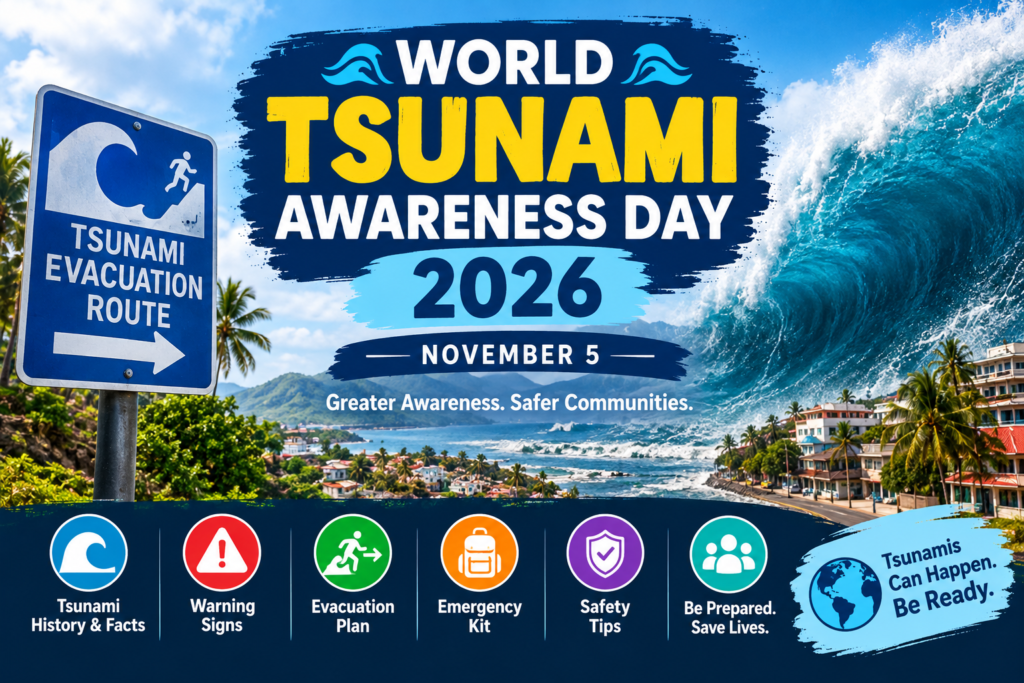
World Tsunami Awareness Day is observed every year on November 5. In 2026, it falls on Thursday, November 5. The day promotes tsunami awareness, preparedness, risk reduction, and education so communities can better understand tsunami hazards and respond quickly to warnings. Tsunami preparedness is particularly important for coastal and tsunami-prone communities, where the time between a warning and a dangerous wave can be very short.
When Is World Tsunami Awareness Day 2026?
- Date: Thursday, November 5, 2026
- Month: November
- Frequency: Annual
- Established by: United Nations General Assembly
- Focus: Tsunami awareness and disaster risk reduction
World Tsunami Awareness Day 2026 is Thursday, November 5. It is an annual United Nations observance that promotes awareness, preparedness, and disaster-risk reduction related to tsunamis.
What Is World Tsunami Awareness Day?
World Tsunami Awareness Day highlights the importance of tsunami education, early warning systems, and community preparedness. It’s a reminder that tsunamis can affect communities far from the location where an undersea disturbance actually occurs, which is why international cooperation and shared warning systems matter so much. The observance touches on several connected priorities:
- Public understanding of tsunami hazards
- Early warning systems
- Community preparedness
- Disaster-risk reduction
- International cooperation
Why Is Tsunami Awareness Day Celebrated?
- Raising awareness about tsunami hazards
- Teaching people to recognize warning signs
- Promoting evacuation preparedness
- Strengthening early-warning systems
- Encouraging community disaster planning
- Reducing loss of life and property
- Promoting international cooperation
- Supporting resilient coastal communities
History of World Tsunami Awareness Day
The 2004 Indian Ocean Tsunami
The devastating December 26, 2004 Indian Ocean tsunami highlighted, in the most tragic way possible, the need for stronger tsunami-warning and preparedness systems across the Indian Ocean and other vulnerable regions. The scale of loss from that event became a turning point in global tsunami-risk conversations.
Japan’s Role in Establishing the Day
World Tsunami Awareness Day was the brainchild of Japan, a country that has built major expertise in tsunami early warning, public action, and disaster recovery through its own repeated, difficult experience with tsunamis. The date November 5 connects to the Japanese story of “Inamura-no-Hi” (Fire of Rice Sheaves), tied to the 1854 Ansei-Nankai earthquake and tsunami, in which quick thinking and decisive action helped save lives.
United Nations Establishes the Observance
In December 2015, the UN General Assembly designated November 5 as World Tsunami Awareness Day through Resolution 70/203, calling on countries, international bodies, and civil society to raise tsunami awareness and share innovative approaches to risk reduction.
The Purpose of the UN Observance
The day is coordinated by the UN Office for Disaster Risk Reduction (UNDRR) and connects to the broader Sendai Framework for Disaster Risk Reduction 2015–2030, which sets out global goals for reducing disaster losses.
World Tsunami Awareness Day 2026 Theme
As of publication, an official, confirmed theme specific to 2026 has not been clearly established. The most recent confirmed theme, used for 2025, was “Be Tsunami Ready: Invest in Tsunami Preparedness,” which focused on building resilient communities through the Tsunami Ready Programme. Given the observance’s consistent focus over recent years, 2026 is likely to continue emphasizing preparedness, early warning systems, and community resilience — but readers should check the official United Nations or UNDRR tsunami awareness pages closer to November for the confirmed 2026 theme and campaign materials.
What Is a Tsunami?
A tsunami is a series of powerful ocean waves generated by a large and sudden displacement of seawater.
What Causes a Tsunami?
Tsunamis are most commonly caused by undersea earthquakes, though volcanic eruptions, underwater landslides, and certain other large disturbances that displace water can also trigger them.
Are Tsunamis the Same as Regular Ocean Waves?
No. Ordinary ocean waves are generated by wind blowing across the water’s surface, while tsunami waves are caused by a sudden displacement of a massive amount of water. Tsunami waves can travel much faster, carry far more energy, and behave very differently as they approach shore.
How Does a Tsunami Form?
The basic sequence looks like this: an undersea disturbance displaces water, waves travel outward across the ocean, the waves reach shallower water near a coastline, wave height can increase significantly, and the result is coastal flooding along with strong, dangerous currents. Tsunami behavior varies depending on the source event, ocean depth, coastline shape, and other local factors, which is part of why local warning systems and evacuation planning matter so much.
What Are the Warning Signs of a Tsunami?
Natural Warning Signs
Important natural warning signs include strong or long earthquake shaking near the coast, a sudden unusual rise or fall in sea level, and a loud ocean roar or other unusual sound coming from the water.
Do not wait for an official warning if you experience strong or long earthquake shaking near the coast or observe natural tsunami warning signs. Move immediately to higher ground or farther inland according to local evacuation guidance.
Official Warning Signs
Official warnings can come through emergency alerts, sirens, official announcements, radio and TV alerts, local emergency-management instructions, and information from tsunami warning centers.
What Should You Do During a Tsunami?
Step 1: Move away from the coast. If a tsunami warning is issued or strong natural warning signs occur, immediately move away from coastal areas.
Step 2: Go to higher ground. Follow designated evacuation routes toward higher ground or another designated safe location.
Step 3: Follow official instructions. Listen closely to emergency-management authorities for updated guidance.
Step 4: Stay away from beaches and shorelines. Do not go to the coast to watch tsunami waves — this is a serious and often fatal mistake.
Step 5: Stay away until officials give the all-clear. A tsunami can consist of multiple waves, and later waves may be more dangerous than the first.
Tsunami Evacuation Plan
Know Your Risk
Determine whether your home, workplace, or school is located in a tsunami hazard zone using official local hazard maps.
Know Your Evacuation Routes
Identify a primary route, a backup route, higher-ground locations, and vertical-evacuation structures where applicable in your area.
Establish a Family Communication Plan
Include emergency contacts, a meeting location, an out-of-area contact, and backup communication alternatives in case phone networks are overloaded.
Practice the Route
Regular evacuation drills, especially in tsunami-prone communities, help ensure everyone knows what to do without hesitation when it matters most.
Tsunami Emergency Kit
- Drinking water
- Nonperishable food
- First-aid supplies
- Flashlight
- Extra batteries
- Battery-powered or hand-crank radio
- Necessary medications
- Phone charging equipment
- Copies of important documents
- Whistle
- Basic clothing
- Essential supplies for children, older adults, and pets
Adapt your kit based on recommendations from your local emergency-management agency, since needs can vary by region.
Tsunami Safety Tips Before, During, and After a Tsunami
| Before | During | After |
|---|---|---|
| Know your hazard zone | Evacuate immediately when instructed | Wait for official all-clear |
| Learn evacuation routes | Move inland/higher | Avoid damaged areas |
| Prepare an emergency kit | Stay away from beaches | Avoid floodwater |
| Sign up for alerts | Follow authorities | Check on others safely |
| Practice evacuation | Don’t watch the waves | Follow recovery guidance |
What Should You Do After a Tsunami?
Wait for official confirmation before returning to coastal areas, avoid floodwater, watch for damaged roads and structures, avoid downed power lines, follow emergency instructions, use only safe drinking water, check on family and neighbors when it’s safe to do so, and follow local disaster-recovery guidance closely.
Tsunami Warning vs. Watch vs. Advisory
| Alert | General Meaning |
|---|---|
| Warning | Dangerous tsunami waves are possible or occurring; evacuation may be required |
| Advisory | Strong currents or dangerous conditions may occur; stay away from beaches/water |
| Watch | A tsunami is possible; monitor official information and prepare |
| Information Statement | Information is being provided; no significant threat may be expected |
Alert terminology and instructions should always be interpreted according to the relevant official warning authority in your region, since exact definitions can vary.
Where Do Tsunamis Occur?
Tsunamis can occur in many ocean and coastal regions, including the Pacific Ocean, Indian Ocean, Atlantic Ocean, Mediterranean Sea, and Caribbean region. Because risk isn’t limited to one part of the world, regional warning systems play a critical role in protecting communities that may not think of themselves as tsunami-prone.
Major Tsunamis in History
- 2004 Indian Ocean tsunami — Triggered by a massive undersea earthquake, this tsunami caused devastating loss of life across multiple countries and became a major catalyst for global tsunami-warning improvements.
- 2011 Japan/Tōhoku tsunami — Caused by a powerful undersea earthquake off Japan’s coast, this event caused widespread destruction and reinforced lessons about coastal infrastructure and evacuation planning.
- 1960 Chile tsunami — Following one of the largest recorded earthquakes in history, this tsunami affected coastlines across the Pacific.
- 1964 Alaska tsunami — Triggered by a major earthquake, this event highlighted tsunami risks along the U.S. Pacific coastline.
Each of these events contributed important lessons to how modern tsunami warning systems and preparedness programs are designed today.
World Tsunami Awareness Day 2026 Activities
For Schools
- Tsunami evacuation drills
- Emergency preparedness lessons
- Tsunami science demonstrations
- Map hazard zones
- Create evacuation-route posters
- Watch educational materials
- Emergency-kit activity
For Families
- Create an evacuation plan
- Identify nearby higher ground
- Sign up for emergency alerts
- Build an emergency kit
- Practice evacuation
For Communities
- Evacuation exercises
- Public awareness campaigns
- Emergency-management workshops
- Coastal hazard mapping
- Warning-system education
If your school or community group likes planning around safety and awareness observances throughout the year, our collection of awareness day guides can help with ideas for what else to plan for.
World Tsunami Awareness Day 2026 for Students
Easy Project Ideas
- Make a tsunami safety poster.
- Create a tsunami timeline.
- Map major historical tsunamis.
- Research tsunami warning systems.
- Create a family evacuation plan.
- Build a disaster-preparedness checklist.
- Prepare a short presentation about tsunami science.
World Tsunami Awareness Day 2026 Quotes & Messages
Short Awareness Messages
- “Know the warning signs. Know where to go.”
- “Prepared communities respond faster.”
- “Tsunami awareness can save lives.”
- “Learn today. Prepare before an emergency.”
World Tsunami Awareness Day Facts
- World Tsunami Awareness Day is observed every November 5.
- The UN General Assembly designated the day in December 2015.
- The 2004 Indian Ocean tsunami was a major catalyst for global tsunami-preparedness efforts.
- November 5 connects to Japan’s “Inamura-no-Hi” story and the 1854 Ansei-Nankai tsunami.
- Undersea earthquakes are a major trigger for tsunamis.
- Natural warning signs include strong shaking, unusual sea-level changes, and loud ocean sounds.
- Tsunamis often consist of multiple waves, not just one.
- Quick evacuation is one of the most important survival actions.
- Early warning systems play a key role in reducing tsunami casualties.
- Community preparedness significantly improves outcomes during a tsunami event.
- Tsunami risk exists beyond the Pacific region, including the Indian Ocean, Atlantic, and Mediterranean.
World Tsunami Awareness Day vs. International Day for Disaster Risk Reduction
| Observance | Date | Focus |
|---|---|---|
| World Tsunami Awareness Day | November 5 | Tsunami awareness and preparedness |
| International Day for Disaster Risk Reduction | October 13 | Broader disaster-risk reduction |
These two observances are related but distinct — one focuses specifically on tsunamis, while the other covers disaster risk more broadly. You can read more about the general science and history of tsunamis on Wikipedia.
Frequently Asked Questions
Why is Tsunami Awareness Day celebrated? It’s celebrated to raise awareness of tsunami hazards, teach people to recognize warning signs, and strengthen preparedness and early-warning systems worldwide.
When is World Tsunami Awareness Day 2026? World Tsunami Awareness Day 2026 is Thursday, November 5, 2026.
What is the theme of World Tsunami Awareness Day 2026? An official 2026 theme has not been clearly confirmed as of publication; the most recent confirmed theme, from 2025, was “Be Tsunami Ready: Invest in Tsunami Preparedness.” Check official UN or UNDRR sources closer to November for confirmation.
What should you do during a tsunami? Move immediately away from the coast toward higher ground, follow official instructions, avoid watching the waves from the shoreline, and stay away until officials confirm it’s safe.
What are the natural warning signs of a tsunami? Strong or long earthquake shaking near the coast, a sudden unusual rise or fall in sea level, and a loud, unusual ocean roar are all natural warning signs.
How do you prepare for a tsunami? Know your local hazard zone, identify evacuation routes, build an emergency kit, establish a family communication plan, and practice your evacuation route in advance.
What causes a tsunami? Tsunamis are most often caused by undersea earthquakes, though volcanic eruptions and underwater landslides can also trigger them.
How does a tsunami warning work? Warnings are issued by tsunami warning centers and relayed through emergency alerts, sirens, and official broadcasts, though natural warning signs should never be ignored even without an official alert.
How long should you stay away after a tsunami? Stay away from coastal areas until local officials confirm it’s safe, since tsunamis can involve multiple waves arriving over an extended period.
Where do tsunamis occur? Tsunamis can occur in the Pacific, Indian, and Atlantic Oceans, as well as the Mediterranean Sea and Caribbean region.
Is World Tsunami Awareness Day a public holiday? No. It is an international awareness observance rather than a public holiday.
World Tsunami Awareness Day 2026 Quick Facts
| Fact | Answer |
|---|---|
| Date | Thursday, November 5, 2026 |
| Observed | Every November 5 |
| Established by | United Nations General Assembly |
| Designation | December 2015 |
| Primary focus | Tsunami awareness and preparedness |
| Historical inspiration for date | Japan’s “Inamura-no-Hi” story |
| Key safety message | Recognize warning signs and evacuate quickly |
| Public holiday? | No |
| Related global framework | Sendai Framework for Disaster Risk Reduction |
Countdown to World Tsunami Awareness Day 2026
As of September 27, 2026, World Tsunami Awareness Day is 39 days away.
Date: Thursday, November 5, 2026.
Conclusion
World Tsunami Awareness Day 2026 provides an important opportunity to learn about tsunami hazards, understand natural warning signs, and strengthen preparedness in coastal and tsunami-prone communities. The most important practical takeaway is simple but critical: know your local tsunami risk, understand your evacuation routes, and act quickly when natural or official warnings indicate danger. Preparedness built well before an emergency is often what makes the difference when there’s no time to think twice. For more awareness and safety-focused observance guides throughout the year, visit our full collection of celebration and awareness resources.