
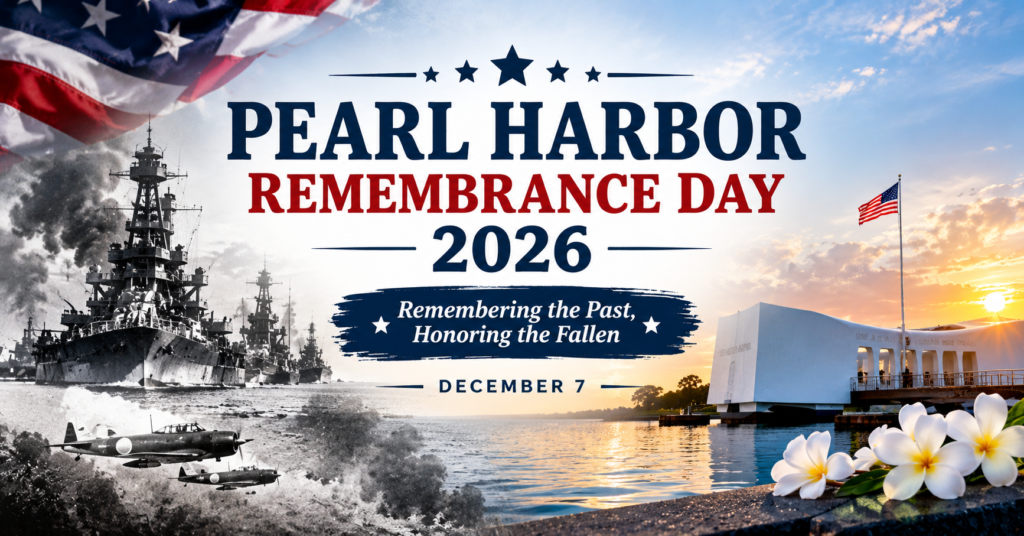
Pearl Harbor Remembrance Day 2026 falls on Monday, December 7. It is a national day of remembrance for the service members and civilians killed or injured when Japanese forces attacked the U.S. naval base at Pearl Harbor, Hawaii, on December 7, 1941. The surprise attack drew the United States into World War II, and it remains one of the defining events of American history.
This guide explains what happened, how many people were lost, why the attack mattered, why we remember it and how you can observe the day respectfully. It covers the timeline, the memorials, the human stories and practical ways to take part. For related observances, see our history category.
What Happened at Pearl Harbor on December 7, 1941?
Why Japan Attacked Pearl Harbor
The attack came after years of rising tension between Japan and the United States in the Pacific. Japan had expanded its military reach in Asia, and the United States responded with economic measures, including restrictions on trade and the freezing of Japanese assets in 1941. Japanese leaders saw access to resources such as oil as essential, and they planned to disable the U.S. Pacific Fleet so it could not interfere with their advance in Southeast Asia.
Historians point to many overlapping causes, so it would be inaccurate to reduce the origins of the attack to a single factor.
How the Attack Unfolded
- Japanese aircraft launched from six aircraft carriers positioned north of Hawaii.
- The attack began shortly before 8 a.m. Hawaii time, in two waves.
- Battleships, military aircraft, airfields and naval facilities were targeted.
- U.S. personnel scrambled to respond while the attack continued for less than two hours.
Many sailors and soldiers were off duty or on weekend routines when the first bombs fell, which added to the shock and confusion. A broader overview is available in the Pearl Harbor attack article on Wikipedia.
The Damage Caused by the Attack
The attack destroyed or damaged many ships and aircraft. The battleships USS Arizona and USS Oklahoma were among the vessels lost, and others, including the USS Utah, were also sunk or badly damaged. The U.S. Pacific Fleet suffered a severe blow. However, the attack did not destroy every part of American naval power, because the U.S. aircraft carriers were not in the harbor that morning. Those carriers would play a major role in the Pacific war that followed.
Pearl Harbor Attack Casualties and Important Facts
The human cost is the heart of remembrance. Commonly cited figures include:
| Measure | Commonly cited figure |
|---|---|
| Total killed (service members and civilians) | 2,403 |
| Total injured | 1,178 |
| USS Arizona crew members who died | 1,177 |
| USS Oklahoma crew members who died | 429 |
| Aircraft destroyed | 188 |
Some historical accounts report slightly different totals depending on which categories and records they count, such as civilians, later deaths from wounds or aircraft damaged versus destroyed. For consistency, this article uses the widely cited figures above.
How Pearl Harbor Changed American History
Franklin D. Roosevelt’s “Day of Infamy” Speech
On December 8, 1941, President Franklin D. Roosevelt addressed Congress. He described December 7 as “a date which will live in infamy,” a phrase that became one of the most recognized in American history. His speech asked Congress to recognize that a state of war existed with Japan.
America’s Entry into World War II
- Congress declared war on Japan on December 8, 1941.
- The attack transformed U.S. public opinion and political debate about involvement in the war, unifying a country that had been deeply divided over whether to intervene.
- Germany and Italy declared war on the United States a few days later, on December 11, and the United States then declared war on them.
The Attack’s Lasting Legacy
Pearl Harbor reshaped military strategy, national security thinking and the way Americans remember wartime sacrifice. It also changed millions of lives, from service members and their families to civilians in Hawaii. Its legacy lives on in memorials, museums, oral histories and the stories of survivors, whose numbers are now very small.
Why Do We Remember Pearl Harbor?
Remembrance serves several purposes:
- To remember those who died or were injured. Each number represents a person with a family.
- To honor courage and service. Many service members and civilians acted bravely under extraordinary pressure.
- To preserve the historical record for future generations.
- To recognize the consequences of war and the value of understanding history.
- To honor survivors, veterans and families affected by the attack.
Remembrance is not only about a military event. It is about individual lives, the families who waited for news and the communities that carried the loss for decades.
What Is National Pearl Harbor Remembrance Day?
When Was the Observance Established?
Congress designated December 7 as National Pearl Harbor Remembrance Day on August 23, 1994. It is observed each year with ceremonies, moments of silence and educational programs, including events at Pearl Harbor itself.
Is Pearl Harbor Remembrance Day a Federal Holiday?
No. It is a national remembrance observance, not a federal public holiday, so government offices and most businesses generally stay open. In 2026 it falls on a Monday, so expect a normal workday and school day in most places.
Is Pearl Harbor Day the Same as Veterans Day?
No. The three U.S. remembrance days have distinct purposes:
- Pearl Harbor Remembrance Day: Remembers the attack of December 7, 1941, and the people affected.
- Veterans Day: Honors all U.S. military veterans who served, in wartime and peacetime. See our Veterans Day 2026 guide.
- Memorial Day: Honors U.S. military personnel who died while serving. Read more in our Memorial Day 2026 guide.
How to Observe Pearl Harbor Remembrance Day 2026
These respectful activities suit individuals, families, schools and communities:
- Observe a moment of silence or reflection.
- Read a first-person account from a Pearl Harbor survivor.
- Explore historical photographs and records in public archives.
- Teach children about the attack using age-appropriate materials.
- Visit a local veterans’ memorial or historical museum.
- Watch a documentary based on reliable historical sources.
- Learn about the USS Arizona Memorial.
- Share a respectful remembrance message on social media.
- Discuss the historical consequences of the attack in a classroom or community group.
- Attend a verified local or official remembrance ceremony, if one is available.
Because December 7 is a weekday in 2026, a short classroom lesson or a quiet moment at work or home can be just as meaningful as a large event. For more ways to give back, browse our December 2026 holidays and observances.
Pearl Harbor Memorials and Places of Remembrance
USS Arizona Memorial
The USS Arizona Memorial spans the sunken hull of the battleship without touching it, and it honors those who died aboard. The names of the fallen are engraved in the shrine room. Many of the crew remain entombed within the ship. Learn more about its design and history in the USS Arizona Memorial article on Wikipedia.
Pearl Harbor National Memorial
The Pearl Harbor National Memorial preserves the history of the attack and commemorates the military personnel and civilians affected. It brings together sites, exhibits and programs that help visitors understand what happened and why it matters.
Remembering Pearl Harbor from Anywhere
You do not have to travel to Hawaii to take part. Digital archives, oral history recordings, educational resources and local remembrance events make it possible to learn and reflect from home, at school or in your community.
Pearl Harbor Remembrance Day Quotes and Messages
The messages below are original and written for sharing on the day.
Short Remembrance Messages
- “We remember the lives lost at Pearl Harbor and honor the courage shown on December 7, 1941.”
- “May the stories of Pearl Harbor continue to teach future generations about sacrifice, history and remembrance.”
- “On Pearl Harbor Remembrance Day, we honor the fallen, the survivors and the families who carry their memories.”
- “We remember December 7, 1941, with respect for all those whose lives were changed by the attack.”
Social Media Captions
- “December 7 is Pearl Harbor Remembrance Day. We remember those who lost their lives and honor their enduring legacy.”
- “Remembering Pearl Harbor means preserving history and honoring the people behind it. #PearlHarborRemembranceDay”
- “We will remember the lives lost and the courage shown on December 7, 1941.”
Historical Quotations
The best-known words associated with the day are those of President Roosevelt, who called December 7, 1941, “a date which will live in infamy.” Other historical quotations should only be shared with verified attribution, and invented quotes should never be presented as the words of survivors, service members or presidents.
Pearl Harbor Remembrance Day Facts
- The attack took place on December 7, 1941.
- It targeted U.S. military installations in Hawaii, including Pearl Harbor.
- Congress designated December 7 as National Pearl Harbor Remembrance Day in 1994.
- Commonly cited figures list 2,403 people killed and 1,178 injured.
- The USS Arizona suffered 1,177 deaths.
- President Roosevelt addressed Congress on December 8, 1941.
- The attack led to the U.S. declaration of war against Japan.
Frequently Asked Questions
When is Pearl Harbor Remembrance Day 2026?
Pearl Harbor Remembrance Day 2026 is Monday, December 7.
What happened at Pearl Harbor?
On December 7, 1941, Japanese forces launched a surprise attack against U.S. military facilities in Hawaii, damaging ships and aircraft and killing thousands of Americans.
Why do we observe Pearl Harbor Remembrance Day?
The day honors those killed or injured in the attack, recognizes the people who responded and preserves the memory of an event that changed U.S. history.
How many people died at Pearl Harbor?
Commonly cited figures report 2,403 service members and civilians killed. Some other historical accounts give different totals depending on their counting categories.
Who attacked Pearl Harbor?
The Imperial Japanese military launched the attack against U.S. military facilities in Hawaii on December 7, 1941.
When did the United States enter World War II?
Congress declared war on Japan on December 8, 1941, the day after the Pearl Harbor attack.
Is Pearl Harbor Remembrance Day a federal holiday?
No. It is a national observance, not a federal public holiday that generally closes government offices.
How can people observe Pearl Harbor Remembrance Day?
People can learn about the attack, read survivor accounts, visit memorials, share remembrance messages and participate in verified ceremonies.
Countdown to Pearl Harbor Remembrance Day 2026
Pearl Harbor Remembrance Day 2026 is Monday, December 7, 2026. As of October 11, 2026, there are 57 days until the observance. (Developer note: replace this with a dynamic countdown so it updates daily, and delete this line before publishing.)
Conclusion: Remembering Pearl Harbor
Pearl Harbor Remembrance Day 2026 is a chance to pause on Monday, December 7, honor the people who were lost and keep their stories alive. Whether you share a message, read a survivor’s account, teach a child or simply reflect in silence, remembering with accuracy and respect is the most meaningful way to observe the day.