
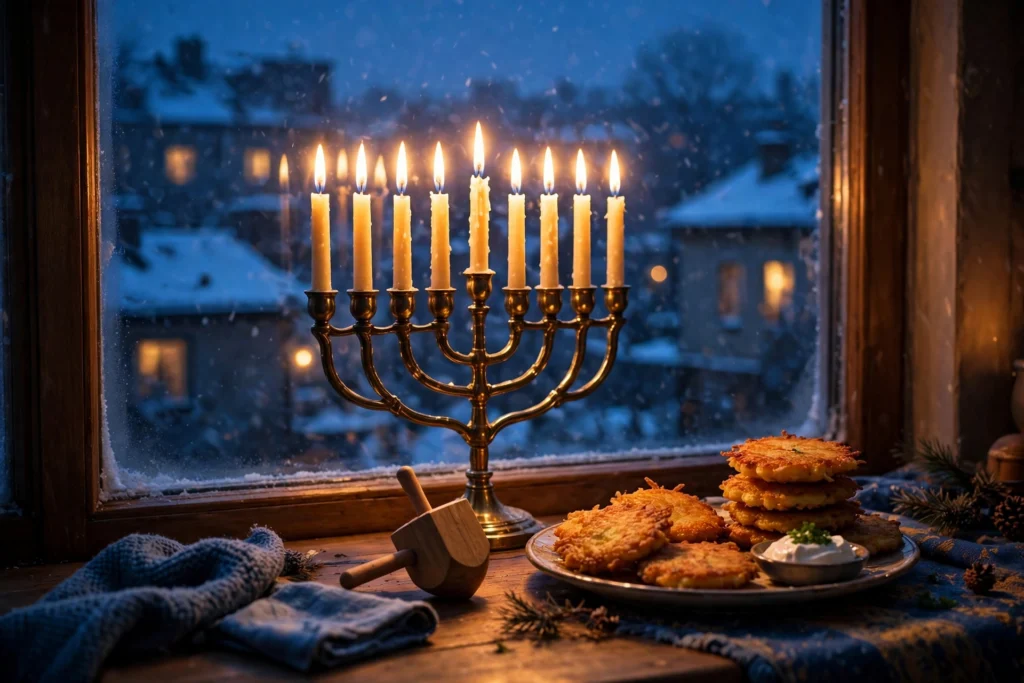
Hanukkah 2026 begins at sundown on Friday, December 4, 2026, and ends at nightfall on Saturday, December 12, 2026. It is the eight-night Jewish Festival of Lights, and in 2026 it falls entirely in December — the first candle is lit before Shabbat begins on that opening Friday, and the eighth and final candle is lit on Friday, December 11.
As of November 2, 2026, Hanukkah 2026 is 32 days away. If you are planning a family gathering, a community lighting, a classroom lesson or simply want to know what to say to a Jewish friend, this guide gives you the dates first, then the story behind them, then the practical parts: how the menorah is lit, what is eaten, what the dreidel game means, and what is — and is not — a public holiday in the United States.
Hanukkah 2026 night by night
Jewish days begin at sundown, so the first night comes before the first full day. Hanukkah 2026 runs from 25 Kislev to 2 Tevet 5787 on the Hebrew calendar. The table below follows Hebcal’s 2026 calendar.
| Night | Date | Candles | Following day / Hebrew date |
|---|---|---|---|
| Night 1 | Friday, December 4, 2026, before Shabbat candles | 1 candle + shamash | 25 Kislev (Saturday, December 5) |
| Night 2 | Saturday, December 5, 2026, after Shabbat ends | 2 + shamash | 26 Kislev |
| Night 3 | Sunday, December 6 | 3 + shamash | 27 Kislev |
| Night 4 | Monday, December 7 | 4 + shamash | 28 Kislev |
| Night 5 | Tuesday, December 8 | 5 + shamash | 29 Kislev |
| Night 6 | Wednesday, December 9 | 6 + shamash | 30 Kislev |
| Night 7 | Thursday, December 10 | 7 + shamash | 1 Tevet |
| Night 8 | Friday, December 11, before Shabbat candles | 8 + shamash | 2 Tevet |
The festival ends at nightfall on Saturday, December 12, 2026. Two practical points for 2026: because both Fridays are Shabbat, the menorah is lit before the Shabbat candles on December 4 and December 11, and on Saturday night, December 5, it is lit only after Shabbat ends. Exact local lighting times vary by city — Hebcal lists, for example, Shabbat candle-lighting at 4:10 p.m. in New York and 4:25 p.m. in Los Angeles on December 4 — so check your city’s time rather than guessing.
What is Hanukkah, and why eight nights?
The Hebrew word Hanukkah — also spelled Chanukah — means “dedication.” The festival commemorates the rededication of the Second Temple in Jerusalem in the second century BCE, after the Maccabees, led by Judah Maccabee, recaptured Jerusalem during the Maccabean Revolt against the Seleucid Empire.
When the Temple was rededicated, tradition holds, only one small sealed cruse of consecrated olive oil remained — enough to keep the Temple menorah burning for a single day. Preparing new consecrated oil would take eight days. According to the Talmudic account, that one day’s oil miraculously burned for all eight days. That is why Hanukkah lasts eight nights, why a candle is added each night, and why foods fried in oil sit at the centre of the table.
Two common misunderstandings are worth clearing up early. Hanukkah is not “Jewish Christmas,” and it is not one of Judaism’s biblically mandated major festivals — Rosh Hashanah, Yom Kippur and Passover all rank higher in religious importance. Its large public profile in the United States owes much to its December timing and its proximity to Christmas, not to a claim that it is Judaism’s most important holiday.
How the menorah is lit, night by night
The Hanukkah lamp is a nine-branched candelabrum, often called a hanukkiah (in everyday speech most people simply call it a menorah, though strictly the Temple’s original lamp had seven branches). Eight branches hold the eight nights’ candles. The ninth, usually raised or set apart, is the shamash — the “helper” or “servant” candle — used to light the others.
The routine, each night, is:
- Place the candles right to left, adding the newest candle each night.
- Light the shamash first, then light the other candles left to right, so the newest candle is lit first.
- Recite the blessings before lighting: two every night, plus a third (Shehecheyanu, marking a first-time or seasonal occasion) on the first night.
- Place the hanukkiah in a window or doorway where it can be seen — publicising the miracle, a concept in Jewish law called pirsumei nisa.
- Let the candles burn for at least half an hour after nightfall, and on Friday evenings, use candles large enough to burn until half an hour after nightfall.
After lighting, many families sing Maoz Tzur (“Rock of Ages”), a 13th-century hymn recounting God’s deliverance of the Jewish people through history. The first blessing praises God for commanding the lighting of the Hanukkah lights; the second recalls the miracles performed for ancestors “in those days, at this time.”
What people eat — and why it is fried
Because the miracle was about oil, Hanukkah food is fried in oil, and the two classics tell you where a family comes from:
- Latkes — crisp potato pancakes, usually served with applesauce or sour cream. They are the defining Hanukkah food in Ashkenazi (central and eastern European Jewish) homes and across much of the United States.
- Sufganiyot — jelly-filled doughnuts, dusted with sugar. They are the signature Hanukkah food in Israel and increasingly popular in American bakeries each December.
Around them sit the rest of the table: brisket or roast chicken for a larger family meal, noodle kugel, and gelt — chocolate coins wrapped in gold foil, echoing the Hanukkah gelt (money) traditionally given to children. Gelt is not just a sweet: in many families it is deliberately tied to giving to charity, so children learn to pass some of what they receive on to others.
Dreidel, gelt and gifts: what each custom actually means
The dreidel is a four-sided spinning top marked with four Hebrew letters: nun, gimel, hei and shin. In the Diaspora they stand for “nes gadol haya sham” — “a great miracle happened there.” In Israel the fourth letter is pei, for “po,” here. Players start with a pot of tokens (coins, chocolate gelt or counters) and spin in turn; each letter means take nothing, take all, take half, or add to the pot. The popular story that the game was a cover for secretly studying Torah under Seleucid persecution is widely told and beloved, but historians treat it as legend rather than documented history — worth knowing before repeating it as fact.
Gifts are a genuinely modern, largely American emphasis. Traditionally children received small amounts of gelt, not eight nights of presents. As Hanukkah’s December profile grew in the United States, gift-giving expanded — one small gift a night in many families — and that is now a normal part of the American celebration, even though it was never the festival’s religious core.
Hanukkah in the United States today
In the United States, Hanukkah is a home and community festival first, and a public spectacle second. Synagogues, Jewish community centres and city councils organise public menorah lightings — the best-known is the National Menorah on the Ellipse in Washington, D.C. — alongside concerts, latke cook-offs and school lessons about the festival. Blue, white and silver are the colours most associated with American Hanukkah decorations, a post-war American association rather than an ancient one.
Crucially, Hanukkah is not a federal holiday in the United States. Federal offices, banks and the Postal Service do not close for it, and most public schools and workplaces remain open. Some Jewish day schools and Jewish organisations close or adjust hours, and some school districts excuse absences for religious observance, but if you are planning around it, check your local school or employer’s calendar — do not assume a day off. That distinction matters in December, when Hanukkah overlaps with Christmas and winter breaks: the two holidays share a season, not a status.
For non-Jewish neighbours, colleagues and friends, the simplest respectful move is also the easiest: a plain “Happy Hanukkah” is always right. “Chag Chanukah Sameach” (happy Hanukkah, in Hebrew) or “Chag Urim Sameach” (happy Festival of Lights) adds a warmer touch for people who use Hebrew at home, and the Yiddish “Ah freilichin Hanukkah” suits grandparents and anyone who grew up with Yiddish. A short list of ready-to-use messages, by audience:
- “Happy Hanukkah! Wishing you eight bright nights.”
- “Chag Urim Sameach — happy Festival of Lights to you and yours.”
- “May your home be warm, your latkes crisp and your candles bright this Hanukkah.”
- “Thinking of you as the candles go up. Happy Hanukkah.”
- For a coworker or client: “Warm wishes for a happy Hanukkah and a healthy new year. Thank you for a great year of working together.”
Planning Hanukkah 2026: a simple eight-night checklist
- Before December 4: buy candles and oil, check your city’s candle-lighting time, and decide where the hanukkiah will stand so it is visible from outside.
- Night 1 (Friday, December 4): light before Shabbat candles; remember the third blessing on this night only.
- Nights 2–7: add one candle a night, light after nightfall (after Shabbat ends on December 5).
- Night 8 (Friday, December 11): light all eight candles before Shabbat candles — the fullest, brightest lighting of the festival.
- Saturday, December 12: the festival ends at nightfall; the eighth day is known as Zot Chanukah.
- Looking ahead: Hanukkah moves with the Hebrew calendar, so it can fall anywhere from late November to late December. It is worth checking next year’s dates early if you are booking travel or a venue.
If your December also includes Christmas, our Christmas 2026 guide covers its dates, history and traditions, and Kwanzaa 2026 — which begins the day after Christmas, on December 26 — completes the season’s major December festivals on this site.
Frequently asked questions about Hanukkah 2026
When is Hanukkah 2026?
Hanukkah 2026 begins at sundown on Friday, December 4, 2026, and ends at nightfall on Saturday, December 12, 2026. The first full day is Saturday, December 5, and the last candle is lit on Friday, December 11.
How many days is Hanukkah?
Eight nights and days, from 25 Kislev to 2 Tevet on the Hebrew calendar. The eight nights commemorate the oil that burned for eight days instead of one.
Is Hanukkah a federal holiday in the US?
No. Hanukkah is not a US federal holiday, so federal offices, banks and most schools and workplaces remain open. Some Jewish schools and organisations close or adjust hours, and some districts excuse religious-observance absences.
Why do you light candles on Hanukkah?
To commemorate and publicise the miracle of the oil at the rededication of the Second Temple. One candle is added each night, so the light grows through the festival, ending with all eight candles burning on the final night.
What does the shamash do?
The shamash is the ninth, helper candle on the hanukkiah. It is lit first and used to light the other candles; it is not counted among the eight nights.
What foods are traditional at Hanukkah?
Foods fried in oil: latkes (potato pancakes) with applesauce or sour cream, and sufganiyot (jelly doughnuts). Brisket, kugel and chocolate gelt are also common.
What do you say for Hanukkah?
“Happy Hanukkah” suits everyone. “Chag Chanukah Sameach” and “Chag Urim Sameach” (happy Festival of Lights) are Hebrew greetings, and “Ah freilichin Hanukkah” is the Yiddish equivalent.
Is Hanukkah the same as Christmas?
No. Hanukkah is a Jewish festival commemorating the Temple’s rededication in the second century BCE; Christmas is a Christian festival celebrating the birth of Jesus. They fall in the same season in the United States, which is why they are often mentioned together, but they are different holidays with different stories, rituals and meanings.
Sources
- Hebcal — Chanukah 2026 (https://www.hebcal.com/holidays/chanukah-2026?i=on) — dates, Hebrew dates and night-by-night candle schedule.
- Chabad.org — Jewish calendar, December 12, 2026 (https://www.chabad.org/calendar/view/day_cdo/aid/215656/jewish/Chanukah.htm) — festival’s end, Zot Chanukah and lighting customs.
Dates checked November 2, 2026. Local candle-lighting times vary by city; confirm yours on Hebcal before the first night.