
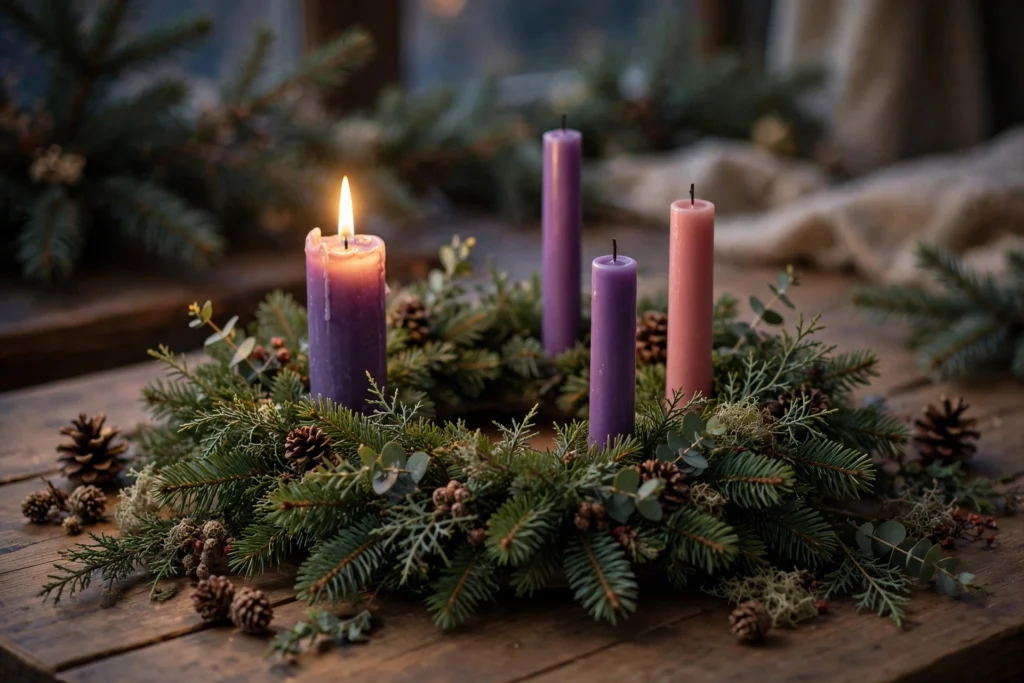
The First Sunday of Advent 2026 is Sunday, November 29, 2026. It is the fourth Sunday before Christmas Day, the first day of the Christian liturgical year in Western churches, and the day the Advent season begins — with one purple candle lit on the Advent wreath, the candle of hope.
As of November 2, 2026, the First Sunday of Advent is 27 days away. It falls the day after Small Business Saturday and the Sunday after Thanksgiving weekend, which is why it can feel like it arrives quietly in the middle of the holiday rush. It is worth pausing for, though: Advent is not the Christmas season itself, but the four-week season of preparation that leads up to it, and this Sunday is its starting line.
Advent 2026 at a glance
| Sunday | Date | Candle lit |
|---|---|---|
| First Sunday of Advent | Sunday, November 29, 2026 | First purple candle — hope (the Prophecy Candle) |
| Second Sunday of Advent | Sunday, December 6, 2026 | Second purple candle — peace (the Bethlehem Candle) |
| Third Sunday of Advent (Gaudete Sunday) | Sunday, December 13, 2026 | Rose (pink) candle — joy (the Shepherd’s Candle) |
| Fourth Sunday of Advent | Sunday, December 20, 2026 | Third purple candle — love (the Angel’s Candle) |
| Christmas Eve / Christmas Day | Thursday, December 24 / Friday, December 25, 2026 | Optional white Christ candle in the centre |
The season runs from the First Sunday of Advent until Christmas Eve, so Advent 2026 lasts 26 days in total — from November 29 to December 24. Because Advent always begins on the fourth Sunday before Christmas, its start date moves each year: it can fall anywhere between November 27 and December 3. In 2027, the First Sunday of Advent will be Sunday, November 28, 2027.
What “Advent” means — and why this Sunday starts a new year
Advent comes from the Latin word adventus, meaning “coming” or “arrival.” The season looks in two directions at once: back to the birth of Jesus in Bethlehem, which Christmas celebrates, and forward to his promised return, which Christians call the Second Coming. That double focus is why the readings and hymns of the first weeks of Advent can sound surprisingly solemn for a season that leads to Christmas — the season is about waiting and preparation, not celebration itself.
That is also why this Sunday, rather than January 1, opens the church year in Western Christian traditions. The First Sunday of Advent is the first day of the new liturgical year: the cycle of Sunday readings turns over, churches change their colours to purple (or, in some traditions, deep blue), and the season of preparation begins. In the Roman Catholic calendar, Advent 2026 begins with First Vespers on the evening of Saturday, November 28, and the season’s Sunday readings follow Cycle B.
It is a season with old roots and an uncertain exact birthday. Advent observances developed over centuries in the early church, growing out of a period of fasting and preparation before Christmas; by the Middle Ages it had settled into roughly its modern four-week shape in the West. Eastern Christian churches follow a different calendar and a longer pre-Christmas fast, so their season does not start on this date — the November 29 date belongs to the Western churches (Catholic, Anglican, Lutheran, Methodist, Presbyterian, Moravian and others).
Is the First Sunday of Advent a public holiday in the United States?
No. The First Sunday of Advent is not a public holiday in the United States, and it is not a federal holiday. Businesses follow regular Sunday opening hours, and nothing closes for it. Its observance is a church and family one: services may be busier than a usual Sunday, and many families use the day to set up their Advent wreath or calendar, but there is no day off, no closure, and no official public ceremony.
That distinction matters if you are planning around it. Unlike Thanksgiving the Thursday before, Advent Sunday changes church life, not public life — and unlike Christmas itself a month later, it is a beginning, not the event.
The first candle: hope, and why it is purple
The best-known Advent symbol is the wreath: a circle of evergreen holding four candles, three purple and one rose, with an optional white candle in the centre for Christmas. The circle stands for everlasting life and God’s unending love; the evergreen stands for enduring life through winter; and the growing light, one candle more each Sunday, stands for light increasing as Christmas approaches.
On the First Sunday of Advent only the first candle is lit. It is purple, and it is traditionally called the Prophecy Candle. Its theme is hope: it recalls the prophets of Israel who foretold the coming of the Messiah, centuries before the birth the season prepares for. Common first-week readings include Isaiah’s prophecies, which is why the candle carries that name.
A note on colour, because it varies: most Western churches use three purple candles and one rose candle, with the rose candle saved for the third Sunday, Gaudete Sunday, as a sign of joy breaking through the penitence of the season. Some Protestant churches use deep blue instead of purple, and some families use all white or all red candles. The order most often used is purple, purple, rose, purple — and on the First Sunday, whatever your set, only one candle burns.
The wreath itself has a story worth knowing. The form we recognise today traces to 19th-century Germany: the Lutheran pastor Johann Hinrich Wichern is credited with building a large wooden ring with candles for the children in his care, so they could count down the days to Christmas. That practical counting device became a devotional one, and the Advent wreath spread from German homes and churches across Europe and, after the Second World War, into American homes too — American families stationed in Germany brought both the wreath and the Advent calendar home with them.
How the First Sunday of Advent is marked
Because the day marks a beginning rather than a single event, there is no one official ceremony. What actually happens, in churches and homes across the United States, looks like this:
- A church service with the first candle lit. Many churches light the first Advent candle during the Sunday service, often with a short reading and prayer for hope, and decorate the sanctuary in purple with evergreen — some with a “Hanging of the Greens” service, decorating the church with wreaths, garlands and a tree for the season.
- The wreath goes up at home. Families place the wreath on the table or hang it, and light the first candle at a meal or in the evening, sometimes with a short reading, a hymn or a prayer. From this Sunday on, the candle is relit each week, with a new one added every Sunday.
- The Advent calendar opens — or waits a day. Advent calendars traditionally begin on December 1, not on Advent Sunday, so in 2026 the calendar’s first window falls two days after the First Sunday of Advent. The wreath, not the calendar, is the First Sunday’s own symbol — a mix-up worth avoiding if you are setting either one up.
- A slower start to December. For many observers, the First Sunday is a deliberate counterweight to the shopping weekend just ended: a week to plan a calmer December, choose readings or devotions for the four weeks, and prepare gifts and gatherings without letting the season collapse into a single shopping rush.
If you are not churchgoing, the day still works as a natural marker: it is the Sunday the Christmas season’s preparation properly begins, four weeks before Christmas Eve, and a good day to decorate, plan, and set the pace for December rather than letting December set it for you.
A simple way to mark the first week at home
You do not need a formal liturgy to keep the first week of Advent. A pattern many families use, and one that fits the theme of hope:
- Set out the wreath on Saturday evening or Sunday morning, with all four candles in place but only the first one to be lit.
- Light the first purple candle on Sunday, November 29, at a meal or in the evening, and read a short passage about hope — Isaiah 9 or Isaiah 40 are common choices.
- Keep the candle’s theme for the week. Hope, in the Advent sense, is not wishful thinking: it is expectation grounded in a promise. A daily moment of quiet, a note to someone who needs encouragement, or a small act of generosity all fit the week’s theme better than another purchase.
- Let the light grow. Relight the first candle each evening if you wish, and add the second candle on Sunday, December 6 — the wreath’s light is meant to increase week by week, which is the whole point of the symbol.
Safety matters with real candles, especially with evergreen close by: never leave a lit wreath unattended, keep it away from curtains and children, and trim the wick. Battery candles are a perfectly good substitute where open flames are not practical.
Wishes and messages for the First Sunday of Advent
Short lines for a card, a message, or a social post on November 29:
- “Happy First Sunday of Advent! May this season of hope bring light to your home.”
- “One candle lit, three to go — Advent has begun. Wishing you a peaceful season of preparation.”
- “As Advent begins, may hope light your way to Christmas.”
- “Blessed First Sunday of Advent to you and your family.”
- “The waiting begins today. Happy Advent — may these four weeks be full of hope.”
The four Sundays of Advent, and what comes after
It helps to see the First Sunday as the start of a short season, not a standalone day:
- First Sunday, November 29 — Hope. The Prophecy Candle, purple. The new liturgical year begins.
- Second Sunday, December 6 — Peace. The Bethlehem Candle, purple, recalling Mary and Joseph’s journey to Bethlehem.
- Third Sunday, December 13 — Joy (Gaudete Sunday). The Shepherd’s Candle, rose. Gaudete means “rejoice,” and the rose candle marks joy breaking into the season.
- Fourth Sunday, December 20 — Love. The Angel’s Candle, purple, recalling the angels’ message of peace on earth.
- Christmas Eve, December 24, and Christmas Day, December 25. The season ends, the Christmas season begins, and the optional white Christ candle is lit.
If you are following the wider season on this site, read the Christmas 2026 guide at https://memorialday2026.com/christmas-2026/ and the Christmas wishes, messages and quotes at https://memorialday2026.com/christmas-wishes-2026/ — Advent is the preparation; Christmas is the arrival it prepares for.
Frequently asked questions about the First Sunday of Advent 2026
When is the First Sunday of Advent in 2026?
Sunday, November 29, 2026 — the fourth Sunday before Christmas Day, and the Sunday nearest to St Andrew’s Day (November 30).
What is the First Sunday of Advent?
The first day of the season of Advent in Western Christian churches, and the first day of the new liturgical year. It begins four weeks of preparation for Christmas, marked by the lighting of the first Advent candle.
Which candle is lit on the First Sunday of Advent?
The first purple candle, traditionally called the Prophecy Candle, representing hope. Only one candle is lit on this Sunday; a new candle is added each following Sunday.
Is the First Sunday of Advent a holiday in the US?
No. It is a Christian observance, not a public or federal holiday. Businesses keep regular Sunday hours and nothing closes for it.
How long is Advent in 2026?
Advent 2026 runs from Sunday, November 29 to Christmas Eve, Thursday, December 24 — 26 days, including four Sundays. Its length varies year by year between 22 and 28 days, depending on which weekday Christmas falls on.
When is the First Sunday of Advent in 2027?
Sunday, November 28, 2027 — again, the fourth Sunday before Christmas Day (Friday, December 25, 2027).
What is the difference between Advent and Christmas?
Advent is the four-week season of preparation before Christmas; Christmas is the celebration itself, beginning on Christmas Eve / Christmas Day. Advent is about waiting and hope; Christmas is about arrival and celebration.
Do Advent calendars start on the First Sunday of Advent?
Usually not. Traditional Advent calendars begin on December 1, whatever weekday that is — in 2026, that is Tuesday, December 1, two days after Advent Sunday. The Advent wreath, not the calendar, is the symbol tied to the Sundays themselves.
Sources and date check
- Time and Date — First Sunday of Advent 2026 in the United States: https://www.timeanddate.com/holidays/us/first-sunday-advent — Sunday, November 29, 2026; not a public holiday; US observance and Advent calendar history.
- Hallow — The Schedule of Advent: https://hallow.com/blog/the-schedule-of-advent-when-does-advent-start/ — Advent 2026 starts Sunday, November 29, ends Christmas Eve, December 24, 2026.
- Archdiocese of Louisville — Season of Advent 2026 notes: https://www.archlou.org/wp-content/uploads/2026/10/Advent-Seasonal-Notes-2026.pdf — season November 29 to December 24, 2026; First Sunday of Advent November 29, 2026.
- United Methodist Discipleship Ministries — Advent Candle Lighting Liturgies 2026: https://www.umcdiscipleship.org/articles/advent-candle-lighting-liturgies-2026 — First Sunday of Advent November 29, 2026, candle of hope.
Dates and facts checked November 2, 2026. Candle colours and weekly themes vary by denomination — the purple/rose order and hope, peace, joy, love themes given here are the most widely used Western pattern.