
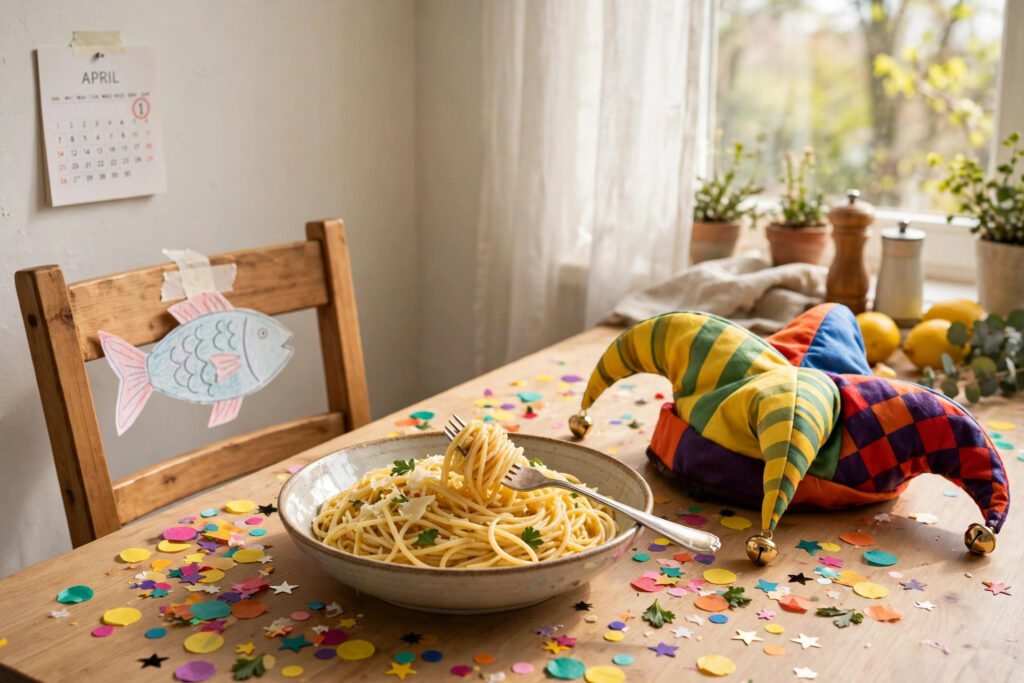
April Fools’ Day 2027 falls on Thursday, April 1, 2027 — the one day of the year when a lie is a gift, a fake headline is a tradition, and the most trusted voice on television once convinced a nation that spaghetti grew on trees. It is not a public holiday anywhere in the world, no one gets the day off, and yet it is celebrated in dozens of countries, from French schoolyards to American newsrooms. This guide covers the real history (including the parts historians still argue about), the greatest hoaxes ever pulled off, 25 harmless prank ideas for home, work and kids, and how to tell a real news story from an April 1 invention.
Quick version if you are in a hurry: the date never moves — April 1 every year. The origin is genuinely unknown, despite the famous calendar-change story. The best pranks are the ones where everyone, including the victim, ends up laughing. And if a story sounds too strange to be true on April 1, it almost certainly is not true.
April Fools’ Day 2027 at a Glance
| Detail | April Fools’ Day 2027 |
|---|---|
| Date | Thursday, April 1, 2027 |
| Observed | Every year on April 1 — the date never changes |
| Also called | All Fools’ Day |
| Public holiday? | No — not a federal or public holiday in the United States or anywhere else; schools and businesses stay open |
| What happens | Harmless pranks, practical jokes and media hoaxes; the victim is told “April Fools!” once the joke lands |
| Nearest holiday | Four days after Easter Sunday, March 28, 2027 |
When Is April Fools’ Day 2027?
April Fools’ Day 2027 is on Thursday, April 1, 2027. Because the date is fixed, it is one of the easiest days on the calendar to remember — the only thing that changes year to year is the weekday.
| Year | Weekday | Date |
|---|---|---|
| 2026 | Wednesday | April 1, 2026 |
| 2027 | Thursday | April 1, 2027 |
| 2028 | Saturday | April 1, 2028 |
| 2029 | Sunday | April 1, 2029 |
| 2030 | Monday | April 1, 2030 |
April 1, 2027 is also the first day of the second quarter of the year — and, for the record, it is the day after Easter Monday (March 29, 2027), so anyone still full of chocolate eggs has four days to recover before the pranking starts.
Is April Fools’ Day a Holiday?
No. April Fools’ Day is not a federal holiday in the United States, and it is not a public holiday in any country. Federal offices, schools, banks and businesses all operate as normal on April 1. Nobody gets paid time off to play pranks.
That is part of what makes it unusual: it is a completely unofficial, bottom-up tradition. There is no organising body, no proclamation, no day off — just a shared, centuries-old agreement that on this one day, a well-meant trick is fair game. It is celebrated in the United States, Canada, the United Kingdom, Ireland, France, Belgium, Australia, New Zealand, and many other countries, each with its own local twist.
The Origin of April Fools’ Day Is a Mystery — and the Famous Explanation Is Probably Wrong
Here is the honest answer first: nobody knows for certain how April Fools’ Day began. Historians have theories, and one of them is told so often that most people believe it is settled fact. It is not. What follows is what the evidence actually supports — and where the popular story falls apart.
The calendar-change theory (the one everyone repeats)
The story goes like this: before the 16th century, much of Europe celebrated the new year around the end of March, in the week running up to April 1. When France adopted the Gregorian calendar — Pope Gregory XIII’s reform of 1582, which moved New Year’s Day to January 1 — people who kept celebrating the old new year in late March were mocked as fools. Pranksters stuck paper fish on their backs, and the victims were called poisson d’avril, “April fish”. So the tradition was born.
It is a neat story. It is also, on the evidence, probably wrong — or at least badly incomplete. France had already moved the start of its legal year to January 1 in 1564, under the Edict of Roussillon issued by King Charles IX, eighteen years before the Gregorian reform. And references to poisson d’avril appear in French writing as early as 1466 and 1508, decades before either change. A tradition cannot be caused by an event that happened after it already existed.
The calendar story works better for Britain, where the new year really did begin on March 25 (Lady Day, the Feast of the Annunciation) with a week of celebration ending on April 1 — but even there, no document directly connects the calendar change to the pranking custom. The theory is conjecture, and it appears to be a modern one.
The Roman festival theory
Another candidate is Hilaria, an ancient Roman festival held around March 25 to celebrate the spring equinox, in which people wore disguises and mocked each other, including public figures. The mood fits — spring, disguise, mockery — but again there is no direct line from a Roman festival to an April 1 custom more than a thousand years later. It is a plausible ancestor, not a proven one.
The Chaucer clue
Geoffrey Chaucer’s The Canterbury Tales (1392) contains a passage in “The Nun’s Priest’s Tale” that some readers interpret as a reference to an April 1 prank — a line mentioning “March 32”, which would be April 1. Scholars argue endlessly over whether it is a deliberate joke, a scribal error, or a reference to something else entirely. It is the earliest English-language hint, and it is genuinely ambiguous.
What the hard evidence actually shows
| Year | What we know |
|---|---|
| 1392 | Chaucer’s “March 32” line — possibly the earliest reference, possibly a copyist’s mistake |
| 1466 / 1508 | Poisson d’avril (“April fish”) appears in French writing — before any calendar reform |
| 1561 | Flemish poet Eduard de Dene writes of a nobleman sending his servant on “fool’s errands” on April 1 — the earliest clear description of the custom |
| 1564 | Edict of Roussillon moves France’s legal new year to January 1 |
| 1582 | Pope Gregory XIII introduces the Gregorian calendar |
| 1698 | Londoners are tricked into going to the Tower of London to “see the lions washed” — an event that never existed, and the oldest documented April Fools’ prank |
| 1700s | The custom spreads across Britain and to the American colonies; by the 18th century it is well established |
| 1983 | The Associated Press is itself fooled by a fake origin story (see below) — proof the mystery was still unsolved in the 20th century |
And then there is the delicious twist: in 1983, Boston University history professor Joseph Boskin told the Associated Press that April Fools’ Day began when Roman Emperor Constantine let a court jester named Kugel be king for a day, and the jester declared April 1 a day of foolishness. News outlets around the world printed it. It was completely made up — Boskin later admitted he had invented the whole thing on the spot. So the most famous “origin” of April Fools’ Day in modern times was itself an April Fools’ joke.
The fairest summary, and the one historians agree on: the custom grew out of the spring festival season, when the old year ended and the new one began and the world felt briefly upside-down. Which exact festival, and when the date settled on April 1, is lost. Merriam-Webster’s history of the day reaches the same conclusion: the origin is still a mystery.
How the World Celebrates April Fools’ Day
The prank is universal; the details are local. A few of the best-known traditions:
France, Belgium and French-speaking Switzerland: Poisson d’Avril
April 1 is Poisson d’Avril — “April Fish”. Children cut out paper fish and try to tape them to the backs of friends, teachers and family members without being noticed. Bakeries and patisseries sell chocolate fish, and newspapers publish fake stories. The fish is said to represent a young, newly hatched fish — unwary, and easily caught.
Scotland: Hunt-the-Gowk Day
In Scotland the day was traditionally known as Hunt-the-Gowk Day. A “gowk” is a cuckoo — and, by extension, a fool. Victims were sent on absurd errands, handed sealed notes asking the recipient to send them on to someone else, and kept running in circles all day. It is the ancestor of the office “go and fetch the left-handed screwdriver” joke.
England and the English-speaking world: the noon rule
In Britain, tradition says pranks must be played before midday. Anyone who tries to trick someone after noon is the fool themselves — or so the saying goes. The rule is widely quoted and widely ignored in the age of the internet, but it is the reason the classic April Fools’ prankster shouts “April Fool!” first thing in the morning.
The United States: the media hoax
America’s signature contribution is the big public hoax. Newspapers, television networks, brands and tech companies all take part, and the best of them have fooled millions — which brings us to the hall of fame.
The Greatest April Fools’ Hoaxes Ever Told
These are the pranks that made history. Every one of them is documented, and every one of them fooled real people in large numbers.
1. The spaghetti tree (BBC, 1957)
The greatest April Fools’ hoax of all time, by common consent. On April 1, 1957, the BBC’s serious current-affairs programme Panorama reported that Swiss farmers were enjoying a bumper spaghetti harvest, thanks to a mild winter and the near-elimination of the dreaded spaghetti weevil. The segment showed footage of Swiss women pulling strands of spaghetti down from trees, narrated in solemn tones by the respected broadcaster Richard Dimbleby. Viewers believed it in large numbers — many phoned the BBC to ask how they could grow their own spaghetti tree. The BBC’s reply has become part of the legend: “Place a sprig of spaghetti in a tin of tomato sauce and hope for the best.”
2. Colour television from a nylon stocking (Sweden, 1962)
Sweden had only one television channel, and it broadcast in black and white. On April 1, 1962, an engineer on the national broadcaster told viewers they could see programmes in colour if they pulled a nylon stocking over their television set. Thousands of Swedes tried it. It did not work.
3. The Jovian–Plutonian gravitational effect (BBC, 1976)
British astronomer Patrick Moore announced on BBC Radio 2 that at 9:47 that morning, Jupiter and Pluto would align with Earth, briefly reducing gravity — and that listeners who jumped at exactly 9:47 would feel themselves float. Hundreds of callers rang in afterwards to report that they had felt lighter, or had floated clean off the ground.
4. The Taco Liberty Bell (1996)
On April 1, 1996, Taco Bell took out full-page newspaper advertisements announcing that it had bought the Liberty Bell — one of America’s most treasured historic objects — in an effort to help reduce the national debt, and had renamed it the “Taco Liberty Bell”. Hundreds of outraged citizens phoned Independence National Historical Park in Philadelphia. The company revealed the joke a few hours later. The best line of the day came from White House press secretary Mike McCurry, who, asked about the sale, replied with a straight face that the Lincoln Memorial had also been sold and would henceforth be known as the Ford Lincoln Mercury Memorial.
5. The Left-Handed Whopper (Burger King, 1998)
Burger King published a full-page advertisement in USA Today announcing a new Left-Handed Whopper, with all the condiments rotated 180 degrees for the benefit of left-handed customers. Thousands of people went into restaurants and asked for one — and, according to the company, many right-handed customers asked for the regular, right-handed version.
6. Alabama changes the value of pi (1998)
The April 1998 newsletter of New Mexicans for Science and Reason reported that the Alabama state legislature had voted to change the mathematical constant pi from 3.14159 to the “Biblical value” of 3.0. Readers who missed the date on the newsletter took it seriously enough for the story to be passed around as fact for years. If you enjoy a good pi joke, our guide to National Pie Day 2027 (January 23) is the place for the real thing — pie, not pi.
7. Google’s greatest hits — and the real thing that looked fake
No company has embraced April Fools’ Day like Google. In 2005 it unveiled Google Gulp, a soft drink with a “DNA scanner embedded in the lip of the bottle” that would optimise your brain. In 2013 came Google Nose, which let you smell your search results. In 2018, Waldo from Where’s Waldo? was hidden in Google Maps. The irony is that Google’s most famous April 1 launch was not a joke at all: Gmail was announced on April 1, 2004, offering a then-unbelievable 1GB of free storage, and millions of people assumed it was a prank. It was real. Apple, too, was founded on April 1, 1976 — a genuine date that has confused people ever since.
8. The flying penguins (BBC, 2008)
Fifty-one years after the spaghetti tree, the BBC struck again. A trailer for its natural-history series announced that camera crews in Antarctica had filmed Adélie penguins taking to the air and flying thousands of miles to South America. The footage — penguins soaring over icebergs — was convincing enough that the clip became one of the most-watched videos of the year. Interesting Facts’ round-up of famous pranks covers several of these hoaxes in more detail.
25 Harmless April Fools’ Prank Ideas
The rule for every prank on this list: it should be reversible in under a minute, cost nothing, and leave everyone laughing — including the person it was played on. If a prank could damage property, embarrass someone in front of others, or cause real distress, it is not a prank; it is just mean. With that settled, here are 25 that work.
At home
- The frozen cereal bowl. The night before, pour milk over cereal in a bowl and freeze it overnight. Serve it in the morning and watch the spoon bounce off.
- Googly eyes everywhere. Stick googly eyes on everything in the fridge — the milk, the eggs, the leftovers. It takes five minutes and the photos are excellent.
- The sugar–salt swap. The oldest trick in the book, and still effective at breakfast. (Put the sugar back before anyone makes coffee for a guest.)
- Clocks an hour ahead. Move every clock in the house forward an hour and see how long it takes before someone notices the day is running fast.
- The “juice” that is jelly. Set a glass of Jell-O the night before and serve it as orange juice. It looks perfect until the straw goes in.
At the office
- Sticky-note takeover. Cover a colleague’s desk, chair or monitor in sticky notes. Colourful, harmless, and genuinely impressive in photos.
- The upside-down screen. Flip a coworker’s display upside down (Ctrl + Alt + Down Arrow on many Windows machines) and wait for the confused stare.
- The “out of order” sign. Put a polite “Out of Order” notice on the lift, the printer, or the coffee machine — then reveal it before anyone is actually inconvenienced.
- The wrapped desk. Wrap a keyboard, mouse or phone in cling film or wrapping paper. Everything still works; nothing is harmed.
- The autocorrect prank. On a willing colleague’s phone or computer, add an autocorrect shortcut that turns a common word (“meeting”) into something silly (“snack break”). Remove it the same day.
For kids
- Brownies that are brown “E”s. Cut the letter E out of brown card, put them on a tray, and offer everyone brownies. A classroom classic.
- The tape on the tap. A small piece of clear tape over the faucet, with a tiny hole poked in it, turns the morning wash into a gentle spray.
- Spaghetti for dessert. Serve “spaghetti” made from pound cake and frosting, with strawberry sauce standing in for tomato. Kids love the reveal.
- The invisible ink note. Write a message in lemon juice, let it dry, and reveal it by holding the paper near a warm lamp.
- Backwards day. Wear clothes backwards, eat dinner for breakfast, and answer every question with the last word first. Younger children find this genuinely hilarious.
Food pranks
- Mashed-potato ice cream. Scoop mashed potato into a cone, add a cherry tomato on top, and serve it as ice cream. Savoury, surprising, and edible.
- The onion apple. Peel a small onion and put it on a stick like a candy apple. Only for a victim with a sense of humour — and a glass of water nearby.
- Toothpaste Oreos. Carefully scrape the cream out of an Oreo, replace it with white toothpaste, and reassemble. The look on the first bite is unforgettable.
- Caramel onions. Dip small peeled onions in caramel and serve them as caramel apples. (See the note above about a sense of humour.)
- The “broken” remote. Put a small piece of clear tape over the remote’s sensor. Nothing is wrong with it — it just will not work until the tape comes off.
Tech and text pranks
- The urgent text. Send “I need to tell you something important…” and then, after a long pause, “April Fools!” The pause is the whole prank.
- The language swap. Change a family member’s phone language to another one they do not speak. (Show them how to change it back immediately.)
- The fake update. Stick a realistic-looking “Update in progress — do not turn off your computer” note on a laptop screen.
- The mouse that will not move. A small piece of tape over the bottom sensor of a computer mouse stops it dead. Peel, reveal, laugh.
- The desktop screenshot. Take a screenshot of someone’s desktop, set it as their wallpaper, then hide all the icons. Everything looks normal; nothing can be clicked.
One more thing about pranks at work: know your audience. A joke that lands perfectly with a close colleague can fall flat — or worse — with a manager you barely know, a new starter, or anyone who is having a bad day. When in doubt, prank your equals, not your juniors, and never prank anyone about their job, their health, or their family.
How to Spot an April Fools’ Hoax
April 1 is the one day of the year when even careful readers get caught out. A few habits will save you from sharing a fake story — or believing one:
- Check the date first. If a story is dated April 1, treat it as guilty until proven innocent. The spaghetti tree, the Taco Liberty Bell and the Left-Handed Whopper were all published on April 1.
- Look for the source. A real announcement will appear on the company’s or organisation’s official site or press page. If the only source is a screenshot or a social-media post, be suspicious.
- Search for a second source. Genuine news is reported by more than one reputable outlet. If only one site is carrying the story, wait an hour and check again.
- Watch for the “too perfect” detail. Hoaxes are built on one detail that is just slightly too neat — the spaghetti weevil, the DNA scanner in a drinks bottle, pi equal to exactly 3.0. Reality is messier than that.
- Read the whole article. Many April Fools’ stories give themselves away in the final paragraph, where the author quietly admits the joke. The headline is the trap; the last line is the escape hatch.
- Check the URL. Fake news sites often use a web address that is one letter away from a real publication. On April 1, look twice at the address bar.
And if you do get fooled, remember you are in excellent company: the Associated Press, the BBC’s own director-general, and hundreds of people who tried to grow spaghetti trees all fell for one. Getting fooled on April Fools’ Day is not a failure — it is participation.
April Fools’ Jokes to Tell in 2027
Not every April Fools’ gag needs props. Here are a dozen original one-liners to carry into April 1:
- Why did the calendar break up with April? Because it could never take a joke — it was always too dated.
- I told my boss I was quitting on April 1. He said, “Nice try.” I said, “That’s what I’m afraid of.”
- What do you call a fish that tells jokes on April 1? A poisson d’avril — it is always fishing for a reaction.
- My computer caught a virus on April Fools’ Day. Now it only opens joke websites. I think it has a sense of humour.
- Why is April 1 the worst day to trust a weather forecast? Because even the rain is just April showers of pranks.
- I tried to prank my cat on April Fools’ Day. She stared at me, knocked a glass off the table, and walked away. She had already won.
- What is a prankster’s favourite kind of music? Anything with a good setup and a punchline.
- I put my phone on silent for April Fools’ Day. It is the only prank that pranks me back.
- Why did the spaghetti go to the party on April 1? Because it heard the pasta-bilities were endless.
- April Fools’ Day is the only day of the year when “trust me” means the exact opposite.
- I told my kids the Wi-Fi was down on April 1. They looked at me like I had cancelled Christmas.
- What do you call an April Fools’ joke that nobody falls for? A prank call — literally, no one picks up.
Prank Etiquette: Where the Line Is
April Fools’ Day has an unwritten code, and it is worth knowing before you plan anything:
- Everyone must laugh — including the target. If the person being pranked is not laughing by the end, it was not a good prank.
- Nothing permanent. No damage to property, no ruined clothes, no deleted files, no wasted food that someone was counting on. Reversible is the rule.
- No fake emergencies. Never fake a fire, an accident, an illness, a break-up, a pregnancy, a firing, or any news that would cause genuine fear or distress. These are not pranks; they are cruelty with a calendar excuse.
- Reveal the joke quickly. A prank that runs for hours stops being funny. The reveal — “April Fools!” — is part of the pleasure, so do not delay it.
- Respect the noon rule if you are in Britain. Pranks after midday are considered bad form, and the prankster becomes the fool.
- Know when to stop. One good prank beats five mediocre ones. Quit while everyone is still laughing.
Frequently Asked Questions About April Fools’ Day
When is April Fools’ Day 2027?
Thursday, April 1, 2027. It is always April 1 — the date never changes, only the weekday does.
Is April Fools’ Day a public holiday?
No. It is not a federal holiday in the United States, and it is not a public holiday in any country. Schools, offices and businesses all operate normally on April 1.
Why do we celebrate April Fools’ Day?
Because it is fun — and because the custom is centuries old. The honest answer about its origin is that nobody knows for sure. The most repeated explanation, the 16th-century calendar change in France, is probably wrong, since references to the French poisson d’avril predate the reform. Spring festivals, Roman Hilaria, and Chaucer are all candidates, but none is proven.
What is the origin of April Fools’ Day?
Unknown. The earliest clear description is a 1561 Flemish poem about fool’s errands on April 1, and the oldest documented prank is the 1698 Tower of London “wash the lions” hoax. The calendar-change theory is the most popular explanation, but the evidence does not support it as the cause.
What is Poisson d’Avril?
Poisson d’Avril — “April Fish” — is the French name for April Fools’ Day. Children tape paper fish to people’s backs, and bakeries sell chocolate fish. The fish stands for a young, easily caught fish — the gullible victim.
Can you play pranks after noon on April Fools’ Day?
In British tradition, no — pranks should end at midday, and anyone who plays one in the afternoon is considered the fool. In the United States there is no such rule, and pranks run all day.
What are some good April Fools’ pranks for kids?
Safe, simple ones work best: the frozen cereal bowl, brown “E”s instead of brownies, googly eyes on the fridge food, mashed-potato “ice cream”, and the tape-on-the-tap trick. Keep everything reversible and reveal the joke quickly.
What was the best April Fools’ prank ever?
Most lists name the BBC’s 1957 spaghetti tree hoax — a solemn Panorama report, narrated by Richard Dimbleby, that convinced viewers spaghetti grew on trees in Switzerland. The Taco Liberty Bell (1996) and Burger King’s Left-Handed Whopper (1998) are the usual runners-up.
Is it okay to play pranks at work on April Fools’ Day?
It depends on your workplace. Keep pranks harmless, reversible, and professional — sticky notes, a wrapped keyboard, a flipped screen — and know your audience. Never prank anyone about their job, health or family, and do not disrupt real work.
What should you not do on April Fools’ Day?
Do not fake emergencies, bad news, or anything that causes genuine fear. Do not damage property, waste food someone needs, or humiliate anyone. A prank is only a prank if everyone — including the victim — ends up laughing.
Sources
- Merriam-Webster — Origin of April Fools’ Day: Still a Mystery
- Interesting Facts — 6 Famous & Funny April Fools’ Day Pranks
- Awareness Days — April Fools’ Day 2027
- Remitly — April Fools’ Day 2026: Date, and History
Dates checked November 8, 2026. No 2027 deals or offers are listed in this article because none had been verified from official sources at the time of writing; April Fools’ Day promotions, if any, are typically announced by brands only in the days before April 1.
Planning your spring? St. Patrick’s Day 2027 falls on Wednesday, March 17, and Presidents’ Day 2027 on Monday, February 15 — and if you want more spring puzzles and games, National Puzzle Day 2027 (January 29) and Groundhog Day 2027 (February 2) are already live.