
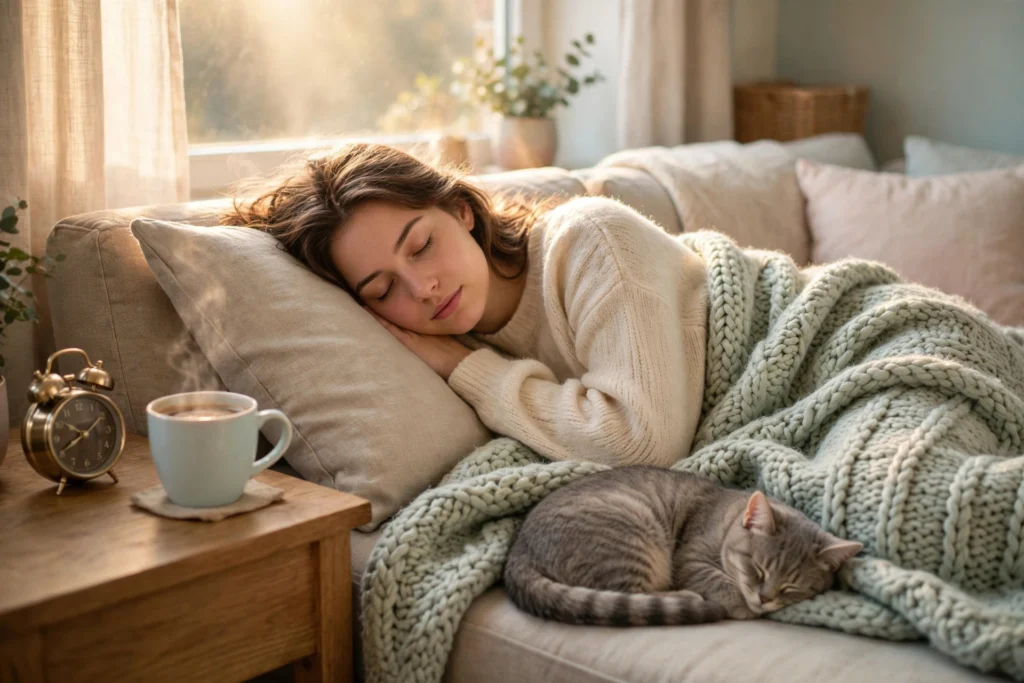
National Napping Day 2027 falls on Monday, March 15, 2027. It is the one day of the year when taking a nap is not lazy — it is the whole point. The date is no accident: it always lands on the Monday after the clocks spring forward for daylight saving time, the groggiest Monday of the year, when millions of Americans are running on an hour less sleep. This guide explains what National Napping Day is, who created it in 1999 and why, what NASA discovered about the perfect 26-minute nap, how long your nap should actually be, and how to celebrate the day properly — ideally, horizontally.
National Napping Day 2027 at a Glance
| Detail | National Napping Day 2027 |
| Date | Monday, March 15, 2027 |
| What it is | An unofficial American observance celebrating the health benefits of daytime napping |
| Why this date | The Monday after daylight saving time begins (Sunday, March 14, 2027) — the day America loses an hour of sleep |
| Founded | 1999, by William Anthony, a Boston University professor, and his wife Camille Anthony |
| Also called | National Siesta Day |
| Public holiday? | No — it is an unofficial observance, not a federal holiday |
| The perfect nap | About 20–30 minutes, ideally in the early afternoon |
| Next occurrences | 2028: Monday, March 13; 2029: Monday, March 12; 2030: Monday, March 11 |
Why the Monday After the Clocks Change?
To understand National Napping Day, you first have to understand the Monday it lands on. Every spring, on the second Sunday of March, clocks in most of the United States jump forward one hour at 2 a.m. — “spring forward.” In 2027 that happens on Sunday, March 14, which means everyone effectively loses an hour of sleep that night. Monday, March 15 is the morning after.
William Anthony, the Boston University clinical psychologist who created the day with his wife Camille in 1999, noticed something his students and colleagues all had in common the week the clocks changed: they were exhausted. The Anthonys chose that Monday deliberately, arguing that Americans are more sleep-deprived on that day than on any other day of the year — and that a nap is the honest, healthy response. The day was also a protest of sorts: against a culture that treats daytime sleep as laziness, and in favour of recognising rest as something the body genuinely needs.
The science backs up the grogginess. Researchers who studied American time-use data found that on the Monday after the spring clock change, workers slept about 40 minutes less than on other days (Barnes & Wagner, Journal of Applied Psychology, 2009). A well-known Michigan hospital study found heart attacks were about 24% higher on the Monday after the spring shift — though the total for the whole week did not change, suggesting the clock change shifted the timing of events that were likely to happen anyway (Sandhu et al., Open Heart, 2014). And a study of fatal road crashes found risk about 6% higher in the week after springing forward (Fritz et al., Current Biology, 2020). None of this means a nap fixes everything — but it does mean the Monday after the time change is a real, measurable sleep-deprivation event, and National Napping Day exists to answer it.
The 26-Minute Nap: What NASA Actually Found
If National Napping Day has a patron saint of science, it is a group of very tired airline pilots. In the mid-1990s, NASA researcher Mark Rosekind and his team studied fatigue in long-haul flight crews. They gave 21 Boeing 747 pilots on overnight trans-Pacific routes a planned 40-minute rest opportunity during cruise flight, while another pilot watched the controls. The pilots who used the window slept for an average of 26 minutes — and the results became the most quoted nap numbers in sleep science.
Compared with the pilots who did not nap, the napping pilots showed up to a 54% improvement in alertness (measured by brain-wave recordings) and a 34% improvement in performance on vigilance and reaction-time tasks. They also had far fewer microsleeps — those involuntary seconds-long lapses — during descent and landing, the most demanding part of the flight. The findings were published by Rosekind and colleagues in 1995, and the Sleep Foundation still calls the 26-minute nap the “NASA nap.”
Two honest caveats matter. First, 26 minutes was the average sleep the pilots achieved, not a magic number handed down on a tablet — the sweet spot is roughly 20 to 30 minutes. Second, the nap helped fatigued pilots stay alert; it did not erase sleep debt or replace a proper night’s sleep. It was a short-term countermeasure, and a very good one. A 2006 study in the journal Sleep found that even a 10-minute nap produced immediate improvements in alertness and performance that lasted more than two and a half hours, and a 2021 meta-analysis confirmed that short daytime naps consistently improve cognitive performance.
How Long Should a Nap Be?
Not all naps are equal. The right length depends on what you want from it — and going too long is the classic mistake, because waking from deep sleep leaves you groggy, a state sleep scientists call sleep inertia. Here is the honest breakdown:
| Nap length | What happens | Best for |
| 10–20 minutes | Light sleep only; you wake up alert, with almost no grogginess | A quick alertness boost before an afternoon meeting or a drive |
| About 26 minutes | The “NASA nap” — light sleep plus sleep spindles that aid memory; alertness up 54% and performance up 34% in the NASA study | The all-round best nap for most people |
| 30–60 minutes | You dip into deeper slow-wave sleep; memory benefits grow, but waking up groggy is likely | Days when you are genuinely sleep-deprived and can afford 30 minutes to shake off the fog |
| About 90 minutes | A full sleep cycle, including deep sleep and REM dreaming | Creativity, emotional processing and memory — only when you have the time and no deadline after it |
The practical rule sleep experts repeat is simple: keep it under 30 minutes unless you have 90 minutes to spare. Set an alarm — the nap is the point, not the three-hour accidental coma that follows it.
How to Take the Perfect Nap
A good nap is a small piece of engineering. Here is the method that works, step by step:
- Time it right. Nap in the early afternoon, roughly between 1 p.m. and 3 p.m., when your body’s natural alertness dips. Napping after 4 p.m. can steal sleep from the coming night.
- Keep it short. Set an alarm for 20 to 30 minutes. Give yourself a few minutes to fall asleep; the NASA pilots took about six.
- Make it dark and quiet. Dim the lights, close the curtains, silence notifications. Even an eye mask and earplugs help if your house is noisy.
- Get comfortable, not too comfortable. A sofa, a recliner or a bed are all fine. A blanket helps because body temperature drops as you fall asleep — which is part of why the nap works.
- Try the caffeine nap. Drink a cup of coffee, then nap for about 20 minutes. Caffeine takes roughly 20 minutes to kick in, so you wake up just as it starts working — the nap clears the sleepiness and the caffeine clears what is left. Researchers have found this combination beats either one alone.
- Wake up gently. Give yourself a few minutes after the alarm: stretch, drink water, step into daylight. The grogginess, if any, passes quickly after a short nap.
- Do not nap to fix a broken night. If you regularly need long daytime naps to function, that is a sign worth mentioning to a doctor — it can point to poor night sleep or a sleep disorder, not a nap deficiency.
What Napping Does for Your Brain and Body
The case for napping is not just “it feels nice,” though it does. Here is what research has actually found:
- Sharper thinking. Short naps improve alertness, reaction time and memory. The 2021 meta-analysis of nap studies found consistent cognitive benefits across dozens of experiments.
- Better mood. A short nap lowers sleepiness and improves mood in the afternoon — which is why the post-lunch slump feels so much worse without one.
- Memory consolidation. The light sleep of a 20–30 minute nap is rich in sleep spindles, bursts of brain activity linked to moving short-term memories into longer-term storage.
- A calmer heart — with a catch. A 2019 Swiss study of about 3,400 adults (published in the journal Heart) found that people who napped once or twice a week had a lower risk of cardiovascular events than people who never napped. People who napped almost every day showed no such benefit. It was an observational study, so it proves an association, not a cause — but it fits the pattern: occasional napping is restorative; constant napping can be a sign something else is wrong.
- Less of the Monday fog. After the spring clock change, a nap is the fastest legal way to pay back part of the hour the time change took.
One thing napping does not do: replace night sleep. No nap, however perfect, makes up for a habit of short nights. Think of it as a top-up, not a substitute.
Famous Nappers: Great Minds Who Slept on the Job
Napping has a surprisingly distinguished history. Some of history’s most productive people were open, even proud, nappers:
- Winston Churchill napped every afternoon and insisted on doing it properly: “You must sleep sometime between lunch and dinner, and no half-way measures. Take off your clothes and get into bed. That’s what I always do.” He credited the habit with letting him work sixteen-hour days through the Second World War.
- Leonardo da Vinci is said to have followed a polyphasic sleep pattern, taking short naps through the day and night instead of one long sleep — though historians still argue about how literally to take the stories.
- Salvador Dalí had a deliberate technique he called “slumber with a key”: he would sit in a chair holding a heavy key over a metal plate, and the clatter of the key dropping would wake him the moment he drifted off — a micro-nap timed to catch the creative ideas that surface just as sleep begins. He described it in his 1948 book 50 Secrets of Magic Craftsmanship.
- Albert Einstein reportedly took short daytime naps alongside his famously long nights of sleep, and kept a chair in his study for the purpose.
- Thomas Edison was famous for catnapping at his desk, sometimes on a cot in his laboratory, between bouts of work — he called sleep a waste of time, then quietly took naps anyway.
The lesson is not that napping makes you a genius. It is that even people who changed the world made time to close their eyes in the afternoon — and were not embarrassed about it.
How to Celebrate National Napping Day 2027
This is one holiday with no dress code, no tickets and no travel required. A few ways to mark it:
- Take the official nap. Block 20–30 minutes in the early afternoon, set an alarm, and take a proper NASA-style nap. Tell your household it is a cultural observance. It is.
- Try the caffeine nap. Coffee first, 20-minute nap second, wake up to the caffeine kicking in.
- Build a nap nest. Fresh sheets, a soft blanket, dim light, phone on silent. Half the pleasure of the day is the preparation.
- Nap outside. If March 15 is mild where you are, a park bench, a hammock or a sunny patch of grass is the classic spring nap. Spring arrives five days later, on March 20, but a sunny March afternoon is close enough.
- Nap with your pet. Cats and dogs are professional nappers and generous teachers.
- Make it a workplace moment. Some employers — Google famously among them — provide nap pods and quiet rooms. If yours does not, National Napping Day is the one day a year to ask why not. If you work from home, the sofa is already there.
- Introduce a child to the power nap. Kids who nap learn better and melt down less; adults are not so different. A family nap is a legitimate celebration.
- Share it. Post a photo of your nap spot — not yourself mid-snore, unless you are brave — with #NationalNappingDay. Keep it kind: the day is about rest, not about shaming anyone’s sleep habits.
- Pair it with Pi Day. The clocks spring forward on Sunday, March 14, 2027 — which is also Pi Day 2027. Pie on Sunday, nap on Monday: the weekend writes itself.
National Napping Day Wishes and Messages
Short on words after a nap? These are ready to send — to friends, family, co-workers, or your group chat:
- Happy National Napping Day! May your nap be long, your blanket warm, and your alarm mercifully quiet.
- Wishing you a National Napping Day full of deep sleep, sweet dreams and zero guilt.
- Today is the one day a year when “I’m just resting my eyes” is officially correct. Happy National Napping Day 2027!
- May your Monday be soft, your pillow fluffed and your to-do list patient. Happy Napping Day!
- Here’s to the power nap: 26 minutes that can rescue a whole Monday. Happy National Napping Day!
- Sleep well, dream big, wake up brilliant. Happy National Napping Day!
- On National Napping Day, the most productive thing you can do is absolutely nothing. Enjoy it.
- Wishing you a cozy blanket, a quiet house and the best nap of the year.
- Happy National Napping Day to the hardest worker I know — you have earned this nap.
- May your dreams be sweet and your alarm be snoozed exactly once. Happy Napping Day 2027!
- Rest is not a reward for finishing everything. It is how you finish anything. Happy National Napping Day!
- Sending you a virtual pillow and a full hour of peace. Happy National Napping Day!
Quotes About Naps and Sleep
- “You must sleep sometime between lunch and dinner, and no half-way measures. Take off your clothes and get into bed. That’s what I always do.” — Winston Churchill
- “Sleep is the best meditation.” — the Dalai Lama
- “Early to bed and early to rise makes a man healthy, wealthy, and wise.” — Benjamin Franklin
- “Think in the morning. Act in the noon. Eat in the evening. Sleep in the night.” — William Blake
- “A nap is a small holiday you can take in the middle of the day.” — adapted from an old saying about rest
- “There is more refreshment and stimulation in a nap, even of the briefest, than in all the alcohol ever distilled.” — Edward Lucas, on the pleasures of an afternoon doze
National Napping Day Dates: 2026–2030
The date moves every year, because it is tied to the clock change rather than a fixed calendar day. It is always the Monday after daylight saving time begins (the second Sunday of March):
| Year | Daylight saving time begins | National Napping Day |
| 2026 | Sunday, March 8 | Monday, March 9 |
| 2027 | Sunday, March 14 | Monday, March 15 |
| 2028 | Sunday, March 12 | Monday, March 13 |
| 2029 | Sunday, March 11 | Monday, March 12 |
| 2030 | Sunday, March 10 | Monday, March 11 |
A warning for anyone checking dates online: some calendars list National Napping Day 2027 as Monday, March 8, because they describe it as “the second Monday of March.” That is wrong for 2027 — March 8 is the second Monday, but daylight saving time does not begin until Sunday, March 14, so the Monday after the change is March 15. The rule is the Monday after the clocks spring forward, and in 2027 that is March 15. (The same sites are right in years when the two descriptions happen to coincide.)
Frequently Asked Questions
When is National Napping Day 2027?
Monday, March 15, 2027. It is always the Monday after daylight saving time begins, which in 2027 is Sunday, March 14.
What is National Napping Day?
An unofficial American observance created in 1999 by Boston University professor William Anthony and his wife Camille Anthony. It celebrates the health benefits of napping, pushes back against the stigma around daytime sleep, and gives Americans a sanctioned excuse to recover the hour of sleep lost when the clocks spring forward.
Is National Napping Day a federal holiday?
No. It is an unofficial observance. Schools, offices and shops stay open — which is exactly why the nap has to be fitted around the working day.
How long should a nap be?
About 20 to 30 minutes is the sweet spot for most people. NASA’s study found an average 26-minute nap improved pilots’ alertness by 54% and performance by 34%. Naps under 30 minutes avoid the grogginess of waking from deep sleep; a full 90-minute nap completes a sleep cycle and works too, if you have the time.
Is napping actually good for you?
Yes, in moderation. Short naps improve alertness, mood, reaction time and memory, and an occasional nap (once or twice a week) has been linked in observational research to better heart health. Long or very frequent naps, on the other hand, can signal poor night sleep — and napping late in the day can make it harder to fall asleep at night.
What is a caffeine nap?
Drink a cup of coffee, then immediately take a 20-minute nap. Caffeine takes about 20 minutes to take effect, so you wake up as it kicks in — the nap clears the sleepiness and the caffeine clears what is left. Studies have found the combination more effective than either coffee or a nap alone.
Can I nap at work on National Napping Day?
That depends on your employer. Some companies provide nap rooms or pods, and many managers tolerate a short break — especially on a day with “napping” in its name. If a workplace nap is not possible, a 20-minute nap in your car during lunch, or as soon as you get home, still counts. The day is unofficial, so there is no legal right to nap on the clock.
Does a nap make up for the hour lost to daylight saving time?
Partly. A 20–30 minute nap repays some of the lost sleep and restores alertness for the afternoon, but it does not erase the sleep debt of a short night. The best fix is still going to bed a little earlier the night the clocks change — and using the nap as a top-up, not a replacement.
Why do we lose an hour of sleep in March?
Daylight saving time begins on the second Sunday of March in most of the United States, when clocks move forward one hour at 2 a.m. to make better use of evening daylight. In 2027 that is Sunday, March 14 — the day before National Napping Day. (Arizona and Hawaii do not observe daylight saving time.)
Is National Napping Day the same as National Siesta Day?
Yes — “National Siesta Day” is simply another name for the same observance, the Monday after the clocks spring forward.
Sources and References
- Awareness Days — National Napping Day 2027: https://www.awarenessdays.com/awareness-days-calendar/national-napping-day/
- Holiday Today — National Napping Day: https://holidaytoday.org/national-napping-day/
- Sleep Foundation — NASA Nap: How to Power Nap Like an Astronaut: https://www.sleepfoundation.org/sleep-hygiene/nasa-nap
- Rosekind, M. R., et al. (1995). “Alertness management: strategic naps in operational settings.” Journal of Sleep Research, 4(S2), 62–66
- Sandhu, A., Seth, M., & Gurm, H. S. (2014). “Daylight savings time and myocardial infarction.” Open Heart, 1, e000019
- Barnes, C. M., & Wagner, D. T. (2009). “Changing to daylight saving time cuts into sleep and increases workplace injuries.” Journal of Applied Psychology, 94(5), 1305–1317
- Fritz, J., et al. (2020). “The effects of daylight saving time on fatal accidents.” Current Biology, 30(9)
- Dutheil, F., et al. (2021). “Effects of a short daytime nap on the cognitive performance: a systematic review and meta-analysis.” International Journal of Environmental Research and Public Health, 18(19), 10212
- Häusler, N., et al. (2019). “Association of napping with incident cardiovascular events.” Heart, 105(23)