
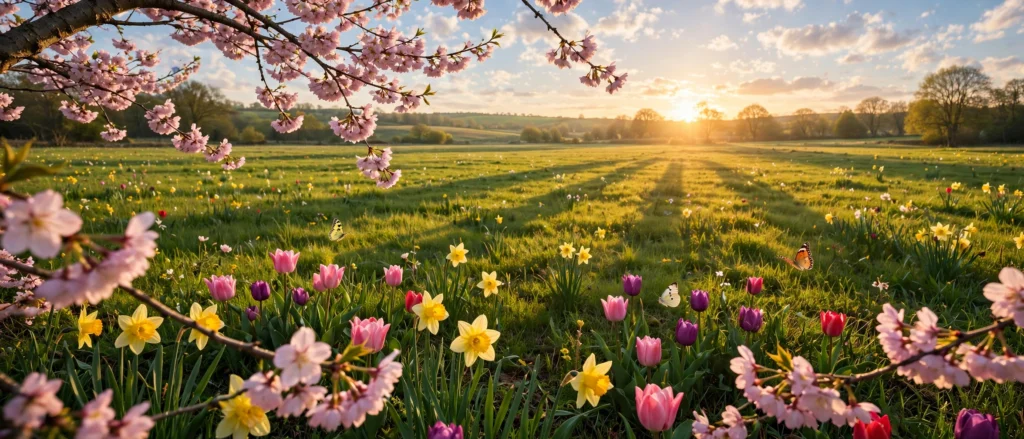
The first day of spring 2027 is Saturday, March 20, 2027. Spring begins at the exact moment of the vernal equinox — 4:24 p.m. Eastern Daylight Time (20:24 UTC) — when the sun crosses the celestial equator heading north and day and night stand almost equal across the planet. From that moment, the days in the Northern Hemisphere keep getting longer until the summer solstice on June 21. This guide gives the exact equinox time in every U.S. time zone, explains why the equinox day is not actually 12 hours long, tours how five cultures have marked this turning point for thousands of years, and lists simple ways to celebrate the first day of spring in 2027.
First Day of Spring 2027 at a Glance
| Detail | First Day of Spring 2027 |
|---|---|
| Date | Saturday, March 20, 2027 |
| Exact moment | 4:24 p.m. EDT (20:24 UTC) |
| What it is | The vernal (spring) equinox — astronomical spring begins |
| Also called | Vernal equinox, March equinox, spring equinox |
| Astronomical spring ends | Sunday, June 21, 2027 (summer solstice) |
| Meteorological spring | March 1 – May 31, 2027 |
| Daylight saving time | Already in effect — clocks sprang forward Sunday, March 14, 2027 |
| Public holiday in the U.S.? | No — it is an astronomical event, not a holiday |
| In the Southern Hemisphere | The same moment is the autumn equinox — the first day of fall |
The Exact Moment Spring Begins, in Your Time Zone
The equinox is a single planetary instant, not a whole day — it happens at the same second everywhere on Earth, and only the clock reading changes. In 2027 it falls on Saturday, March 20, across the Americas and Europe, and on Sunday, March 21, in East Asia and Australia, where the same instant lands after midnight.
| Time zone | Spring 2027 begins |
|---|---|
| Eastern (EDT) | Saturday, March 20, 4:24 p.m. |
| Central (CDT) | Saturday, March 20, 3:24 p.m. |
| Mountain (MDT) | Saturday, March 20, 2:24 p.m. |
| Pacific (PDT) | Saturday, March 20, 1:24 p.m. |
| Alaska (AKDT) | Saturday, March 20, 12:24 p.m. |
| Hawaii (HST) | Saturday, March 20, 10:24 a.m. |
| London (GMT) | Saturday, March 20, 8:24 p.m. |
| Tokyo | Sunday, March 21, 5:24 a.m. |
| Sydney | Sunday, March 21, 7:24 a.m. |
One small note for the precise-minded: some almanacs list the 2027 equinox as 4:25 p.m. EDT (20:25 UTC). The difference is rounding — the computed instant is 20:24 UTC, and sources that round to the nearest minute print 20:25. Either way, spring arrives on the afternoon of Saturday, March 20, in the United States.
Why the Equinox Day Is Not Actually 12 Hours Long
“Equinox” comes from the Latin aequus (equal) and nox (night), so it is natural to assume the day is split exactly in half. It is not — and the reason is a good piece of trivia for the day itself.
On March 20, 2027, New York gets about 12 hours and 8 minutes of daylight, not 12 hours exactly. Two things tip the balance. First, the sun is a disc, not a point: sunrise is counted from the moment the sun’s upper edge appears, and sunset from the moment its upper edge disappears, which adds several minutes of light. Second, Earth’s atmosphere bends — refracts — sunlight, so the sun is visible for a few minutes before it geometrically rises and after it geometrically sets. The day when daylight and darkness are truly equal is called the equilux, and it falls a few days before the equinox — around March 17 in the New York area.
The equinox is still the moment of balance in the astronomical sense: it is the day the sun rises due east and sets due west everywhere on Earth, and the day the sun stands directly above the equator at noon.
Two Springs: Astronomical and Meteorological
Americans actually have two answers to “when does spring start?” and both are correct.
Astronomical spring begins at the March equinox — Saturday, March 20, 2027 — and runs until the June solstice. It is defined by Earth’s position relative to the sun, which is why its date shifts slightly year to year (March 19, 20 or 21).
Meteorological spring runs on the calendar: March 1 to May 31 every year. Meteorologists use it because it lines up neatly with the annual temperature cycle and makes seasonal statistics easy to compare. The National Weather Service recognizes both definitions.
So if your calendar says spring started on March 1, it was not wrong — it was just using the meteorologists’ spring. The astronomical spring, the one marked by the equinox, arrives on March 20.
Spring Equinox Dates: The Next Five Years
| Year | First day of spring (U.S.) | Weekday |
|---|---|---|
| 2027 | March 20 | Saturday |
| 2028 | March 19 (evening) | Sunday* |
| 2029 | March 20 | Tuesday |
| 2030 | March 20 | Wednesday |
| 2031 | March 20 | Thursday |
*In 2028 the equinox falls late in the evening of Sunday, March 19, in U.S. time zones (March 20 in UTC). The date drifts about 5 hours 49 minutes later each common year until a leap day resets it — which is why the equinox lands on March 19 in some years and March 21 in others.
A World Tour of the Equinox: Five Places That Have Marked It for Centuries
The spring equinox is one of humanity’s oldest shared holidays. Long before anyone could calculate it to the minute, people built monuments to it, set their new year by it, and still do.
Mexico: The Serpent Descends at Chichen Itza
At Chichen Itza in Mexico’s Yucatan Peninsula, the Maya pyramid El Castillo — the Temple of Kukulcan — is a calendar in stone: four stairways of 91 steps each, plus the platform on top, total 365, one step for every day of the solar year. At the spring and autumn equinoxes, the late-afternoon sun casts a row of seven triangular shadows down the northwest balustrade, joining the carved serpent head at the base — the feathered serpent god Kukulcan, apparently descending the pyramid. The effect lasts about 45 minutes and draws tens of thousands of visitors each equinox; it was first documented in the modern era by archaeologist Jean-Jacques Rivard in 1969. Climbing the pyramid is no longer allowed, so the view is from the plaza below. The shadow is visible in weaker form for a few days on either side of the equinox, so visiting just before or after the date gives you the phenomenon with far smaller crowds.
England: Stonehenge and the Rising Sun
Stonehenge, built in phases between roughly 3000 and 1500 BCE on Salisbury Plain in Wiltshire, is most famous for the summer solstice — but its builders were attuned to all the major solar turning points, including the equinoxes. Crowds still gather at the stones on the equinoxes to watch the sun rise in alignment with the monument, a tradition of marking the turning seasons that is older than the pyramids of Giza’s final form. In Mexico, the Pyramid of the Sun at Teotihuacan is oriented so that on the spring and autumn equinoxes, the sun sets directly in front of its western face.
Iran and the Persian World: Nowruz, the New Year
Nowruz — Persian for “new day” — is the Persian New Year, and it begins at the exact moment of the vernal equinox. It is one of the oldest continuously celebrated holidays on Earth, observed for more than 3,000 years by over 300 million people across Iran, Central Asia, the Caucasus and diaspora communities worldwide, and recognized by UNESCO as an Intangible Cultural Heritage of Humanity. Preparations begin weeks in advance: homes are deep-cleaned (the original spring cleaning), families set a haft-seen table with seven symbolic items beginning with the letter S, and the festival runs for 13 days of visiting, feasting and new beginnings.
Japan: Shunbun no Hi, a Day for Ancestors
In Japan the spring equinox is Shunbun no Hi, a national public holiday. Families visit ancestral graves, clean and decorate them with fresh flowers, and gather to honor those who have passed — a quiet, reflective equinox tradition that pairs the season’s renewal with remembrance. The week around the equinox is also when cherry blossoms often begin blooming in Tokyo and Kyoto, and the blossom season that follows is Japan’s most famous spring spectacle.
India: Holi, the Festival of Colors
Holi, the Hindu festival of colors, falls in the spring season around the equinox — in 2027 it lands on Monday, March 22, just two days after the equinox, with the Holika Dahan bonfire on the evening of Sunday, March 21. Streets fill with music, dancing and clouds of colored powder as people celebrate love, the triumph of good over evil, and the arrival of spring. It is one of the most joyful spring festivals in the world, and one of the few where getting covered in color is the whole point.
How to Celebrate the First Day of Spring 2027
You do not need a pyramid or a 3,000-year-old tradition. The equinox is an easy day to mark, at home or outdoors:
- Watch the sunrise or the sunset. The sun rises due east and sets due west on the equinox — the only two days of the year it does so exactly. Pick a spot with a clear horizon and watch it happen.
- Do the real spring cleaning. Nowruz has the right idea: clear out a closet, open the windows, and let the season start with a clean house. The ritual is thousands of years old for a reason.
- Plant something. In much of the United States, mid-to-late March is the window for cool-season crops — peas, lettuce, spinach and radishes go in the ground in many zones — and for starting warm-season seeds indoors. Check your USDA hardiness zone before planting.
- Eat the season. The first spring foods — asparagus, peas, strawberries in the South, rhubarb — are appearing in markets. A meal built around them is the simplest equinox feast.
- Take a first walk of spring. A walk in a park or a nature trail on March 20 is a small ritual with a real payoff: the first buds, the returning birds, and the noticeably longer evening.
- Set a spring intention. The equinox is the year’s natural fresh start — halfway between New Year’s resolutions and summer. Pick one goal for the season and write it down.
- Balance an egg. The old equinox legend says an egg will stand on its end on the equinox. It is a myth — an egg balances just as well on any other day with patience and a steady hand — but trying it with kids is a fun bit of folklore to test together.
- Celebrate with kids. Plant seeds in cups on a windowsill, make a spring nature scavenger hunt, or decorate eggs — the egg, symbol of new life, is the equinox’s oldest symbol, and it predates the Easter bunny by centuries.
If you are looking for more March celebrations nearby, see Pi Day 2027 (March 14 — the same day the clocks sprang forward), St Patrick’s Day 2027 (March 17) and Easter 2027 (March 28). For the day that asks whether spring will come early, see Groundhog Day 2027, and for the season’s other new-year celebration, Lunar New Year 2027. Daylight saving time, which began a week before the equinox, is why the spring-forward grogginess lingers — National Napping Day 2027 was created for exactly that Monday.
Spring Quotes for Cards and Captions
- “No matter how long the winter, spring is sure to follow.” — proverb
- “Spring is nature’s way of saying, ‘Let’s party!'” — Robin Williams
- “The earth laughs in flowers.” — Ralph Waldo Emerson
- “In the spring, I have counted 136 different kinds of weather inside of 24 hours.” — Mark Twain
- “Spring will come and so will happiness. Hold on. Life will get warmer.” — Anita Krizzan
- “The first day of spring is one thing, and the first spring day is another. The difference between them is sometimes as great as a month.” — Henry Van Dyke
Frequently Asked Questions
When is the first day of spring 2027?
Saturday, March 20, 2027. The vernal equinox arrives at 4:24 p.m. EDT (20:24 UTC).
What time is the spring equinox in 2027?
4:24 p.m. Eastern, 3:24 p.m. Central, 2:24 p.m. Mountain and 1:24 p.m. Pacific on Saturday, March 20, 2027. Some almanacs list 4:25 p.m. — the difference is rounding of the computed instant.
Is the first day of spring March 20 or March 21?
In 2027 it is March 20 in the United States. The equinox can fall on March 19, 20 or 21 depending on the year — in 2028 it falls on the evening of March 19 in U.S. time zones.
Is day and night exactly equal on the spring equinox?
Not quite. Because the sun is a disc and the atmosphere bends its light, New York gets about 12 hours and 8 minutes of daylight on March 20. The truly equal day, the equilux, falls a few days earlier.
When does spring start — March 1 or March 20?
Both. Meteorological spring runs March 1 to May 31; astronomical spring begins at the March equinox, March 20 in 2027.
Is the first day of spring a public holiday?
No, not in the United States. The equinox is an astronomical event. Japan is an exception: its spring equinox day, Shunbun no Hi, is a national holiday.
What is the vernal equinox?
“Vernal” is Latin for “spring.” The vernal equinox is the moment the sun crosses the celestial equator heading north, marking the start of astronomical spring in the Northern Hemisphere — and the start of autumn in the Southern Hemisphere.
How long is spring 2027?
Astronomical spring runs 93 days, from the equinox on March 20 to the summer solstice on June 21, 2027.
What is the difference between the spring equinox and Easter?
The equinox is an astronomical event fixed by the sun. Easter is a moveable feast set by the moon: it falls on the first Sunday after the first full moon on or after the equinox — which is why Easter 2027 is March 28, eight days after the equinox.
No 2027 spring deals or sales are listed here — none were verified from official sources at the time of writing (November 8, 2026), and spring sales are not tied to a single date the way holiday deals are. Check individual retailers closer to March 2027.