
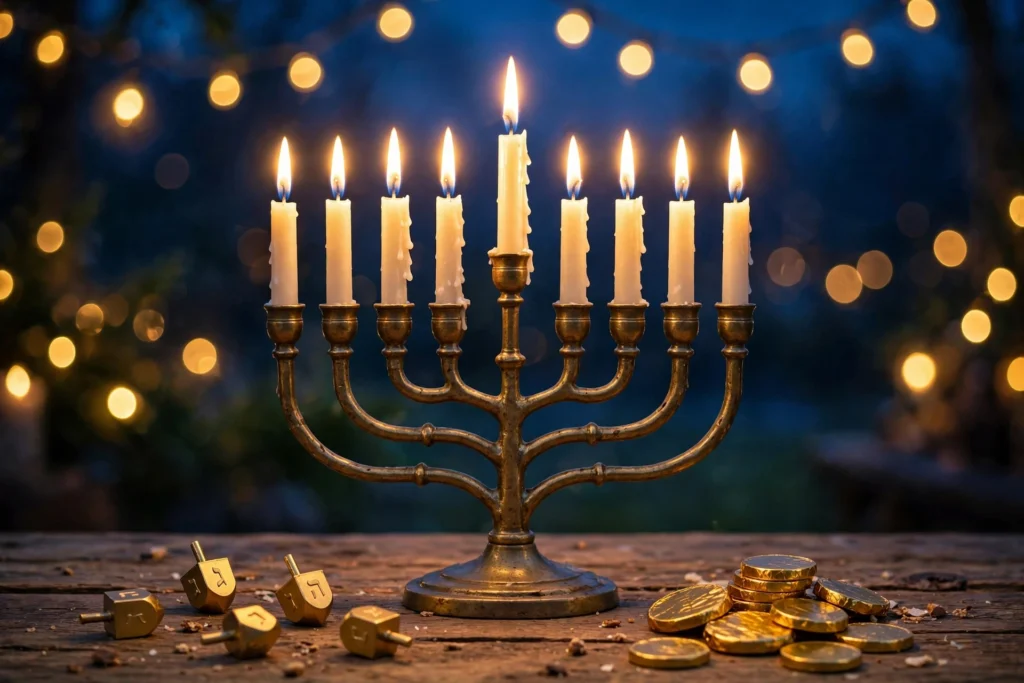
Hanukkah 2027 begins at sundown on Friday, December 24, 2027 — Christmas Eve. The first candle is lit that evening, the first full day falls on Saturday, December 25 — Christmas Day itself — and the eight-night Festival of Lights runs through the eighth candle on Friday, December 31, ending at nightfall on Saturday, January 1, 2028. It is one of the rare years when Hanukkah and Christmas share the calendar, and this guide has the exact dates, a live countdown, the night-by-night candle schedule, the story of the Maccabees and the oil, and how Hanukkah is celebrated across the United States.
Countdown to Hanukkah 2027
Loading…
until Friday, December 24, 2027 — the day the first candle is lit at sundown, Eastern Time
When Is Hanukkah 2027?
Hanukkah 2027 begins at sundown on Friday, December 24, 2027, when the first candle is lit. Because Jewish days begin at sunset rather than midnight, the first full day is Saturday, December 25, 2027 — the 25th of Kislev, 5788, on the Hebrew calendar. The festival lasts eight nights and ends at nightfall on Saturday, January 1, 2028. The eighth and final candle is lit on Friday, December 31, 2027.
That is the short answer, and it is the one most people need. If you are marking a calendar, write "Hanukkah begins" on the evening of December 24, not the morning of December 25 — the candle-lighting happens after sunset on the 24th.
| Year | First candle (sundown) | Ends (nightfall) |
|---|---|---|
| 2026 | Friday, December 4 | Saturday, December 12 |
| 2027 | Friday, December 24 | Saturday, January 1, 2028 |
| 2028 | Tuesday, December 12 | Wednesday, December 20 |
| 2029 | Saturday, December 1 | Sunday, December 9 |
| 2030 | Friday, December 20 | Saturday, December 28 |
Hanukkah always begins on the 25th of Kislev in the Hebrew calendar, but the Hebrew calendar follows the moon as well as the sun, so the Gregorian date moves every year — anywhere from late November to late December. In 2026 it started in early December; in 2027 it jumps nearly three weeks later, to Christmas Eve. That jump is the Hebrew calendar's leap month at work: an extra month is added seven times in every nineteen years to keep the festivals in their season.
Why Hanukkah 2027 Is Unusual: Christmas Eve and Christmas Day
Hanukkah and Christmas overlap on the calendar only occasionally, and 2027 is one of the striking years. The first night of Hanukkah falls on Christmas Eve, and the first full day of Hanukkah falls on Christmas Day. The last time the first candle was lit on Christmas Eve was 2016.
The overlap is a scheduling coincidence, not a shared origin — the two holidays come from different calendars and different stories — but for American families it is a real one. In interfaith households, December 24, 2027, will hold both a Christmas Eve and a first-night Hanukkah candle-lighting. And there is a practical wrinkle worth knowing: Christmas Day 2027 falls on a Saturday, so under the federal rule the Christmas federal holiday is observed on Friday, December 24 — the same day the first Hanukkah candle is lit. Federal offices are closed that Friday for Christmas, while Hanukkah itself is not a federal holiday and carries no day off.
It is also worth saying plainly: Hanukkah is not "the Jewish Christmas." It is a minor festival in the Jewish calendar that became prominent in America largely because it falls in December. Its own story — a revolt, a rededication and a small jar of oil — has nothing to do with Christmas, and the gifts and decorations that surround it in the United States are a modern, American layer on an older holiday.
How Many Days Until Hanukkah 2027?
The live countdown at the top of this page ticks down to midnight at the start of Friday, December 24, 2027, Eastern Time — the day the first candle is lit at sundown. At the time this article was published (November 14, 2026), there were 405 days remaining until Hanukkah 2027.
That long runway is genuinely useful for planning. Menorahs, candles, dreidels and gelt sell out in the week before Hanukkah in many American cities, and community lightings and school programs are scheduled months ahead. If you are hosting a Hanukkah gathering in 2027, note the date now: the first candle is lit on a Friday evening, which is also Shabbat, so the lighting happens before the Shabbat candles — an early start to the evening, not a late one.
What Is Hanukkah?
Hanukkah is the Jewish Festival of Lights, an eight-night holiday that commemorates the rededication of the Second Temple in Jerusalem in the second century BCE. The Hebrew word Hanukkah — also spelled Chanukah — means "dedication."
It is observed by lighting candles in a special nine-branched candelabrum, the menorah (more precisely, the hanukkiah): one candle on the first night, two on the second, and so on until all eight burn together on the final night. The ninth branch holds the shamash, the "helper" candle, which is used to light the others. Around the lighting, families sing songs such as Ma'oz Tzur, eat foods fried in oil, play dreidel, and give gelt — chocolate coins, and in some families real money for children.
Hanukkah begins on the 25th of Kislev and is the only Jewish holiday that starts in one Hebrew month (Kislev) and ends in another (Tevet). In 2027 it runs from 25 Kislev to 2 Tevet, 5788.
The Story Behind Hanukkah: The Maccabees and the Oil
The story begins in the second century BCE, when the land of Judea was ruled by the Seleucid king Antiochus IV Epiphanes (reigned 175–164 BCE). Antiochus outlawed Jewish religious practice and desecrated the Temple in Jerusalem. A family of Jewish rebels, the Maccabees — led by Judah Maccabee — rose against him, recaptured Jerusalem, and cleansed and rededicated the Temple on Kislev 25, 164 BCE. Judah proclaimed that the rededication should be celebrated every year for eight days, beginning on the 25th of Kislev.
The second half of the story, the miracle of the oil, comes from a later source. According to the Talmud (tractate Shabbat 21b), when the Maccabees entered the Temple they found almost all the ritual olive oil had been defiled. Only one small sealed jar remained — enough to keep the Temple menorah burning for a single day. Yet that oil burned for eight days, the time needed to press and consecrate a fresh supply. That is why Hanukkah lasts eight nights, why a candle is added each evening, and why foods fried in oil sit at the centre of the table.
It is worth knowing the two parts of the story come from different books. The eight-day rededication is described in 1 Maccabees, but the miracle of the oil does not appear there or in 2 Maccabees — it is told in the Talmud, written down about 600 years after the events. The oil story is the traditionally accepted account, and it is the one the candles commemorate.
Hanukkah 2027 Night by Night
Jewish days begin at sundown, so each night's lighting comes before the Hebrew date it belongs to. Here is the full 2027 schedule, following Hebcal's calendar:
| Night | Evening of | Candles lit | Hebrew date | Note |
|---|---|---|---|---|
| Night 1 | Friday, December 24, 2027 | 1 + shamash | 25 Kislev | Light before the Shabbat candles; Christmas Eve |
| Night 2 | Saturday, December 25 | 2 + shamash | 26 Kislev | Light after Shabbat ends; Christmas Day |
| Night 3 | Sunday, December 26 | 3 + shamash | 27 Kislev | |
| Night 4 | Monday, December 27 | 4 + shamash | 28 Kislev | |
| Night 5 | Tuesday, December 28 | 5 + shamash | 29 Kislev | |
| Night 6 | Wednesday, December 29 | 6 + shamash | 30 Kislev | |
| Night 7 | Thursday, December 30 | 7 + shamash | 1 Tevet | |
| Night 8 | Friday, December 31 | 8 + shamash | 2 Tevet | Light before the Shabbat candles; New Year's Eve |
The festival ends at nightfall on Saturday, January 1, 2028. Two practical points for 2027: both Fridays of the festival are Shabbat, so the menorah is lit before the Shabbat candles on December 24 and December 31, and on Saturday night, December 25, it is lit only after Shabbat ends. Exact local lighting times vary by city — Hebcal lists candle-lighting times by location, so check your city's time rather than guessing.
How to Light the Menorah
The mechanics are simple, and getting them right is part of the tradition:
- Place the candles from right to left. On the first night, one candle goes in the far-right holder. Each night, add one more to its left.
- Light from left to right. The newest candle is always lit first, using the shamash — so each night you light the newest candle, then the ones to its right.
- Recite the blessings before lighting. Two blessings are said every night: one for the commandment to kindle the Hanukkah light, and one thanking God for the miracles of those days. On the first night only, a third blessing is added, the Shehecheyanu, giving thanks for reaching this season.
- Let the candles burn where they can be seen. The menorah is traditionally placed in a window or by a doorway, so the light is visible from outside — the Talmud says the point is to publicize the miracle.
- Do not use the flames for anything else. The Hanukkah lights are for looking at, not for reading or working by; that is one reason the shamash exists as a separate, usable flame.
Candles should burn for at least half an hour after nightfall. Electric menorahs are common in windows and public displays, but the blessings are said over real flames.
What to Eat: Latkes, Sufganiyot and Dairy
Hanukkah food is fried in oil, in memory of the oil that burned for eight days. Two dishes lead the table:
- Latkes — crisp potato pancakes, fried in oil and served with applesauce or sour cream. They are the classic Ashkenazi Hanukkah food, and in many American families the latke fry is the main event of the first night.
- Sufganiyot — jelly-filled doughnuts, fried in oil and dusted with sugar. They are the Israeli Hanukkah staple, and in the United States they appear in bakeries from the week before the holiday.
Dairy foods also belong to the table — cheesecake, cheese blintzes and other cheese dishes — a custom linked to the story of Judith, who by tradition fed the enemy general salty cheese before defeating him. Olive oil is the traditional frying oil, for the obvious reason: it is the oil of the miracle.
The Dreidel: Letters, Meaning and How to Play
The dreidel is a four-sided spinning top, and the game around it is the best-known Hanukkah pastime. Each side carries a Hebrew letter:
- Nun — do nothing.
- Gimmel — take everything in the pot.
- Hei — take half the pot.
- Shin — put one token into the pot.
The letters stand for the phrase Nes Gadol Hayah Sham — "a great miracle happened there." In Israel, the shin is replaced by a pei, for Nes Gadol Hayah Po — "a great miracle happened here." To play, each player starts with ten or fifteen tokens (chocolate gelt, coins or counters), everyone puts one token in the pot, and players take turns spinning until one player holds all the tokens or the game is called. The traditional story is that Jewish children played dreidel to hide their Torah study from the Seleucid soldiers — a legend rather than documented history, but one that has become part of the game.
Gelt, Gifts and Greetings
Hanukkah gelt — Yiddish for "money" — is traditionally real coins given to children, and today most often chocolate coins wrapped in gold foil. In the United States, gift-giving has grown into a major part of the holiday: many families give one gift on each of the eight nights, and in 2027 that rhythm lands conveniently, with the eighth night falling on New Year's Eve.
If you want to greet a Jewish friend, "Happy Hanukkah" is all you need. The Hebrew greeting is Chag Sameach (pronounced khag sah-MAY-akh), meaning "happy holiday." And if you are invited to a lighting, bring something fried or sweet — latkes, doughnuts or chocolate gelt are all welcome, and the host will tell you the rest.
Hanukkah in the United States
Hanukkah is widely celebrated in the United States, home to the world's largest Jewish community outside Israel. The Pew Research Center's 2020 survey of Jewish Americans estimated about 7.5 million Jews in the United States — around 2.4% of the population — including 5.8 million adults and 1.8 million children.
Public celebration has been part of American Hanukkah since the 1970s, when the Chabad movement began erecting large menorahs in public squares. The most famous is the National Menorah on the Ellipse in Washington, D.C., a 30-foot menorah first lit in 1979 by President Jimmy Carter, named the National Menorah by President Ronald Reagan in 1982, and moved to its current spot on the Ellipse in 1987. It is lit every year, alongside the National Christmas Tree, and in 2027 its first candle will be lit on Christmas Eve itself. Chabad now erects some 15,000 public menorahs around the world, and most American cities hold a public lighting during the eight nights — check your local Chabad or synagogue for the 2027 schedule.
Is Hanukkah a Public Holiday? What Is Open?
No — Hanukkah is not a federal holiday in the United States. Schools, businesses, banks and government offices stay open throughout the eight days, and nobody gets a day off for it. What is closed on December 25, 2027, is closed for Christmas, not for Hanukkah — and in 2027 that matters more than usual, because the first full day of Hanukkah falls on Christmas Day itself. Expect the usual Christmas closures on December 25 (most shops, banks and offices), a federal observance of Christmas on Friday, December 24, and normal hours on the other days of the festival, including New Year's Eve and New Year's Day, which follow their own holiday schedules. If you are planning a Hanukkah gathering for December 25, plan the meal at home or check restaurant hours in advance — many restaurants close for Christmas Day.
Frequently Asked Questions About Hanukkah 2027
When is Hanukkah 2027?
Hanukkah 2027 begins at sundown on Friday, December 24, 2027, and ends at nightfall on Saturday, January 1, 2028. The first full day is Saturday, December 25, 2027.
How many days until Hanukkah 2027?
At publication on November 14, 2026, there were 405 days remaining. The live countdown at the top of this page shows the exact time left, ticking down to the start of December 24, 2027, Eastern Time.
Why does Hanukkah last eight days?
According to the Talmud, one day's supply of consecrated oil miraculously burned for eight days in the rededicated Temple — long enough to prepare fresh oil. The festival lasts eight nights, one for each day the oil burned.
What day is the first night of Hanukkah 2027?
Friday, December 24, 2027 — Christmas Eve. The first candle is lit at sundown that evening, before the Shabbat candles.
Is Hanukkah always in December?
Almost always, but not quite. It begins on the 25th of Kislev, which can fall anywhere from late November to late December on the Gregorian calendar, and the festival can run into January, as it does in 2027–28.
When is Hanukkah 2028?
Hanukkah 2028 begins at sundown on Tuesday, December 12, 2028, and ends at nightfall on Wednesday, December 20, 2028.
Does Hanukkah overlap with Christmas often?
Not often. The two holidays follow different calendars, so they line up only occasionally. In 2027 the overlap is unusually close: the first night falls on Christmas Eve and the first full day on Christmas Day. The last time the first candle fell on Christmas Eve was 2016.
Hanukkah 2027 is 405 days away at the time of writing, and it is a year worth marking early: a first candle lit on Christmas Eve, a first full day on Christmas Day, and eight nights that carry the festival past New Year's Eve and into the first day of 2028. Light the candles one at a time, fry something in oil, spin the dreidel, and let the countdown above do the waiting for you. For the season around it, see our Hanukkah 2026 guide, our Christmas 2026 guide, our Kwanzaa guide, our New Year's Eve guide and our home page.