
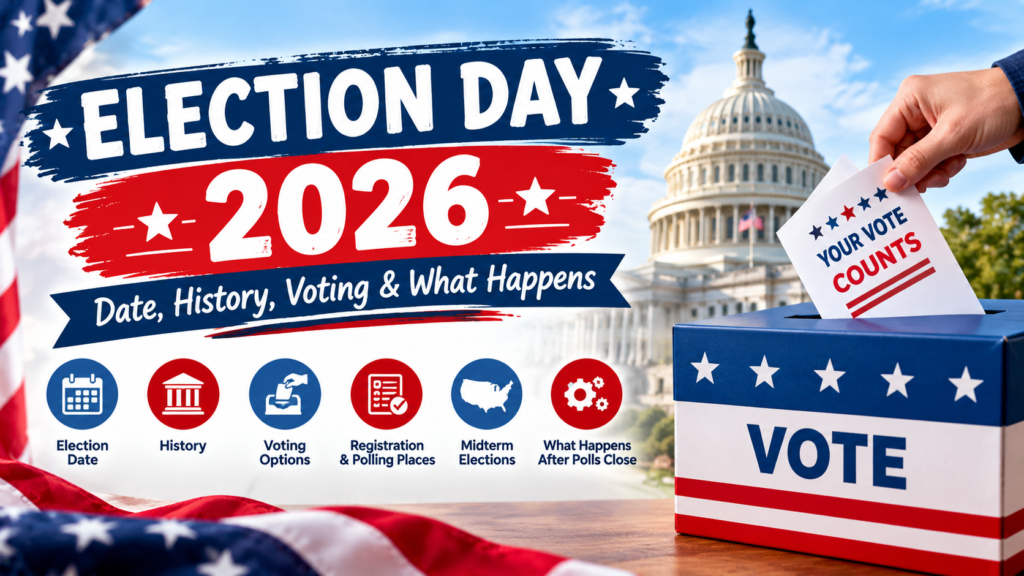
Election Day 2026 is Tuesday, November 3, 2026. It’s the regularly scheduled U.S. federal general election date for 2026 and falls during the midterm election cycle. Federal congressional elections will be held, while state and local contests and ballot measures vary by jurisdiction.
2026 is not a presidential election year. The next scheduled presidential general election is November 7, 2028.
When Is Election Day 2026?
| Detail | Information |
|---|---|
| Date | Tuesday, November 3, 2026 |
| Year | 2026 |
| Election type | Federal general election / midterm election |
| Presidential election? | No |
| House elections | All 435 seats |
| Senate elections | Approximately one-third of Senate seats |
| State elections | Varies by state |
| Local elections | Varies by jurisdiction |
| Ballot measures | Vary by state and locality |
| Voting methods | Vary by state |
Election Day 2026 is Tuesday, November 3, 2026. It’s the U.S. federal general election date for the 2026 midterm elections. Voters will elect members of Congress, while additional state and local contests depend on where they live.
What Is Election Day?
Election Day is the legally established day for U.S. general elections for federal offices. Federal general elections occur in November of even-numbered years, though state and local elections can follow different schedules. Many voters can also cast a ballot before Election Day itself through early voting or absentee/mail voting, depending on their state’s rules.
Federal general elections for president, vice president, and Congress are held on the Tuesday after the first Monday in November in even-numbered years.
Why Is Election Day 2026 on November 3?
The federal election date formula is simple: the Tuesday after the first Monday in November. For 2026, that date lands on Tuesday, November 3.
Congress established the uniform November presidential-election date in 1845 and later aligned House elections with that same schedule beginning in 1876.
Why Tuesday?
The 19th-century election schedule reflected the travel, communication, and largely agricultural rhythms of the period — Tuesday allowed time to travel to a county seat after observing the Sabbath on Sunday without conflicting with market day, which was often Wednesday. It’s a historical artifact more than a modern design choice, but it has remained the standard ever since.
Is Election Day 2026 a Presidential Election?
No.
This is worth stating clearly, since “Election Day” searches can easily lead to confusion between midterm and presidential years.
2026 includes:
- Congressional midterm elections
- House of Representatives
- Senate
- State offices
- Local offices
- Ballot measures, depending on jurisdiction
2028 will include:
- Presidential election
- Vice presidential election through the Electoral College process
- Congressional elections
- State and local contests
The next scheduled presidential election is November 7, 2028.
What Is a Midterm Election?
A midterm election occurs halfway through a four-year presidential term. In 2026:
- Every seat in the U.S. House of Representatives is up for election.
- Approximately one-third of the U.S. Senate is elected.
- State and local elections vary.
All 435 House seats are up during each midterm and presidential election, while Senate elections are staggered so that roughly one-third of the Senate is elected every two years.
What Does Congress Do?
House of Representatives: Members serve two-year terms.
Senate: Senators serve six-year terms, with elections staggered across three classes.
What Will Be on the Ballot in 2026?
The exact ballot depends on a voter’s state, county, district, and locality. Possible ballot items include:
- U.S. House candidates
- U.S. Senate candidates
- Governor
- State legislators
- Mayors
- County offices
- Judges, where applicable
- School-board offices
- Ballot propositions or constitutional amendments
- Local measures
Election administration is highly decentralized, and states and local jurisdictions can administer elections differently.
There is no single nationwide 2026 ballot. Your ballot depends on your state and local election district.
Who Can Vote in U.S. Elections?
Generally, voters must meet federal and state eligibility requirements, including:
- Being a U.S. citizen
- Meeting applicable age requirements
- Meeting state residency requirements
- Being registered where registration is required
- Meeting any applicable state eligibility rules
Because state rules differ, this isn’t a complete legal eligibility checklist — check your state’s official election office for the specifics that apply to you.
How to Register to Vote for Election Day 2026
Step 1: Check Your Registration
Confirm that:
- Your registration is active
- Your name is correct
- Your address is current
- Your political-party information, if applicable, is correct
Step 2: Check Your State Deadline
Every state has its own voter registration deadline, and some deadlines fall weeks before Election Day.
Step 3: Register or Update Your Information
Vote.gov lets you begin the registration process and select your state or territory.
Step 4: Confirm Your Registration
Check your state election office or official voter-registration system to make sure everything went through.
How Can You Vote on Election Day 2026?
In-Person Voting
Voters can go to their assigned polling location. Polling places and voting hours vary by jurisdiction, so it’s worth verifying details with your state or local election office ahead of time.
Early Voting
Many states offer early in-person voting, but dates, locations, and eligibility rules all vary by state.
Absentee or Mail Voting
States have different rules for requesting and returning absentee or mail ballots. Check your state election authority for request deadlines, identification requirements, return deadlines, drop-off locations, and postmark requirements.
How to Find Your Polling Place
- Check your voter-registration record.
- Visit your state’s official election website.
- Confirm the assigned polling location.
- Check opening and closing times.
- Review identification requirements.
- Check accessibility information if needed.
Polling places are assigned according to residence and can change between elections, so it’s worth verifying the location before Election Day rather than assuming it’s the same as last time.
What ID Do You Need to Vote?
There is no single voter-ID rule that applies identically to every state. Each state sets its own voter-ID requirements, and most states require some form of identification for in-person voting, though the specific rules differ by jurisdiction.
Voter ID requirements depend on the state. Check your state or local election office before Election Day to determine which identification, if any, you need.
Can You Vote Online in the 2026 U.S. Election?
No. Voters cannot vote online in U.S. federal elections. Depending on state rules, voters generally cast ballots in person or through an absentee/mail process.
What Happens on Election Day?
Before Polls Open
Election workers prepare polling locations, voting equipment, ballots, check-in systems, and accessibility equipment.
When Voters Arrive
Voters generally:
- Check in
- Verify registration
- Receive or access their ballot
- Mark the ballot
- Cast the ballot
Exact procedures vary by jurisdiction.
After Polls Close
Election officials secure voting equipment and ballots, tabulate votes, report unofficial results, and conduct required canvassing and certification procedures. Election administration is carried out primarily by state and local officials and varies considerably across jurisdictions.
What Happens After Election Day?
Unofficial Results
Media organizations and election officials may report preliminary or unofficial results as ballots are counted.
Canvassing
Election officials conduct required processes to verify and compile results.
Certification
Results are officially certified according to applicable state and local procedures.
Why Results May Take Time
Reasons can include different counting procedures, mail and absentee ballots, provisional ballots, state-specific certification requirements, and close contests requiring additional processes. Preliminary reporting on election night is not the same thing as official certification.
What Is the Electoral College?
Because 2026 is not a presidential election, this deserves a brief clarification. The Electoral College is the process used to select the U.S. president and vice president — it does not determine the outcome of ordinary congressional elections. Presidential voters cast ballots that contribute to their state’s electoral-vote allocation, and electors later cast the formal electoral votes.
There is no presidential Electoral College vote in 2026. The next presidential Electoral College cycle is tied to the 2028 presidential election.
Election Day History
Early U.S. Elections
The early United States did not always use one nationwide Election Day — states set their own election dates for years after the country’s founding.
The 1845 Election-Date Law
Congress established the Tuesday-after-the-first-Monday-in-November formula for choosing presidential electors in 1845.
Congressional Elections
Congress later established the same general date for House elections beginning in 1876, with current federal law setting the Tuesday after the first Monday in November in even-numbered years as the election day for Representatives and Delegates.
Election Day 2026 Quick Facts
| Fact | Answer |
|---|---|
| Election Day 2026 | Tuesday, November 3 |
| Election type | Federal general election |
| Election cycle | Midterm |
| Presidential election? | No |
| House elections | All 435 seats |
| Senate elections | About one-third of seats |
| State/local races | Vary by jurisdiction |
| Ballot measures | Vary by jurisdiction |
| Early voting | Available in many states |
| Mail/absentee voting | Rules vary by state |
| Online federal voting | No |
| Next presidential election | November 7, 2028 |
Election Day 2026 Checklist for Voters
- Check voter registration
- Confirm your address
- Check your state’s registration deadline
- Review your sample ballot
- Check polling-place information
- Verify voter-ID requirements
- Research voting options available in your state
- Check early-voting dates if applicable
- Check absentee/mail-ballot deadlines if applicable
- Make a voting plan
- Allow enough time to vote
For state-specific information, official state election offices are a more reliable resource than generalized national rules, since requirements can vary significantly from one state to the next. Some voters compare notes on registration and polling logistics in general civics-focused communities like r/Ask_Politics on Reddit, though official state resources should always be the final word.
Election Day 2026 for Students
Potential educational activities include learning how federal elections work, studying the history of Election Day, learning about the three branches of government, comparing federal, state, and local elections, learning how voter registration works, conducting a mock election, studying the Electoral College, researching how ballots are counted, and discussing civic participation. Classroom material works best when it stays informational rather than favoring particular candidates or parties — much like how we approach other civic and awareness observances on this site.
Election Day 2026 vs. Presidential Election
| Feature | Election Day 2026 | Presidential Election 2028 |
|---|---|---|
| Date | November 3, 2026 | November 7, 2028 |
| Election type | Midterm | Presidential + congressional |
| President on ballot? | No | Yes |
| House | Yes | Yes |
| Senate | Yes | Yes |
| Electoral College | No presidential vote | Yes |
| State/local races | Vary | Vary |
Frequently Asked Questions
When is Election Day 2026? Election Day 2026 is Tuesday, November 3, 2026. It’s the regularly scheduled federal general election date.
What is Election Day? Election Day is the legally established date for U.S. general elections for federal offices, defined more broadly on Wikipedia’s overview of Election Day in the United States. Federal general elections take place on the Tuesday after the first Monday in November in even-numbered years.
Is Election Day 2026 a presidential election? No. The 2026 election is a midterm election. The next presidential election is scheduled for November 7, 2028.
What is being elected in 2026? The 2026 federal elections include elections for the U.S. House and a portion of the U.S. Senate. State and local offices and ballot measures vary by jurisdiction.
Can I vote before Election Day? In many states, yes. Early in-person voting and absentee/mail voting are available under state-specific rules.
When is the voter registration deadline for Election Day 2026? There is no single nationwide registration deadline. Each state sets its own deadline, so check your state’s official election information.
Can I vote online in the 2026 election? No. Online voting is not available for federal elections.
How do I find my polling place? Contact or use the official website of your state or local election office. Your assigned polling place is based on your residential address and can change between elections.
Do I have to vote for the political party I registered with? No, not in a general election. Voters in a general election may vote for candidates from any party; primary rules can differ by state.
Is voting mandatory in the United States? No. U.S. law does not require citizens to vote in local, state, or presidential elections.
What happens after Election Day? Election officials count ballots and conduct canvassing and certification processes under applicable state and local rules. Preliminary results may be reported before official certification.
How Many Days Until Election Day 2026?
As of September 26, 2026, there are 38 days until Election Day 2026 on November 3.
Conclusion
Election Day 2026 takes place on Tuesday, November 3, giving U.S. voters the opportunity to participate in federal congressional elections and, depending on their location, state and local contests and ballot measures. Because election rules vary by state, checking registration status, deadlines, polling-place information, and available voting methods before Election Day can help voters prepare.