
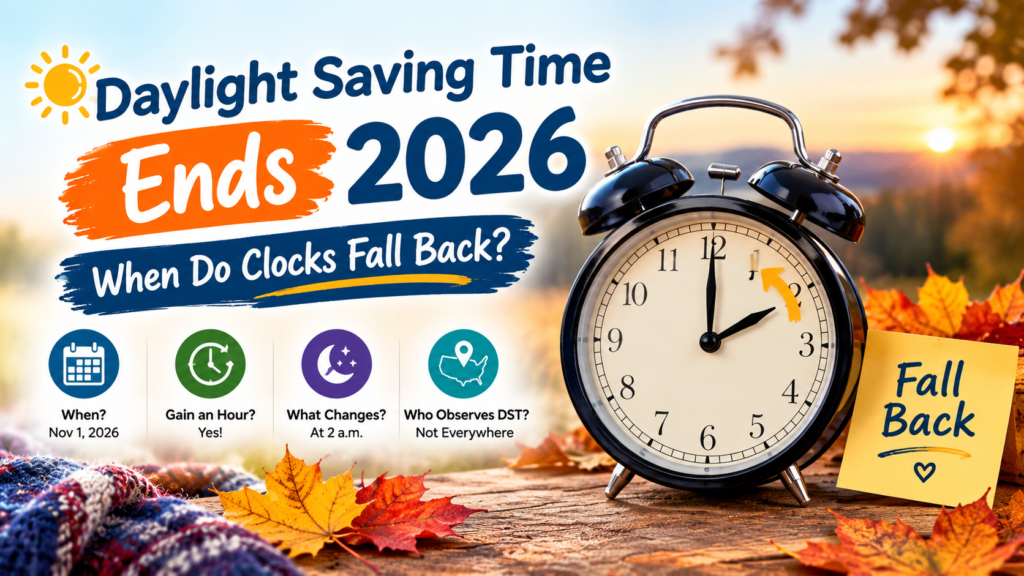
Daylight Saving Time ends in the United States on Sunday, November 1, 2026. At 2:00 a.m. local daylight time, clocks are set back to 1:00 a.m. standard time, which means the day gets an extra hour. Here’s a complete breakdown of what changes, when it changes, and what to do about it.
When Does Daylight Saving Time Ends 2026?
| Detail | Information |
|---|---|
| Date | Sunday, November 1, 2026 |
| Day | Sunday |
| Change | Clocks move back 1 hour |
| At | 2:00 a.m. local daylight time |
| New time | 1:00 a.m. standard time |
| What happens? | The 1:00 a.m. hour occurs twice |
| Extra hour? | Yes |
| Season after change | Standard Time |
| U.S. rule | First Sunday in November |
Quick answer: Daylight Saving Time ends on November 1, 2026, in most of the United States. At 2:00 a.m., clocks fall back to 1:00 a.m., giving people in areas that observe DST an extra hour that day.
Do We Gain an Hour When Daylight Saving Time Ends?
Yes. When clocks move from 2:00 a.m. back to 1:00 a.m., the hour between 1:00 and 2:00 a.m. happens twice.
Before the change: 1:59 a.m. → 2:00 a.m.
After the change: 1:59 a.m. → 1:00 a.m.
So the overnight period is technically one hour longer than usual.
Do You Get an Extra Hour of Sleep?
Potentially, yes. If you keep the same bedtime and wake-up time by the clock, the change effectively adds an hour between when you go to bed and when you get up. That said, not everyone experiences it as extra rest — sleep schedules vary from person to person, so it’s more of an opportunity than a guarantee.
What Time Do Clocks Fall Back in 2026?
The official transition happens at 2:00 a.m. local daylight time.
| Before | After |
|---|---|
| 1:59 a.m. | 1:59 a.m. |
| 2:00 a.m. | 1:00 a.m. |
| 2:30 a.m. | 1:30 a.m. |
| 3:00 a.m. | 2:00 a.m. |
Most smartphones and computers adjust automatically as long as their time-zone and automatic date/time settings are current.
Daylight Saving Time Ends 2026 by U.S. Time Zone
| U.S. Time Zone | Standard-Time Abbreviation | UTC Offset |
|---|---|---|
| Eastern | EST | UTC−5 |
| Central | CST | UTC−6 |
| Mountain | MST | UTC−7 |
| Pacific | PST | UTC−8 |
| Alaska | AKST | UTC−9 |
| Hawaii-Aleutian | HST* | UTC−10 |
Important: the change doesn’t happen at one simultaneous moment across the country. Each time zone falls back at 2:00 a.m. local time, so the transition rolls across the map rather than happening all at once.
Which States Do Not Observe Daylight Saving Time?
Hawaii and most of Arizona do not observe DST. Several U.S. territories also skip it, including American Samoa, Guam, Puerto Rico, and the U.S. Virgin Islands. One notable exception within Arizona: the Navajo Nation does observe DST, so it isn’t accurate to say Arizona never changes its clocks.
Does Arizona Change Its Clocks?
Most of Arizona does not change clocks for DST — but the Navajo Nation, which extends into Arizona, does observe the time change.
Does Hawaii Change Its Clocks?
No. Hawaii does not observe Daylight Saving Time at all, so clocks there stay the same year-round.
Daylight Saving Time vs. Standard Time
| Daylight Saving Time | Standard Time |
|---|---|
| Clocks are advanced by 1 hour | Clocks return to the standard offset |
| More daylight occurs later in the evening | More daylight occurs earlier relative to the clock |
| U.S. DST begins in March | U.S. standard time returns in November |
| Ends November 1, 2026 | Begins after the fall transition |
Why Does Daylight Saving Time End in November?
Under current U.S. law, DST begins on the second Sunday in March and ends on the first Sunday in November. This isn’t tied to weather — it’s a fixed federal rule. The current schedule dates back to the Uniform Time Act, as amended by the Energy Policy Act of 2005, which extended the DST period and took effect in 2007.
History of Daylight Saving Time in the United States
When Did DST Begin in the U.S.?
Daylight Saving Time was formally introduced in the United States in 1918, originally as a wartime measure intended to conserve fuel and make better use of daylight hours.
The 2007 Rule Change
The schedule familiar to most Americans today — starting in March and ending in November — dates to legislation passed in 2005 that extended the length of DST, with the new rule taking effect in 2007. Before that, DST ran on a shorter calendar, from early April to late October.
Current U.S. DST Rule
- Second Sunday of March → spring forward
- First Sunday of November → fall back
That’s the entire rule in a nutshell, and it’s applied consistently every year unless Congress changes it.
What Happens When Daylight Saving Time Ends?
- Clocks move back one hour
- The overnight period becomes longer
- Standard time resumes
- Sunrise and sunset occur earlier according to the clock
- Phones and computers may update automatically
- Manual clocks may need adjustment
Keeping your device’s operating system updated matters here, since local DST rules are handled through built-in time-zone data.
What Devices Need to Be Changed?
Usually automatic:
- Smartphones
- Computers
- Tablets
- Smartwatches
- Internet-connected devices
May need manual adjustment:
- Wall clocks
- Analog watches
- Some alarm clocks
- Older vehicles
- Some appliances
- Older electronic clocks
If a device doesn’t update correctly, check its time-zone settings first before assuming something is broken.
Daylight Saving Time Ends 2026: What Should You Do?
- Check automatic clock settings on your devices.
- Update your phone and computer if needed.
- Check household wall clocks.
- Check alarm clocks specifically — these are easy to forget.
- Verify your car’s clock, especially in older vehicles.
- Review weekend schedules, since the change happens overnight.
- Take advantage of the extra hour if your routine allows it.
- Remember that not every U.S. location observes DST, so travelers should double-check before assuming a time change applies.
Does the Time Change Affect Sleep?
The clock shifts by exactly one hour, and for some people that briefly misaligns their internal schedule with the clock. Responses vary — some barely notice, others feel off for a day or two. Keeping a consistent sleep routine around the transition tends to make the adjustment smoother, regardless of which way it goes.
Daylight Saving Time Ends 2026 Facts
| Fact | Answer |
|---|---|
| Date | November 1, 2026 |
| Day | Sunday |
| Clock change | Back 1 hour |
| Transition time | 2:00 a.m. local daylight time |
| New clock time | 1:00 a.m. standard time |
| Extra hour? | Yes |
| DST began in 2026 | March 8 |
| DST ends | November 1 |
| Rule | First Sunday in November |
| Most of Arizona | Does not observe DST |
| Hawaii | Does not observe DST |
Daylight Saving Time Ends vs. Daylight Saving Time Begins
| Feature | DST Begins | DST Ends |
|---|---|---|
| Common phrase | Spring forward | Fall back |
| 2026 date | March 8 | November 1 |
| Clock movement | Forward 1 hour | Back 1 hour |
| Hour gained/lost | Lose an hour | Gain an hour |
| Time after change | Daylight Time | Standard Time |
Frequently Asked Questions
When do clocks fall back in 2026?
Clocks fall back on Sunday, November 1, 2026. At 2:00 a.m. local daylight time, clocks move back to 1:00 a.m. standard time.
Do we gain an hour in November 2026?
Yes. In areas observing DST, moving the clock from 2:00 a.m. back to 1:00 a.m. repeats one hour, creating a 25-hour calendar day.
What time does Daylight Saving Time end?
In the United States, the transition occurs at 2:00 a.m. local daylight time, when the clock moves back to 1:00 a.m.
Does Daylight Saving Time end everywhere in the U.S.?
No. Hawaii and most of Arizona do not observe DST, and several U.S. territories don’t either. The Navajo Nation in Arizona is an exception and does observe DST.
Do phones automatically change time?
Many modern phones and computers update automatically as long as their operating system has current time-zone information and automatic date/time settings enabled.
Do we lose or gain an hour when clocks fall back?
You gain an hour. The clock moves from 2:00 a.m. back to 1:00 a.m.
When does Daylight Saving Time start again?
Under the current U.S. rule, DST resumes on the second Sunday of March. In 2027, that will be March 14.
Why do we change the clocks?
The current U.S. system advances clocks during DST and returns to standard time in November, following rules set in federal law that were last updated in 2005 and took effect in 2007.
How Many Days Until Daylight Saving Time Ends 2026?
As of September 26, 2026, there are 36 days until Daylight Saving Time ends on November 1, 2026.
If you’re tracking other key dates through the rest of the year, our 2026 calendar of observances covers what else is coming up. And if you’re specifically mapping out the year’s holidays and seasonal shifts together, the full 2026 holidays overview is a useful place to plan around dates like this one.
Conclusion
Daylight Saving Time ends on November 1, 2026, giving people in participating U.S. locations an extra hour as clocks move from 2:00 a.m. back to 1:00 a.m. Checking automatic time settings ahead of time and manually adjusting older clocks can help make the switch to Standard Time smooth and uneventful.