
Winter Solstice 2026 marks the astronomical start of winter in the Northern Hemisphere and the shortest daylight period of the year there. It is the darkest turning point of the season, but it is also the day the light begins to return. At the same moment, the Southern Hemisphere reaches its summer solstice and enjoys its longest day.
The solstice has been watched, measured and celebrated for thousands of years. This guide covers the exact date and time, the science behind the shortest day, the history of solstice customs and simple ways to mark the occasion.
Quick answer: The winter solstice in 2026 occurs on Monday, December 21 in the United States. It marks the moment the Northern Hemisphere is tilted farthest away from the Sun, producing the shortest day and longest night of the year. The exact local date and time depend on your time zone.
When Is the Winter Solstice 2026?
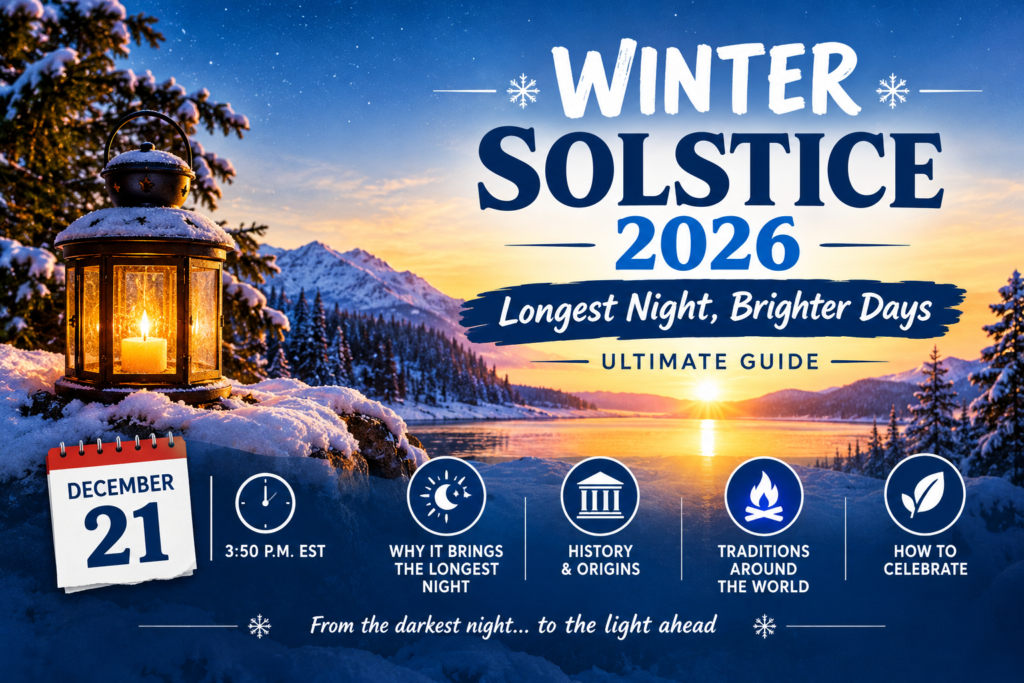
The December solstice 2026 happens on Monday, December 21, 2026, at 20:50 UTC. In the United States, that is 3:50 p.m. Eastern Standard Time (EST).
- Date in the United States: Monday, December 21, 2026
- Event: December solstice
- Northern Hemisphere: Astronomical winter begins
- Southern Hemisphere: Astronomical summer begins
- Frequency: Once a year, around December 21 or 22
The solstice is a single instant shared by the whole planet, not a period that starts separately in each country. Only the local clock time and calendar date change. Here is the same moment in several time zones:
| Location | Local time of the solstice |
|---|---|
| Eastern Time (New York) | Monday, December 21, 3:50 p.m. |
| Central Time (Chicago) | Monday, December 21, 2:50 p.m. |
| Mountain Time (Denver) | Monday, December 21, 1:50 p.m. |
| Pacific Time (Los Angeles) | Monday, December 21, 12:50 p.m. |
| UTC / GMT (London) | Monday, December 21, 8:50 p.m. |
| Pakistan (PKT) | Tuesday, December 22, 1:50 a.m. |
| India (IST) | Tuesday, December 22, 2:20 a.m. |
| Eastern Australia (Sydney) | Tuesday, December 22, 7:50 a.m. |
If you are counting down, the solstice is 66 days away as of October 16, 2026. The solstice arrives about three months after the Autumnal Equinox 2026 and a few days before Christmas 2026, so it fits neatly into the holiday calendar.
What Happens on the Winter Solstice?
Earth’s tilt and the Sun
Earth’s axis is tilted about 23.5 degrees relative to its orbit around the Sun. That tilt, not our distance from the Sun, causes the seasons. At the December solstice, the Northern Hemisphere leans away from the Sun, so sunlight arrives at a shallow angle. The Sun follows its lowest, shortest path across the sky.
Why is it the shortest day of the year?
With the Sun taking a low, short arc, it spends less time above the horizon in the Northern Hemisphere. The result is the shortest daylight period and the longest night of the year. The effect grows with latitude. In New York City, the solstice brings roughly nine hours and fifteen minutes of daylight, while places far to the north get far less, and areas inside the Arctic Circle see no direct sunrise at all.
Where is the Sun directly overhead?
On the December solstice, the Sun is directly overhead at noon along the Tropic of Capricorn, about 23.5 degrees south of the equator. That is why countries such as Australia, South Africa and Brazil are in the height of summer while North America and Europe are in the depths of winter.
Why Is the Winter Solstice the Shortest Day of the Year?
In simple terms, the shortest day comes down to four ideas:
- Axial tilt: Earth’s tilt changes the angle and duration of sunlight through the year.
- The Sun’s low arc: In the Northern Hemisphere, the Sun appears to travel its lowest path at the December solstice.
- A turning point: The word “solstice” comes from Latin words meaning “sun” and “stand still.” The Sun’s noon position stops moving south and begins to climb again.
- Slowly returning light: After the solstice, daylight gradually increases, though the change is tiny at first and hard to notice for several days.
One common misconception is that the solstice brings both the earliest sunset and the latest sunrise. It usually does not. Because clock time and true solar time drift apart slightly in December, the earliest sunsets in the mid-northern latitudes typically fall in early December. The latest sunrises come in early January. The solstice sits between them as the day with the least total daylight.
Winter Solstice in the Northern and Southern Hemispheres
The December solstice is one astronomical event, but each hemisphere experiences it differently.
| Feature | Northern Hemisphere | Southern Hemisphere |
|---|---|---|
| December solstice season | Winter begins astronomically | Summer begins astronomically |
| Daylight | Shortest day of the year | Longest day of the year |
| Sun’s apparent path | Lowest daily arc of the year | Highest daily arc of the year |
| After the solstice | Days gradually lengthen | Days gradually shorten |
So when people in Chicago bundle up for the darkest day of the year, people in Sydney are heading to the beach for the brightest one.
Winter Solstice History and Cultural Significance
For thousands of years, people have tracked the Sun’s seasonal journey. Farming, food storage and survival depended on knowing when the days would start to lengthen again. Many cultures built seasonal calendars, ceremonies and monuments around that turning point. Others tied it to renewal, rebirth and hope in the dead of winter.
Ancient monuments and seasonal observations
Several famous prehistoric structures appear to be aligned with solar events. At Newgrange in Ireland, a passage tomb more than 5,000 years old, sunrise light enters the inner chamber around the winter solstice, weather permitting. At Stonehenge in England, the main axis lines up with the midwinter sunset in one direction and the midsummer sunrise in the other. Archaeologists continue to study these sites, and their exact purposes remain debated, so it is wise to avoid assuming that every ancient monument served the same role.
Winter solstice traditions around the world
Customs differ by culture, region and era. Here are a few well-known examples:
- Yule: A midwinter festival rooted in Germanic and later Northern European traditions. Many of today’s seasonal customs, including evergreen decorations and festive feasts, are linked to its history, though modern celebrations vary widely.
- Dongzhi Festival: An East Asian observance marking the winter solstice, often centered on family gatherings and seasonal foods such as dumplings and sweet rice balls.
- Soyal: A winter ceremony observed by Hopi communities, connected with the Sun’s return and the new ceremonial cycle. Hopi cultural sources are the best place to learn about its meaning.
- Newgrange, Ireland: Visitors still gather around the solstice to witness the sunlight entering the chamber, and a lottery is used to select who can attend.
- Stonehenge, England: Thousands gather at the monument each year to watch the solstice sunrise, a modern tradition that continues to draw people from around the world.
You can read more in the general overview of the winter solstice on Wikipedia. For related seasonal customs, browse more seasonal traditions and holiday guides on our blog.
Winter Solstice 2026 Traditions and Ways to Celebrate
You do not need a stone monument to mark the occasion. These simple ideas work for individuals, families and classrooms.
Spend time outdoors
Take a short winter walk, watch the sunset from a safe spot, or step outside at the exact moment of the solstice. Noticing how low the Sun sits is a quiet way to feel the season.
Learn about astronomy
Use a sky map or astronomy app to explore Earth’s tilt, the Sun’s apparent path and the changing seasons. The solstice is also a good night for stargazing, since long winter nights give you more dark hours to enjoy the sky. Amateur astronomers often share observations and tips in communities like r/astronomy on Reddit.
Enjoy seasonal foods and gatherings
Share a meal with family or friends, cook a warming winter recipe, or try a dish linked to a solstice tradition from another culture. If you are planning holiday meals and get-togethers, our Christmas 2026 guide can help you plan the rest of the month.
Reflect and set intentions
Some people use the solstice for journaling, gratitude or setting goals for the coming year. These are modern, optional practices rather than universal traditions, but the idea of “light returning” makes the day a natural moment for a fresh start.
Activities for children and students
- Model Earth’s tilt using a globe and a lamp.
- Compare daylight hours at different latitudes.
- Draw the Sun’s apparent path across the sky on the solstice and again in summer.
- Research how different cultures mark the solstice.
Winter Solstice Facts
- The winter solstice occurs once a year in each hemisphere.
- In 2026, the December solstice occurs on December 21 at 20:50 UTC.
- It marks astronomical winter in the Northern Hemisphere and astronomical summer in the Southern Hemisphere.
- The Northern Hemisphere has its shortest daylight period of the year.
- The Sun is directly overhead at the Tropic of Capricorn.
- The solstice is an exact moment, not a day-long event.
- The earliest sunset and latest sunrise do not usually fall on the solstice itself.
- After the December solstice, daylight gradually increases in the Northern Hemisphere.
Frequently Asked Questions About Winter Solstice 2026
When is the winter solstice 2026?
The winter solstice occurs on Monday, December 21, 2026, at 3:50 p.m. Eastern Standard Time (EST), which is 20:50 UTC. In Pakistan, it occurs at 1:50 a.m. on Tuesday, December 22.
What happens on the winter solstice?
The Northern Hemisphere is tilted farthest away from the Sun, producing its shortest daylight period and longest night of the year. The Southern Hemisphere experiences its longest day.
Is December 21 the shortest day of the year?
In most Northern Hemisphere locations, December 21, 2026, is the day with the least daylight. The exact local date can vary slightly with time zone and geography.
Is the winter solstice the first day of winter?
It is the first day of astronomical winter in the Northern Hemisphere. Meteorological winter uses a calendar-based definition and begins on December 1.
Does daylight increase after the winter solstice?
Yes. Daylight gradually increases in the Northern Hemisphere after the solstice, although the earliest sunset and latest sunrise fall on different dates.
Is the winter solstice the same date worldwide?
Not always. The solstice happens at one global moment, but the local date can differ by time zone. In 2026, it falls on December 22 in Pakistan even though it is still December 21 in the United States.
What is the difference between the winter solstice and the summer solstice?
The winter solstice marks the shortest day in a hemisphere, while the summer solstice marks its longest day. They occur at opposite times of the year in each hemisphere.
How do people celebrate the winter solstice?
Celebrations vary. Some people watch the sunrise or sunset, attend seasonal gatherings, enjoy traditional foods, study astronomy, or take part in cultural and spiritual ceremonies.
Countdown to Winter Solstice 2026
Monday, December 21, 2026 at 3:50 p.m. EST (20:50 UTC)
66 days to go (calculated from October 16, 2026).