
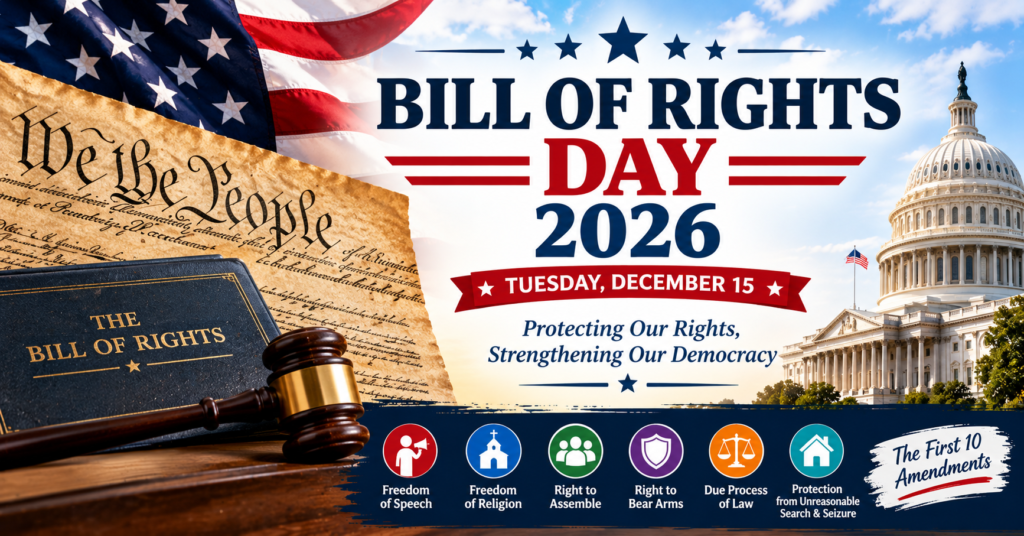
Bill of Rights Day 2026 falls on Tuesday, December 15. It is an annual U.S. observance that recognizes the first ten amendments to the Constitution, which protect core liberties and set limits on government power. These amendments guard freedoms that many Americans use every day, from speaking and worshipping freely to receiving a fair trial.
This guide covers the date, the history behind the Bill of Rights, a plain-language summary of all ten amendments, why they still matter, key facts, quotes and activities for students and families.
Quick answer: Bill of Rights Day is observed on December 15 each year to commemorate the ratification of the first ten amendments to the U.S. Constitution in 1791. These amendments protect key freedoms and establish important legal safeguards.
When Is Bill of Rights Day 2026?
Bill of Rights Day 2026 is on Tuesday, December 15, 2026.
- Date: Tuesday, December 15, 2026
- Annual observance: Every December 15
- Historical milestone: Ratification of the Bill of Rights in 1791
- Purpose: To recognize the rights and freedoms protected by the first ten amendments
The observance sits in the middle of a busy December. If you are planning ahead, the Winter Solstice 2026 arrives just six days later, on December 21.
What Is Bill of Rights Day?
The Bill of Rights is the name given to the first ten amendments to the U.S. Constitution. Together they protect individual liberties, such as freedom of speech and religion, and set out procedural safeguards, such as the right to a fair trial. Bill of Rights Day gives Americans a yearly reason to read these amendments, understand their history and talk about how they shape public life.
Learning about constitutional rights is a core part of civic education. People who understand how these protections work are better prepared to take part in community life, serve on juries and discuss public issues thoughtfully.
It is also worth remembering that constitutional rights have legal limits. How an amendment applies in practice depends on its wording, court decisions and relevant law, so the meaning of some rights has evolved over time.
History of Bill of Rights Day
Why Was the Bill of Rights Created?
When the Constitution was drafted in 1787, it created a new framework for the national government but did not include a list of individual rights. Opponents, often called Anti-Federalists, worried that a strong central government could threaten personal liberties without such explicit protections.
Several state ratifying conventions approved the Constitution while calling for amendments. James Madison, who first doubted the need for a bill of rights, came to support the idea. He took on the task of proposing amendments to address these concerns and help build public confidence in the new government.
When Was the Bill of Rights Written?
The timeline moved quickly after the first Congress convened:
- June 1789: James Madison introduced proposed amendments in the House of Representatives.
- September 25, 1789: Congress approved twelve proposed amendments and sent them to the states for ratification.
- 1791: Ten of the twelve were ratified by the required number of states.
Why Is December 15 Important?
On December 15, 1791, Virginia’s ratification supplied the final approval needed for ten of the proposed amendments to become part of the Constitution. Those ten amendments became known as the Bill of Rights. The date remains a touchstone in U.S. history and civics lessons.
How Did Bill of Rights Day Become an Observance?
December 15 is recognized as Bill of Rights Day, and President Franklin D. Roosevelt issued a proclamation for it in 1941, marking the 150th anniversary of ratification. Today, institutions such as the National Archives and the federal courts offer educational materials and classroom activities for the occasion.
Bill of Rights Day is an observance, not a federal public holiday. Government offices, schools and businesses do not automatically close.
What Are the First Ten Amendments?
This table summarizes each amendment in plain language.
| Amendment | Main protection or principle |
|---|---|
| First Amendment | Freedom of religion, speech, press, peaceful assembly and petitioning the government. |
| Second Amendment | The right to keep and bear arms, with legal interpretation shaped by constitutional text and court decisions. |
| Third Amendment | Limits the quartering of soldiers in private homes without the owner’s consent, subject to the amendment’s terms. |
| Fourth Amendment | Protection against unreasonable searches and seizures. |
| Fifth Amendment | Includes protections involving grand juries in certain cases, double jeopardy, self-incrimination, due process and takings of private property. |
| Sixth Amendment | Rights of people accused of crimes, including a speedy and public trial, an impartial jury, notice of charges and assistance of counsel. |
| Seventh Amendment | Preserves jury-trial rights in certain civil cases in federal courts. |
| Eighth Amendment | Prohibits excessive bail, excessive fines and cruel and unusual punishments. |
| Ninth Amendment | Clarifies that listing certain rights in the Constitution does not mean other rights retained by the people are denied. |
| Tenth Amendment | Reserves powers not delegated to the federal government, nor prohibited to the states, to the states or the people. |
For the full original wording, you can read the Bill of Rights on Wikipedia, which includes the text and background on each amendment.
Why Is the First Amendment So Well Known?
The First Amendment protects five major freedoms: religion, speech, the press, peaceful assembly and the right to petition the government. These freedoms support open debate, independent journalism, religious liberty and the ability of citizens to organize and ask their government for change. Because they appear in so many everyday situations, from classroom discussions to news coverage, the First Amendment is the part of the Bill of Rights most people know best.
How Do the Fourth, Fifth and Sixth Amendments Protect Individuals?
These three amendments focus on fairness in the legal system:
- Fourth Amendment: Sets limits on government searches and seizures, which is the foundation of many privacy protections.
- Fifth Amendment: Guarantees due process and protects people from being forced to testify against themselves or tried twice for the same offense.
- Sixth Amendment: Gives people accused of crimes the right to a speedy, public trial, an impartial jury and legal counsel.
Together they help ensure that government power is exercised under clear rules.
Why Are the Ninth and Tenth Amendments Different?
The Ninth and Tenth Amendments do not name a specific freedom the way the First or Fourth do. Instead, they explain how to read the Constitution as a whole. The Ninth says that listing some rights does not erase others retained by the people. The Tenth says that powers not given to the federal government, and not prohibited to the states, belong to the states or the people. Both reflect the founders’ goal of keeping government power limited.
Why Is Bill of Rights Day Celebrated?
Bill of Rights Day is celebrated to recognize the ratification of the first ten amendments and to encourage Americans to understand the freedoms and legal protections they provide. It also promotes civic education and reflection on the Constitution’s role in public life.
- Raise constitutional awareness: Help people learn what each amendment says.
- Recognize individual liberties: Explore both freedoms and legal protections.
- Support civic education: Show students how government and constitutional law work.
- Reflect on history: Understand the debates that shaped the Bill of Rights.
- Encourage informed discussion: Talk through constitutional questions with reliable information and respectful dialogue.
If you enjoy this topic, our guide to Constitution Day 2026 covers the signing of the Constitution itself, and our Independence Day 2026 article explores the earlier founding moment.
Why Is the Bill of Rights Important Today?
More than 230 years after ratification, the Bill of Rights still shapes American life:
- Expression and belief: Freedom of speech and religious liberty protect the right to share ideas and practice (or not practice) a faith.
- Press and assembly: A free press and peaceful public gatherings help hold institutions accountable.
- Privacy: The Fourth Amendment limits unreasonable government searches.
- Fair process: Due process and fair-trial protections guard people accused of crimes.
- Balance of power: The amendments define the relationship between individual rights and government authority.
Courts continue to interpret these amendments as new technologies and social questions arise. In many areas, the text of an amendment and its current judicial interpretation are not the same thing, so understanding precedent is an important part of understanding the law.
Bill of Rights Day Facts
| Fact | Detail |
|---|---|
| Observance date | December 15 |
| 2026 date | Tuesday, December 15 |
| Ratification year | 1791 |
| Number of amendments in the Bill of Rights | 10 |
| Number originally proposed by Congress | 12 |
| Key historical figure | James Madison played a major role in proposing the amendments |
| Important historical date | September 25, 1789, when Congress proposed twelve amendments |
| Ratifying state on December 15, 1791 | Virginia |
The two proposed amendments that were not ratified in 1791 had different outcomes. One, about congressional apportionment, was never ratified. The other, about congressional pay, was finally ratified in 1992 as the Twenty-Seventh Amendment, more than 200 years after it was first proposed.
Bill of Rights Day 2026 Quotes
The preamble to the Bill of Rights explains why the amendments were proposed. It says they were meant “to prevent misconstruction or abuse of its powers.” That short phrase captures the purpose of the entire Bill of Rights.
Original Bill of Rights Day 2026 Quotes
The following lines are original and written for this article:
- “Understanding our rights is an important step toward responsible citizenship.”
- “The Bill of Rights reminds us that liberty depends on both principles and protections.”
- “A strong civic culture begins with learning the Constitution and discussing it thoughtfully.”
- “Constitutional rights matter most when people understand how they work.”
Short Bill of Rights Day 2026 Messages
- “Remembering the Bill of Rights means recognizing the constitutional freedoms and safeguards that shape American civic life.”
- “This Bill of Rights Day, take time to learn the first ten amendments and the history behind them.”
- “December 15 is an opportunity to explore constitutional rights, civic responsibility and the foundations of American government.”
Bill of Rights Day 2026 Activities for Students
Teachers and parents can use these ideas in the classroom or at home:
- Create a poster explaining one of the ten amendments.
- Organize a classroom quiz on constitutional history.
- Match each amendment to a plain-language summary.
- Hold a structured debate about a historical constitutional question.
- Read excerpts from the original document.
- Ask students to explain how one amendment relates to everyday life.
- Create a timeline from the Constitution’s ratification to the Bill of Rights.
The federal courts also publish educational videos and discussion materials for Bill of Rights Day that work well in civics lessons.
How to Celebrate Bill of Rights Day 2026 at Home or in the Community
You do not need a formal event to mark the day. Here are simple ways to take part:
- Read the first ten amendments.
- Visit the National Archives website to explore the original document.
- Share a verified historical fact with family or friends.
- Watch an educational documentary or lecture.
- Host a Constitution-themed discussion.
- Use reputable civics materials to learn about constitutional rights.
- Encourage students to compare the original text with accessible explanations.
If you want to discuss constitutional history with other enthusiasts, communities such as r/AskHistorians on Reddit are a good place to ask questions and learn from people who study the period. For more American observances throughout the year, browse the guides on our homepage.
Frequently Asked Questions
When is Bill of Rights Day?
Bill of Rights Day is observed every year on December 15. In 2026, it falls on Tuesday, December 15.
Why is Bill of Rights Day celebrated?
It commemorates the ratification of the first ten amendments to the U.S. Constitution in 1791 and encourages awareness of constitutional rights.
What is the Bill of Rights?
The Bill of Rights is the name given to the first ten amendments to the U.S. Constitution.
Who wrote the Bill of Rights?
James Madison played a major role in drafting and proposing the amendments, but the final document emerged through congressional deliberations and state ratification.
How many amendments were originally proposed?
Congress proposed twelve amendments in 1789. Ten were ratified in 1791 and became the Bill of Rights.
Is Bill of Rights Day 2026 a federal holiday?
No. It is an annual observance, not a federal public holiday that automatically closes government offices or businesses.
What is the most famous amendment in the Bill of Rights?
The First Amendment is widely recognized for protecting freedoms of religion, speech, press, peaceful assembly and petition. The importance of any amendment depends on the context and legal question being discussed.
Countdown to Bill of Rights Day 2026
Bill of Rights Day 2026,Tuesday, December 15, 2026
60 days to go (calculated from October 16, 2026).