
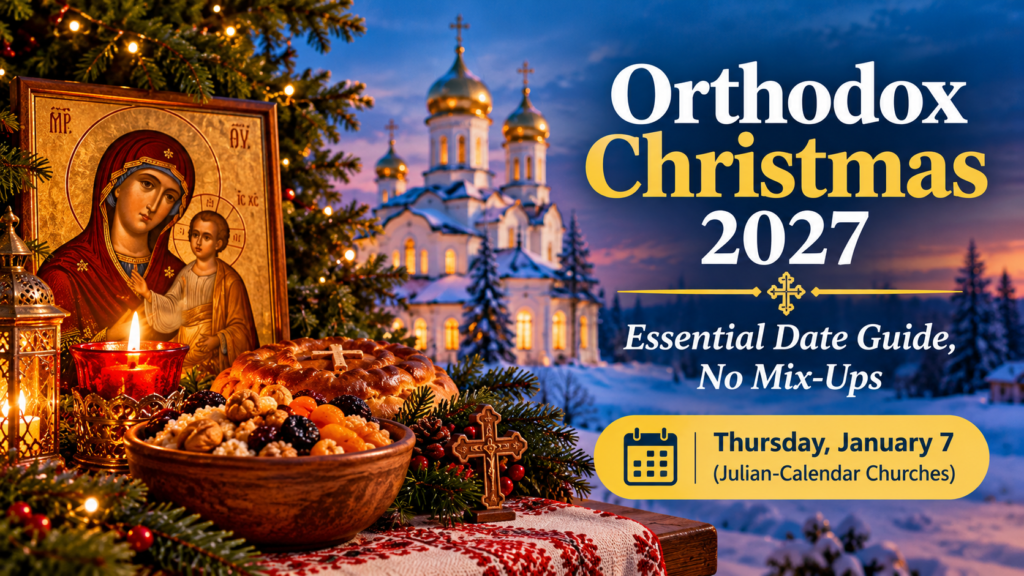
Orthodox Christmas 2027 will be celebrated on Thursday, January 7, by Orthodox Christian communities that follow the traditional Julian calendar for the Nativity of Christ. The holiday commemorates the birth of Jesus Christ and is marked by church services, prayer, family gatherings and traditional foods. However, Orthodox Christians do not all celebrate Christmas on the same civil-calendar date: many churches observe Christmas on December 25, 2026. Understanding this calendar difference helps explain why the holiday falls on different dates around the world.
This guide explains the date, the history and meaning of the feast, regional traditions, foods and greetings, so you can follow the day with confidence whichever calendar your community uses.
When Is Orthodox Christmas 2027?
Orthodox Christmas 2027 falls on Thursday, January 7, 2027, for communities that follow the traditional Julian calendar. Many other Orthodox churches celebrate Christmas on Friday, December 25, 2026.
| Celebration | Date | Day |
|---|---|---|
| Orthodox Christmas on the traditional Julian calendar | January 7, 2027 | Thursday |
| Christmas for many Orthodox churches using the Gregorian or Revised Julian calendar | December 25, 2026 | Friday |
| Orthodox Christmas Eve for Julian-calendar communities | January 6, 2027 | Wednesday |
The January 7 date corresponds to December 25 on the traditional Julian calendar during the years 1901 to 2100. Many other Orthodox churches use a different calendar for fixed feasts and celebrate Christmas on December 25 in the civil calendar. If you’re not sure which applies to you, check with your own parish.
If you’re also looking for the most widely observed Christmas date, see our Christmas 2026 guide.
What Is Orthodox Christmas?
Orthodox Christmas is the feast of the Nativity of Christ, celebrating the birth of Jesus. It is one of the major feasts of the Orthodox Christian year.
Here are the main ideas behind the celebration:
- It honors the Nativity of Jesus, as told in the Gospels.
- Prayer, worship and spiritual preparation are central.
- Church services mark both the eve and the day itself.
- Family customs and local traditions add their own character.
“Orthodox Christmas” is a broad label that covers multiple churches and communities, so traditions and calendar practices are not identical everywhere. Treat any single custom as one example, not a rule for all Orthodox Christians.
Why Is Orthodox Christmas Celebrated on January 7?
This is the question most readers ask, and the answer comes down to calendars.
The Julian Calendar Explained
The Julian calendar was introduced in ancient Rome and was the standard calendar in much of Europe for centuries. Over time it drifted slightly from the solar year, which led to the Gregorian calendar used for most civil dates today. You can read more on Wikipedia’s Julian calendar page.
How December 25 Becomes January 7
Churches that follow the traditional Julian calendar celebrate the Nativity on December 25 according to that calendar. Between 1901 and 2100, that date falls 13 days later on the Gregorian calendar, which is January 7. The feast itself is not moved. The two calendars simply label the same day differently.
Why Some Orthodox Christians Celebrate on December 25
Many Orthodox churches use the Gregorian or Revised Julian calendar for fixed feasts, so their Christmas is December 25 in the civil calendar. It would be wrong to describe January 7 as the date followed by all Orthodox Christians.
| Calendar | How Christmas is dated | Civil date for 2026 to 2027 |
|---|---|---|
| Traditional Julian | December 25 on the Julian calendar | January 7, 2027 |
| Gregorian or Revised Julian | December 25 on the civil calendar | December 25, 2026 |
History and Religious Meaning of Orthodox Christmas
The Biblical Account of Jesus’ Birth
The Nativity story appears in the Gospels of Matthew (chapters 1 and 2) and Luke (chapters 1 and 2). It describes the birth of Jesus in Bethlehem and the visits of the shepherds and, later, the Magi. For Christians, these events show God entering the world in humility. For the Magi story and its traditions, see our Three Kings Day 2027 guide.
The Nativity Feast in Orthodox Christianity
The Church prepares worshippers for the feast through Scripture readings, hymns, prayer and special services. The celebration is not only a single day but part of a wider liturgical season, with Nativity hymns and services leading up to and following the feast.
The Nativity Fast
Many Orthodox traditions keep a forty-day Nativity Fast before Christmas. It usually begins on November 15 on each church’s own calendar and ends with the feast. Dates and practices depend on the calendar and on local church guidance. You can read an overview on Wikipedia’s Nativity Fast page. Rules differ between communities and individuals, so follow your church’s guidance.
Orthodox Christmas Traditions Around the World
Practices vary by country, parish and family. These examples show the range, and none should be treated as universal.
Russian Orthodox Christmas
In Russia and in communities that follow the Julian calendar, January 7 is the main day of celebration. People attend church services, pray and gather for festive meals. Many families wait for the first star on Christmas Eve before eating, in memory of the star followed by the Magi.
Serbian Orthodox Christmas
In many Serbian communities, the tradition of the badnjak is important. It involves an oak branch or a young oak tree brought in on Christmas Eve and burned in the home or at the church. Families also share a festive meal and greet each other with “Hristos se rodi” (“Christ is born”). This is a regional tradition, not something every Orthodox Christian practices.
Greek Orthodox Christmas
Many Greek Orthodox communities celebrate Christmas on December 25. Church services, the Nativity Fast and family meals are central. Customs such as sweet breads and festive gatherings can vary by region and family.
Ukrainian Orthodox Christmas
Christmas dates and customs can vary according to church jurisdiction, calendar practice and family tradition. Many families keep a meatless Christmas Eve supper with several dishes, but not every household does it the same way. Don’t assume all Ukrainian Orthodox communities follow the same date.
Orthodox Christmas in Other Countries
Georgian, Romanian, Bulgarian, Coptic, Ethiopian and other Orthodox communities each have their own customs and, in some cases, their own calendars. Some, such as Georgian and Ethiopian communities, celebrate on January 7, while others, such as Romanian and Bulgarian communities, celebrate on December 25. Always check local church resources before describing a custom as typical.
Orthodox Christmas Eve and Christmas Day Services
Christmas Eve Services
Some churches hold Royal Hours, Vespers and the Divine Liturgy of Saint Basil on the eve of the feast. For Julian-calendar communities in 2027, that means Wednesday, January 6.
Christmas Day Worship
The Divine Liturgy and Nativity hymns are central on Christmas Day. Congregations gather to sing, pray and celebrate the birth of Christ.
Prayer and Reflection at Home
Families may read the Nativity story, pray together or prepare a festive meal. Some households set up a Nativity icon or a small display.
Visiting a Local Parish
Service times vary widely, so check your parish’s official schedule before you go. If you’re visiting an Orthodox church for the first time, arrive a little early and follow the lead of those around you.
Orthodox Christmas Foods and Traditional Meals
Christmas foods vary across countries and families, and fasting practices shape the meals before the feast.
- Kutia: A wheat-based dish associated with Ukrainian and some Eastern European Christmas Eve customs.
- Christmas breads: Different communities prepare distinctive breads and pastries for the Nativity season.
- Beans, grains, vegetables and dried fruits: These can feature in some traditional fasting meals.
- Festive meat dishes and desserts: Served in some families after the fast, depending on local custom.
No single menu is universal to all Orthodox Christians. If you’re planning a festive meal, our food and celebrations section has ideas for holiday cooking.
How to Celebrate Orthodox Christmas 2027
These are suggestions, not a checklist of religious obligations. Follow your church’s guidance for worship and fasting.
- Attend a Christmas service at a local parish, if appropriate.
- Read the biblical Nativity story.
- Learn about the calendar your church community uses.
- Prepare a traditional family meal.
- Share time with relatives and friends.
- Give food, donations or practical help to people in need.
- Display a Nativity icon or decoration respectfully.
- Share a greeting with friends who celebrate Christmas on January 7.
January 7 falls a few days after New Year’s Day, so it can fit easily into your holiday plans. Our New Year’s Day 2027 guide covers the days just before.
Orthodox Christmas 2027 Wishes and Greetings
These are original messages, not quotations from saints or religious leaders. For more seasonal greetings, see our Christmas 2026 wishes and messages.
- Wishing you a blessed Orthodox Christmas filled with peace, faith and love.
- May the joy of Christ’s Nativity bring hope and warmth to your home.
- Wishing you and your family a peaceful and meaningful Christmas celebration.
- May this holy season bring kindness, comfort and renewed faith.
- Sending warm wishes to everyone celebrating Orthodox Christmas on January 7.
- May your Christmas be filled with prayer, gratitude and precious family moments.
Short greetings: “Merry Orthodox Christmas!” or “Wishing you a blessed Nativity!” Many Orthodox Christians also use the traditional greeting “Christ is born!” with the reply “Glorify Him!”
Frequently Asked Questions About Orthodox Christmas 2027
When is Orthodox Christmas 2027?
Orthodox Christmas falls on Thursday, January 7, 2027, for communities following the traditional Julian calendar. Many other Orthodox churches celebrate on December 25, 2026.
Why is Christmas celebrated on January 7 by some Orthodox Christians?
They follow the traditional Julian calendar for the Nativity feast. Its December 25 corresponds to January 7 on the Gregorian calendar during 1901 to 2100.
Do all Orthodox Christians celebrate Christmas on January 7?
No. Many Orthodox churches celebrate Christmas on December 25 in the civil calendar, while others celebrate on January 7.
What is the difference between Orthodox Christmas Eve and Orthodox Christmas Day?
Christmas Eve is the day before the Nativity feast and may include preparatory services and family customs. Christmas Day celebrates the birth of Christ.
Do Orthodox Christians fast before Christmas?
Many observe a Nativity Fast, traditionally lasting forty days, but the calendar and specific fasting rules depend on the church tradition.
What are common Orthodox Christmas traditions?
Common practices include church services, prayer, Nativity hymns, family gatherings and traditional foods. Customs vary across communities.
Is Orthodox Christmas 2027 a public holiday?
It depends on the country. January 7 is an official holiday in some countries, such as Russia, Serbia, Georgia and Ethiopia, but it is not a nationwide U.S. federal public holiday.
What is a respectful greeting for Orthodox Christmas 2027?
“Merry Orthodox Christmas” or “Wishing you a blessed Nativity” are suitable general greetings.
Countdown to Orthodox Christmas 2027
Thursday, January 7, 2027
77 days to go (calculated from October 22, 2026). This date applies to communities celebrating Christmas on the traditional Julian calendar.
For more guides as the season approaches, visit our upcoming days and events page or browse the latest posts on our blog.
Checks done: Jan 7, 2027 is a Thursday, Jan 6 is a Wednesday and Dec 25, 2026 is a Friday. The 13-day Julian-Gregorian offset holds for 1901 to 2100. The countdown from Oct 22 is 77 days. There are 2 external links (both Wikipedia), 7 internal links to pages confirmed live on your blog, and no sources section, source names or divider lines.