
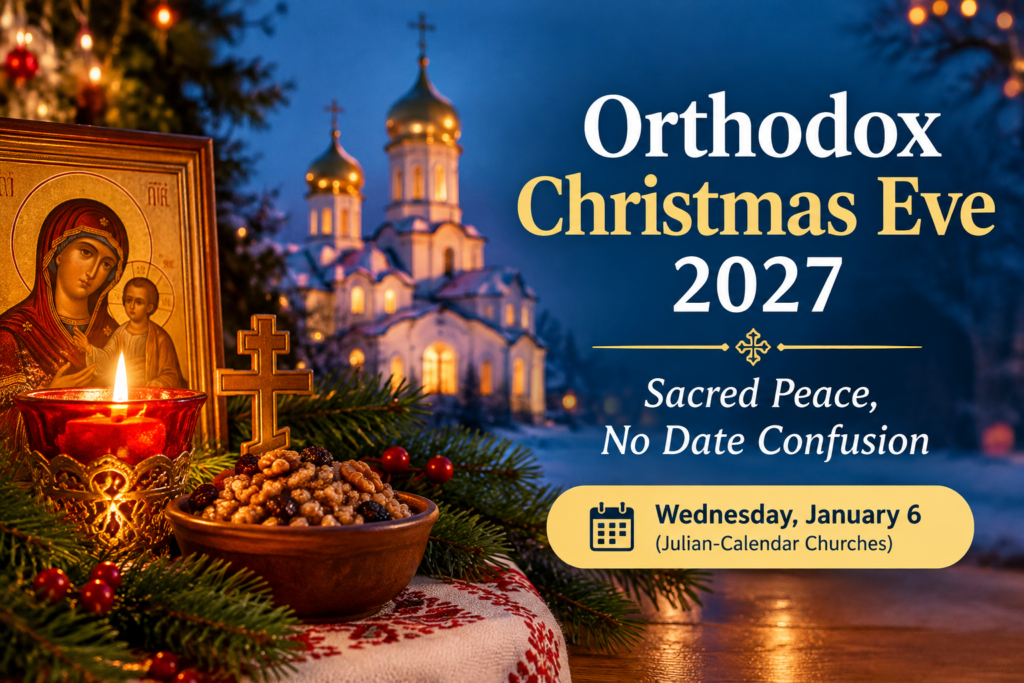
Orthodox Christmas Eve 2027 falls on Wednesday, January 6, for Orthodox Christians who follow the traditional Julian calendar for the Nativity of Christ. These communities celebrate Christmas Day on Thursday, January 7 in the Gregorian calendar. The eve is a time of spiritual preparation, prayer, fasting according to local church practice, and gathering with family.
Orthodox Christians do not all use the same civil-calendar date, though. Many Orthodox churches celebrated Christmas on December 25, 2026, with Christmas Eve on December 24. This guide explains the calendar difference, the history behind it, and the fasting, services, foods and traditions linked to the day. If you are looking for the earlier holiday, see our Christmas 2026 guide.
Quick answer: Orthodox Christmas Eve is Wednesday, January 6, 2027, for communities celebrating Christmas on January 7. Other Orthodox Christians observe Christmas Eve on Thursday, December 24, 2026.
When Is Orthodox Christmas Eve 2027?
The date depends on which calendar a church uses for fixed-date feasts.
| Observance | Date | Day |
|---|---|---|
| Orthodox Christmas Eve for Julian-calendar communities | January 6, 2027 | Wednesday |
| Orthodox Christmas Day for those communities | January 7, 2027 | Thursday |
| Christmas Eve for many Orthodox churches using the Gregorian or Revised Julian calendar | December 24, 2026 | Thursday |
| Christmas Day for those communities | December 25, 2026 | Friday |
For the years 1901 to 2100, December 25 on the traditional Julian calendar corresponds to January 7 on the Gregorian calendar. Churches that use a different calendar for fixed feasts celebrate on December 25 in the civil calendar. Orthodox Christmas Eve 2027 is therefore a date for specific church traditions, not for every Orthodox Christian.
What Is Orthodox Christmas Eve?
Orthodox Christmas Eve is the day before the feast of the Nativity of Christ. It prepares believers for the celebration of Jesus Christ’s birth.
- Religious meaning: The Nativity is one of the major feasts of the Orthodox Church year.
- Prayer and worship: Many parishes hold special services on the eve.
- Fasting: For communities that observe the Nativity Fast, the eve falls at the end of that period.
- Family and food: Households gather for a traditional meal shaped by their culture and fasting practice.
- Local variation: Customs differ between Orthodox jurisdictions and countries.
Orthodox Christianity includes many church traditions, so no single description fits every community.
History of Orthodox Christmas Eve
The Early Christian Celebration of the Nativity
The celebration of Christ’s birth developed gradually in the early Church. Historical sources describe January 6 as an early date associated with Christ’s birth and baptism in some Christian communities. Over time, the Nativity and the commemoration of Christ’s baptism became distinct observances.
Why Some Orthodox Christians Celebrate Christmas in January
Churches that keep the traditional Julian calendar for Christmas celebrate December 25 according to that calendar. In the civil Gregorian calendar, that date currently falls on January 7. The Julian calendar runs behind the Gregorian calendar, which is why the observance appears to come later. You can read more about the calendar itself in this Wikipedia article on the Julian calendar.
Why Other Orthodox Christians Celebrate on December 25
Some Orthodox churches use the Gregorian or Revised Julian calendar for fixed feasts, so their Christmas falls on December 25 in the civil calendar. January 7 is not the universal Orthodox Christmas date, and nationality alone does not decide which calendar a community follows.
Orthodox Christmas Eve Fasting and Prayer
The Nativity Fast
Many Orthodox traditions observe a Nativity Fast before Christmas. One widely cited description gives the traditional period as November 15 through December 24 on the church’s own calendar. Fasting practices and dates differ by jurisdiction and calendar.
What Do Orthodox Christians Do on Christmas Eve?
Depending on the local church, observances may include:
- Attending special liturgical services
- Praying and reading Scripture
- Preparing for the Nativity feast
- Giving to people in need
- Sharing a traditional meal according to family custom and fasting practice
Is Fasting Required on Orthodox Christmas Eve?
Fasting rules vary. They may depend on the church calendar, local guidance and individual circumstances. Readers should ask their parish priest or consult official church guidance instead of treating one menu or rule as universal.
Orthodox Christmas Eve Traditions Around the World
Customs differ by community, region and family. The examples below are not practices followed by every Orthodox Christian.
Russian Orthodox Christmas Eve
In communities observing Christmas on January 7, the eve often includes church services, prayer, family gatherings and a modest traditional meal. Some customs are long-standing, but not every family follows them.
Serbian Orthodox Christmas Eve
Many Serbian families observe the badnjak, often an oak branch or young oak tree associated with Christmas Eve. Its form and use vary by region and family.
Greek Orthodox Christmas Eve
Many Greek Orthodox communities celebrate Christmas on December 25. Christmas Eve may include church services, preparation for the feast and family traditions.
Orthodox Christmas Eve in Other Communities
Ukrainian, Romanian, Bulgarian, Georgian and other communities each have their own customs, and calendar practices differ between churches. Orthodox Christmas is a shared religious feast with many local expressions. For current practice in your area, check your own parish.
Traditional Orthodox Christmas Eve Foods
Meals differ by culture, family and fasting tradition. Some examples include:
- Kutia: A wheat-berry dish associated with Ukrainian and some Eastern European Christmas Eve traditions.
- Beans, grains, vegetables and dried fruit: Foods that appear in some fasting-friendly regional meals.
- Fish or other special dishes: Practices vary, so no one menu applies to everyone.
- Christmas bread and regional specialties: Many families bake breads with local meaning.
Not every Orthodox household follows a specific menu, and regional customs are not church requirements.
How to Observe Orthodox Christmas Eve 2027 Respectfully
- Check the calendar and service schedule of your local Orthodox parish.
- Attend a service if it is appropriate and welcome.
- Learn about the Nativity through Scripture or trusted church resources.
- Follow personal or family fasting practices in line with church guidance.
- Prepare a traditional meal linked to your family’s heritage.
- Share food or help someone in need.
- Spend time in prayer, reflection and family connection.
The most suitable practices depend on your church tradition and circumstances. If you want to talk with others about customs and parish life, communities such as r/OrthodoxChristianity on Reddit are a place to ask questions respectfully.
Orthodox Christmas Eve 2027 Wishes and Greetings
These greetings are original and simple.
- “Wishing you a peaceful and blessed Orthodox Christmas Eve.”
- “May this holy evening bring your family faith, hope, and peace.”
- “Wishing you a meaningful Nativity celebration filled with love and gratitude.”
- “May the light of Christ bring comfort and joy to your home.”
- “Sending warm wishes to you and your family on this sacred evening.”
Wording such as “Merry Christmas Eve” or “Blessed Nativity” may suit different communities. Keep the message simple and respectful, and check the recipient’s calendar before sending. Looking ahead to the civil new year, our New Year’s Day 2027 guide covers traditions for January 1, and our New Year’s Day wishes 2027 page has greetings you can send.
Frequently Asked Questions About Orthodox Christmas Eve 2027
When Is Orthodox Christmas Eve 2027?
It falls on Wednesday, January 6, 2027, for Orthodox communities observing Christmas on January 7. Many other Orthodox churches celebrated Christmas on December 25, 2026, with Christmas Eve on December 24.
Why Do Some Orthodox Christians Celebrate Christmas on January 7?
They follow the traditional Julian calendar for the Nativity feast. Its December 25 corresponds to January 7 on the Gregorian calendar from 1901 to 2100.
Do All Orthodox Christians Celebrate Christmas on January 7?
No. Many Orthodox churches celebrate on December 25 in the civil calendar, while others celebrate on January 7. Practice depends on the church calendar.
What Do Orthodox Christians Do on Christmas Eve?
Practices may include prayer, church services, fasting according to local tradition, preparing a festive meal and gathering with family. Customs vary by church and region.
Do Orthodox Christians Fast on Christmas Eve?
Many traditions have fasting practices tied to the Nativity Fast, but specific rules vary. Your parish is the best source for individual guidance.
What Is the Difference Between Orthodox Christmas Eve and Three Kings Day?
Orthodox Christmas Eve prepares for the celebration of Christ’s birth. Three Kings Day is a common Western Christian name for Epiphany, linked to the Magi’s visit to Jesus. In Eastern Orthodox traditions, January 6 is commonly associated with Theophany, which commemorates Christ’s baptism, though dates vary by calendar.
Is Orthodox Christmas Eve a Public Holiday?
It depends on the country and local rules. Some places recognize Christmas Eve or Orthodox Christmas as a public holiday, while others do not.
Countdown to Orthodox Christmas Eve 2027
Wednesday, January 6, 2027
76 days to go (calculated from October 22, 2026). This countdown applies to communities observing Christmas on January 7, 2027. Other Orthodox communities celebrate Christmas on December 25, 2026.
Browse more seasonal guides on our homepage.