
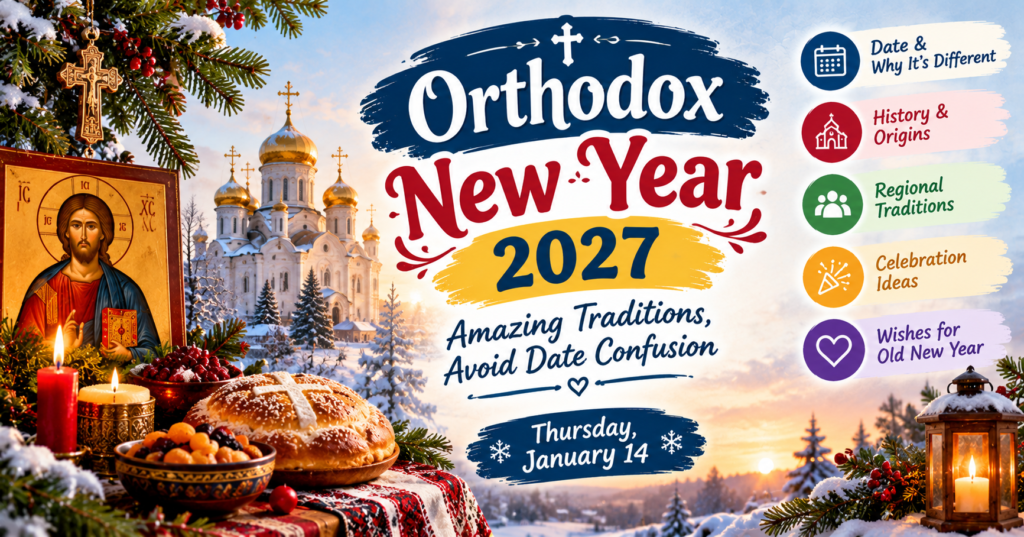
Orthodox New Year 2027 will be celebrated on Thursday, January 14, by communities that follow the traditional Julian calendar for the New Year. Also known as the Old New Year, this observance preserves a calendar tradition that continues in parts of Eastern Europe and in Orthodox communities around the world. This guide explains why the date falls in January, explores regional customs and offers meaningful greetings and celebration ideas.
It is a cultural and calendar-based observance, not a universal feast for every Orthodox Christian. If you are looking for the civil New Year, see our New Year’s Day 2027 guide.
Quick answer: Orthodox New Year 2027 is Thursday, January 14, 2027. It matches January 1 on the traditional Julian calendar, which currently runs 13 days behind the Gregorian calendar. Not all Orthodox Christians observe it.
When Is Orthodox New Year 2027?
Orthodox New Year 2027 is on Thursday, January 14, 2027.
- Date: Thursday, January 14, 2027
- Julian calendar date: January 1
- Also called: Old New Year
- Gap: The Gregorian date is 13 days later than the Julian date
This observance is different from the Orthodox liturgical year, which traditionally begins on September 1. The two are often confused, so keep them separate when you write or share greetings.
What Is Orthodox New Year?
Orthodox New Year, or Old New Year, is a second New Year observed by some communities after January 1. It combines family customs, cultural identity, reflection and, in some places, religious practice.
Some people mark it with a family meal or gathering. Others attend a church service or observe the date quietly. Customs differ widely between countries, families and parishes, so no single description fits everyone.
Why Is Orthodox New Year Celebrated on January 14?
The Julian Calendar Explained
The Julian calendar was introduced under Julius Caesar in 45 BCE and was widely used for centuries before the Gregorian reform.
The Gregorian Calendar Reform
The Gregorian calendar was introduced in 1582 to correct inaccuracies in how the Julian calendar measured the year. Countries adopted it at different times.
Why January 1 Becomes January 14
January 1 on the traditional Julian calendar currently falls on January 14 on the Gregorian calendar. This 13-day difference applies from 1901 through 2100.
Why Not Every Orthodox Christian Celebrates on January 14
Orthodox churches do not all use the same calendar for fixed dates. Some follow the Julian calendar, while others use the Revised Julian calendar, whose fixed dates currently match the Gregorian calendar. As a result, January 14 is not a universal Orthodox observance. For more on how the calendar itself works, see this Wikipedia article on the Julian calendar.
History of Orthodox New Year
- 45 BCE: Julius Caesar’s reform establishes the Julian calendar.
- 1582: Pope Gregory XIII introduces the Gregorian calendar reform.
- Different adoption dates: Countries move to the Gregorian calendar at different times.
- 1918 in Soviet Russia: The civil calendar changes to the Gregorian system, while the Russian Orthodox Church keeps the Julian calendar for church observances.
- Today: January 14 is still celebrated as Old New Year in communities that keep the relevant calendar tradition.
It is best understood as a calendar-based cultural observance with local expressions, not as an identical religious feast across all Orthodox churches.
Orthodox New Year Traditions Around the World
Russia
Old New Year is generally a second, more informal celebration after January 1. Some families gather for meals, visit friends or enjoy entertainment. Customs differ between households.
Serbia
Serbian New Year brings public festivities, family gatherings, music and local customs. Some celebrations include church-related observances, while others are mainly social or cultural.
Other Communities
Customs vary across parts of Eastern Europe and among communities abroad. No single dish, ritual or greeting is universal to every Orthodox household.
How to Celebrate Orthodox New Year 2027
- Share a thoughtful New Year greeting with family and friends.
- Prepare a meal inspired by your family’s cultural background.
- Gather for a meal, music or a quiet evening together.
- Reflect on the past year and set achievable goals.
- Attend a local service or community event if it is part of your tradition.
- Teach children about the Julian and Gregorian calendars.
- Call relatives who live abroad and share family memories.
- Support a local charity or do an act of kindness to start the year well.
Check your local church or community calendar for events rather than assuming every parish holds a special service on January 14. If you want to ask others about customs, communities such as r/OrthodoxChristianity on Reddit are a respectful place to start.
Orthodox New Year Wishes, Greetings and Messages
These greetings are original suggestions, not quotations from religious authorities or liturgical texts.
Short Orthodox New Year Wishes
- “Wishing you peace, health, and happiness in the New Year.”
- “May the year ahead bring your family love, hope, and many blessings.”
- “Happy Old New Year! May your home be filled with warmth and joy.”
- “May this new beginning bring you wisdom, strength, and beautiful memories.”
- “Wishing you a peaceful Orthodox New Year filled with kindness and gratitude.”
Family Messages
- “May our family share another year of love, laughter, good health, and treasured moments together. Happy New Year!”
- “As we welcome the Old New Year, may our home remain full of warmth, understanding, and hope for the future.”
Messages for Friends
- “Happy Orthodox New Year! May your plans move forward, your friendships grow stronger, and your days bring plenty of reasons to smile.”
- “Wishing you a fresh start, new opportunities, and peace in everything you do this year.”
Faith-Oriented Wishes
- “May God grant you peace, wisdom, good health, and strength throughout the coming year.”
- “May your year be guided by faith, filled with compassion, and blessed with hope.”
For the Christmas greetings that come just before this date, see our Orthodox Christmas wishes 2027 and Orthodox Christmas Eve 2027 guides.
Orthodox New Year Facts
| Question | Answer |
|---|---|
| What is another name for Orthodox New Year? | Old New Year |
| When is it in 2027? | Thursday, January 14 |
| What date is it on the Julian calendar? | January 1 |
| Why does it fall on January 14? | The Julian and Gregorian calendars currently differ by 13 days |
| Do all Orthodox Christians observe it? | No. Calendar practices and local traditions differ |
| Is it the start of the Orthodox liturgical year? | No. The traditional liturgical year begins on September 1 |
| Is it a public holiday everywhere? | No. Status depends on the country or region |
Frequently Asked Questions About Orthodox New Year 2027
When Is Orthodox New Year in 2027?
It is Thursday, January 14, 2027, for communities observing January 1 on the traditional Julian calendar.
Why Is Orthodox New Year Celebrated on January 14?
January 14 on the Gregorian calendar corresponds to January 1 on the traditional Julian calendar during the current 13-day difference.
What Is the Difference Between Orthodox New Year and Old New Year?
The names are often used interchangeably for the January 14 observance tied to the Julian calendar. Usage varies by country and community.
Do All Orthodox Christians Celebrate Orthodox New Year on January 14?
No. Orthodox churches follow different calendar practices, and not all treat January 14 as a special New Year celebration.
What Are Common Orthodox New Year Traditions?
Depending on the community, traditions may include family meals, visiting friends, music, reflection, cultural events and religious observances.
Is Orthodox New Year a Religious Holiday?
It has religious and cultural associations, but the Old New Year is not a universal feast day for all Orthodox Christians. Its meaning and customs vary.
When Does the Orthodox Church Year Begin?
The traditional Orthodox liturgical year begins on September 1. This is separate from the Old New Year celebrated by some communities on January 14.
Countdown to Orthodox New Year 2027
Thursday, January 14, 2027
81 days to go (calculated from October 25, 2026).
Browse more seasonal guides on our homepage.