
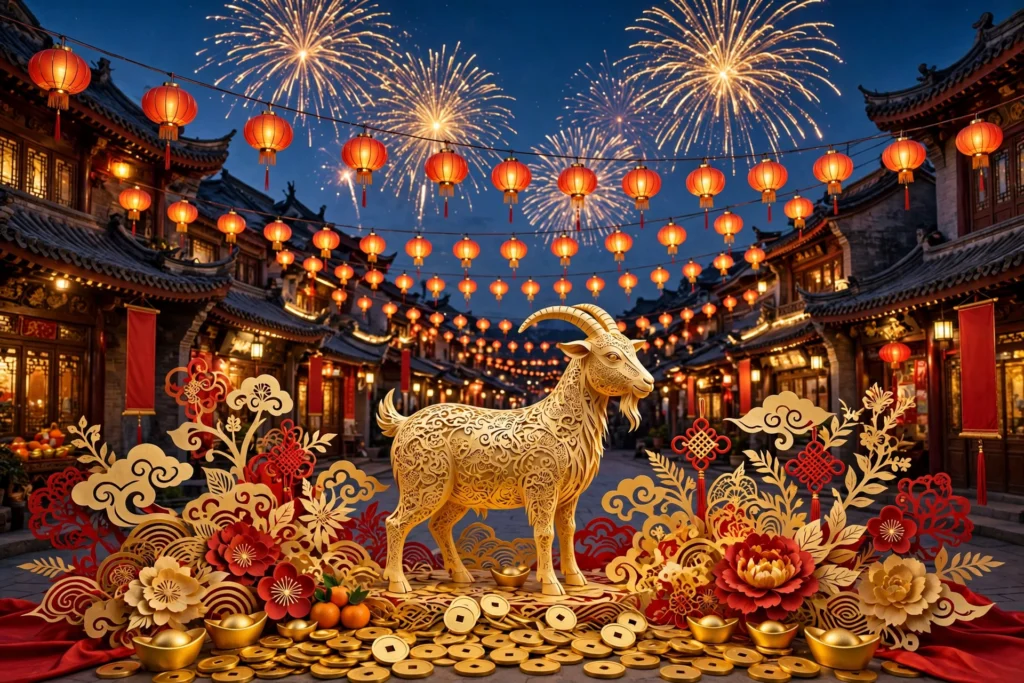
Lunar New Year 2027 at a Glance
Lunar New Year 2027 falls on Saturday, February 6, 2027. It opens the Year of the Fire Goat (Ding Wei, 丁未) and begins a 15-day festival that ends with the Lantern Festival on Saturday, February 20, 2027. New Year’s Eve — the night of the family reunion dinner — is Friday, February 5, 2027.
Known as the Spring Festival (Chūnjié, 春节) in China, Tết in Vietnam, and Seollal in Korea, Lunar New Year is the biggest celebration of the year for hundreds of millions of people across East and Southeast Asia — and for Asian American communities across the United States. It is not a single day: the festival runs from the second new moon after the winter solstice to the first full moon of the new lunar year, which is why its date on the Gregorian calendar moves every year, always falling somewhere between January 21 and February 20.
This guide covers the 2027 dates, what the Year of the Fire Goat means, where the festival comes from, the traditions day by day, the foods and their meanings, how it is celebrated in the United States, and the greetings to use.
Key Dates for Lunar New Year 2027
| Occasion | Date | Day |
|---|---|---|
| Lunar New Year’s Eve (reunion dinner) | February 5, 2027 | Friday |
| Lunar New Year’s Day | February 6, 2027 | Saturday |
| Lantern Festival (Day 15, festival ends) | February 20, 2027 | Saturday |
| Zodiac animal | Goat — also called the Sheep or Ram | |
| Element and stem-branch | Fire — Ding Wei (丁未) | |
| Fire Goat year ends | January 25, 2028 | Monday |
Because the festival follows the moon, the date shifts each year. Here are the next few:
| Year | Lunar New Year’s Day | Animal |
|---|---|---|
| 2027 | Saturday, February 6, 2027 | Goat (Fire) |
| 2028 | Wednesday, January 26, 2028 | Monkey |
| 2029 | Tuesday, February 13, 2029 | Rooster |
One date worth noting: a baby born on February 5, 2027 is still born in the Year of the Horse. The Goat year only begins with the new moon on February 6. (In BaZi birth-chart tradition the year turns slightly earlier, at Li Chun, the Start of Spring, on February 4, 2027 — a different system from the festival calendar.)
Why Does the Date Change Every Year?
Lunar New Year is set by the lunisolar calendar, not the Gregorian one. It falls on the second new moon after the winter solstice — or the third new moon if an extra leap month intervenes. That is why it always lands between January 21 and February 20, and why it rarely falls on the same date twice in a row.
The festival itself lasts 15 days because it runs from that new moon to the first full moon of the lunar year. The full moon on Day 15 is the Lantern Festival, the closing night of the celebration.
The same lunar calendar is used by several cultures, so the festival is shared but not identical everywhere. Chinese New Year, Vietnamese Tết, and Korean Seollal all begin on the new moon, but local calendars occasionally put them a day apart: in 2027, Tết falls on the same day as the Chinese date (Saturday, February 6), while Korea’s Seollal falls on Sunday, February 7, with South Korea’s public holiday running February 6–9.
The Year of the Fire Goat: What It Means
2027 is the Year of the Goat, the eighth animal in the 12-year Chinese zodiac cycle. The single Chinese character 羊 (yáng) covers goat, sheep, and ram, which is why English sources use all three names — the San Francisco Chinese New Year Parade, for example, calls 2027 the Year of the Ram.
The “Fire” part comes from the 60-year stem-branch cycle: 2027 is Ding Wei (丁未), pairing the Goat branch with yin fire. The last Fire Goat year was 1967, a full 60 years ago.
In zodiac tradition — cultural belief, not science — Goat people are described as gentle, kind-hearted, creative, and harmony-seeking, with a quiet resilience underneath. The Fire element is said to add warmth, passion, and confidence to that calm nature. People born in Goat years include 2015, 2003, 1991, 1979, 1967, and 1955. For anyone born in a Goat year, 2027 is their Ben Ming Nian, their own zodiac year, which tradition treats as a year of change to approach thoughtfully.
| Traditional associations for the Goat | |
|---|---|
| Lucky numbers | 2 and 7 |
| Lucky colors | Brown, red, and purple |
| Lucky flowers | Carnations and primroses |
| Unlucky number | 4 — it sounds like the word for “death” in Mandarin |
| Unlucky colors | Blue and black |
Sources vary slightly on some of these associations, so treat them as folklore rather than fixed rules — the numbers 2 and 7 and the flowers carnation and primrose are the most consistently cited.
Where Lunar New Year Comes From
The legend of Nian
The best-known origin story is the legend of Nian (年), a beast said to emerge from the sea at the end of each year to devour people and livestock. Villagers discovered that Nian feared the color red, loud noises, and bright light — so they hung red decorations, lit lanterns, and set off firecrackers. The beast never returned, and the customs stuck. Nian is also simply the Chinese word for “year,” which is why the story doubles as an explanation of the festival itself.
A festival with thousands of years behind it
Beyond the legend, the festival grew out of ancient agrarian life: the end of winter, the start of spring, and the hope of a good planting season. The earliest New Year rituals trace back to the Shang Dynasty (around 1600–1046 BCE), when ceremonies honored deities and ancestors. During the Han Dynasty (206 BCE–220 CE), the first day of the lunar year was officially recognized as a holiday, and by the Tang and Song Dynasties the celebration had become a public festival of lanterns, poetry, theater, and feasting. That is why the festival is still called the Spring Festival in China — it marks winter giving way to spring.
The 15 Days of Lunar New Year, Day by Day
Not every day is celebrated the same way. The first days are for family; the middle days are quieter; the last day is a public finale.
| Day | Date in 2027 | What happens |
|---|---|---|
| New Year’s Eve | Fri, Feb 5 | The reunion dinner (nián yè fàn) — the most important meal of the year, with family gathered. Firecrackers at midnight to welcome the new year and scare off Nian. |
| Day 1 | Sat, Feb 6 | New Year’s Day. Children greet elders with bows and auspicious phrases and receive red envelopes. Wear red; avoid sweeping, using knives, or lending money so good fortune is not swept or cut away. |
| Day 2 | Sun, Feb 7 | Visiting day — in many traditions married daughters return to their parents’ home, and families visit in-laws and elders. |
| Day 3 | Mon, Feb 8 | Chikou, “Red Dog Day” — traditionally considered unlucky for social visits, so many families stay home and rest. |
| Day 5 | Wed, Feb 10 | Po Wu — many of the early taboos lift, and the God of Wealth is welcomed with offerings and firecrackers. |
| Day 7 | Fri, Feb 12 | Renri, “everyone’s birthday” — the day humans were created in legend, marked with long noodles for a long life. |
| Days 8–14 | Feb 13–19 | Visits, temple fairs, and preparations: lanterns are made, lion and dragon dances rehearsed, and markets stay busy. |
| Day 15 | Sat, Feb 20 | The Lantern Festival (Yuánxiāo Jié) — lanterns are lit and displayed, riddles are solved, and sweet glutinous rice balls (tangyuan) are eaten. The festival ends. |
Regional customs vary, and many families keep only the days that matter most to them — Eve, Day 1, and the Lantern Festival are the three almost everyone marks.
Foods of Lunar New Year and What They Mean
Almost every dish on the New Year table is a wish in edible form. The reunion dinner is built around foods whose names or shapes sound like prosperity, abundance, or long life.
| Food | Why it is eaten |
|---|---|
| Dumplings (jiǎozi) | Shaped like old silver ingots — a wish for wealth in the new year. |
| Whole fish | “Fish” sounds like “surplus” in Mandarin (年年有余) — a wish for abundance year after year. The fish is served whole, head to tail. |
| Niangao (sticky rice cake) | Its name sounds like “a higher year” — growth, promotion, a step up. |
| Spring rolls | Golden and bar-shaped — another symbol of wealth. |
| Longevity noodles | Long, uncut noodles for a long life. Cutting them is avoided. |
| Tangerines and oranges | Their round shape and golden color suggest fullness and good luck; often given as gifts. |
| Tangyuan / yuanxiao (sweet rice balls) | Round like the full moon — family unity and togetherness, eaten at the Lantern Festival. |
Red Envelopes and the Color Red
Red envelopes — hóngbāo in Mandarin, lai see in Cantonese — are the festival’s most recognizable gift. Elders give them to children and unmarried young adults, filled with money as a wish for prosperity and protection in the year ahead.
A few customs surround them: use crisp, new banknotes, never old or wrinkled ones; give even amounts, which are considered lucky; and avoid any amount containing the number 4. The envelopes are not opened in front of the giver — that is a matter of respect. Digital red envelopes sent through payment apps are now common too, especially among younger people and friends who cannot be together.
Red itself runs through the whole festival — lanterns, banners, clothing, decorations — because it stands for vitality, joy, and protection against evil spirits. New clothes, especially red ones, are traditionally worn on New Year’s Day to mark a fresh start.
How Different Countries Mark the Festival
Lunar New Year is one festival with many local forms. The shared core is family, food, red envelopes, and lanterns; the details differ.
| China — Spring Festival | Vietnam — Tết | Korea — Seollal | |
|---|---|---|---|
| 2027 date | Sat, Feb 6 | Sat, Feb 6 | Sun, Feb 7 |
| Signature food | Dumplings, whole fish, niangao | Bánh chưng (sticky rice cake), pickled onions | Tteokguk (rice cake soup), jeon pancakes |
| Signature custom | Reunion dinner, red envelopes, lion dances | First-footing (xông nhà), ancestral altars, peach blossoms | Sebae (deep bow to elders), wearing hanbok, yutnori game |
| Closing | Lantern Festival, Feb 20 | Lanterns and temple visits | Ancestral rites (charye) across the holiday |
Singapore, Malaysia, the Philippines, and Indonesia also mark the festival with public holidays, lion dances, and open houses. In the United States, the festival belongs to all of these communities at once, which is why American celebrations often mix traditions from several of them.
Lunar New Year in the United States
Lunar New Year is widely celebrated in the United States, but its official status is uneven — and that catches people out every year.
Is Lunar New Year a federal holiday?
No. Lunar New Year is not a federal holiday in the United States. Federal offices, post offices, and banks operate on their normal schedules. A bill called the Lunar New Year Day Act (H.R. 794) was introduced in the 119th Congress to make it the 12th federal holiday, but as of early 2026 it had not advanced beyond introduction.
Where it is officially recognized
California was the first state to designate Lunar New Year an official state holiday: Governor Gavin Newsom signed Assembly Bill 2596 in September 2022, adding it to the list in California Government Code Section 6700. The listing does not automatically give state workers a paid day off the way Christmas or Labor Day does, but it is formal state recognition. Colorado followed in 2023, and New York and New Jersey added the designation in 2023 and 2024.
Schools are a different story, because calendars are set locally. New York’s governor signed legislation in September 2023 making Lunar New Year a public school holiday across New York State, so schools are not in session on the day. New York City’s public schools close, and large districts such as San Francisco Unified (closed since 2023) and Los Angeles Unified also close. Whether your district closes depends on its own calendar — check it directly rather than assuming.
The San Francisco Chinese New Year Parade
The best-known American celebration is the San Francisco Chinese New Year Festival and Parade, which calls itself the biggest Lunar New Year parade outside Asia and one of the few remaining illuminated night parades in North America. For 2027 it is scheduled for Saturday, February 20, 2027 — Lantern Festival night — starting at 5:15 p.m. from 2nd and Market Streets, looping around Union Square and ending at Kearny Street and Columbus Avenue, a route of about 1.3 miles lasting roughly two and a half hours.
The parade is free to watch from behind the barricades; bleacher seats are sold online through Eventeny via the official site and are non-refundable. The showpiece is the 288-foot Golden Dragon (Gum Lung), carried by more than 180 martial artists, alongside floats, lion dances, firecrackers, and the newly crowned Miss Chinatown U.S.A. and her court. The organizers say the parade is not cancelled for rain. New York’s Chinatown parade and other city celebrations had not announced 2027 dates at the time of writing — check the organizers closer to February.
Greetings and Wishes for Lunar New Year 2027
What you say depends on whose New Year it is. A few greetings that work:
- Mandarin: Xīnnián kuàilè (新年快乐) — “Happy New Year”; Gōngxǐ fācái (恭喜发财) — “Wishing you prosperity.”
- Cantonese: Gōng héi faat chòih (恭喜發財) — the Cantonese form of “wishing you prosperity.”
- Korean: Saehae bok mani badeuseyo (새해 복 많이 받으세요) — “Please receive many blessings in the new year.”
- Vietnamese: Chúc mừng năm mới — “Happy New Year.”
For cards, texts, and social media:
- “Happy Lunar New Year! May the Year of the Fire Goat bring you health, happiness, and prosperity.”
- “Wishing you and your family a bright and joyful Lunar New Year — good fortune in the year ahead.”
- “May your home be filled with laughter, your table full, and your year blessed. Happy Lunar New Year 2027!”
- “Gong xi fa cai! Wishing you success, good health, and happiness in the Year of the Goat.”
- “Happy Seollal! 새해 복 많이 받으세요 — may the new year bring you many blessings.”
- “Chúc mừng năm mới! Wishing you a peaceful and prosperous Tết.”
For colleagues and professional contacts, keep it simple: “Wishing you a happy and prosperous Lunar New Year” is warm without overstepping.
Things People Traditionally Avoid
Many Lunar New Year customs are about not disturbing the luck of the new year. The most commonly observed:
- Do not sweep or take out the trash on Day 1 — it is believed to sweep away good fortune.
- Do not use knives or scissors on Day 1 — sharp objects are thought to cut luck.
- Do not wash your hair on Day 1 — in the tradition, it washes away good fortune.
- Do not lend money or ask for repayment — debts and lending on New Year’s Day are considered bad luck for the year.
- Do not break dishes or glassware — if it happens, the traditional response is to say “suì suì píng ān” (岁岁平安), “peace year after year,” which turns the break into a blessing.
- Avoid the number 4 and black or white clothing — 4 sounds like “death,” and black and white are associated with mourning.
- Avoid arguments and negative words — the first days are meant to set a harmonious tone for the year.
These are traditions, not rules everyone follows — many families keep a few and let the rest go. The spirit is the same either way: start the year clean, generous, and at peace with the people around you.
Frequently Asked Questions
When is Lunar New Year 2027?
Lunar New Year 2027 is Saturday, February 6, 2027. New Year’s Eve is Friday, February 5, and the festival ends with the Lantern Festival on Saturday, February 20, 2027.
What animal is 2027 in the Chinese zodiac?
2027 is the Year of the Goat — also called the Sheep or Ram — and specifically the Year of the Fire Goat (Ding Wei). The Goat year runs from February 6, 2027 to January 25, 2028.
Is Lunar New Year the same as Chinese New Year?
Largely, yes. “Chinese New Year” is the name for the festival as celebrated in China (the Spring Festival). “Lunar New Year” is the broader term that also covers Vietnam’s Tết, Korea’s Seollal, and the festival as celebrated by other Asian communities and the diaspora.
How long does Lunar New Year last?
Traditionally 15 days, from New Year’s Day to the Lantern Festival on the 15th day. In China the public holiday is shorter — the first days are the official break — but family celebrations run the full 15 days.
Is Lunar New Year a public holiday in the US?
Not federally. California made it an official state holiday in 2022, and New York made it a public school holiday in 2023. Many large school districts, including New York City, San Francisco, and Los Angeles, close on the day — but check your local calendar.
What is the Lantern Festival?
The Lantern Festival is the 15th and final day of Lunar New Year (February 20, 2027), celebrated with lit lanterns, riddles, lion and dragon dances, and sweet glutinous rice balls called tangyuan.
What do you say for Lunar New Year?
In Mandarin, “Xīnnián kuàilè” (Happy New Year) or “Gōngxǐ fācái” (wishing you prosperity). In Cantonese, “Gōng héi faat chòih.” In Korean, “Saehae bok mani badeuseyo,” and in Vietnamese, “Chúc mừng năm mới.”
When is the San Francisco Chinese New Year Parade in 2027?
Saturday, February 20, 2027, starting at 5:15 p.m. from 2nd and Market Streets. It is free to watch from the route; bleacher seats are sold online through the official site.
Sources
Dates and zodiac verified against the Farmers’ Almanac’s Lunar New Year guide and the Hong Kong Observatory’s 2027 calendar as reported there; festival history and the Nian legend via Britannica; the San Francisco parade date, route, and ticketing via the official Chinese New Year Festival & Parade FAQ; California’s state-holiday status via the text of Assembly Bill 2596 (2022). Event details were checked on November 5, 2026; parade times and school closures can change, so confirm with the organizers closer to the date. No 2027 deals or offers are listed here because none were verified from official sources at the time of writing.
More winter festivals on MemorialDay2026.com: our Hanukkah 2026 guide covers the festival of lights that runs December 4–12, our Christmas 2026 guide and best Christmas movies list cover the December season, and our Kwanzaa 2026 guide covers December 26–January 1. For the days around Lunar New Year itself, see National Freedom Day 2027 (February 1), Groundhog Day 2027 (February 2), and New Year’s Day 2027.