
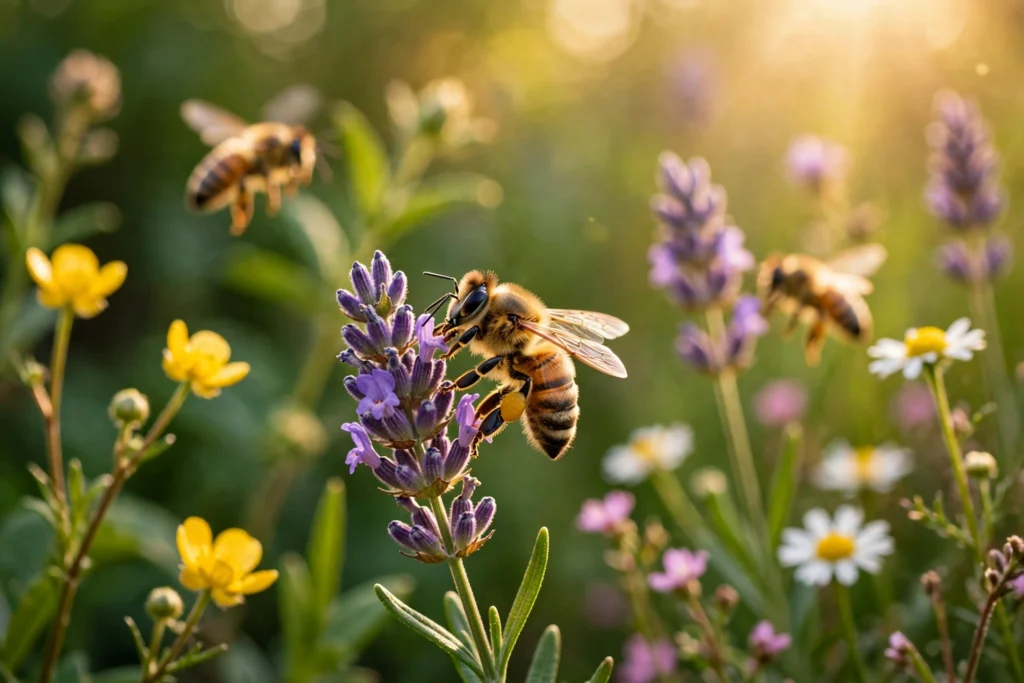
World Bee Day 2027 falls on Thursday, May 20, 2027. It is the one day of the year the whole world stops to notice the smallest farm workers on the planet: the bees that pollinate the apples in your lunchbox, the almonds in your granola and the coffee in your morning cup. This guide has the exact date, a live countdown, the story of the Slovenian beekeeper whose birthday fixed the date, why bees matter so much to the food on your plate, and simple ways to help them in your own yard.
Countdown to World Bee Day 2027
Loading…
until Thursday, May 20, 2027 at 12:00 AM Eastern Time
When Is World Bee Day 2027?
World Bee Day 2027 is on Thursday, May 20, 2027. The day is fixed on May 20 every year, so it never moves around the calendar the way Easter or Thanksgiving does. It always lands in the heart of spring in the Northern Hemisphere, when colonies are at their busiest and gardens are full of flowers to pollinate.
How many days until World Bee Day 2027?
From today, November 24, 2026, there are 177 days remaining until World Bee Day 2027. The countdown timer at the top of this page ticks down live to midnight at the start of Thursday, May 20, 2027, Eastern Time, so you can check the exact days, hours, minutes and seconds left at any moment.
| Year | Date | Weekday |
|---|---|---|
| 2026 | May 20, 2026 | Wednesday |
| 2027 | May 20, 2027 | Thursday |
| 2028 | May 20, 2028 | Saturday |
| 2029 | May 20, 2029 | Sunday |
| 2030 | May 20, 2030 | Monday |
What Is World Bee Day?
World Bee Day is a United Nations observance held every May 20 to raise awareness of the importance of bees and other pollinators for food production, biodiversity, ecosystems and sustainable development. The Food and Agriculture Organization of the United Nations (FAO) leads the global celebration, working with governments, beekeeping associations, schools and community groups. Around the world the day is marked with educational campaigns, beekeeping events, community planting days, workshops, exhibitions and school activities. The 2026 theme was "Bee together for people and the planet: a partnership that sustains us all." As of November 24, 2026, the FAO has not yet announced a theme for 2027.
It is easy to think of bees as a countryside concern, but their work reaches every American kitchen. Without pollinators, the produce aisle would look very different: no almonds, far fewer apples, berries, melons, cucumbers, pumpkins, avocados or coffee beans. That is why the day exists, not to celebrate honey, but to protect the insects that make a third of our food possible.
Why May 20? The Slovenia Story
World Bee Day exists because of Slovenia, a small country with an outsized love of beekeeping. About one in every 200 Slovenians keeps bees, and Slovenia was the first country in the world to pass legislation protecting bees. The Slovenian Beekeepers Association, with the support of Apimondia, the International Federation of Beekeepers Associations, and the FAO, began the campaign for a global day in 2014 and formally proposed it through the FAO in 2015.
On December 20, 2017, the United Nations General Assembly in New York unanimously adopted the resolution proclaiming May 20 as World Bee Day, co-sponsored by 115 countries. The first ever World Bee Day was celebrated on May 20, 2018, with the official ceremony in Zirovnica, Slovenia.
The date was chosen for one man: Anton Jansa (1734-1773), the Slovenian pioneer of modern beekeeping, who was born on May 20, 1734. Jansa came from a family of beekeepers and was appointed by the Austrian Empress Maria Theresa as the first teacher of modern beekeeping at the new beekeeping school in Vienna. His methods laid foundations that beekeepers still use today. May was also chosen because it is the month when pollination is needed most and bee colonies in the Northern Hemisphere are swarming and reproducing, while in the Southern Hemisphere it is the season when bee products are harvested.
Why Bees Matter: The Numbers Behind the Buzz
The FAO figures behind World Bee Day are startling, and they explain why a whole United Nations day is devoted to an insect most of us swat away from a picnic:
| What bees do | The number |
|---|---|
| Share of the world's leading food crops that depend at least partly on pollinators | About 75% |
| Share of world crop production by volume affected by pollinators | About 35% |
| Leading food crops whose production pollinators directly affect | 87 |
| Known bee species worldwide | More than 20,000 |
| Flowering plant species pollinated by animals, mostly insects | More than 80% |
| Value of pollination to American agriculture each year | About $15 billion |
| Invertebrate pollinator species, especially bees and butterflies, now facing extinction | About 40% |
Only the honey bee gets most of the attention, but it is one species among more than 20,000. Native wild bees, bumblebees, mason bees and solitary bees do a huge share of the pollinating, often more efficiently than honey bees, flower for flower. Protecting bees means protecting all of them, not just the ones in managed hives.
Why Bees Are in Trouble
Bee numbers have been falling for decades, and the causes are now well documented. Five threats do most of the damage:
- Habitat loss. Wildflower meadows, hedgerows and nesting sites disappear under lawns, pavement and single-crop farmland, leaving bees with nowhere to feed or nest.
- Pesticides. Neonicotinoid insecticides harm bees' navigation, memory and reproduction. Slovenia banned some of them as early as 2011, and the European Union extended the ban to all field crops in 2018.
- Parasites and disease. The Varroa mite, a tiny parasite that feeds on honey bees and spreads viruses, is one of the biggest killers of managed colonies worldwide.
- Climate change. Warmer winters, shifting seasons and extreme weather throw bees and the flowers they depend on out of sync, so blooms open before bees are ready, or after.
- Invasive species and pollution. Non-native plants, pests and air pollution add stress to colonies already weakened by the threats above.
None of these threats is mysterious, and that is the hopeful part of World Bee Day: every one of them has a practical answer, and many of the answers start in an ordinary backyard.
10 Ways to Celebrate World Bee Day 2027
You do not need a hive or a farm to help bees. These ten ideas work for anyone with a yard, a balcony or a grocery list:
- Plant bee-friendly flowers. Lavender, sunflowers, coneflowers, borage, clover and wildflowers give bees nectar all season. Plant a mix that blooms from spring to fall so food never runs out.
- Leave the dandelions. Early spring dandelions are one of the first foods available to bees waking from winter. Hold off mowing the first flush and let them feed.
- Skip the spray. Avoid insecticides on flowering plants, and never spray while bees are foraging. If you must treat a plant, do it in the evening when bees are home.
- Put out a bee hotel. Most native bees are solitary and nest in hollow stems or holes in wood. A simple bundle of hollow stems or a drilled wooden block gives them a home.
- Leave a shallow water dish. Bees need water too. A shallow dish with pebbles or marbles to land on keeps them from drowning.
- Buy local honey. Local beekeepers keep colonies alive in your area. Buying their honey supports the people doing the hands-on work of bee care.
- Grow herbs and let them flower. Basil, mint, thyme, rosemary and oregano are all bee magnets once they bloom, and you get herbs for the kitchen too.
- Teach a child about bees. Show a child a bee on a flower, explain the waggle dance, or visit a local apiary open day. The 2024 World Bee Day theme was "Bee engaged with youth" for exactly this reason.
- Support pollinator groups. Organizations like the Pollinator Partnership, Bee City USA and the Xerces Society run planting programs, citizen science and habitat projects you can join.
- Share the day. Post a photo of a bee in your garden on May 20 and tell people what bees do for their food. Awareness is the whole point of the day.
Bee Facts That Will Surprise You
- A honey bee visits 50 to 100 flowers on a single collection trip, and a colony must visit about 2 million flowers to make one pound of honey.
- To make that one pound of honey, foraging bees fly about 55,000 miles together, more than twice around the Earth.
- A single worker bee makes only about 1/12 of a teaspoon of honey in her entire life. Every spoonful in your jar is the lifetime work of many bees.
- A queen can lay up to 2,000 eggs a day at peak season, and she can live three to five years, while a summer worker bee lives only about six weeks.
- Honey bees talk by dancing. A forager performs a waggle dance that tells her sisters the direction and distance of good flowers. Scientist Karl von Frisch won the Nobel Prize in 1973 for decoding it.
- Honey bees have five eyes: two large compound eyes and three small simple eyes on top of their head. They also have four wings.
- A honey bee flies at about 15 miles per hour, beating its wings about 200 times a second, which is what makes the familiar buzz.
- A healthy colony holds 20,000 to 60,000 bees, with one queen, thousands of female workers and a few hundred male drones.
- Honey never spoils. Archaeologists have found pots of honey in ancient Egyptian tombs that were still perfectly edible after thousands of years.
- Honey bees are not native to North America. European settlers brought them here in the 1600s, and the more than 4,000 native bee species in the United States were pollinating long before they arrived.
World Bee Day Quotes
Four lines often quoted on the day, for a card, a classroom board or a social media post:
- "The hum of bees is the voice of the garden." - Elizabeth Lawrence
- "When the flower blooms, the bees come uninvited." - Ramakrishna
- "The bee is more honored than other animals, not because she labors, but because she labors for others." - Saint John Chrysostom
- "Handle a book as a bee does a flower, extract its sweetness but do not damage it." - often attributed to John Muir
Also on May 20, 2027
World Bee Day shares its date with a few lighter observances. National Be a Millionaire Day falls on May 20, a fun excuse to daydream about what you would do with a fortune. National Rescue Dog Day, also May 20, celebrates adopted dogs and the shelters that care for them. Food lovers mark National Quiche Lorraine Day on the same date, and theatre fans note Eliza Doolittle Day, named for the heroine of My Fair Lady. If your family celebrates more than one of these, May 20 is a busy day.
World Bee Day 2027 FAQ
When is World Bee Day 2027?
World Bee Day 2027 is on Thursday, May 20, 2027. It is observed on May 20 every year.
Why is World Bee Day on May 20?
May 20 is the birthday of Anton Jansa, born in 1734, the Slovenian pioneer of modern beekeeping. May is also the peak month for pollination in the Northern Hemisphere.
What is the theme of World Bee Day 2027?
The official theme for World Bee Day 2027 has not been announced yet. The latest confirmed theme is the 2026 theme, "Bee together for people and the planet: a partnership that sustains us all." The FAO usually announces each year's theme in the months before May.
Who started World Bee Day?
Slovenia proposed the day through the Slovenian Beekeepers Association, with support from Apimondia and the FAO. The United Nations General Assembly adopted it unanimously on December 20, 2017, and it was first celebrated on May 20, 2018.
Do all bees make honey?
No. Only honey bees make honey in any quantity, and they are just one species among more than 20,000 bee species. Most wild bees are solitary, do not live in hives, and do not make honey, but they are vital pollinators all the same.
What can I do to help bees?
Plant bee-friendly flowers, leave dandelions in spring, avoid spraying insecticides on blooms, provide a shallow water dish, put up a bee hotel, and buy honey from local beekeepers. Small actions in many yards add up to real habitat.
World Bee Day 2027 is 177 days away, and that is plenty of time to plan. Plant a patch of lavender now, or mark May 20 on your calendar and use the day to give the bees in your neighbourhood a better year. The bees have been feeding us for thousands of years. One day a year, and a few small habits, is a fair return. For more about the day and its global events, see the FAO World Bee Day page, the IUCN report on pollinator conservation and the Awareness Days listing. On this site, see also Earth Day 2027, Arbor Day 2027, Mother's Day 2027, Memorial Day 2027, World Family Doctor Day 2027 and May Ray Day 2027.
Note: no 2027 theme, events or offers were verified from official sources at the time of writing, November 24, 2026, and none are listed above. This article will be updated when the FAO announces the 2027 theme.