
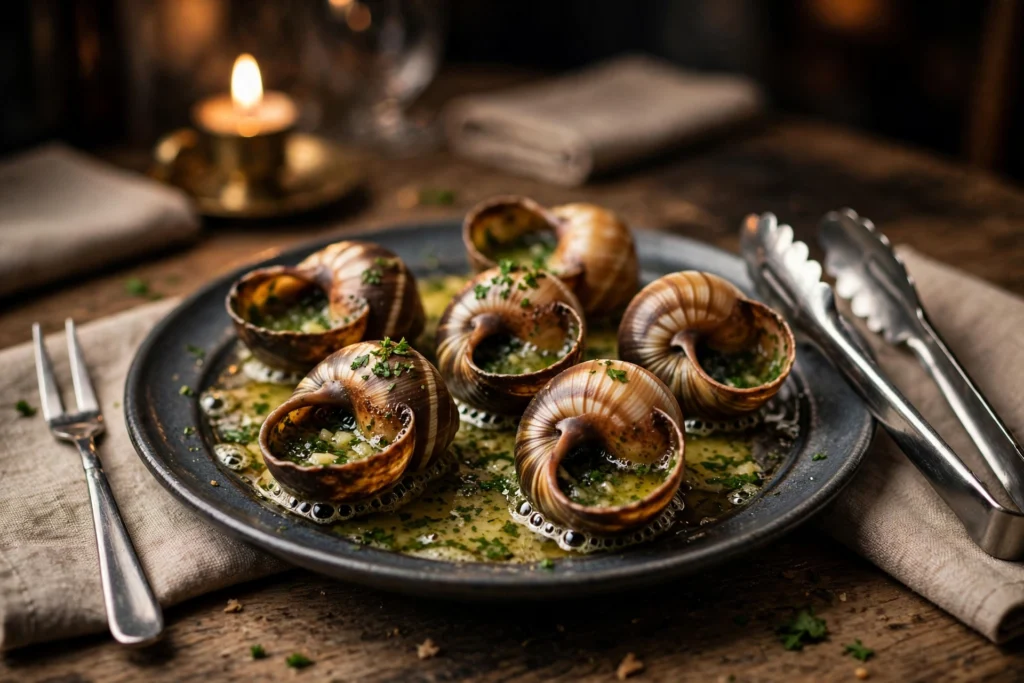
National Escargot Day 2027 falls on Monday, May 24, 2027. It is the one day of the year that asks you to set aside the squeamishness and taste one of the oldest delicacies in the world: land snails cooked in garlic, parsley and butter, served bubbling hot in their shells. This guide has the exact date and a live countdown, the 10,000-year story of humans eating snails, the famous 1814 dinner for a Russian tsar, how to eat escargot properly at a restaurant, what it actually tastes like, and ten ways to celebrate.
Countdown to National Escargot Day 2027
Loading…
until Monday, May 24, 2027 at 12:00 AM Eastern Time
When is National Escargot Day 2027?
National Escargot Day 2027 is on Monday, May 24, 2027. The date is fixed: the day is celebrated every year on May 24, whatever weekday that happens to be. It lands exactly one week before Memorial Day 2027 (Monday, May 31), so a French dinner on May 24 makes a fitting, slightly fancy warm-up to the holiday weekend that follows.
| Year | Date | Weekday |
|---|---|---|
| 2026 | May 24, 2026 | Sunday |
| 2027 | May 24, 2027 | Monday |
| 2028 | May 24, 2028 | Wednesday |
| 2029 | May 24, 2029 | Thursday |
| 2030 | May 24, 2030 | Friday |
| 2031 | May 24, 2031 | Saturday |
How many days until National Escargot Day 2027?
From today, November 26, 2026, there are 179 days remaining until National Escargot Day 2027. The live countdown at the top of this page ticks down to midnight at the start of Monday, May 24, 2027, Eastern Time, so you can check the exact days, hours, minutes and seconds left at any moment. If you are booking a table at a French restaurant for the day, that countdown is your planning deadline, since popular bistros fill up for food holidays.
What is escargot?
Escargot is the French word for snail, and in English it means one specific thing: edible land snails, cooked and served as a dish, usually as an appetizer. The snails are not the ones from your garden. They are farmed under controlled conditions, in an industry called heliciculture, and only a few species qualify as proper escargot.
| Species | Common name | What to know |
|---|---|---|
| Helix pomatia | Roman snail, Burgundy snail | The large one, about 1.5 to 2 inches, prized for rich flavour; under French labelling rules only this species may be sold as escargots de Bourgogne |
| Helix aspersa | Garden snail, petit-gris | Smaller, about 1 to 1.5 inches, milder flavour; the most commonly farmed snail worldwide; the same Burgundy-style preparation with this species is usually called escargots a la bourguignonne |
| Helix lucorum | Eastern snail | Medium sized, mainly from Eastern Europe and Turkey |
The classic serving is escargots de Bourgogne: cooked snails returned to their shells, topped with a compound butter of garlic, flat-leaf parsley and shallot, then baked until the butter bubbles. A portion is usually six or twelve snails, served hot on a dimpled plate that holds the shells steady, with a small pair of tongs and a narrow two-pronged fork. The snail meat itself is mild, slightly earthy and firm. Most of the flavour comes from the butter, which melts, pools in the shell and coats every bite.
A 10,000-year history in five courses
Snails are one of the oldest foods humans have ever eaten. The trail runs from prehistoric caves to a Paris dinner table.
| When | What happened |
|---|---|
| About 10,700 BCE | Broken snail shells pile up in Franchthi Cave in Greece, among the earliest evidence of people eating land snails |
| Ancient Rome | Snails become an elite food. Pliny the Elder writes about snails raised in ponds and fed wine to fatten them; the breeder Quintus Fulvius Lippinus runs a snail farm at Tarquinia; the gourmet Apicius includes a snail recipe in the oldest surviving cookbook |
| 1390s | The first French snail recipe appears in Le Menagier de Paris, the Parisian household book |
| 1814 | French diplomat Talleyrand hosts a dinner for Tsar Alexander I of Russia in Paris; his chef, Antonin Careme, serves snails with garlic, parsley and butter. The tsar is said to have loved the dish, and snails become fashionable in Paris. Treat this as legend rather than documented fact |
| 1850s onward | Edible snails are introduced to California and the United States; by the 1980s escargot is a 300-million-dollar-a-year business in America; the dish peaks in 1970s fine dining |
There is a curious detail in the middle of that story. For about 200 years after the 1390s recipe, snails appeared in Parisian cookbooks only alongside an apology for including such a disgusting ingredient, while country people in eastern France kept eating them happily. Part of the appeal was practical: the Catholic Church classified snails as fish, so they could be eaten on meatless days and even during Lent. It took a foreign emperor who had just defeated Napoleon to make snails fashionable in Paris again.
Who invented National Escargot Day?
Honestly, nobody knows for sure. That is the documented answer. The earliest print mention of an Escargot Day in May that researchers have located dates from 2001, in the Rochester Democrat and Chronicle, which listed National Escargot Day on May 24 among the month's food holidays. Food columnist Jason Wilson of the Philadelphia Daily News later attributed the day to Doug "The Snailman" Dussault, whose company Potironne imported wild Burgundy snails. But that attribution is unconfirmed, and other researchers list the day's creator as unknown. By 2004, the Cafe Rouge chain in Scotland and England was already promoting the day with a gratin of escargots on its menus throughout May, so the observance was circulating well before then. The day's own origin is a mystery; the dish it celebrates is not.
How to eat escargot at a restaurant
If you have never ordered escargot, the tools on the table can look more intimidating than the food. They are simple once you know the routine.
- Pick up the tongs in your non-dominant hand. Use them to grip one shell firmly and hold it steady on the plate.
- Take the narrow two-pronged fork in your other hand. Slide it into the shell and twist or pull the snail out.
- Eat the snail in one bite. It is small, and one bite is the polite way to do it.
- Sop up the butter. The melted garlic butter left in the shell and on the plate is half the point of the dish. Bread is your friend here, and using it is expected, not rude.
- Work through the plate one shell at a time. Six or twelve snails is a normal portion, and there is no rush.
One safety note worth knowing: only eat escargot from a restaurant or a reputable supplier. Wild garden snails can carry parasites and should never be eaten. Commercially prepared escargot is purged, cleaned and cooked above 165 degrees Fahrenheit (74 degrees Celsius), which makes it safe.
What does escargot taste like?
Most first-timers are surprised, and usually in a good way. The snail itself tastes mild and slightly earthy, with a firm, chewy texture that people often compare to a mushroom or a clam. It does not taste slimy when it is cooked properly. What you actually taste is the garlic-parsley butter, which is rich, savoury and garlicky, with fresh parsley cutting through the fat. If you like garlic butter on bread, you will probably like escargot. The texture is the part people either accept or do not; the flavour is rarely the problem.
10 ways to celebrate National Escargot Day 2027
- Book a French bistro. Order escargots de Bourgogne as a starter and let the restaurant handle the cooking. Call ahead on May 24, since food holidays fill tables.
- Cook it at home. Canned escargot, shells, butter, garlic, parsley and shallots are all you need, and most gourmet shops stock them in May.
- Try the tongs-and-fork ritual properly. Half the fun of the dish is the ceremony of eating it the French way.
- Pair it with a crisp white wine. A dry white such as a Chablis or a Sauvignon Blanc is the classic match for garlic butter.
- Make garlic butter the star. Even if you skip the snails, a proper beurre a la bourguignonne on good bread is a worthy celebration.
- Take a first-timer. Escargot is a rite of passage dish, and watching someone try it for the first time is half the entertainment.
- Learn the snail species. Compare a Burgundy snail with a petit-gris and you will understand why French labelling law treats them differently.
- Watch a French cooking show or documentary. Antonin Careme, the chef behind the 1814 legend, is a good place to start.
- Visit a snail farm or French market. Heliciculture is a real industry, and some farms offer tours and tastings in spring.
- Share a photo, not a dare. Post the dish, the butter, the tongs. Escargot deserves better than a gross-out challenge.
Escargot around the world
France gets the fame, but snails are eaten far beyond Burgundy. In Spain, snails appear in stews and tapas, and in Catalonia the snail festival known as the Aplec del Caragol draws thousands of people every May. In Italy, lumache are served in tomato sauce or with herbs. In Greece and North Africa, snails have been eaten since ancient times, often simply grilled with herbs. In parts of West Africa and Southeast Asia, snails are a valued source of protein. The French preparation is the most famous version, but the appetite for snails is genuinely worldwide, and it is far older than France itself.
Fun facts about escargot
- The word escargot entered English in 1892, from the French word for snail, which itself traces back through Old French and Latin to the Greek word for a small shell.
- Snails were classified as fish by the Catholic Church, which is why they were allowed on meatless days and during Lent.
- France consumes more snails than any other country, and consumption peaks during the Christmas holidays.
- A single snail can have around 14,000 teeth on its tongue, called a radula, though you will not notice them at dinner.
- Snails are one of the first animals humans ever farmed. Snail farming, heliciculture, is thousands of years old.
- The dimpled plate escargot is served on has a name in French: an assiette a escargots. The tongs are called pinces a escargots.
- Wild Burgundy snails became scarce enough in the twentieth century that France has regulated their collection since 1979, with a minimum shell size of 3 centimetres and a ban on picking from April to June.
- May 24 is a crowded food date: it is also National Asparagus Day in the United States.
Also on May 24, 2027
National Escargot Day shares its date with two other celebrations already covered on this site. National Brother's Day 2027 falls on the same Monday, and so does National Scavenger Hunt Day 2027. If you are planning the day, a family scavenger hunt in the afternoon and a French dinner in the evening would cover all three at once.
Frequently asked questions
When is National Escargot Day 2027?
Monday, May 24, 2027. The day is observed every year on May 24.
How many days until National Escargot Day 2027?
From November 26, 2026, there are 179 days remaining. The live countdown at the top of this page shows the exact days, hours, minutes and seconds left.
What is escargot made of?
Edible land snails, usually the Burgundy snail or the petit-gris, cooked in their shells with garlic, parsley and shallot butter. The classic dish is escargots de Bourgogne.
Is escargot safe to eat?
Yes, when it comes from a restaurant or reputable supplier. Farmed snails are purged and cooked above 165 degrees Fahrenheit. Never eat wild garden snails.
What does escargot taste like?
Mild, slightly earthy and firm, a little like a mushroom or a clam. Most of the flavour comes from the garlic-parsley butter.
Who started National Escargot Day?
Unknown. The earliest print mention found dates from 2001. Food columnist Jason Wilson attributed it to Doug "The Snailman" Dussault, but that attribution is unconfirmed.
Do you eat escargot with your hands?
No. Use the tongs to hold the shell and the small two-pronged fork to pull the snail out. Bread for the leftover butter is expected.
Is May 24 also another food holiday?
Yes. May 24 is also National Asparagus Day in the United States, as well as National Brother's Day and National Scavenger Hunt Day.
Sources: CooksInfo, Escargot Day; Wikipedia, Snails as food; National Today, National Escargot Day; Checkiday, National Escargot Day. No 2027 deals or restaurant promotions were verified from official sources as of November 26, 2026; none are listed.