
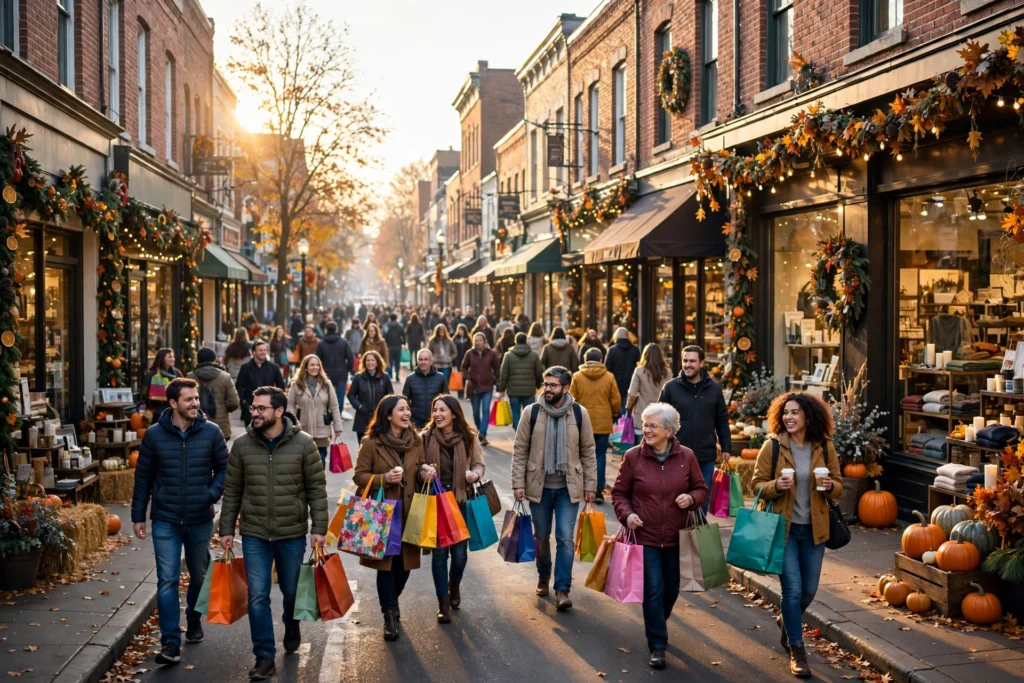
Black Friday 2027 falls on Friday, November 26, 2027 — the day after Thanksgiving, and the biggest shopping day of the year in the United States. It is the Friday that opens the Christmas shopping season, when stores and websites run their deepest discounts, and when a record number of Americans shop in a single weekend. This guide has the exact date, a live countdown, the real history of the name (and the myths that are not true), the full 2027 sale calendar from Thanksgiving to Cyber Monday, what the latest spending figures actually say, and how to tell a genuine deal from a fake one.
Countdown to Black Friday 2027
The timer below is counting down live to midnight at the start of Black Friday 2027, Eastern Time — the moment Friday, November 26, 2027 begins in the United States.
Black Friday 2027 — Friday, November 26, 2027
Loading…
Counting down to midnight Eastern Time, November 26, 2027
When Is Black Friday 2027?
Black Friday 2027 is Friday, November 26, 2027. Black Friday has no fixed calendar date of its own: it is always the Friday after Thanksgiving, and Thanksgiving is always the fourth Thursday in November. In 2027 Thanksgiving falls on Thursday, November 25, so Black Friday follows the next morning. The date moves between November 23 and November 29 from year to year, but the rule never changes.
Black Friday dates for the next few years:
| Year | Thanksgiving (Thursday) | Black Friday date |
|---|---|---|
| 2026 | November 26 | Friday, November 27 |
| 2027 | November 25 | Friday, November 26 |
| 2028 | November 23 | Friday, November 24 |
| 2029 | November 22 | Friday, November 23 |
| 2030 | November 28 | Friday, November 29 |
| 2031 | November 27 | Friday, November 28 |
How Many Days Until Black Friday 2027?
The live countdown above shows exactly how many days, hours, minutes and seconds are left until Black Friday 2027 begins at midnight Eastern Time on November 26, 2027. Black Friday 2027 is a little over a year away from the time of writing, so the number on the timer is large right now — but it is the number that matters for planning. If you are saving for a big purchase, the countdown is the simplest way to keep track of how much time you have left to build your budget, make a list, and watch prices before the sales begin.
One practical note: the deals no longer wait for the day itself. Most major retailers now open their Black Friday sales in early November, and some start in late October, so the smartest shoppers treat the countdown as the deadline for research, not the starting gun. Decide what you want, check its normal price now, and you will know on the day whether the "deal" is real.
What Is Black Friday?
Black Friday is the informal name for the Friday after Thanksgiving in the United States, and it traditionally marks the start of the Christmas shopping season. It is the busiest shopping day of the year in the country, in stores and online, and the weekend around it — Thanksgiving through Cyber Monday — is the biggest shopping stretch of the year. The day itself is not a federal holiday, and it is not an official holiday at all: it is a retail event that grew out of a shopping tradition, and its name came from the crowds, not from a calendar.
What makes it different from any other sale is scale. On Black Friday 2025, a record 202.9 million Americans shopped at some point between Thanksgiving and Cyber Monday, according to the National Retail Federation, and US shoppers spent $11.8 billion online on Black Friday alone, according to Adobe. The day has also spread far beyond the United States: retailers in the UK, Canada, Europe and many other countries now run Black Friday sales of their own, usually on the same Friday.
The History of Black Friday: Where the Name Really Comes From
The history of Black Friday is one of the most misunderstood stories in American shopping, because the explanation most people hear first is not the true one. Here is what the evidence actually shows.
1869: The First "Black Friday" Had Nothing to Do With Shopping
The phrase "Black Friday" was first used for a financial disaster, not a sale. On September 24, 1869, financiers Jay Gould and James Fisk tried to corner the US gold market, and when the Treasury released gold to stop them, prices collapsed by 18 percent. The crash became known as Black Friday, and for decades the adjective "black" was attached to days of calamity — which is why the shopping day's name sounded so odd when it first appeared.
1951: The First Shopping Use
The earliest known use of "Black Friday" for the day after Thanksgiving appears in the journal Factory Management and Maintenance in November 1951, and again in 1952. There it described a different problem: workers calling in sick on the day after Thanksgiving so they could stretch the holiday into a four-day weekend.
The 1950s and 1960s: Philadelphia Police Coin the Name
The name stuck because of the police in Philadelphia. In the 1950s and 1960s, huge crowds of suburban shoppers and tourists flooded into downtown Philadelphia on the day after Thanksgiving, ahead of the annual Army–Navy football game played that Saturday. The traffic jams, the packed sidewalks and the accidents made it a miserable day for the officers on duty, who had to work long shifts without leave — and they called it Black Friday. By 1961 the term was in common use in the city, and local merchants disliked it so much that they tried, unsuccessfully, to rebrand the day as "Big Friday". The phrase spread slowly, first appearing in The New York Times on November 29, 1975, and becoming national in the early 1980s.
1939: The President Who Moved Thanksgiving to Make the Season Longer
The shopping season itself is older than the name. In the 1930s, retailers wanted a longer Christmas shopping season, but no store wanted to be the first to advertise before Thanksgiving. In 1939 President Franklin D. Roosevelt issued a proclamation moving Thanksgiving a week earlier, to the second-to-last Thursday in November, to give shoppers more days. The change was so unpopular — critics called it "Franksgiving" — that Congress fixed Thanksgiving by law in 1941 as the fourth Thursday in November, where it has stayed. Black Friday has been regarded as the start of the Christmas shopping season since 1952.
The Myths About the Name — and What Is Actually True
| What people say | What the evidence shows |
|---|---|
| "Stores go from losing money (in the red) to making a profit (in the black) on this day." | A friendly story retailers promoted in the 1980s. The earliest published version is in the Philadelphia Inquirer on November 28, 1981 — decades after the police were already using the name. |
| "The name comes from selling enslaved people at a discount after Thanksgiving." | False, with no historical basis. The claim spread as an internet rumour in 2013 and was debunked by Snopes in 2015. |
| "The name comes from the chaos and crowds in Philadelphia." | True. This is the documented origin, traced to Philadelphia police in the 1950s and 1960s. |
Black Friday 2027 by the Numbers
No 2027 sales figures exist yet — the day is still a year away — but the most recent full results show just how big the event has become, and they are the honest baseline for judging 2027.
| Measure | 2025 result | Source |
|---|---|---|
| People who shopped, Thanksgiving to Cyber Monday | 202.9 million — a record, up from 197 million in 2024 | National Retail Federation |
| Average holiday spending per shopper over the weekend | $337.86, the highest since 2019 | National Retail Federation |
| Black Friday shoppers in stores | 80.3 million | National Retail Federation |
| Black Friday shoppers online | 85.7 million | National Retail Federation |
| US online spending, Black Friday | $11.8 billion, up 9.1% on 2024 | Adobe |
| US online spending, Thanksgiving Day | $6.4 billion, up 5.3% | Adobe |
| US online spending, Cyber Monday | $14.25 billion, up 7.1% — the biggest online shopping day of the year | Adobe |
| US online spending, the five-day Cyber Week | $44.2 billion, up 7.7% | Adobe |
| US online spending, whole holiday season (Nov 1–Dec 31) | $257.8 billion, up 6.8% | Adobe |
Looking ahead, Adobe's forecast published on September 28, 2026 expects $12.9 billion in US online spending on Black Friday 2026 and $15.1 billion on Cyber Monday 2026, with $47.5 billion across the five days and $275.1 billion for the whole online holiday season. The National Retail Federation's forecast from October 15, 2026 expects November and December 2026 retail sales to grow 4.2% to $1.013 trillion. These are forecasts for 2026, not results — the 2026 figures will be published in early December 2026, and this guide will be updated when 2027 forecasts appear.
The 2027 Sale Calendar: From Thanksgiving to Green Monday
Black Friday 2027 is one day in a five-day stretch retailers call Cyber Week, and the sales now run for weeks on either side of it. Here is the calendar that matters:
| Date in 2027 | Day | What happens |
|---|---|---|
| Late October – early November | — | Early Black Friday sales begin at many major retailers |
| Thursday, November 25 | Thanksgiving Day | Many Black Friday deals go live online; most major stores stay closed |
| Friday, November 26 | Black Friday | The main sale day, in stores and online |
| Saturday, November 27 | Small Business Saturday | Shops local: the day for small and independent businesses |
| Sunday, November 28 | — | Sales continue; a record 32.6 million people shopped in stores on this Sunday in 2025 |
| Monday, November 29 | Cyber Monday | Online-only deals; the biggest online shopping day of the year |
| Monday, December 13 | Green Monday | eBay's online sale day, the second Monday in December |
Cyber Monday has its own, much shorter history than Black Friday. The term was coined in 2005 by Ellen Davis of the National Retail Federation, in a Shop.org press release on November 28, 2005, after 2004 research showed a spike in online shopping on the Monday after Thanksgiving, when people returned to faster office internet connections. Unlike Black Friday, which grew out of a police nickname, Cyber Monday was invented on purpose by retailers to give online shopping its own day — and it worked: in 2025 it took $14.25 billion online, more than Black Friday itself. A dedicated Cyber Monday 2027 guide will follow in this cluster.
What to Buy on Black Friday 2027
No 2027 deals or prices have been announced yet — retailers publish them in the weeks before the day — so nothing below is a price promise. These are the categories where the deepest discounts reliably appear, year after year, based on the published results:
- Televisions and home electronics: the classic Black Friday doorbuster. Big-screen TVs, soundbars and streaming devices see some of their lowest prices of the year.
- Laptops, tablets and smartwatches: strong discounts on computing and wearables, both in stores and online, and a category where Cyber Monday often matches or beats Black Friday.
- Toys and games: heavy discounting ahead of Christmas, with the biggest toy deals usually in the week of Black Friday itself.
- Small kitchen appliances: stand mixers, air fryers and coffee machines are among the most discounted items every year.
- Clothing and shoes: broad site-wide discounts rather than single doorbusters, and often just as good in the early November sales.
- Video games and consoles: bundles and game discounts, though console stock itself is often limited — if a console is on your list, buy early rather than waiting for the day.
- Beauty and fragrance gift sets: holiday-exclusive sets that rarely go on sale again before Christmas.
What is usually not a real Black Friday bargain: furniture and mattresses (better in January and around Presidents' Day), winter coats (deeper discounts come in January), and gift cards sold at face value. And remember that research has repeatedly found many "Black Friday deals" are the same price, or cheaper, at other times of the year — the discount is only real if the price is lower than the price you could have paid last week.
In Stores or Online: Which Is Better in 2027?
The split has flipped. In 2025, 85.7 million Americans shopped online on Black Friday and 80.3 million shopped in stores — online overtook in-store for the first time in the modern era, and the gap is likely to widen. Online wins on convenience, price comparison and avoiding queues; in-store still wins for doorbuster-only items, for seeing a product before you buy it, and for same-day pickup. Most shoppers now do both: research and compare online, then buy whichever channel has the better price. Whichever you choose, set a budget before the sales start — the NRF's 2025 figure of $337.86 average weekend spending is a reminder of how quickly "just one more deal" adds up.
Is Black Friday a Federal Holiday? What Is Open and Closed?
No — Black Friday is not a federal holiday. It is not one of the eleven federal holidays, so federal offices, banks and post offices run on their normal Friday schedules, and there is no automatic day off work. In practice, many schools are closed as part of the Thanksgiving break, and some states give state employees the day off — California, for example, observes the day after Thanksgiving as a state holiday — but that varies by state and employer, so check your own workplace and school calendar rather than assuming.
For shoppers, the practical picture is simple: almost all major retail chains now stay completely closed on Thanksgiving Day itself, and open early on Friday morning instead. Grocery stores, pharmacies and restaurants generally open on Black Friday with normal or slightly reduced hours. Public transport runs a normal Friday service in most cities, though some systems run a reduced holiday schedule — check your local operator on the day.
How to Spot a Real Black Friday Deal
- Check the price now. Write down the current price of anything you want before the sales start. A "50% off" label means nothing if the starting price was inflated last week.
- Use a price-history tool. Free browser tools that show a product's price over the past months will tell you in seconds whether today's price is genuinely the lowest.
- Compare the same item across stores. The same television or laptop is often sold by several retailers at different "sale" prices — the real price is the lowest of them, not the biggest percentage off.
- Watch for the early sales. The best price on many items appears in early November, not on Black Friday itself, and popular items sell out before the day.
- Read the return policy before you buy. Some Black Friday items are final sale, or have a shortened return window that ends before Christmas.
- Do not buy what you were not going to buy anyway. A discount on something you do not need is not a saving — it is spending.
Stay Safe: Black Friday Scams to Watch For
Black Friday is also the busiest season for shopping scams. Fake online stores, phishing emails pretending to be delivery notices, and social-media ads for products that never arrive all spike in November. Our Black Friday 2026 guide covers the most common scams in detail, and the advice still applies: buy only from retailers you know, or from a seller you have checked independently; never pay by bank transfer or gift card; and treat any "deal" that arrives by unsolicited text message or email as suspicious until you have verified it on the retailer's own website.
Frequently Asked Questions About Black Friday 2027
When is Black Friday 2027?
Friday, November 26, 2027 — the day after Thanksgiving, which falls on Thursday, November 25, 2027.
How many days until Black Friday 2027?
Check the live countdown at the top of this page: it ticks down in real time to midnight Eastern Time on November 26, 2027, showing the exact days, hours, minutes and seconds remaining.
Is Black Friday 2027 a public holiday?
No. Black Friday is not a federal holiday, and it is not an official public holiday. Federal offices, banks and post offices are open as normal, though many schools close for the Thanksgiving break and some states give state employees the day off.
When do Black Friday 2027 deals start?
Most major retailers now start their Black Friday sales in early November, and some begin in late October. The biggest discounts run across the five days from Thanksgiving to Cyber Monday, November 25–29, 2027. No specific 2027 deals have been announced yet as of November 13, 2026.
What is the difference between Black Friday and Cyber Monday?
Black Friday, Friday, November 26, 2027, is the big in-store and online sale the day after Thanksgiving. Cyber Monday, Monday, November 29, 2027, is the online-only sale three days later, created in 2005 to promote e-commerce. In 2025 Cyber Monday took more money online ($14.25 billion) than Black Friday ($11.8 billion).
Why is it called Black Friday?
The name comes from Philadelphia police in the 1950s and 1960s, who used it for the chaotic crowds and traffic on the day after Thanksgiving. The popular story about stores moving "into the black" (into profit) came later, first published in 1981, and the claim linking the name to the slave trade is false.
Is Black Friday or Cyber Monday better for deals?
It depends on what you are buying. Black Friday is usually better for televisions, appliances and in-store doorbusters; Cyber Monday is often as good or better for laptops, tech and online-only items. The best approach is to compare both days for the specific item you want.
Black Friday 2027 is still a year away, and the deals, store hours and doorbusters for 2027 have not been announced yet. Bookmark this page and check back as November 2027 approaches — the countdown will keep ticking, and this guide will be updated when the 2027 sales are confirmed. In the meantime, the rest of the holiday season is already covered here: our Thanksgiving 2027 guide has the date, countdown and traditions for the day before, our Thanksgiving gift ideas will help with the table, and Small Business Saturday covers the day after. When Cyber Monday 2027 arrives, its own guide will join this cluster.
Deals and prices for 2027: no 2027 deals, prices or store hours have been verified from official sources as of November 13, 2026. This guide will be updated when retailers publish their 2027 offers. Spending figures are from the National Retail Federation and Adobe Analytics, as cited above.