
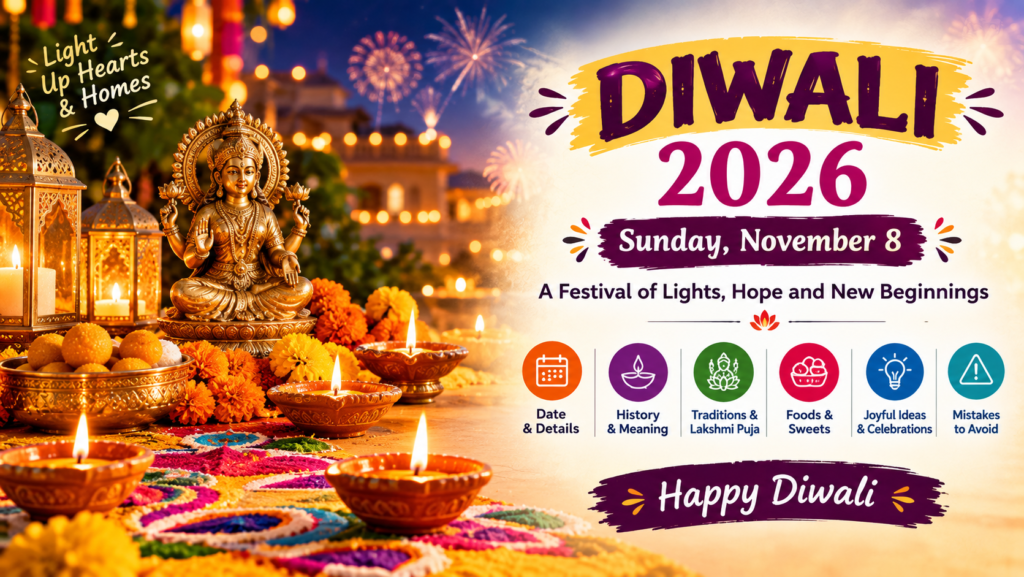
Diwali 2026 will be celebrated on Sunday, November 8, 2026. Also known as Deepavali, Diwali is one of the most widely celebrated festivals of light, renewal, prosperity and family gatherings, symbolising the triumph of light over darkness.
Diwali is not understood in exactly the same way by every community. Hindu, Jain, Sikh and some Buddhist communities observe related traditions, each with its own history and meaning. This guide covers the date, the stories behind the festival, the customs, the food and the best ways to celebrate in 2026, while helping you avoid the common mistakes that can take the shine off the occasion. For more festival planning ideas, visit our holiday and celebration guides.
When Is Diwali 2026?
Diwali 2026 is Sunday, November 8. Also called Deepavali, it is a major festival of lights celebrated by millions of people in India and around the world.
| Detail | Information |
|---|---|
| Diwali 2026 | Sunday, November 8, 2026 |
| Festival | Diwali / Deepavali |
| Diwali 2025 | October 20, 2025 |
| Diwali 2027 | October 29, 2027 |
| Naraka Chaturdashi 2026 | November 8 in India’s central holiday calendar |
| Govardhan Puja 2026 | Monday, November 9 |
| Bhai Dooj 2026 | Wednesday, November 11 |
If you are planning travel, gifts or family gatherings, note that the festival period stretches across several days, so it helps to block out the whole week. Our festival date planner and holiday calendar can help you keep track of other important dates this season.
What Is Diwali?
Diwali, or Deepavali, is commonly called the Festival of Lights because homes, streets and temples glow with diyas (oil lamps), candles and decorative lights. At its heart, it is a celebration of hope, renewal and gratitude, marked with prayers, cleaning and decorating homes, sweets, gifts and community gatherings.
What Does the Word Diwali Mean?
Diwali comes from Deepavali, usually interpreted as a row or garland of lights. The word is linked to Sanskrit roots meaning lamp and row, though pronunciation and spelling differ across languages and regions, and no single English translation captures every nuance.
Why Is Diwali Celebrated?
The significance of Diwali varies by religion, region and family tradition. Common themes include light over darkness, good over evil, prosperity and new beginnings.
Diwali in Hindu Traditions
In many Hindu communities, Diwali is linked to several stories:
- Rama’s return to Ayodhya: In many parts of North India, lamps celebrate Rama, Sita and Lakshmana returning after exile.
- Goddess Lakshmi: Many families worship Lakshmi, the goddess of wealth and wellbeing, on the main Diwali night.
- Lord Ganesha: Often worshipped alongside Lakshmi for wisdom and auspicious beginnings.
- Krishna and Narakasura: In parts of South and West India, the festival recalls Krishna’s victory over the demon Narakasura.
Not every Hindu community celebrates Diwali for the same reason, and that diversity is part of what makes the festival so rich.
Diwali in Jainism
For Jains, Diwali marks the nirvana of Lord Mahavira, the final liberated state he attained. Many Jain families observe the day with prayer, reflection and lamps symbolising the light of knowledge.
Diwali in Sikhism
Sikhs observe Bandi Chhor Divas, which commemorates the release of Guru Hargobind from imprisonment. It often falls around the same time as Diwali, but it is a distinct Sikh observance with its own meaning. You can read more about it on Wikipedia’s Bandi Chhor Divas page.
Diwali and Other Traditions
Diwali and Deepavali customs have developed across South Asia and among diaspora communities, including some Buddhist communities, particularly in Nepal. Practices differ widely by region and community.
Diwali History
Ancient Roots of Diwali
There is no single universally accepted origin for the entire modern festival. Historians point to a blend of ancient religious traditions, harvest-season rhythms, the symbolism of lamps and light, and regional festivals that gradually merged over centuries.
Diwali in Ancient and Medieval India
Religious texts, local legends and cultural practices all shaped how Diwali was celebrated. Over time, customs such as lighting lamps, worshipping Lakshmi, trading-year rituals and family feasts became widespread, each adapting to local languages and beliefs. For a broader overview of the festival’s development, see Wikipedia’s Diwali article.
How Diwali Became a Global Festival
Indian migration over the last two centuries carried Diwali to the Caribbean, Africa, Southeast Asia, the Pacific, the UK, North America and Australia. Today, cities around the world host public lighting ceremonies, cultural festivals and temple events, and the festival enjoys growing public recognition.
Diwali Traditions
What are Diwali traditions? Here are the most common ones, keeping in mind that customs vary by region.
Lighting Diyas
Clay lamps filled with oil or ghee are placed at doorways, windows and altars. The flame symbolises knowledge, hope and the victory of light over ignorance.
Rangoli
Rangoli is a colourful floor design made with coloured powder, rice flour, flower petals or chalk, usually near entrances to welcome guests and, in many homes, Goddess Lakshmi.
Lakshmi Puja
Families gather in the evening to worship Lakshmi, often with Ganesha, offering flowers, sweets, fruit and lit lamps.
Cleaning and Decorating Homes
Homes are thoroughly cleaned before Diwali. People often wear new clothes, hang flower garlands, string lights and set out diyas and decorative items.
Exchanging Gifts
Sweets, dry fruits, clothing, decorative items and thoughtful family gifts are shared with relatives, neighbours and friends.
Diwali Sweets
Ladoo, barfi, jalebi, gulab jamun, kaju katli, Mysore pak and halwa are popular, but sweets differ greatly by region and family recipe.
Fireworks
Fireworks are common in many places today, but they are not a required part of Diwali. If you choose to use them, consider noise, air pollution, fire safety, animals and local regulations first.
Five Days of Diwali
The festival is commonly described as a five-day sequence, though names and order vary by region.
| Day | Common Observance | General Significance |
|---|---|---|
| Day 1 | Dhanteras | Prosperity, wealth and auspicious beginnings |
| Day 2 | Naraka Chaturdashi / Choti Diwali | Traditions of overcoming evil |
| Day 3 | Diwali / Lakshmi Puja | Main festival day in many communities |
| Day 4 | Govardhan Puja / Annakut | Krishna-related and regional traditions |
| Day 5 | Bhai Dooj | Celebrates sibling bonds |
Diwali 2026 Calendar
| Observance | 2026 Date |
|---|---|
| Dhanteras | Check your local religious calendar |
| Naraka Chaturdashi / Choti Diwali | November 8 (India’s central calendar) |
| Diwali / Deepavali | Sunday, November 8 |
| Govardhan Puja | Monday, November 9 |
| Bhai Dooj | Wednesday, November 11 |
Regional calendars can differ, so confirm exact observances with your local temple or community calendar.
Diwali 2026 Lakshmi Puja
What Is Lakshmi Puja?
Lakshmi Puja is a Hindu worship ritual honouring Goddess Lakshmi, associated with prosperity, abundance and wellbeing. It is a central part of Diwali night in many Hindu communities.
Diwali Lakshmi Puja 2026 Date
The main Diwali date is Sunday, November 8, 2026. The exact puja muhurat depends on your location and local Hindu calendar, so check a local panchang rather than relying on one universal time. Many families prepare by cleaning the home, setting up an altar, lighting diyas, arranging flowers and offering sweets and fruit, with the whole family taking part.
Diwali 2026 Decorations and Lights
Diya Decoration Ideas
Arrange diyas in rows along steps, windowsills and balconies, or float them with petals in a shallow bowl of water.
Rangoli Ideas
Try geometric patterns, lotus motifs or flower-petal designs. Stencils make it easy for beginners and kids.
Flower Decoration Ideas
Marigold garlands on doors and around the altar are a classic choice and add colour and fragrance.
Balcony and Outdoor Lights
Warm-white or golden string lights create a welcoming glow. Use outdoor-rated lights and avoid overloading sockets.
Eco-Friendly Diwali 2026 Decoration Ideas
- Clay diyas instead of plastic lamps
- LED string lights to save energy
- Marigolds and other natural flowers
- Reusable decorations and paper lanterns
- Natural materials such as leaves and coconut shells
Traditional Diwali Foods
Popular Diwali Sweets
Ladoo, barfi, kaju katli, jalebi, gulab jamun, rasgulla and halwa are festival favourites.
Savory Diwali Snacks
Samosas, mathri, chakli, namak pare, mixture and pakoras balance the sweetness and are perfect for guests.
Regional Diwali Foods
Food traditions differ across North, South, Western and Eastern India, Nepal and diaspora communities. For example, many South Indian homes serve special breakfast dishes and Diwali marundu, while many North Indian homes focus on mithai and fried snacks.
Diwali 2026 Celebration Ideas for
- Light diyas at dusk
- Create a rangoli at your entrance
- Decorate the home with lights and flowers
- Prepare traditional sweets together
- Host a family dinner
- Exchange thoughtful gifts
- Perform prayers according to your tradition
- Visit relatives and neighbours
- Donate to people in need
- Organise a community gathering
- Wear traditional clothing
- Make Diwali crafts
- Take family photographs
- Send Diwali wishes
- Choose environmentally responsible celebrations
Looking for more seasonal inspiration? Browse our festival and holiday celebration ideas for hosting and planning tips.
Diwali 2026Activities for Kids
- Diwali coloring pages and diya crafts
- Rangoli designs
- Diwali storytelling
- Festival vocabulary and handmade Diwali cards
- Sweet-making with adults
- A family gratitude activity
- A simple Diwali quiz
Diwali 2026 Classroom Activities
Teachers can build a Diwali history timeline, map celebrations around the world, compare cultural traditions, run a rangoli art session or assign a festival research project. Keep activities educational and give context rather than asking children to imitate sacred practices.
Diwali Around the World
Diwali is celebrated with community events, cultural festivals, temple gatherings and public decorations in the United States, United Kingdom, Canada, Singapore, Malaysia, Australia, Mauritius, Fiji, South Africa and Nepal, where it is known as Tihar. Public holiday status varies by country, so always check local rules.
Diwali in India
North India
In many communities, Rama’s return and Lakshmi Puja are prominent.
South India
Deepavali traditions often centre on the Narakasura story, with early-morning oil baths and festive breakfasts in many communities.
Western India
Lakshmi Puja, business new-year customs and regional rituals are important in many communities.
Eastern India
Kali Puja is especially significant in parts of eastern India and can coincide with Diwali.
Diwali and Fireworks
Fireworks became popular in modern celebrations in many places, but their impact deserves honest attention. Key issues include air quality, noise, fire safety, children’s safety, stress to pets and wildlife, and local restrictions. Avoiding these is among the biggest mistakes to avoid during Diwali.
Eco-Friendly Diwali Ideas
- Use diyas and LED lights
- Reduce or skip fireworks, or choose lower-impact options where legal
- Reuse decorations
- Avoid unnecessary plastic
- Buy locally made products
- Dispose of waste responsibly
Diwali 2026 Gift Ideas
Diwali Gifts for Family
Home décor, sweets boxes and matching festive outfits.
Diwali Gifts for Friends
Scented candles, plants, books or a handmade diya set.
Diwali Gifts for Coworkers
Dry-fruit boxes, tasteful gift baskets or desk plants.
Diwali Gifts for Parents
Traditional clothing, devotional items or a family photo frame.
Diwali Gifts for Children
Craft kits, storybooks and small toys.
Traditional Diwali Gifts
Sweets, dry fruits, diyas, candles, clothing, home décor, gift baskets, books, plants or a charitable donation made in someone’s name.
Diwali 2026 Wishes and Messages
Short Diwali Wishes
- Happy Diwali 2026! May your home glow with joy.
- Wishing you light, love and laughter this Deepavali.
Diwali Wishes for Family
May this Diwali bring our family health, togetherness and endless sweet moments. Happy Diwali 2026!
Diwali Wishes for Friends
Sending you a diya full of happiness, friend. Happy Deepavali!
Diwali Messages for Coworkers
Wishing you and your family a bright and prosperous Diwali.
Professional Diwali Messages
On behalf of our team, we wish you a Diwali filled with light, success and new opportunities.
Diwali WhatsApp Messages
Happy Diwali! May this festival of lights brighten every corner of your life.
Diwali Instagram Captions
- Lighting up the night, one diya at a time.
- Good vibes, sweet treats and glowing hearts.
Diwali 2026 Quotes
- Tamaso ma jyotirgamaya (“Lead me from darkness to light”) is a well-known verse from the Brihadaranyaka Upanishad.
- Martin Luther King Jr. wrote, “Darkness cannot drive out darkness; only light can do that.”
Both capture the spirit of light, hope and goodness at the heart of the festival.
Diwali Facts
- Diwali 2026 falls on Sunday, November 8.
- Diwali is also called Deepavali.
- It is commonly known as the Festival of Lights.
- Different religious and regional communities observe Diwali-related traditions.
- Lakshmi Puja is important in many Hindu communities.
- Diyas are among the festival’s best-known symbols.
- Rangoli is a popular decorative tradition.
- Celebrations extend well beyond India.
- The five-day sequence varies by region and tradition.
- Fireworks are common in some celebrations but are not a universal requirement.
Is Diwali a Public Holiday?
India
India’s central government holiday calendar lists Diwali (Deepavali) on Sunday, November 8, 2026. Arrangements can vary by state, institution and organisation.
Other Countries
Public holiday status varies by country and jurisdiction, so check local listings.
Diwali 2026 Quick Facts
| Question | Answer |
|---|---|
| When is Diwali 2026? | Sunday, November 8 |
| What is Diwali also called? | Deepavali |
| What is Diwali known as? | Festival of Lights |
| What does Diwali celebrate? | Meaning varies by religious and regional tradition |
| Is Diwali a Hindu festival? | Strongly associated with Hinduism, and also important in Jain, Sikh and some Buddhist traditions |
| Common traditions? | Diyas, rangoli, prayers, decorations, food, gifts and family gatherings |
| What is Lakshmi Puja? | A Hindu worship tradition honouring Goddess Lakshmi |
| Is Diwali a public holiday? | Depends on the country or jurisdiction |
Diwali 2026 Countdown
As of October 6, 2026, Diwali is 33 days away.
🪔 Diwali 2026 Countdown: 33 Days Until Sunday, November 8, 2026
Frequently Asked Questions About Diwali 2026
When is Diwali 2026?
Diwali 2026 is Sunday, November 8, 2026.
Why is Diwali celebrated?
Its meaning differs across traditions, but it is commonly associated with light over darkness, good over evil, prosperity, renewal and spiritual reflection.
What are the main Diwali traditions?
Lighting diyas, decorating homes, creating rangoli, prayers or puja, preparing sweets, exchanging gifts, visiting family and joining community celebrations.
Is Diwali the same as Deepavali?
They generally refer to the same festival, though naming and traditions vary by region and language.
What is Lakshmi Puja during Diwali?
A Hindu worship practice honouring Goddess Lakshmi, important in many Hindu communities during Diwali.
How many days is Diwali celebrated?
Often five days, but the number, names and order of observances vary by region and tradition.
Is Diwali only celebrated in India?
No. It is celebrated by communities around the world, particularly across the South Asian diaspora.
What food is eaten during Diwali?
Sweets such as ladoo, barfi and jalebi, savory snacks and regional festive dishes.
Is Diwali a public holiday?
It depends on the country. In India’s central government calendar, Diwali 2026 is listed for November 8.
What is the difference between Diwali and Bandi Chhor Divas?
Bandi Chhor Divas is a distinct Sikh observance associated with Guru Hargobind and often falls around the same time as Diwali. The two are related in timing but are not identical.
Wishing you a bright, safe and joyful Diwali 2026! For more celebration ideas and seasonal guides, explore our blog.