
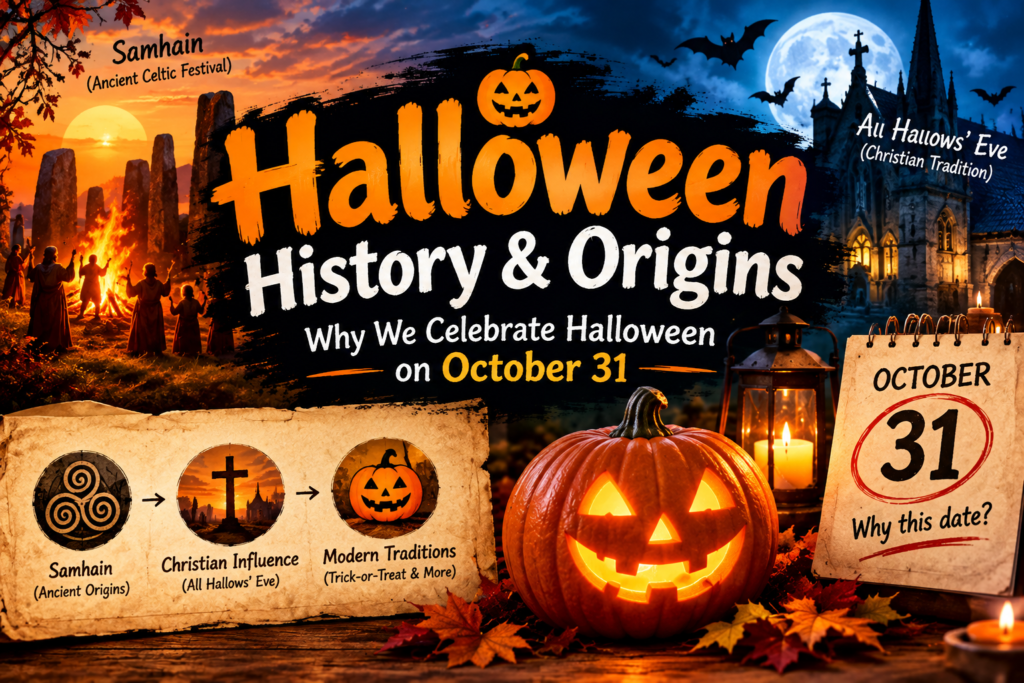
Halloween History and Origins:Halloween developed over centuries through a combination of Celtic seasonal traditions, Christian observances, European folk customs, and later traditions in North America. October 31 is known as All Hallows’ Eve, the evening before All Saints’ Day on November 1. In 2026, Halloween falls on Saturday, October 31. Practices such as costumes, trick-or-treating, and pumpkin carving evolved gradually over time rather than originating from a single event.
For quotes and captions to use this season, see our Halloween quotes, wishes, and captions page, and for party and activity ideas, visit our Halloween celebration ideas.
Halloween History and Origins
The Historical Roots of Halloween
Halloween’s history is not a straight line from one ancient festival to today’s traditions. Instead, it emerged from the layering of several cultural and religious practices across centuries, each contributing pieces of what we now recognize as Halloween.
Celtic Seasonal Traditions and Samhain
Among the influences most often cited is Samhain, a Celtic festival marking the end of the harvest season and the beginning of the darker half of the year. Communities in ancient Ireland and Scotland observed this time with bonfires and seasonal gatherings tied to the shifting agricultural calendar.
Christian Observances and All Hallows’ Eve
As Christianity spread through Europe, the Church established All Saints’ Day on November 1 and, later, All Souls’ Day on November 2. The evening before All Saints’ Day became known as All Hallows’ Eve — the phrase that eventually shortened to “Halloween.”
European Folk Customs and Local Traditions
Beyond Celtic and Christian influences, various regions across Europe developed their own local folk customs tied to the autumn season, including practices involving bonfires, seasonal foods, and community gatherings that varied significantly by region.
How Halloween Developed Into a Modern Holiday
Over time, these separate strands — seasonal, religious, and folk — combined and changed as they moved through different communities and eventually across the Atlantic, forming the holiday recognized today.
What Was Samhain?
What Samhain Marked in the Seasonal Calendar
Samhain marked the transition from the harvest season into winter, a significant turning point for agricultural communities dependent on seasonal cycles.
Historical Beliefs and Customs Associated With Samhain
Historical accounts describe Samhain as a time associated with bonfires and communal gathering, with later folklore adding beliefs about the thinning of boundaries between the living and the dead.
How Samhain Is Connected to Halloween
Samhain is frequently cited as one influence on Halloween’s development, particularly regarding the timing and some seasonal symbolism.
What Historians Can — and Cannot — Establish About the Connection
It’s important to note that historians caution against treating Halloween as a direct, unbroken continuation of Samhain. The documented historical record shows a more gradual blending of influences rather than one festival simply being renamed.
Why Is Halloween Celebrated on October 31?
The Meaning of All Hallows’ Eve
“All Hallows’ Eve” refers to the evening before All Saints’ Day, with “hallow” being an older English word for “saint” or “holy person.”
All Saints’ Day on November 1
All Saints’ Day, observed on November 1 in the Western Christian calendar, is dedicated to honoring all saints, known and unknown.
All Souls’ Day on November 2
All Souls’ Day follows on November 2, traditionally set aside for remembering the deceased more broadly.
How the Dates Relate to Halloween’s Development
Together, these three days — October 31, November 1, and November 2 — form a connected span on the Christian calendar that historically shaped how the late-October and early-November period was observed in many communities.
What Does the Word “Halloween” Mean?
The Meaning of “All Hallows’ Eve”
“Halloween” is a contraction of “All Hallows’ Even,” meaning the evening before All Hallows’ (or All Saints’) Day.
How the Name Changed Over Time
Over centuries, “All Hallows’ Even” was shortened through common usage — first to “Hallowe’en” and eventually to the modern spelling “Halloween.”
Halloween’s Connection to the Christian Calendar
Despite its modern secular and commercial associations, the name itself remains directly tied to the Christian liturgical calendar.
Halloween History Timeline
| Period | What Happened |
|---|---|
| Ancient Celtic societies | Seasonal traditions associated with Samhain marked the harvest’s end |
| Early Christian calendar | All Saints’ and All Souls’ observances were established in early November |
| Medieval Europe | Local customs, beliefs, and seasonal practices developed across regions |
| Early modern period | Regional folk traditions and customs continued to evolve |
| 19th century | Migration brought various customs to North America, where they began blending |
| 20th century | Community celebrations, costumes, and trick-or-treating grew in popularity |
| Today | Halloween is a varied cultural holiday celebrated differently around the world |
How Did Halloween Come to North America?
Irish and Scottish Immigration
Large waves of Irish and Scottish immigration during the 19th century brought various seasonal customs to North America, where they began to blend with existing local traditions.
How Customs Changed in North America
As these traditions took root in a new cultural context, they were adapted and reshaped, gradually forming distinct North American Halloween practices.
The Development of Neighborhood Celebrations
Over the following decades, Halloween increasingly became associated with neighborhood-based activities rather than solely private or religious observance.
Halloween’s Shift Toward Family and Community Activities
By the 20th century, Halloween had shifted toward a family- and community-oriented holiday centered on shared local activities.
The History Behind Popular Halloween Traditions
Where Did Trick-or-Treating Come From?
Trick-or-treating has links to older European customs such as souling, in which people went door to door offering prayers in exchange for food, and guising, where people in disguise offered a performance or verse in return for treats. These practices changed considerably as they developed in North America, eventually forming the neighborhood trick-or-treating recognized today. It is not accurate to describe modern trick-or-treating as an unchanged survival of a single ancient custom — it developed gradually.
Why Do People Carve Pumpkins?
Jack-o’-lantern traditions have roots in older folk customs that originally used carved turnips and other root vegetables. When these customs reached North America, pumpkins — native to the region and easier to carve — became the more popular choice, and the tradition evolved from there.
Why Do People Wear Halloween Costumes?
Costume-wearing draws on older traditions of disguise found in various European folk customs. Over time, and particularly through the 20th century, costumes became closely tied to community celebrations and, later, commercial Halloween culture.
Where Did Halloween Ghosts, Witches, and Supernatural Symbols Come From?
Supernatural imagery associated with Halloween developed from a mix of folklore, storytelling traditions, and shifting cultural symbolism over time. Not all of these symbols share the same origin — some come from European folklore, while others developed later through popular culture and media.
How Halloween Changed During the 19th and 20th Centuries
Community Celebrations and Seasonal Gatherings
As Halloween took hold in North America, community gatherings and seasonal events became a central part of how the holiday was observed.
The Growth of Organized Halloween Activities
Schools, churches, and local organizations increasingly began hosting organized Halloween activities, shifting the holiday further toward a communal event.
Costumes, Parties, and Trick-or-Treating
By the mid-20th century, costumes, parties, and trick-or-treating had become widely recognized as the core elements of the holiday.
The Development of Modern Halloween Entertainment and Traditions
In more recent decades, Halloween has continued to grow through haunted attractions, themed entertainment, and a broader commercial culture surrounding the holiday.
Halloween Around the World
How Halloween Is Celebrated in the United States and Canada
In the U.S. and Canada, Halloween centers on trick-or-treating, costumes, pumpkin carving, and neighborhood or community events.
Halloween Customs in the United Kingdom and Ireland
In parts of the UK and Ireland, older customs connected to Samhain and related seasonal traditions remain more visible alongside modern Halloween practices.
Halloween Traditions in Other Countries
Various other countries have developed their own Halloween-adjacent observances, often blending imported customs with existing local traditions.
Why Celebrations Differ Across Cultures
These differences reflect how each region absorbed and adapted incoming customs based on its own cultural and religious history, rather than adopting one uniform version of the holiday.
Halloween vs. Samhain, All Saints’ Day, and Día de los Muertos
| Observance | Main Distinction |
|---|---|
| Halloween | October 31 observance with varied cultural, social, and entertainment traditions |
| Samhain | Celtic seasonal festival with its own historical and contemporary significance |
| All Saints’ Day | Christian observance on November 1 |
| All Souls’ Day | Christian observance on November 2 |
| Día de los Muertos | A distinct Mexican tradition honoring deceased loved ones, with its own separate history and practices |
Importantly, Día de los Muertos is not simply another name for Halloween — it is a separate observance with its own customs, timing, and cultural meaning.
Halloween History Facts
- “Halloween” is a contraction of “All Hallows’ Even,” the evening before All Saints’ Day.
- October 31 is linked to All Hallows’ Eve, the day before All Saints’ Day on November 1.
- Samhain is one of several historical influences on Halloween, not its sole origin.
- Pumpkin carving grew out of older traditions that originally used carved turnips.
- Trick-or-treating developed from customs including souling and guising, changing significantly in North America.
- Halloween customs vary by country because each region blended imported traditions with its own local practices.
Frequently Asked Questions About Halloween History
Where did Halloween originate?
Halloween developed through several influences, including Celtic seasonal traditions, Christian observances, and European folk customs, later shaped further by traditions in North America.
Why is Halloween celebrated on October 31?
October 31 is All Hallows’ Eve, the evening before All Saints’ Day on November 1, a date tied to the Christian liturgical calendar.
What is the history of Halloween?
Halloween’s history spans centuries, blending Celtic seasonal customs, Christian observances, and European folk traditions before evolving into the modern holiday through North American customs.
What is Samhain, and how is it related to Halloween?
Samhain is a Celtic festival marking the harvest’s end. It’s considered one influence among several on Halloween, rather than its single, direct source.
Is Halloween based on Samhain?
Not entirely. Samhain contributed some seasonal and symbolic elements, but Halloween developed through multiple additional cultural and religious influences over time.
What does Halloween mean?
“Halloween” comes from “All Hallows’ Even,” meaning the evening before All Hallows’ (All Saints’) Day.
What is All Hallows’ Eve?
All Hallows’ Eve is the evening before All Saints’ Day, observed on November 1 in the Christian calendar.
How did Christianity influence Halloween?
The Christian calendar established All Saints’ Day and All Souls’ Day in early November, shaping the timing and some traditions associated with the surrounding period.
Where did trick-or-treating originate?
Trick-or-treating has links to older customs such as souling and guising, which changed considerably as they developed into the modern practice in North America.
Why do people carve pumpkins for Halloween?
Pumpkin carving grew from earlier traditions using carved turnips, with pumpkins becoming the preferred choice once the custom reached North America.
How did Halloween become popular in America?
Irish and Scottish immigration during the 19th century brought various customs to North America, where they blended with local traditions and grew into community-based celebrations.
Is Halloween the same as Día de los Muertos?
No. Día de los Muertos is a distinct Mexican tradition with its own history and customs, separate from Halloween.
For readers who want to explore Halloween’s folklore and historical development in more depth, Wikipedia’s overview of Halloween offers a broad summary of its documented history. Those interested in ongoing discussions about regional customs and traditions may also find r/AskHistorians on Reddit useful for exploring historically grounded conversations on the topic.
To plan your own celebration once you understand the history, check out our Halloween celebration ideas and activities page.