
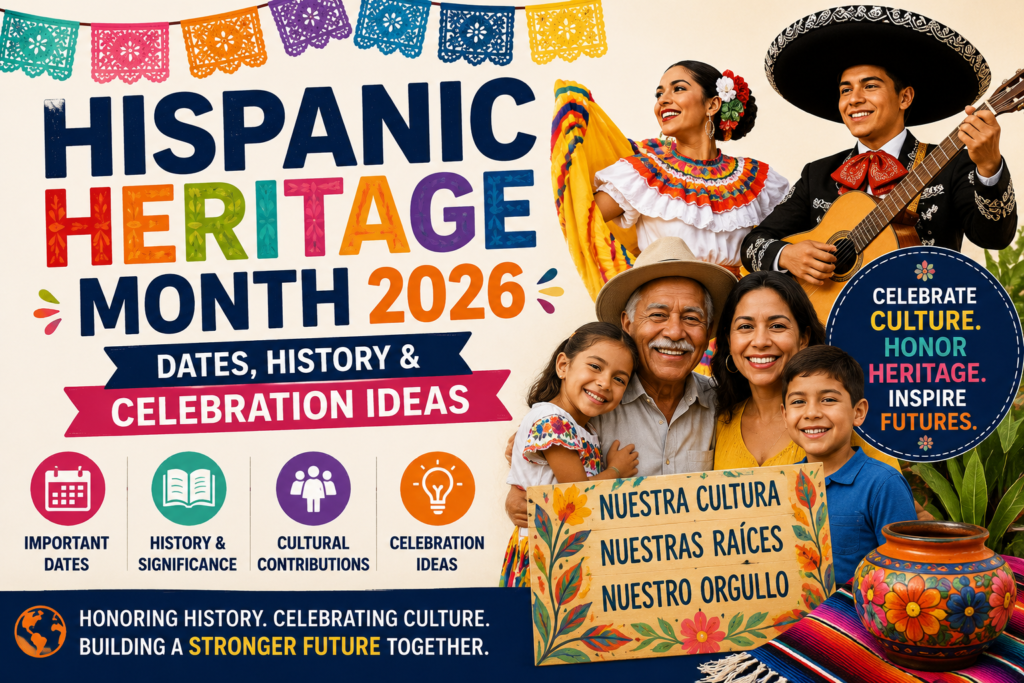
Learn when Hispanic Heritage Month 2026 begins and ends, why it is celebrated, its history, significance, cultural contributions and activity ideas.
Quick Facts
| Start Date | September 15, 2026 |
| End Date | October 15, 2026 |
| Duration | 31 days (one month) |
| Country | United States |
| Type | Cultural observance |
| Observed | Annually |
What Is Hispanic Heritage Month?
Hispanic Heritage Month is a 31-day national observance in the United States dedicated to celebrating the histories, cultures, and contributions of Americans whose roots trace back to Spain, Mexico, the Caribbean, and Central and South America. It’s a time when schools, workplaces, museums, and communities across the country highlight the achievements of Hispanic and Latino Americans and recognize the depth of their influence on American life — from language and food to science, government, and the arts. It arrives in the weeks following Labor Day 2026, during one of the busiest stretches of observances on the fall calendar.
The observance is unique in that it doesn’t follow a single calendar month. Instead, it runs from the middle of September to the middle of October, a timing choice rooted in history rather than convenience. It’s one of several major observances that fall within the September Holidays 2026 calendar.
When Is Hispanic Heritage Month 2026?
Hispanic Heritage Month 2026 runs from September 15 through October 15, 2026.
This 31-day observance always follows the same dates every year, regardless of the day of the week they fall on. It begins mid-September and concludes exactly one month later in mid-October.
Why Does Hispanic Heritage Month 2026 Start on September 15?
September 15 was chosen as the starting date because it coincides with the independence day celebrations of five Central American nations — Costa Rica, El Salvador, Guatemala, Honduras, and Nicaragua — all of which declared independence from Spain on September 15, 1821. Mexico’s independence day follows immediately after, on September 16, 1810. Chile also marks its independence within this window, on September 18. Because so many Latin American nations celebrate their independence in this same stretch of days, choosing September 15 as the start date connects the U.S. observance directly to that shared history.
The period also includes Día de la Raza (observed as Columbus Day in the U.S.) on October 12, adding another layer of cultural significance to the 31-day window. Just days before the observance begins, the U.S. also marks Patriot Day 2026 on September 11, making mid-September a particularly significant stretch on the national calendar.
History of Hispanic Heritage Month
Hispanic Heritage Week (1968) National Hispanic Heritage Month traces its origins to 1968, when Congress passed Public Law 90-498, requesting that the President issue an annual proclamation designating the week including September 15 and 16 as National Hispanic Heritage Week. President Lyndon B. Johnson signed the bill and issued the first proclamation that same year, formally launching the observance.
Presidential Recognition (1969–1988) Between 1969 and 1988, Presidents Nixon, Ford, Carter, and Reagan each continued the tradition, issuing annual proclamations that designated a week in September to honor Hispanic Americans and recall the legacy of early Spanish explorers and settlers.
Expansion to a Full Month (1988) By the mid-1980s, advocates — including Representative Esteban Torres of California — argued that a single week wasn’t enough time to properly recognize the scope of Hispanic and Latino contributions to the country. Senator Paul Simon of Illinois introduced a bill to extend the observance, and it was signed into law by President Ronald Reagan on August 17, 1988.
First Official Month-Long Observance (1989) On September 14, 1989, President George H.W. Bush became the first president to declare the full 31 days from September 15 to October 15 as National Hispanic Heritage Month. Every U.S. president since has continued the tradition of issuing an annual proclamation.
What Does Hispanic Heritage Month Celebrate?
Hispanic Heritage Month recognizes the full breadth of Hispanic and Latino identity in the United States, including:
- History — the long, often under-told story of Hispanic and Latino communities in America, predating the country’s founding
- Culture — traditions, celebrations, and customs passed down through generations
- Languages — Spanish and Indigenous languages spoken across Hispanic communities
- Arts — visual art, film, theater, and design
- Music — from traditional folk styles to genres that have shaped mainstream American music
- Food — regional cuisines that have become part of everyday American life
- Literature — poetry, fiction, and storytelling traditions
- Contributions to American society — in science, business, government, education, and beyond
Hispanic Heritage Month: Countries and Cultures
“Hispanic” and “Latino” are broad umbrella terms that encompass a wide range of distinct nations, cultures, and identities — not a single, uniform culture. The observance includes communities with roots in:
- Mexico
- Spain
- The Caribbean (including Cuba, Puerto Rico, and the Dominican Republic)
- Central America (Costa Rica, El Salvador, Guatemala, Honduras, Nicaragua, Panama, Belize)
- South America (including Colombia, Argentina, Peru, Venezuela, Chile, and others)
Each of these regions carries its own history, dialects, culinary traditions, music, and customs. Hispanic Heritage Month is meant to honor that diversity rather than flatten it into a single narrative — a family with roots in Puerto Rico and a family with roots in Argentina may share a language but have very different traditions, foods, and histories.
Hispanic Contributions to the United States
Arts and Entertainment Hispanic and Latino artists, musicians, actors, and filmmakers have shaped American pop culture across generations, influencing everything from film and television to contemporary music genres.
Science Hispanic scientists and researchers have made significant contributions across medicine, engineering, environmental science, and space exploration.
Education Hispanic educators and scholars have played a major role in expanding access to bilingual education and shaping curricula that reflect a more complete picture of American history.
Business Hispanic-owned businesses represent one of the fastest-growing segments of the U.S. economy, spanning industries from technology to hospitality to retail.
Government Hispanic Americans have served in every level of government, from local city councils to Congress, the Cabinet, and the U.S. Supreme Court.
Sports Hispanic athletes have left a lasting mark on American sports, particularly in baseball, boxing, soccer, and track and field.
Military Hispanic Americans have served in every branch of the U.S. military and in every major conflict, including a number of Medal of Honor recipients.
Literature Hispanic authors and poets have enriched American literature with stories that reflect immigrant experience, identity, and cultural heritage.
Hispanic Heritage Month Activities
For Schools
- Cultural presentations by students or guest speakers
- Research projects on notable Hispanic figures or historical events
- Art projects exploring traditional crafts or symbols
- History lessons on Latin American independence movements
- Music activities featuring different regional styles
- Book discussions centered on Hispanic and Latino authors
For Families
- Cook a traditional recipe from your family’s country of origin
- Learn about your own family history and heritage
- Read books by Hispanic and Latino authors
- Listen to music from different Spanish-speaking countries and regions
- Visit a local cultural museum or exhibit
- Interview grandparents or older relatives about family history and traditions — a fitting continuation of the storytelling activities from National Grandparents Day 2026
For Workplaces
- Host educational sessions on Hispanic history and culture
- Organize cultural events or potlucks
- Invite employee presentations on personal heritage
- Start a book club featuring Hispanic authors
- Partner with local Hispanic community organizations
Hispanic Heritage Month Events Across the USA
Hispanic Heritage Month is marked nationwide through a wide range of local and national events:
- Schools and universities often host cultural fairs, guest lectures, and student showcases
- Museums run special exhibits highlighting Hispanic art, history, and culture
- Libraries organize reading lists, author events, and bilingual story hours
- Cultural centers host performances, workshops, and community celebrations
- Community organizations coordinate festivals, parades, and heritage events
- Local festivals in cities with large Hispanic populations often feature food, music, and dance
Planning ahead for the rest of the season? Check out the complete September Holidays 2026 calendar, or visit MemorialDay2026.com for more upcoming U.S. observances.
Hispanic Heritage Month 2026 Facts
- Hispanic Heritage Month runs for 31 days, from September 15 to October 15 each year.
- It began in 1968 as a week-long observance under President Lyndon Johnson.
- It was expanded from a week to a full month in 1988 under President Ronald Reagan.
- George H.W. Bush was the first president to observe the full 31-day month, in 1989.
- September 15 marks the independence anniversary of five nations: Costa Rica, El Salvador, Guatemala, Honduras, and Nicaragua.
- Mexico’s independence day, September 16, falls within the first two days of the observance.
- Chile’s independence day, September 18, also falls within the 31-day period.
- Columbus Day / Día de la Raza on October 12 falls within the observance window as well.
- The terms “Hispanic” and “Latino” cover dozens of distinct nations and cultures, not one single identity.
- Hispanic Heritage Month proclamations have been issued by every U.S. president since the observance began.
- The observance highlights contributions across science, business, government, sports, the military, and the arts.
- Many U.S. cities hold dedicated festivals, parades, and cultural fairs during this period.
- Hispanic Heritage Month is observed in schools, universities, workplaces, and community organizations nationwide.
- The Smithsonian’s National Museum of the American Latino is one of several institutions that expand programming during this period.
- Each year’s observance is often given a specific theme by federal proclamation.
Frequently Asked Questions
When is Hispanic Heritage Month 2026? Hispanic Heritage Month 2026 runs from September 15 through October 15, 2026.
Why does Hispanic Heritage Month start on September 15? September 15 marks the independence day of five Central American countries — Costa Rica, El Salvador, Guatemala, Honduras, and Nicaragua — which all declared independence from Spain on that date in 1821. Mexico’s independence day follows on September 16.
How long is Hispanic Heritage Month? It lasts 31 days, spanning from September 15 to October 15 every year.
What is the history of Hispanic Heritage Month? It began in 1968 as National Hispanic Heritage Week under President Lyndon Johnson and was expanded into a full month in 1988 under President Ronald Reagan.
What countries are represented during Hispanic Heritage Month 2026? The observance represents people with roots in Spain, Mexico, the Caribbean, and Central and South America — a wide range of distinct nations and cultures rather than one single group.
How do schools celebrate Hispanic Heritage Month 2026? Schools often hold cultural presentations, research projects, art activities, history lessons, and book discussions centered on Hispanic and Latino history and culture.
What are some Hispanic Heritage Month activities? Popular activities include cooking traditional foods, reading books by Hispanic authors, visiting cultural museums, listening to music from Spanish-speaking countries, and learning about family heritage.