
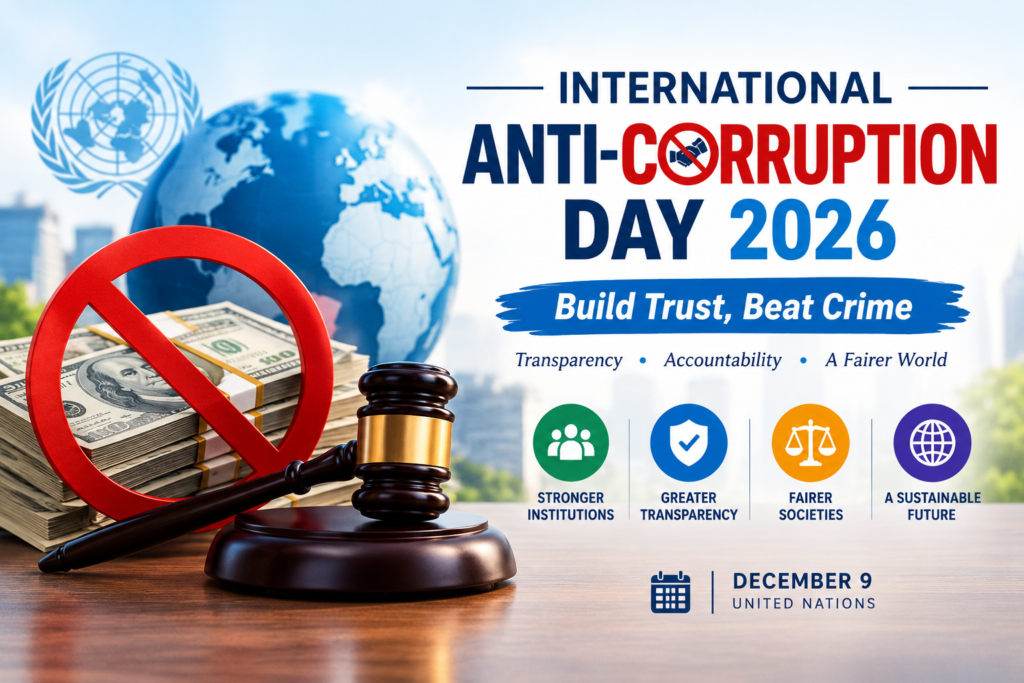
Corruption rarely makes headlines in the way a natural disaster does, yet its effects can be just as far-reaching. When public money is diverted, when decisions are bought rather than earned, or when criminals exploit weak oversight, ordinary people pay the price through weaker schools, hospitals, roads and trust in institutions. International Anti-Corruption Day 2026 is observed on Wednesday, December 9, and it is a global call to prevent corruption and strengthen accountability.
This year’s focus is the United Nations 2026–2027 campaign, “Connecting the Dots: Exposing the Links Between Corruption and Crime,” which highlights how corruption enables organized crime, money laundering and other criminal activity. Below you will find the date, the theme, the history of the observance, why it matters and practical steps for governments, businesses, students and individuals..
When Is International Anti-Corruption Day 2026?
International Anti-Corruption Day 2026 is on Wednesday, December 9. It promotes awareness, transparency, accountability and international cooperation to prevent and combat corruption.
- The United Nations observes the day every year on December 9.
- It raises awareness about preventing corruption and putting the principles of the United Nations Convention against Corruption (UNCAC) into practice.
- In 2026, it falls midweek, which makes it easy to hold a classroom discussion, a workplace session or a community event.
Countdown to International Anti-Corruption Day 2026
As of October 12, 2026, there are 58 days remaining until Wednesday, December 9, 2026. (Developer note: replace this with a dynamic countdown so it updates daily, and delete this line before publishing.)
What Is International Anti-Corruption Day?
Meaning of International Anti-Corruption Day
The observance encourages governments, businesses, civil society and individuals to recognize the harm caused by corruption and to support stronger prevention and accountability measures. It is not about accusing anyone; it is about building systems in which fair rules apply to everyone.
What Counts as Corruption?
Corruption takes many forms. Common examples include:
- Bribery: Offering, giving, requesting or accepting an improper benefit.
- Embezzlement: Misappropriating money or property entrusted to someone.
- Abuse of entrusted power: Using an official or professional position for improper personal gain.
- Fraud: Deliberately deceiving others for an unlawful benefit.
- Nepotism or favoritism: Giving unfair advantages to relatives or associates where impartial decisions are required.
- Money laundering: Concealing the criminal origins of money or assets.
Legal definitions and offenses vary by jurisdiction, and not every ethical concern is necessarily a criminal offense.
Who Leads the International Campaign?
The United Nations Office on Drugs and Crime (UNODC) and the United Nations Development Programme (UNDP) support international anti-corruption work and the annual awareness campaign.
International Anti-Corruption Day 2026 Theme
What Is the Official Theme for 2026?
The UN’s published 2026–2027 campaign is “Connecting the Dots: Exposing the Links Between Corruption and Crime.” This is the published campaign direction for the period, rather than a separate slogan created just for a single day. It calls on governments and partners to stand #UnitedAgainstCorruption.
What Does “Connecting the Dots” Mean?
The campaign highlights several ideas:
- Understanding how corruption helps organized criminal networks operate
- Identifying links between corruption, money laundering and illicit financial flows
- Strengthening international cooperation to investigate cross-border crime
- Improving financial integrity, oversight and accountability
- Reducing opportunities for criminal networks to exploit institutions and regulatory gaps
What Does #UnitedAgainstCorruption Mean?
The hashtag is a call for collective action by governments, organizations, businesses, communities and individuals. Preventing corruption takes more than public statements. It also requires transparent systems, credible oversight and effective enforcement.
History of International Anti-Corruption Day
The United Nations Convention against Corruption
The UN General Assembly adopted the United Nations Convention against Corruption on October 31, 2003, through Resolution 58/4. It is an international legal framework for preventing and combating corruption, and it emphasizes four areas:
- Prevention
- Criminalization and law enforcement
- International cooperation
- Asset recovery
Why December 9 Was Chosen
The UN General Assembly designated December 9 as International Anti-Corruption Day in 2003 to raise awareness of corruption and the role of UNCAC in preventing and combating it. The date coincides with the period when the convention was opened for signature at a high-level conference in Mérida, Mexico, in December 2003.
When Did the Convention Enter into Force?
UNCAC entered into force on December 14, 2005, after the required number of instruments of ratification, acceptance, approval or accession had been deposited.
How the Observance Has Evolved
Over the years, anti-corruption efforts have broadened to include public procurement, financial transparency, whistleblower protection, international investigations, asset recovery and the corruption risks linked to organized crime. The 2026–2027 campaign continues that evolution by focusing on how corruption and crime reinforce each other.
Why Is International Anti-Corruption Day Important?
International Anti-Corruption Day is important because corruption can weaken public institutions, divert resources from essential services, discourage investment, undermine fair decision-making and damage trust in the rule of law. The observance encourages stronger prevention, transparency, accountability and cooperation.
Key reasons it matters:
- Protecting public resources: Corruption can divert money intended for health care, education, infrastructure and other public services.
- Supporting fair institutions: Transparent systems help decisions follow clear rules rather than improper influence.
- Encouraging economic development: Corruption can increase business costs, discourage investment and disadvantage businesses that follow the rules.
- Strengthening public trust: Accountability helps people understand how decisions are made and how public resources are used.
- Protecting justice and the rule of law: Effective oversight and fair enforcement help limit abuses of entrusted power.
- Disrupting organized crime: The 2026–2027 campaign highlights how corruption can help criminal networks evade detection and move illicit money.
How Corruption Connects to Organized Crime
Corruption and Money Laundering
Corrupt arrangements can help conceal the origins of illicit funds, enable improper transactions or weaken financial controls. When controls are weak, it becomes easier to move money that comes from crime.
Corruption and Cross-Border Criminal Networks
Criminal networks may exploit bribery, compromised oversight or institutional weaknesses to move people, goods and money across borders. The more gaps there are in the system, the more room they have to operate.
Why International Cooperation Matters
Because these crimes cross national boundaries, no single country can address them alone. Information sharing, financial investigations, coordinated law enforcement and cooperation between countries are essential ways to respond.
The Role of Financial Integrity
Accurate records, transparent transactions, risk-based checks and effective financial oversight help detect and deter illicit activity. Strong financial integrity makes it harder for corruption and crime to hide.
Practical Ways to Prevent and Fight Corruption
What Governments Can Do
- Establish clear rules and enforce them fairly
- Improve transparency in public spending and procurement
- Strengthen independent oversight and audit processes
- Investigate credible allegations through lawful procedures
- Cooperate internationally on cross-border corruption cases
- Support appropriate asset recovery mechanisms
What Businesses Can Do
- Adopt clear anti-bribery policies
- Train employees on conflicts of interest and ethical decision-making
- Keep accurate financial and procurement records
- Establish appropriate reporting channels
- Investigate concerns fairly and protect people from retaliation where applicable
- Conduct proportionate due diligence on business partners
What Individuals Can Do
- Refuse to participate in bribery or fraudulent activity
- Follow relevant reporting procedures when it is safe and appropriate
- Verify information before sharing corruption allegations
- Support transparent, evidence-based public decision-making
- Learn about integrity, accountability and your rights under applicable laws
A safety note: do not confront suspected offenders directly. Reporting options and personal safety considerations vary by location, so use official or lawful channels.
How to Observe International Anti-Corruption Day 2026
Schools, workplaces, community groups and organizations can mark the day in simple, practical ways:
- Share educational information about the UN’s 2026–2027 campaign.
- Organize a discussion about transparency and accountability.
- Host a school or university presentation on ethics and integrity.
- Review workplace policies on bribery and conflicts of interest.
- Promote awareness of safe, lawful reporting channels.
- Discuss how transparent procurement protects public resources.
- Share the official #UnitedAgainstCorruption campaign hashtag.
- Invite an appropriate expert to discuss corruption prevention.
- Explain how corruption can enable organized crime and money laundering.
- Publish a commitment to ethical practices with specific, measurable actions.
The day also sits close to International Human Rights Day on December 10, so you may want to read our International Human Rights Day 2026 guide. If you are interested in the UN itself, see our United Nations Day 2026 article.
International Anti-Corruption Day Activities for Students
- Create posters explaining integrity, fairness and accountability
- Discuss ethical scenarios and how to make fair decisions
- Prepare a presentation about UNCAC and the UN
- Write short essays on why public resources should be protected
- Develop a classroom code of integrity
Activities for Businesses and Workplaces
- Review ethics and anti-bribery policies
- Provide staff training on conflicts of interest
- Discuss procurement transparency and recordkeeping
- Review how employees can raise concerns safely
- Identify measurable improvements to internal controls
For more ways to take positive action in your community, see our Make a Difference Day 2026 guide.
International Anti-Corruption Day Facts
- International Anti-Corruption Day is observed annually on December 9.
- The UN General Assembly adopted UNCAC on October 31, 2003.
- December 9 was designated as the observance date in 2003.
- UNCAC entered into force in December 2005.
- The UN’s 2026–2027 campaign is titled “Connecting the Dots: Exposing the Links Between Corruption and Crime.”
- The campaign uses the hashtag #UnitedAgainstCorruption.
- Anti-corruption work involves prevention, accountability, international cooperation and enforcement.
Frequently Asked Questions
What is Anti-Corruption Day?
International Anti-Corruption Day is a UN observance held on December 9 to raise awareness of corruption and promote efforts to prevent and combat it.
What is the theme of International Anti-Corruption Day 2026?
The UN’s 2026–2027 campaign is “Connecting the Dots: Exposing the Links Between Corruption and Crime.”
When is International Anti-Corruption Day 2026?
It falls on Wednesday, December 9, 2026.
Why is December 9 Anti-Corruption Day?
The UN General Assembly designated December 9 in 2003 to raise awareness about corruption and the role of UNCAC in combating and preventing it.
What is the United Nations Convention against Corruption?
UNCAC is an international convention adopted in 2003 that establishes a framework for preventing and combating corruption, strengthening cooperation and addressing related legal and institutional challenges.
How does corruption affect society?
Corruption can divert public funds, weaken institutions, discourage investment, undermine trust and interfere with fair and effective law enforcement.
How can ordinary people help fight corruption?
People can follow ethical practices, learn about relevant laws, support transparent institutions, verify claims before sharing them and use appropriate reporting channels when concerns arise.
What does #UnitedAgainstCorruption mean?
It is a campaign hashtag encouraging collective action to prevent corruption and address the harm it causes, including its connections to organized crime.
Conclusion: Stand United Against Corruption
International Anti-Corruption Day 2026 on Wednesday, December 9 is a reminder that integrity is built through everyday choices and strong systems. The UN’s 2026–2027 campaign asks us to connect the dots between corruption and crime, and to respond with transparency, cooperation and accountability. Whether you run a classroom, a company or a community group, you can start with one practical step: review a policy, start a conversation or share accurate information.