
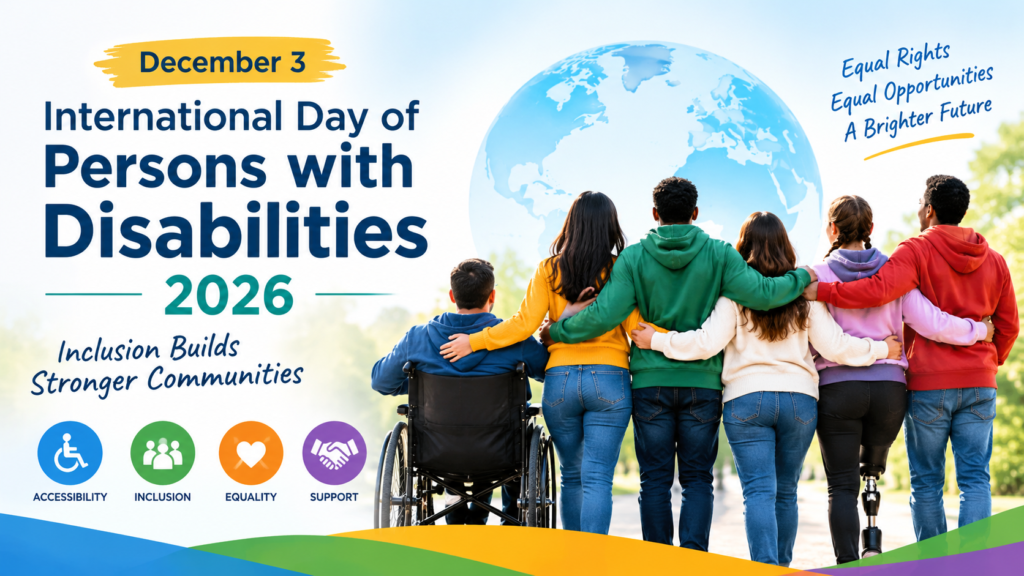
International Day of Persons with Disabilities 2026 will be observed on Thursday, December 3, 2026. The United Nations marks the day every year to promote the rights, dignity and well-being of persons with disabilities and to highlight the barriers that still limit full participation in society.
This guide explains what the day is, where it came from, why accessibility and inclusion matter, and how individuals, schools and workplaces can take meaningful action. It also answers the question many readers are asking: what is the 2026 theme? For other dates on the calendar, browse our Upcoming Days & Events section.
When Is International Day of Persons with Disabilities 2026?
International Day of Persons with Disabilities 2026 is Thursday, December 3, 2026. The United Nations established the annual observance to promote the rights and well-being of persons with disabilities and to raise awareness of barriers to full participation in society.
- Full date: Thursday, December 3, 2026
- Frequency: Every year on December 3
- Abbreviation: IDPD
- Origin: Proclaimed by the UN General Assembly in 1992
The December 3 date has been in place since the 1992 proclamation, which came at the end of the UN Decade of Disabled Persons (1983–1992). Because the date is fixed, it moves through the days of the week from year to year, and in 2026 it falls on a Thursday.
What Is International Day of Persons with Disabilities (IDPD)?
IDPD is a United Nations observance held every December 3 to promote understanding of disability issues and mobilize support for the dignity, rights and well-being of persons with disabilities. It also highlights the benefits of including persons with disabilities in every part of political, social, economic and cultural life.
The day is not only about awareness. It is a call to remove barriers so that people with disabilities can learn, work, travel, use services and take part in decisions on equal terms.
You can find a general overview of the observance on Wikipedia’s International Day of Persons with Disabilities page.
Main Goals of IDPD
- Promote the rights and dignity of persons with disabilities.
- Encourage inclusive education, employment and public services.
- Increase awareness of physical, digital and social barriers.
- Support participation in decision-making and community life.
What Is the Theme of International Day of Persons with Disabilities 2026?
As of October 10, 2026, the official 2026 theme has not yet been confirmed. The United Nations selects a new theme each year, and it is typically announced ahead of December 3. This page will be updated once an official theme and its explanation are published.
Some websites already list a 2026 theme, but those are often a previous year’s theme repeated or an unofficial guess. To avoid spreading incorrect information, we only list themes confirmed by the UN.
| Year | Official UN Theme |
|---|---|
| 2025 | Fostering disability inclusive societies for advancing social progress |
| 2024 | Amplifying the leadership of persons with disabilities for an inclusive and sustainable future |
| 2026 | Not yet confirmed |
Where to Find the Official 2026 Theme
- Check the United Nations’ official observance page for International Day of Persons with Disabilities.
- Review announcements from the UN Department of Economic and Social Affairs.
- Look for statements from the UN Secretary-General closer to December 3.
Until then, the most useful approach is to focus on the day’s lasting priorities: accessibility, inclusion, equal rights and participation.
History of International Day of Persons with Disabilities
The observance grew out of decades of UN work on disability rights. In 1981, the United Nations proclaimed the International Year of Disabled Persons, which focused on full participation and equality. It then declared 1983–1992 the UN Decade of Disabled Persons.
The 1992 United Nations Proclamation
When that decade ended, the UN General Assembly proclaimed December 3 as the International Day of Disabled Persons in 1992 through Resolution 47/3. The observance later became known as the International Day of Persons with Disabilities. The change reflects a broader shift in how disability is discussed, from charity and medical models toward rights and inclusion.
The Convention on the Rights of Persons with Disabilities
A major milestone came in 2006, when the UN General Assembly adopted the Convention on the Rights of Persons with Disabilities (CRPD). The treaty affirms the rights, dignity and equal participation of persons with disabilities, and it covers areas such as accessibility, education, work, health and independent living.
It is now one of the central reference points for disability rights worldwide, and IDPD events often promote its implementation. You can read an accessible summary on Wikipedia’s page for the Convention on the Rights of Persons with Disabilities.
Why Is International Day of Persons with Disabilities Important?
IDPD matters because barriers to participation still exist in education, work, transport, technology and public life. The day helps shift attention from what individuals cannot do to what societies must change.
Disability Inclusion and Equal Rights
Inclusion means enabling people to participate fully in society. It does not mean expecting individuals to overcome every barrier on their own. When buildings, systems and attitudes are designed with everyone in mind, more people can contribute and succeed.
Accessibility in Everyday Life
Accessibility affects daily life in many ways:
- Buildings, transport and public spaces: ramps, step-free access, tactile paving and accessible restrooms
- Websites and online services: screen-reader compatibility, captions, readable contrast and keyboard navigation
- Classrooms and workplaces: flexible learning materials, assistive technology and reasonable adjustments
- Healthcare and emergency information: clear, accessible communication in multiple formats
Challenging Discrimination and Stereotypes
Stigma, exclusion and inaccessible systems can limit education, employment, independence and social participation. Stereotypes can also shape how people with disabilities are treated, whether through low expectations or being portrayed only as objects of pity or inspiration. Respectful representation starts with listening to people with lived experience.
Many people prefer person-first language such as “person with a disability,” while others prefer identity-first language such as “disabled person.” When in doubt, follow the preference of the person you are speaking about.
How Can People Celebrate International Day of Persons with Disabilities 2026?
The most meaningful observances go beyond symbolic gestures. They involve practical actions that reduce barriers.
10 Ways to Participate
- Attend a local disability inclusion event, in person or online.
- Learn about disability rights and accessibility.
- Review the accessibility of a website or public space you use.
- Support organizations led by persons with disabilities.
- Promote inclusive hiring and workplace practices.
- Share verified information from disability advocates.
- Make online content accessible with captions and descriptive alt text.
- Encourage accessible learning materials in schools.
- Ask people about their access requirements instead of making assumptions.
- Include persons with disabilities in planning and decision-making.
Families can also turn the day into a conversation. Our Family & Lifestyle section has ideas for meaningful time together.
International Day of Persons with Disabilities 2026 Activities for Schools and Workplaces
Activities for Students
- Research disability rights and the history of IDPD.
- Review whether school materials are accessible.
- Discuss inclusive design and assistive technology.
- Invite a disability advocate to speak, with appropriate consent and compensation.
Workplace Activities
Work is one of the most important areas of inclusion. Just as Labor Day 2026 recognizes the contributions of workers, IDPD is a good moment to ask whether every worker has a fair chance to contribute.
- Review accessibility policies and recruitment processes.
- Provide accessible meeting materials, such as captions and readable documents.
- Offer disability inclusion training.
- Ask employees what practical improvements would help, while respecting privacy.
Avoid activities that imitate disability or turn disability into a game. Focus instead on removing barriers and listening to lived experience.
Facts About International Day of Persons with Disabilities
- It is observed annually on December 3.
- The UN General Assembly proclaimed it in 1992.
- It was originally called the International Day of Disabled Persons.
- It promotes rights, well-being, accessibility and inclusion.
- The Convention on the Rights of Persons with Disabilities was adopted in 2006.
- In 2026, December 3 falls on a Thursday.
- The 2025 theme was “Fostering disability inclusive societies for advancing social progress.”
- The 2026 theme will be added once officially confirmed.
International Day of Persons with Disabilities 2026 Quotes and Messages
The messages below are original and are not attributed to any public figure. We only attribute a quotation when it can be verified, so none are listed here.
- Accessibility creates opportunities for everyone to participate.
- Inclusion begins when we listen, remove barriers and respect every person’s rights.
- A more accessible community is a community where more people can contribute.
- Nothing about us without us: include persons with disabilities in every decision that affects them.
- Real inclusion is built into the design, not added as an afterthought.
Social Media Captions
- Marking International Day of Persons with Disabilities 2026 by committing to accessibility all year.
- Inclusion is a practice, not a post. #IDPD2026
- On December 3, we’re listening, learning and removing barriers.
- Access for all starts with design that includes everyone. #IDPD
- Today and every day: equal rights, equal opportunities, equal participation.
Frequently Asked Questions About IDPD 2026
What is IDPD?
IDPD stands for International Day of Persons with Disabilities, a UN observance held each year on December 3 to promote disability rights, well-being and inclusion.
When is International Day of Persons with Disabilities 2026?
It falls on Thursday, December 3, 2026.
What is the 2026 theme?
The official 2026 theme has not yet been confirmed. Check the United Nations’ official observance page for updates.
Why is International Day of Persons with Disabilities celebrated?
It raises awareness of disability rights and encourages action to remove barriers to equal participation in society.
How can schools celebrate IDPD?
Schools can teach disability-rights history, improve the accessibility of learning materials and involve persons with disabilities in discussions about inclusion.
What is the difference between disability awareness and disability inclusion?
Awareness helps people understand disability and related barriers. Inclusion involves taking practical steps to ensure equal access, participation and decision-making.
Countdown to International Day of Persons with Disabilities 2026
🗓️ IDPD 2026 Countdown: International Day of Persons with Disabilities is Thursday, December 3, 2026.
Conclusion: Building a More Accessible and Inclusive World
International Day of Persons with Disabilities 2026 falls on Thursday, December 3. It is a day to remember that disability rights are human rights, and that accessibility and inclusion benefit entire communities.
The strongest response to this day is lasting action: improving access, listening to lived experience and including persons with disabilities in every decision. Accessibility and inclusion should be priorities throughout the year, not just on December 3. For more awareness days and observances, visit the National Days & Events Guide.