
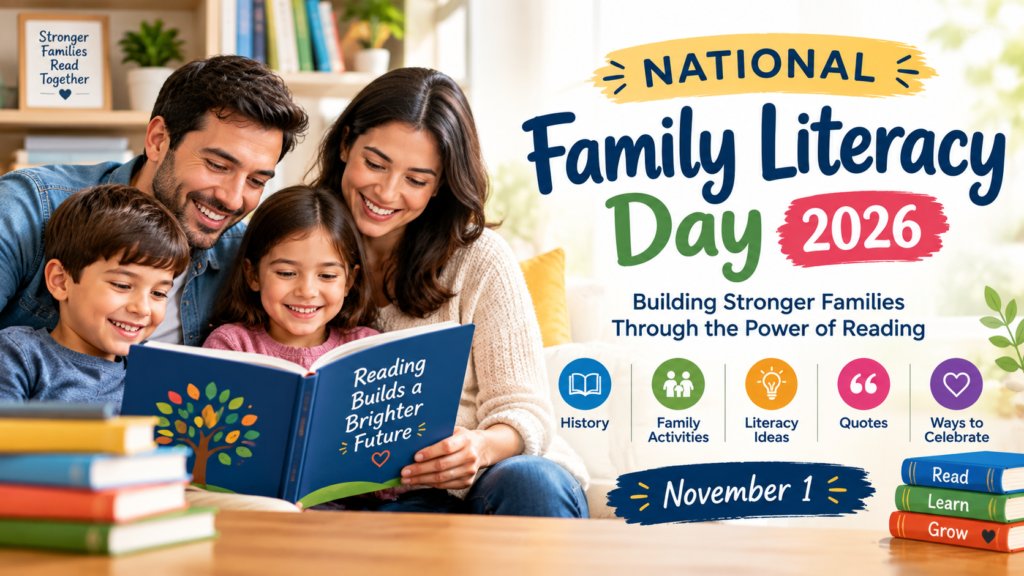
National Family Literacy Day 2026 falls on Sunday, November 1. The observance recognizes how important it is for families to learn together through reading, writing, conversation, play, and other everyday educational moments. It was designated in 1994 through the work of the National Center for Families Learning (NCFL) alongside Congress, and NCFL now promotes the entire month of November as National Family Literacy Month, extending the spirit of the day well beyond a single date.
Whether you’re a parent, a teacher, a librarian, or simply someone who loves reading, this guide covers everything you need to know about the day — its history, its meaning, and dozens of practical activities to celebrate literacy as a family.
When Is National Family Literacy Day 2026?
What date is National Family Literacy Day?
National Family Literacy Day is observed every year on November 1.
What day of the week is it in 2026?
In 2026, November 1 falls on a Sunday, making it an easy day to build into a relaxed weekend routine of reading and family time.
National Family Literacy Day 2026: Sunday, November 1, 2026
Is National Family Literacy Day always November 1?
Yes. Unlike floating holidays that move to a specific weekday, National Family Literacy Day is fixed to November 1 every year.
What is National Family Literacy Month?
November 1 is the official designated day, but NCFL promotes all of November as National Family Literacy Month. This distinction matters: the day is a starting point, while the month is an invitation to keep the momentum going with ongoing reading, writing, and learning activities at home, at school, and in the community.
What Is National Family Literacy Day?
What family literacy means
Family literacy is the idea that learning happens best when it’s shared across generations — not just between a teacher and a student, but between a parent and a child, or even between siblings. It includes reading, but it also includes talking, storytelling, writing, and exploring new ideas together.
Why families learning together matters
When literacy becomes a shared family activity rather than a solitary homework task, it tends to feel less like a chore and more like a habit that sticks. Children see literacy modeled by the adults around them, and adults often rediscover their own love of reading or writing in the process.
The role of parents and caregivers in literacy
Parents and caregivers don’t need to be reading experts to support literacy at home. Asking questions, listening to a child retell a story, or writing a simple note together all count as meaningful family literacy moments.
How family literacy extends beyond reading books
Family literacy isn’t limited to books. Reading a recipe together while cooking, writing a grocery list, or discussing a news story at dinner are all literacy-building activities.
How schools, libraries, and communities support family literacy
Schools and libraries play a major role in family literacy by hosting reading events, offering take-home books, and creating spaces where families can learn together outside the classroom.
NCFL’s current model describes family literacy through several connected areas, including adult education, parent education, children’s education, and Parent and Child Together (PACT) Time — a structure that treats literacy as something the whole family grows into together.
National Family Literacy Day History
When was National Family Literacy Day established?
National Family Literacy Day was established in 1994.
The 1994 designation
The National Center for Families Learning worked with Congress to designate November 1 as National Family Literacy Day, formally recognizing family-based learning as a distinct and valuable approach to literacy education.
The role of the National Center for Families Learning
NCFL has continued to champion the observance since its creation, expanding its focus from a single day of awareness into a broader movement supporting families across the country.
How one day expanded into a month-long focus
Over time, NCFL began encouraging schools, libraries, and organizations to extend literacy activities across all of November rather than concentrating them into a single day.
National Family Literacy Month today
Today, National Family Literacy Month is the more commonly promoted framework, with November 1 serving as the symbolic kickoff for a month of shared reading, writing, and learning. It’s worth noting that this is an awareness observance rather than a federal public holiday, so schools, offices, and businesses generally operate on a normal schedule.
Why Is Family Literacy Important?
Reading together builds family learning routines
A regular reading habit — even just ten minutes a night — creates a routine that both children and adults can look forward to.
Talking and asking questions supports language development
Conversation is one of the most underrated literacy tools. Asking open-ended questions about a story, a photo, or a daily event helps build vocabulary and comprehension naturally.
Writing can become a family activity
Writing doesn’t have to mean essays or homework. A shared journal, a note left on the fridge, or a letter to a grandparent all count.
Everyday activities can include literacy
Cooking, shopping, and even doing chores together offer natural opportunities to read instructions, write lists, and talk through steps.
Parents and caregivers can learn alongside children
Family literacy works both ways. Parents pursuing their own education or learning goals alongside their children can be just as powerful as reading to a child.
NCFL describes family literacy as a multigenerational approach that can support children’s learning while also addressing adult education and workforce-related goals — meaning the benefits of family literacy programs can reach the whole household, not just the youngest members.
National Family Literacy Day 2026 Activities for Families
Family Reading Activities
- Read aloud together
- Take turns reading pages or chapters
- Let children choose the book
- Ask prediction questions before turning the page
- Discuss favorite characters
- Retell the story together afterward
- Create a cozy family reading corner
- Have a screen-free reading hour
Family Writing Activities
- Write a family story together
- Start a family journal
- Write letters to relatives
- Make a grocery list together
- Write postcards
- Create a family recipe book
- Keep a shared reading journal of books you’ve finished
Conversation and Vocabulary Activities
- Play “word of the day”
- Take turns in a storytelling circle
- Describe an object without naming it
- Ask open-ended questions about the day
- Discuss new or unfamiliar words from a book
- Invent family word games
Literacy Activities for Young Children
- Picture-book reading
- Alphabet games
- Rhyming games
- Nursery-rhyme activities
- Picture storytelling
- Letter hunts around the house
Literacy Activities for Older Children
- Family book discussions
- Research a topic together
- Write short reviews of books or movies
- Create a family newsletter
- Debate a book’s ideas
- Compare two versions of the same story
Low-Cost Family Literacy Activities
- Library visits
- Reading books you already own
- Storytelling without books
- Word-based games
- Word scavenger hunts around the house
- Family discussion prompts at dinner
NCFL itself recommends activities such as family read-alouds, open-ended discussion, play-based learning, and hands-on family learning as simple, low-barrier ways to build literacy at home.
Family Literacy Activities by Age Group
| Age Group | Activity Ideas |
|---|---|
| Toddlers | Picture books, naming objects, rhymes, songs |
| Preschoolers | Storytelling, alphabet games, drawing and labeling |
| Early readers | Read-alouds, simple writing, word games |
| Elementary students | Book discussions, journals, research projects |
| Tweens | Book clubs, reviews, creative writing |
| Teens | Family discussions, independent reading, research and writing |
| Adults | Reading groups, adult education, writing and shared learning |
Literacy activities don’t need to be academic to count. Talking, playing, exploring, asking questions, and creating stories together can all become genuine literacy opportunities.
National Family Literacy Day 2026 Ideas for Schools
- Classroom family reading event
- Family book exchange
- Parent-child reading challenge
- Family storytelling day
- Student-created family newsletters
- Family literacy bulletin board
- School library family reading event
National Family Literacy Day 2026 Ideas for Libraries
- Family read-aloud sessions
- Themed book displays
- Parent-child reading workshops
- Storytelling sessions
- Family book clubs
- Take-home literacy kits
- Local-author events
- Multilingual reading activities
National Family Literacy Day 2026 Quotes
Short family literacy quotes
- “A family that reads together grows together.”
- “Every book shared is a memory made.”
- “Literacy is a gift best given as a family.”
Quotes about reading together
- “The best stories are the ones we discover side by side.”
- “Reading aloud is a small act with a lasting echo.”
Quotes about families and learning
- “In every family, there’s a teacher and a student in each of us.”
- “Learning together turns ordinary evenings into something meaningful.”
Inspirational literacy quotes
- “Words open doors that stay open for a lifetime.”
- “A single page read together can spark a lifelong love of learning.”
Original family literacy appreciation lines
- “Happy National Family Literacy Day — may your shelves and your conversations both be full.”
- “Here’s to the stories we read, the words we write, and the lessons we share as a family.”
National Family Literacy Day 2026 Messages
Short messages for families
“Wishing our family a Happy National Family Literacy Day — let’s keep learning together, one page at a time.”
Messages for parents and caregivers
“Thank you for making reading and learning a shared part of our home. Happy National Family Literacy Day.”
Messages for teachers
“Happy National Family Literacy Day to the teachers who encourage families to keep learning together outside the classroom.”
Messages for students
“Happy National Family Literacy Day! Keep reading, keep asking questions, and keep sharing what you learn with your family.”
Messages for schools and libraries
“Grateful for the schools and libraries that make family literacy events possible. Happy National Family Literacy Day.”
Social media captions
- “This National Family Literacy Day, make time to read, talk, write, explore, and learn together. 📚”
- “One book, one story, one family. Happy National Family Literacy Day!”
How Can Families Celebrate National Family Literacy Day 2026?
- Choose a book everyone can enjoy.
- Set aside dedicated family reading time.
- Talk about what you read.
- Let children ask and answer questions.
- Try a writing activity together.
- Visit a library.
- Play a word or storytelling game.
- Share a favorite book with another family.
- Create a family reading goal for November.
- Continue the activity throughout National Family Literacy Month.
7-Day National Family Literacy Challenge
This simple challenge — created as a fun way to celebrate the day and kick off National Family Literacy Month — is a great way to build a week of shared learning into your family’s routine.
| Day | Family Activity |
|---|---|
| Day 1 | Read a book together |
| Day 2 | Tell a family story |
| Day 3 | Play a word game |
| Day 4 | Write something together |
| Day 5 | Visit a library |
| Day 6 | Discuss a favorite book |
| Day 7 | Create a family reading goal |
If your family enjoys building small traditions like this, you may also like our roundup of Halloween quotes, wishes, and messages for another fun way to connect with loved ones this fall, or browse more 2026 holidays and observances to plan your family’s calendar throughout the year.
Frequently Asked Questions
What is Family Literacy Day? It’s an annual observance, held November 1, that recognizes the value of families learning together through reading, writing, and conversation.
When is National Family Literacy Day 2026? Sunday, November 1, 2026.
Why is National Family Literacy Day celebrated? To highlight the importance of literacy as a shared, multigenerational family activity rather than something limited to the classroom.
What is family literacy? A multigenerational approach to learning in which children and adults take part in literacy and educational activities together, according to the National Center for Families Learning.
How can families celebrate Family Literacy Day? By reading together, visiting a library, telling stories, writing together, or simply talking more intentionally about books and ideas.
What are family literacy activities? Reading aloud, family journals, word games, library visits, and storytelling are all examples of accessible family literacy activities.
What is National Family Literacy Month? The broader November-long observance that extends the focus of November 1 into a month of ongoing family learning. Communities and families discussing literacy routines, like those found in forums such as r/literacy on Reddit, often highlight how small daily habits make the biggest long-term difference.
Who started National Family Literacy Day? The National Center for Families Learning, working with Congress, designated the day in 1994.
Why is Family Literacy Day on November 1? November 1 was chosen as the official designation date in 1994 and has remained the fixed date ever since.
National Family Literacy Day 2026 is a simple reminder that literacy doesn’t have to be a solo pursuit. Whether it’s a bedtime story, a family journal, or a trip to the library, the smallest shared moments on November 1 — and throughout National Family Literacy Month — can grow into lifelong habits worth celebrating.