
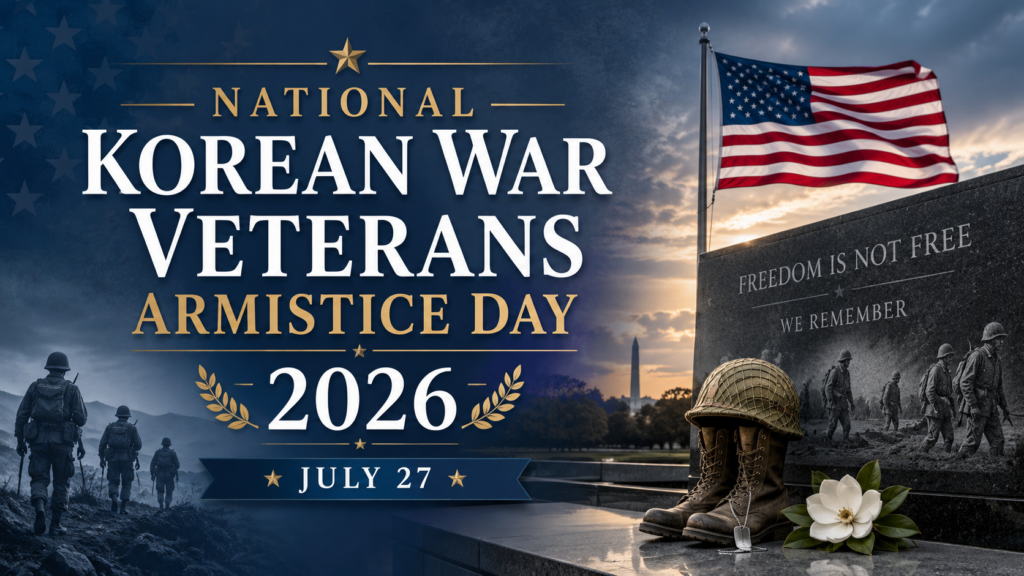
National Korean War Veterans Armistice Day 2026 is observed on Monday, July 27, 2026, in the United States. The annual observance honors Americans who served during the Korean War and commemorates the armistice signed on July 27, 1953, which brought organized combat on the Korean Peninsula to a halt.
The day is a commemorative observance rather than a federal public holiday. Federal offices, schools, banks and most businesses are therefore expected to follow their normal Monday schedules unless a local organization announces a ceremony or closure. National Korean War Veterans Armistice Day is not included among the legal federal holidays listed by the U.S. Office of Personnel Management.
National Korean War Veterans Armistice Day 2026: Quick facts
| Question | Answer |
|---|---|
| When is Korean War Veterans Armistice Day 2026? | Monday, July 27, 2026 |
| How often is it observed? | Every year on July 27 |
| What anniversary is observed in 2026? | The 73rd anniversary of the 1953 armistice |
| Is it a federal holiday? | No |
| Are federal offices closed? | No special nationwide closure |
| Should the American flag be displayed? | Yes, flag display is specifically encouraged |
| Does the day mark a peace treaty? | No; it commemorates a military armistice |
| Who is honored? | U.S. Korean War veterans, fallen service members and allied participants |
| Main national memorial | Korean War Veterans Memorial in Washington, D.C. |
July 27 is included in the U.S. Flag Code as National Korean War Veterans Armistice Day and as an occasion on which display of the American flag is especially encouraged.
What is National Korean War Veterans Armistice Day?
National Korean War Veterans Armistice Day is an American remembrance day recognizing the service and sacrifices of people who served during the Korean War.
It also commemorates the Korean Armistice Agreement signed on July 27, 1953. The agreement stopped large-scale fighting, established military separation measures and created a system for supervising the ceasefire.
The observance has two closely connected purposes:
- To honor American Korean War veterans and those who died while serving.
- To remember the armistice that halted active hostilities after more than three years of conflict.
Approximately 5.7 million American veterans served during the Korean War period, according to the Department of Veterans Affairs.
When is National Korean War Veterans Armistice Day 2026?
National Korean War Veterans Armistice Day is observed on the fixed date of July 27 every year.
In 2026, July 27 falls on a Monday. The observance takes place on the actual calendar date and is not moved to a nearby Monday or Friday.
Future Korean War Veterans Armistice Day dates
| Year | Date | Day |
|---|---|---|
| 2026 | July 27 | Monday |
| 2027 | July 27 | Tuesday |
| 2028 | July 27 | Thursday |
| 2029 | July 27 | Friday |
| 2030 | July 27 | Saturday |
| 2031 | July 27 | Sunday |
Why is Korean War Veterans Armistice Day observed on July 27?
The date commemorates the signing of the Korean Armistice Agreement on July 27, 1953.
The agreement was signed at 10 a.m. in Panmunjom. Eighteen official copies were prepared in English, Korean and Chinese. The signing followed lengthy negotiations involving 158 formal meetings over more than two years.
The agreement did not immediately stop every military operation at the moment it was signed. The ceasefire became effective 12 hours later, after which the opposing forces were required to separate according to the agreement’s terms.
A brief history of the Korean War
The Korean War began on June 25, 1950, when North Korean forces invaded South Korea. The conflict involved South Korean forces supported by a United Nations Command led by the United States, while North Korea received major military support from China and assistance from the Soviet Union.
The fighting continued for approximately 37 months. By 1951, the front had largely stabilized, but armistice negotiations and military operations continued for another two years.
Negotiators reached agreement on the remaining issues in July 1953. The Korean Armistice Agreement was signed on July 27, stopping active large-scale combat without establishing a permanent political settlement.
Who signed the Korean Armistice Agreement?
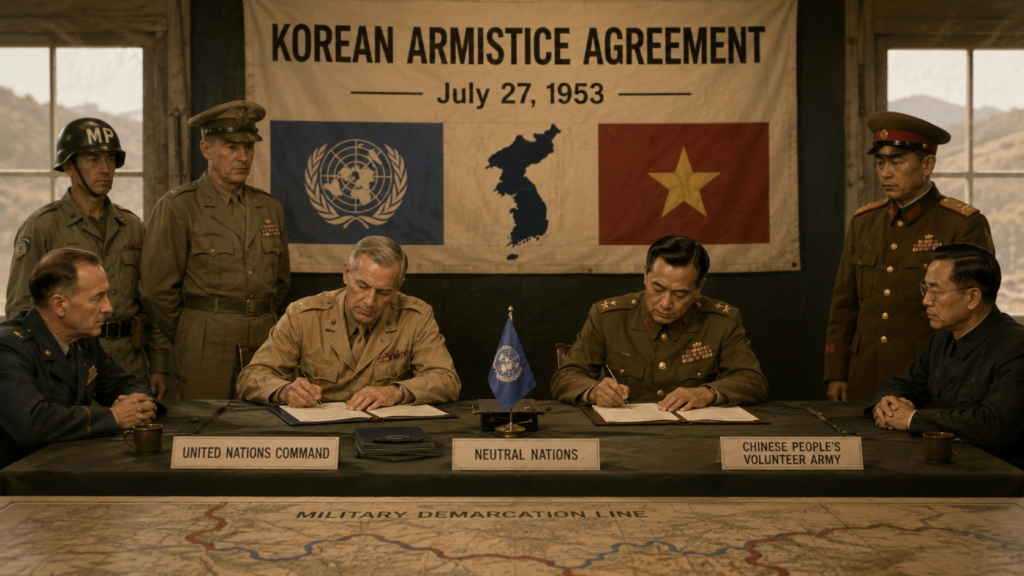
At the signing ceremony, U.S. Army Lieutenant General William K. Harrison Jr. signed as the senior delegate for the United Nations Command.
General Nam Il signed as the senior delegate representing the Korean People’s Army and the Chinese People’s Volunteers. Eighteen official copies were signed during the ceremony.
The official parties represented in the agreement were:
- The United Nations Command
- The Korean People’s Army
- The Chinese People’s Volunteers
The Republic of Korea government was not one of the agreement’s signatories. This follows from the official signatory record, which identifies the three military commands above as the participating parties.
Did the Korean Armistice Agreement end the Korean War?
The armistice ended organized fighting, but it was not a permanent peace treaty.
An armistice is a formal agreement by opposing military forces to stop fighting. A peace treaty normally provides a broader political settlement and formally ends the state of war between governments.
The 1953 agreement was described by U.S. Army historical sources as a temporary ceasefire rather than a final peace settlement. The armistice framework remains important to the management of military activity around the Korean Demilitarized Zone.
Therefore, the most accurate explanation is:
The Korean Armistice Agreement ended active combat in 1953, but it did not create a permanent peace treaty.
What did the Korean Armistice Agreement establish?
The armistice created several measures intended to separate opposing military forces and prevent fighting from resuming.
The Military Demarcation Line
The agreement established a Military Demarcation Line, or MDL, near the final positions occupied by opposing forces.
The Korean Demilitarized Zone
Forces on both sides withdrew two kilometers from the Military Demarcation Line. This created a Demilitarized Zone approximately four kilometers wide and about 241 kilometers long across the Korean Peninsula.
A ceasefire-monitoring system
The agreement created military mechanisms for supervising its implementation, investigating possible violations and managing authorized access around the Demilitarized Zone.
United Nations Command continues to describe control of access to the DMZ and crossings of the Military Demarcation Line as part of its armistice-related responsibilities.
Arrangements involving prisoners
The negotiations also addressed the handling and repatriation of prisoners of war, one of the most difficult issues discussed during the armistice talks.
Why is National Korean War Veterans Armistice Day important?
The observance ensures that Korean War veterans remain part of America’s public memory.
The Korean War has sometimes been called the “Forgotten War” because it received less sustained public attention than World War II and the Vietnam War. National Korean War Veterans Armistice Day helps communities recognize the people who served, the families who supported them and those who never returned.
The day also highlights the continuing importance of the armistice. Although the agreement was signed in 1953, it continues to shape military separation and security arrangements on the Korean Peninsula.
How did the United States officially recognize the observance?
The legal history of the observance has developed in stages.
Congress originally designated July 27 as National Korean War Veterans Armistice Day through provisions now found in 36 U.S.C. §127. The wording of that provision designated the annual observance through 2003 and requested presidential proclamations encouraging ceremonies and activities.
In 2009, the Korean War Veterans Recognition Act added National Korean War Veterans Armistice Day, July 27, to the U.S. Flag Code’s list of occasions on which display of the flag is especially encouraged.
Presidents have continued recognizing the occasion through proclamations or official messages. A presidential message was issued again in 2025 honoring Korean War veterans and their service.
Is National Korean War Veterans Armistice Day a federal holiday?
No. National Korean War Veterans Armistice Day is not one of the federal public holidays established for federal employees.
The OPM federal-holiday list includes holidays such as Memorial Day, Independence Day, Veterans Day and Labor Day, but it does not include Korean War Veterans Armistice Day.
That means:
- Federal offices are not automatically closed.
- Federal employees do not automatically receive a paid holiday.
- Schools are not required to close.
- Banks and businesses are not required to close.
- Mail and delivery schedules are not changed solely because of this observance.
Organizations can still hold ceremonies, remembrance programs or educational activities while operating according to their normal schedules.
Are schools, banks and businesses open on July 27, 2026?
Most schools, government offices, banks, stores and private businesses are expected to operate normally on Monday, July 27, 2026.
The observance does not create a legally required nationwide closure. Local schools, veterans organizations, military installations and government agencies may hold ceremonies without closing for the entire day.
Readers should check directly with a specific organization when its schedule matters.
Should the American flag be displayed?
Yes. The U.S. Flag Code identifies National Korean War Veterans Armistice Day as an appropriate occasion for displaying the American flag.
Individuals, schools, businesses and public organizations can display the flag respectfully from sunrise to sunset. A properly illuminated flag may be displayed overnight under general flag etiquette.
Should the flag be flown at half-staff?
National Korean War Veterans Armistice Day does not, by itself, create an automatic nationwide half-staff requirement.
Its inclusion in the Flag Code encourages the display of the flag. A separate presidential or state order would be needed for a specific half-staff observance.
Check current federal and state notices before publishing a claim that flags will be lowered in 2026. more about American national parents day.
How to observe National Korean War Veterans Armistice Day
The day should be observed respectfully, with an emphasis on veterans, history and remembrance.
Attend a local remembrance ceremony
VA facilities, military organizations, veterans groups, museums and local governments may organize wreath-laying ceremonies or recognition programs.
Because event details vary by location, search for announcements from:
- A local Department of Veterans Affairs facility
- A state veterans affairs department
- A nearby military museum
- Local veterans organizations
- City or county government offices
- The National Park Service
The VA includes National Korean War Veterans Armistice Day in its annual calendar of veteran-related observances.
Display the American flag
Fly the flag at your home, school, office or community center in accordance with appropriate flag etiquette.
Thank a Korean War veteran
A respectful letter, phone call or personal conversation can recognize a veteran’s service without placing pressure on the person to discuss difficult experiences.
A suitable message is:
On National Korean War Veterans Armistice Day, we honor your service and thank you for the contribution you made to our country.
Record a veteran’s story
With the veteran’s permission, families can record memories, scan photographs or identify names and locations in old documents. These personal records can help preserve history for future generations.
Visit a memorial
Many American communities have memorials recognizing Korean War veterans. Visitors can leave flowers, attend a public program or spend a few quiet moments reading the names and inscriptions.
Organize an educational activity
Schools and libraries can prepare:
- A Korean War timeline
- A map explaining the Korean Peninsula
- A comparison between an armistice and a peace treaty
- A display about Korean War veterans from the local community
- A lesson about the United Nations Command
- An oral-history project
- A flag-etiquette lesson
Support veterans and their families
People can volunteer with reputable veteran-support programs, help an older veteran attend a ceremony or share verified information about VA services.
Korean War Veterans Memorial in Washington, D.C.
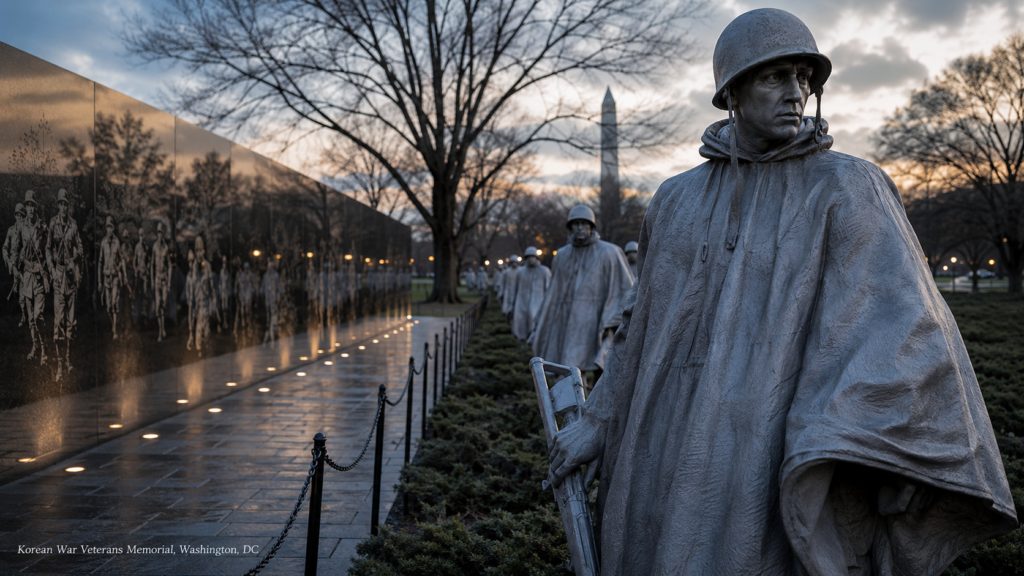
The Korean War Veterans Memorial is located southeast of the Lincoln Memorial on the National Mall in Washington, D.C. The memorial is open 24 hours a day throughout the year.
The memorial includes:
- Nineteen stainless-steel service-member statues
- A polished granite Mural Wall
- A Pool of Remembrance
- The inscription “Freedom Is Not Free”
- A Wall of Remembrance containing the names of the fallen
The Mural Wall contains etchings based on more than 2,400 historical photographs obtained from the National Archives.
The Wall of Remembrance includes the names of 36,574 American service members and 7,114 members of the Korean Augmentation to the United States Army who died while defending South Korea. It was dedicated on July 27, 2022.
Respectful National Korean War Veterans Armistice Day messages
These original messages can be used by schools, communities, businesses and public organizations.
- On National Korean War Veterans Armistice Day, we honor the courage, service and sacrifice of every American who served during the Korean War.
- Today we remember those who defended freedom on the Korean Peninsula and recognize the veterans whose service must never be forgotten.
- We express our lasting gratitude to Korean War veterans and to the families who supported them.
- July 27 reminds us that peace must be protected, service must be honored and history must be remembered.
- We honor those who served, remember those who did not return and thank every Korean War veteran for answering the call of duty.
- On the 73rd anniversary of the Korean Armistice, America remembers the veterans whose courage helped defend the Republic of Korea.
Social media captions
- Honoring America’s Korean War veterans on National Korean War Veterans Armistice Day.
- July 27 marks the anniversary of the 1953 Korean Armistice Agreement.
- Remembering those who served and honoring the sacrifices that must never be forgotten.
- Freedom Is Not Free. Today we recognize the service of Korean War veterans.
- On Korean War Veterans Armistice Day, we remember the fallen and thank every veteran who served.
- Seventy-three years after the armistice, their courage and service remain part of America’s history.
Suggested hashtags
#KoreanWarVeterans#KoreanArmisticeDay#NationalKoreanWarVeteransArmisticeDay#HonorVeterans#July27#FreedomIsNotFree#KoreanWarMemorial
National Korean War Veterans Armistice Day vs. Veterans Day
These observances have different purposes.
| Observance | Date | Purpose |
|---|---|---|
| National Korean War Veterans Armistice Day | July 27 | Honors Korean War veterans and commemorates the 1953 armistice |
| Veterans Day | November 11 | Honors all U.S. military veterans |
| Memorial Day | Last Monday in May | Remembers U.S. military personnel who died while serving |
| Armed Forces Day | Third Saturday in May | Recognizes people currently serving in the U.S. Armed Forces |
National Korean War Veterans Armistice Day has a more specific historical focus than Veterans Day or Memorial Day.
Frequently asked questions
When is National Korean War Veterans Armistice Day 2026?
It is observed on Monday, July 27, 2026.
What anniversary is Korean Armistice Day in 2026?
The 2026 observance marks the 73rd anniversary of the Korean Armistice Agreement signed in 1953.
Is National Korean War Veterans Armistice Day a federal holiday?
No. It is a commemorative observance and not a legal federal holiday for federal employees.
Do Americans receive a day off?
No automatic paid day off is provided. Most workplaces and public services operate normally.
Why is it observed on July 27?
The Korean Armistice Agreement was signed on July 27, 1953, at Panmunjom.
What time was the Korean Armistice signed?
It was signed at approximately 10 a.m. on July 27, 1953. The ceasefire became effective 12 hours later.
Who signed the Korean Armistice Agreement?
Lieutenant General William K. Harrison Jr. signed for the United Nations Command, while General Nam Il signed for the Korean People’s Army and Chinese People’s Volunteers delegation.
Did South Korea sign the armistice?
The Republic of Korea was not one of the official signatories. The agreement was signed by military representatives of the United Nations Command, Korean People’s Army and Chinese People’s Volunteers.
Did the armistice officially create peace?
No. It stopped active fighting but did not establish a permanent peace treaty.
Is the Korean Armistice still active?
The armistice framework remains relevant to the management of the Military Demarcation Line, DMZ access and military activities around the border.
Should the flag be displayed on July 27?
Yes. The U.S. Flag Code specifically encourages displaying the American flag on National Korean War Veterans Armistice Day.
Is the flag automatically flown at half-staff?
No automatic nationwide half-staff requirement is created by the observance. Follow any separate federal or state half-staff order that may be issued.
Where is the national Korean War memorial?
The Korean War Veterans Memorial is located near the Lincoln Memorial in Washington, D.C., and is open 24 hours a day.
How can schools observe the day?
Schools can hold a moment of reflection, invite a veteran speaker, study the armistice, create a historical timeline or organize a local veterans oral-history project.
What is an appropriate greeting?
Because this is a solemn veterans observance, use respectful wording such as “We honor Korean War veterans on National Korean War Veterans Armistice Day” rather than “Happy Armistice Day.”
Final thoughts
National Korean War Veterans Armistice Day 2026 will be observed on Monday, July 27.
The day commemorates the agreement that stopped active fighting in Korea while honoring the millions of Americans who served during the Korean War period. It also reminds the public that an armistice is not the same as permanent peace.
By displaying the flag, learning the history, visiting a memorial or thanking a Korean War veteran, Americans can help ensure that their service and sacrifices are not forgotten.\
Sources and References
[1] U.S. National Archives and Records Administration
“Armistice Agreement for the Restoration of the South Korean State (1953)”
https://www.archives.gov/milestone-documents/armistice-agreement-restoration-south-korean-state
[2] U.S. Office of Personnel Management
“Federal Holidays—Work Schedules and Pay”
https://www.opm.gov/policy-data-oversight/pay-leave/pay-administration/fact-sheets/holidays-work-schedules-and-pay/
[3] U.S. House of Representatives, Office of the Law Revision Counsel
“4 U.S.C. §6—Time and Occasions for Display of the Flag”
https://uscode.house.gov/view.xhtml?req=%28title%3A4%20section%3A6%20edition%3Aprelim%29
[4] National Park Service
“Korean War Veterans Memorial”
https://www.nps.gov/kowa/
[5] National Park Service
“Mural Wall—Korean War Veterans Memorial”
https://www.nps.gov/kowa/learn/historyculture/mural-wall.htm
[6] National Park Service
“Wall and Pool of Remembrance”
https://www.nps.gov/kowa/learn/historyculture/wall-and-pool-of-remembrance.htm
Sources were accessed for fact-checking and should be reviewed again if the article is substantially updated.