
National Pack Rat Day 2027 is on Monday, May 17, 2027. It is the day for everyone who has ever kept a ticket stub from a concert they barely remember, a t-shirt from a race they walked instead of ran, or a drawer full of cables for devices that no longer exist. The holiday celebrates the deeply human habit of holding on to things, and it also gives you permission to finally sort through them. This guide has the exact date, a live countdown, the real animal behind the name, why scientists treasure a pack rat’s nest, the line between collecting and hoarding, and a practical one-day plan for taming your own stash.
Countdown to National Pack Rat Day 2027
Loading…
until Monday, May 17, 2027 at 12:00 AM Eastern Time
When Is National Pack Rat Day 2027?
National Pack Rat Day 2027 falls on Monday, May 17, 2027. The date is fixed on May 17 every year, so it lands on a different weekday each year. In 2026 it was a Sunday, in 2028 it will be a Wednesday, in 2029 a Thursday, in 2030 a Friday, and in 2031 a Saturday. It is not a federal holiday, so schools, offices and shops stay open. It is a light-hearted observance, and the best way to mark it is with a drawer, a closet or a garage you have been avoiding.
How Many Days Until National Pack Rat Day 2027?
The live countdown above ticks down to midnight at the start of Monday, May 17, 2027, Eastern Time. At the time this article was published (November 21, 2026), there were 177 days remaining until National Pack Rat Day 2027. That is just over 25 weeks, which puts the day in the middle of May, one week after Mother's Day 2027 and two weeks before Memorial Day 2027 weekend. May 17 is a busy date on the calendar: it is also National Walnut Day 2027, National Graduation Tassel Day 2027 and National Cherry Cobbler Day 2027.
What Is a Pack Rat? Two Meanings, One Animal
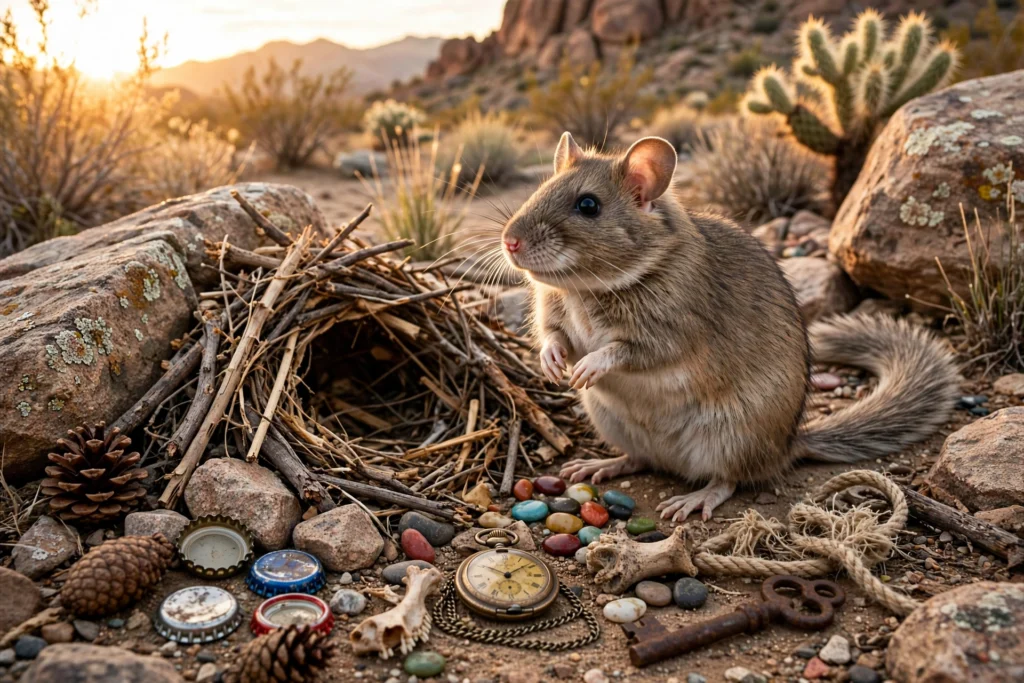
The phrase pack rat has two meanings, and the day celebrates both. Literally, a pack rat is a woodrat, a medium-sized North American rodent of the genus Neotoma that is famous for collecting objects and dragging them back to its nest. Figuratively, a pack rat is a person who keeps things they might need someday, long past the point where keeping them makes sense. The animal gave the person the name, and the name stuck because the resemblance is hard to miss.
The bushy-tailed woodrat (Neotoma cinerea) is the species most people picture when they hear the name. It is one of 23 woodrat species, and it is among the largest, weighing up to 600 grams (about 1.3 pounds) with a body up to 25 cm (nearly 10 inches) long, plus a long bushy tail that is unique in the genus. Its smaller cousin, the Arizona woodrat, weighs less than 132 grams (4.7 ounces). Woodrats are nocturnal, active all year, and mostly solitary, and they range from Yukon and the westernmost Northwest Territories through most of the United States and south to western Honduras.
The Midden: A Nest Built From Everything It Finds
A woodrat's nest is called a midden, and it is less a nest than a collection. The rat gathers sticks, bones, pebbles, pinecones, bits of rope and leather, feathers, owl pellets, paper, and anything shiny it comes across, then packs it all into a den built at the base of a cactus or tree, in a cave, on a rocky slope, or inside an abandoned building. The most elaborate version belongs to the dusky-footed woodrat (Neotoma fuscipes), whose stick nest can stand more than 1 metre (3.3 feet) high.
The rat has one more habit that gave it a second nickname. It will drop whatever it is carrying in order to pick up something more interesting, which is why naturalists also call it the trade rat. At Jewel Cave National Monument in South Dakota, where bushy-tailed woodrats live inside the cave entrance, rangers note that the rats collect objects they find interesting, eat some, and keep the rest as treasure to fortify the walls of their nests.
| Woodrat species | Size | What makes it notable |
|---|---|---|
| Bushy-tailed woodrat (Neotoma cinerea) | Up to 600 g, body to 25 cm | The classic pack rat; bushy tail unique in the genus; lives in caves and rocky outcrops |
| Dusky-footed woodrat (Neotoma fuscipes) | Similar build, darker feet | Builds domed stick dens over 1 metre high; also called a trade rat |
| Arizona woodrat (Neotoma devia) | Under 132 g, body to 15 cm | One of the smallest woodrats |
| Mexican woodrat (Neotoma mexicana) | Mid-sized | Ranges from Colorado and Utah south to Guatemala and Honduras |
| Allegheny woodrat (Neotoma magister) | Mid-sized | Keeps a simple plant cup nest, guarded by a small pile of sticks on a cliff ledge |
Woodrats are vegetarians. Most eat a wide range of plant parts, and three species specialise: Stephen's woodrat lives almost entirely on juniper sprigs, while two others feed mostly on prickly pear, cholla cacti and yucca plants. They are on the menu for most small and medium predators, including weasels, foxes, bobcats, coyotes and owls, which is one reason a well-fortified midden matters.
Why Scientists Love a Pack Rat's Hoard
Here is the twist that makes the pack rat more than a joke about clutter. A woodrat urinates on everything in its nest to mark it, and in dry climates that urine crystallises as it dries, cementing the whole midden into a rock-hard mass. The preserved material is called amberat, and it can survive for thousands of years. Scientists have found specimens up to 50,000 years old, about the limit of carbon dating.
That makes middens natural time capsules. By soaking the amberat for a week or more to break it down, researchers can pull out leaves, seeds and twigs from an ancient world, identify the exact plant species, and reconstruct plant communities and climate over the last 40,000 years in the southwestern United States. The animal that cannot throw anything away turns out to be one of the best record keepers in nature. The lesson for the human version of the day is kinder than it sounds: a collection is only a mess until someone finds the story in it.
From Animal to Adjective: How "Pack Rat" Entered the Language
The term pack rat began as a description of the animal, then crossed over to people. According to Merriam-Webster, the first documented use of pack rat to describe a person who hoards food and random objects dates to 1885, which means Americans were already recognising the tendency in themselves roughly 140 years ago. The phrase gained ground through the 20th century as mass production made things cheap and plentiful, and the instinct to keep things for later kept operating at full strength anyway.
National Pack Rat Day itself has no documented founder and no recorded first year. It is one of many internet-era observances that grew up on the calendar without a proclamation to point to, and it is honest to say so. The day's appeal is that almost everyone recognises a little of the pack rat in themselves, whether it is the junk drawer, the garage, or the 40,000 photos on a phone.
Collecting or Hoarding? Know Which One You Are
Psychologists take the distinction between collecting and hoarding seriously, and the difference matters more than the size of the pile. Collecting is intentional: a collector chooses a category, organises it, displays it with pride, and can explain why each piece matters. Hoarding, recognised as a distinct condition in the DSM-5 since 2013, involves the inability to discard possessions regardless of their actual value, and it causes significant distress or interferes with daily life.
| Collecting | Everyday pack-rat clutter | Hoarding disorder | |
|---|---|---|---|
| How items are chosen | Deliberate, one category | Whatever might be useful someday | Anything, regardless of value |
| Organisation | Sorted, catalogued, displayed | Piled in drawers, boxes, the garage | Disorganised to the point rooms cannot be used |
| How it feels | Pride and enjoyment | Mild guilt, mostly affection | Distress at the thought of discarding |
| Effect on daily life | None, or positive | Annoying but manageable | Significant impairment |
| What helps | Keep enjoying it | A sorting session and honest keep rules | Professional support, not shame |
Most people who call themselves pack rats sit in the middle column. The day is not about diagnosing anyone. It is about noticing which of your piles is a collection you love, which is a stash you keep out of habit, and which is clutter that is quietly costing you space and peace of mind.
The "Just in Case" Test: 7 Questions Before You Keep Something
Nearly every pack rat keeps things for the same reason: just in case. The test below turns that vague feeling into a decision. Ask each question about one item, and be honest with the answer.
- Have I used it in the past year? If not, the odds you will use it in the next year are low.
- Would it cost more than $20 and a day to replace? If it is cheap and easy to buy again, keeping it costs more in space than it saves in money.
- Am I keeping the thing, or the memory? If it is the memory, take a photo and let the object go.
- Do I own a duplicate? Two of something you rarely use is one too many.
- Would I buy it again today? If you would walk past it in a shop, it does not earn a place in your home.
- Does it have a home? An item with no place to live becomes clutter by definition.
- Am I keeping it for someone else's someday? A box labelled "for the kids" that no one asked for is a storage bill, not a gift.
Three honest "no" answers is a keep. Four or more is a donate, recycle or bin, depending on the item. The test works on the junk drawer, the garage, and the phone: digital clutter counts too, and the same questions apply to the 12,000 screenshots and the apps you have not opened since 2023.
10 Ways to Celebrate National Pack Rat Day 2027
- Run a 15-minute sort. Set a timer, pick one drawer, and sort everything into keep, donate and toss. Fifteen minutes is short enough to start and long enough to see a difference.
- Hold a treasure hunt. Dig through your stash for the three strangest things you own and share their stories. The weirdest find wins.
- Photograph before you let go. Sentimental items keep their memory in a photo. Take the picture, then donate the object to someone who will use it.
- Donate a box. Fill one box with usable things you no longer need and drop it at a local charity shop the same day, so it does not become a new pile by the door.
- Clear the digital midden. Delete duplicate photos, old downloads and unused apps. Your phone is a pack rat too.
- Start a real collection. If you love keeping things, give the habit a shape: pick one category, a shelf, and a rule that everything on it earns its place.
- Visit a natural history museum. Many museums display woodrat middens and explain how scientists read climate history from them.
- Watch for a woodrat. If you live in the western United States, look for a midden at the base of a cactus or rock pile on a hike, and leave it exactly as you found it.
- Swap, do not shop. Trade the useful things you do not need with friends or neighbours. One person's junk drawer is another's spare part.
- Write the story of one object. Pick the oldest thing in your stash and write down where it came from. That is what turns a pile into a collection.
Quotes About Clutter, Keeping and Letting Go
A few lines worth keeping, which is the point of the day.
- "Have nothing in your house that you do not know to be useful or believe to be beautiful." — William Morris
- "Out of clutter, find simplicity." — Albert Einstein
- "The question of what you want to own is actually the question of how you want to live your life." — Marie Kondo
- "The things you own end up owning you." — Chuck Palahniuk, Fight Club
- "Simplicity is the ultimate sophistication." — Leonardo da Vinci
Also on May 17, 2027
National Pack Rat Day shares its date with several other observances. National Walnut Day 2027, National Graduation Tassel Day 2027 and National Cherry Cobbler Day 2027 fall on the same Monday, along with National Idaho Day and National Mushroom Hunting Day. The world also marks World Hypertension Day, World Telecommunication and Information Society Day, and Honor Our LGBT Elders Day on May 17. It is a crowded date, and a pack rat's garage is a good place to start clearing it.
Frequently Asked Questions
When is National Pack Rat Day 2027?
National Pack Rat Day 2027 is on Monday, May 17, 2027. It is observed every year on May 17.
How many days are left until National Pack Rat Day 2027?
The live countdown at the top of this page ticks down to midnight at the start of Monday, May 17, 2027, Eastern Time. At publication on November 21, 2026, there were 177 days remaining.
What is a pack rat?
A pack rat is a woodrat of the genus Neotoma, a North American rodent that collects objects and stores them in its nest, called a midden. The term is also used for a person who keeps things they might need someday, even when the things have little value.
Who founded National Pack Rat Day?
Nobody knows. The day has no documented founder and its first year is not recorded. The term pack rat itself is much older: Merriam-Webster dates its use for a person to 1885.
Is being a pack rat the same as hoarding?
No. Collecting is intentional and organised, everyday pack-rat clutter is a habit that is annoying but manageable, and hoarding disorder is a recognised condition in the DSM-5 since 2013 that causes distress or interferes with daily life. Most self-described pack rats are in the middle, not at either extreme.
Why do scientists study pack rat nests?
Woodrat urine crystallises in dry climates and cements the midden into a hard mass called amberat, which can survive for thousands of years. Scientists have found specimens up to 50,000 years old and use the preserved plants inside to reconstruct past plant communities and climate over the last 40,000 years.
How can I celebrate National Pack Rat Day?
Sort one drawer, box or shelf with the "just in case" test, donate what you no longer need, photograph sentimental items before letting them go, and clear some digital clutter too. Or simply enjoy your collection and share the story of your strangest kept object.
Is National Pack Rat Day a federal holiday?
No. It is a light-hearted observance, not a federal holiday, so schools, offices and shops stay open.
Sources
- Britannica: Woodrat
- National Park Service: Bushy-tailed Woodrat, Jewel Cave National Monument
- Smithsonian Magazine: From Ancient Seeds to Scraps of Clothing, Rats' Nests Are Full of Treasures
- Day of the Day: National Pack Rat Day
- Mind Classic: National Pack Rat Day, May 17th
No 2027 deals or promotions are listed because none were verified from official sources at the time of writing, November 21, 2026.