
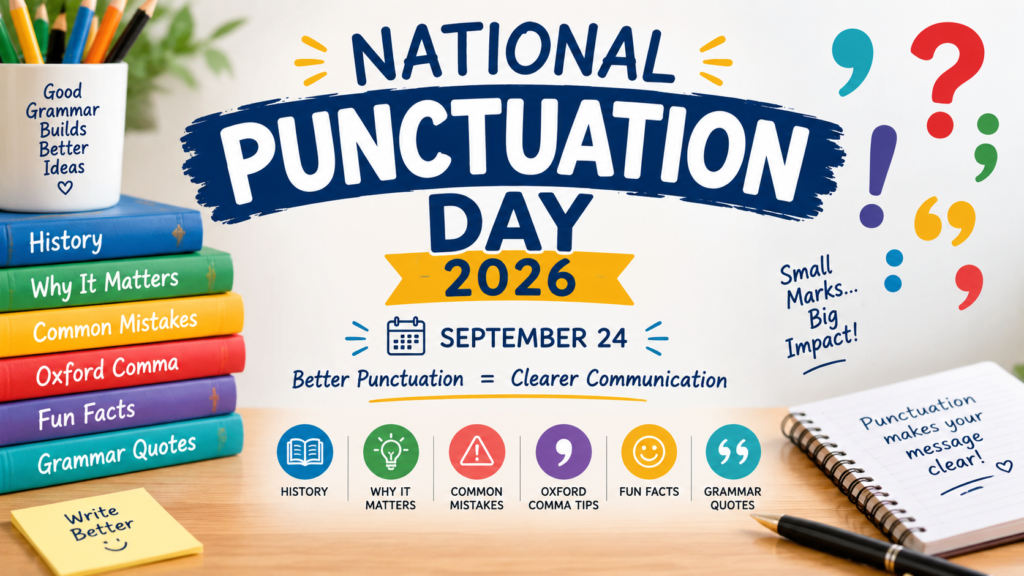
National Punctuation Day 2026 is Thursday, September 24. The annual observance highlights the importance of punctuation in making written communication clear, organized, and easier to understand. From the humble period to the often-debated Oxford comma, punctuation marks are the quiet traffic signals of language — and this day is a fun excuse to pay them a little extra attention. If you’re keeping track of every notable date this year, our 2026 holiday calendar covers what else is coming up.
When Is National Punctuation Day 2026?
| Quick Fact | Details |
|---|---|
| Date | Thursday, September 24, 2026 |
| Observed | September 24 annually |
| Founded | 2004 |
| Founder | Jeff Rubin |
| Category | Education / Fun |
| Focus | Punctuation, writing, and language |
What Is National Punctuation Day?
National Punctuation Day is a lighthearted, educational observance dedicated to correct and effective use of punctuation in everyday writing. It’s not a formal grammar exam — it’s a reminder that small marks like commas, periods, and apostrophes carry real weight in how a sentence is read and understood.
The day gives teachers, students, writers, editors, and casual readers alike a reason to slow down and notice punctuation. Classrooms use it for quizzes and games, writers use it to review their own habits, and plenty of people simply enjoy sharing punctuation jokes and examples online. It works because it’s approachable: everyone writes something, and everyone can benefit from a punctuation refresher.
Who Created National Punctuation Day?
Jeff Rubin and the Beginning of Punctuation Day
National Punctuation Day was founded by Jeff Rubin in 2004. Rubin, an American punctuation enthusiast and author, wanted a dedicated day to spotlight a part of writing that often gets overlooked despite its outsized effect on clarity.
Why Was National Punctuation Day Created?
The observance was created to draw attention to the importance of punctuation and to encourage better, clearer writing overall. National Punctuation Day was created by Jeff Rubin in 2004 to highlight the importance of punctuation and encourage better writing. It has since grown into an informal but recognizable date on the education and language calendar, celebrated by schools, writers, and grammar enthusiasts rather than through any official government designation.
Why Is Punctuation Important?
Punctuation does more work than most readers realize. It helps signal:
- Where a sentence begins and ends
- Where a natural pause belongs
- Which words in a sentence belong together
- Whether a sentence is a statement or a question
- Who is speaking in a piece of dialogue
- How information is grouped and organized
Punctuation Can Change Meaning
A single comma can completely change what a sentence means. Compare:
Let’s eat, Grandma.
Let’s eat Grandma.
The first sentence is an invitation to a meal. The second, missing only a comma, turns into something far more alarming. It’s a small example, but it captures exactly why National Punctuation Day exists — punctuation isn’t decoration, it’s meaning.
Common Punctuation Marks and Their Uses
| Punctuation Mark | Main Use | Example |
|---|---|---|
| Period (.) | Ends a statement | She reads every day. |
| Comma (,) | Separates items or clauses | We bought apples, pears, and oranges. |
| Question Mark (?) | Ends a direct question | Where are you going? |
| Exclamation Mark (!) | Expresses emphasis or excitement | That’s amazing! |
| Colon (:) | Introduces information | Bring three things: water, food, and a map. |
| Semicolon (;) | Links closely related independent clauses | It was raining; we stayed inside. |
| Apostrophe (‘) | Possession or contractions | Sarah’s book; don’t |
| Quotation Marks (” “) | Indicates direct speech or quoted material | She said, “Hello.” |
| Parentheses ( ) | Adds supplementary information | The event begins at noon (local time). |
The Oxford Comma Explained
What Is an Oxford Comma?
The Oxford comma, also called the serial comma, is the comma placed before the final conjunction in a list of three or more items. In the sentence “I bought apples, oranges, and bananas,” the comma right before “and” is the Oxford comma.
Is the Oxford Comma Always Required?
No. Whether to use the Oxford comma depends on the style guide, publication, or organization you’re writing for. Some style systems recommend it consistently, while others prefer to leave it out except in cases where its absence would cause confusion.
Why Can the Oxford Comma Matter?
Even though it’s optional in many style guides, the Oxford comma can prevent genuine ambiguity in lists, particularly when items could otherwise be misread as belonging together. Because opinions differ so widely, it remains one of the more debated points in the serial comma discussion among writers and editors.
Common Punctuation Mistakes
Missing Commas
Introductory phrases and items in a list often need commas to keep sentences readable — skipping them can make a sentence harder to parse at a glance.
Comma Splices
A comma splice happens when two complete, independent sentences are joined with only a comma instead of a conjunction, semicolon, or period.
Apostrophe Confusion
Some of the most common mix-ups in everyday writing involve:
- its vs. it’s
- your vs. you’re
- their vs. they’re vs. there
Misusing Semicolons
A semicolon can join two closely related independent clauses, but it isn’t a stand-in for every comma. Overusing semicolons where a comma or period would work better can make writing feel cluttered.
Unnecessary Exclamation Marks
Exclamation marks are meant to signal genuine emphasis or excitement. Using too many in a row — or using them in professional writing — can undercut clarity and come across as less polished.
Confusing Hyphens, En Dashes, and Em Dashes
Hyphens join words or word parts, en dashes typically show ranges (like 9–5), and em dashes set off an interruption or extra thought in a sentence. Mixing them up is a common but easily fixable error.
Punctuation Rules Every Writer Should Know
- End complete statements with appropriate punctuation.
- Use commas to organize lists and sentence elements.
- Use apostrophes correctly for contractions and possession.
- Use question marks for direct questions.
- Use quotation marks consistently.
- Don’t add punctuation simply because a sentence “sounds like” it needs it.
- Follow the style guide relevant to your writing.
- Read sentences aloud when punctuation feels unclear.
Fun Punctuation Facts
- The period is one of the most frequently used sentence-ending marks in written English.
- The question mark signals an interrogative sentence.
- The exclamation mark is typically used to express strong emotion or urgency.
- The ampersand (&) originated as a stylized way of writing “et,” the Latin word for “and.”
- The Oxford comma is also widely known as the serial comma.
- Punctuation conventions have shifted considerably over the history of written language, and many marks we use today weren’t standardized until relatively recently.
How to Celebrate National Punctuation Day 2026
For Students
- Take a punctuation quiz
- Correct poorly punctuated sentences
- Create a punctuation poster
- Play grammar games
- Write a short story using different punctuation marks
For Teachers
- Run a punctuation challenge
- Give students editing exercises
- Create a classroom punctuation wall
- Hold a comma or apostrophe quiz
For Writers and Editors
- Review an old article
- Check punctuation consistency
- Review your preferred style guide
- Practice editing difficult sentences
For Families
- Play a grammar game
- Find punctuation examples in books
- Create funny sentences together
- Challenge each other to fix punctuation errors
National Punctuation Day 2026 Activities
- Punctuation scavenger hunt
- Comma challenge
- Grammar trivia
- Punctuation quiz
- Sentence correction competition
- Funny punctuation meme contest
- Create-your-own punctuation poster
- Write a story using unusual punctuation
If you enjoy running themed activity days like this one, our seasonal activities guide has more ideas that work well for classrooms and family game nights alike.
Funny National Punctuation Day 2026 Quotes and Sayings
- “A comma can be small, but its job can be huge.”
- “Good punctuation keeps your sentences from getting lost.”
- “Never underestimate the power of a well-placed comma.”
- “Punctuation: because words need traffic signals too.”
Funny Comma Quotes
“A comma can be small, but its job can be huge” captures why this one mark causes so much debate among writers.
Funny Grammar Quotes
“Punctuation: because words need traffic signals too” is a reminder that grammar rules exist to guide readers, not to trip them up.
Punctuation Quotes for Students
“Good punctuation keeps your sentences from getting lost” is a simple line worth remembering before turning in any assignment.
National Punctuation Day 2026 Social Media Captions
- “Comma celebrate National Punctuation Day!”
- “Today, every comma counts.”
- “Good writing starts with clear punctuation.”
- “Keep calm and punctuate correctly.”
Suggested hashtags: #NationalPunctuationDay #PunctuationDay #Grammar #WritingTips #EnglishGrammar
National Punctuation Day 2026 vs. Grammar Day
| Punctuation | Grammar |
|---|---|
| Focuses on written marks and conventions | Covers broader language structure |
| Includes commas, periods, semicolons, etc. | Includes sentence structure, word classes, agreement, etc. |
| Helps organize written meaning | Governs how words and sentences are formed |
Punctuation is part of effective written communication, but punctuation and grammar aren’t identical concepts — one focuses on the marks themselves, the other on the rules governing word and sentence structure.
Is National Punctuation Day an Official Holiday?
National Punctuation Day is an annual observance, not a U.S. federal public holiday. Schools, businesses, and government offices don’t generally close for the occasion, but it’s still widely recognized in classrooms and among writers and editors.
National Punctuation Day 2026 Quick Facts
| Question | Answer |
|---|---|
| When is National Punctuation Day 2026? | September 24, 2026 |
| What day is it? | Thursday |
| Who created it? | Jeff Rubin |
| When was it created? | 2004 |
| What does it celebrate? | Punctuation and clear writing |
| Is it a federal holiday? | No |
| Popular topics | Commas, apostrophes, Oxford comma, punctuation rules |
Frequently Asked Questions
When is National Punctuation Day 2026? National Punctuation Day 2026 is Thursday, September 24, 2026.
Who created National Punctuation Day? Jeff Rubin created National Punctuation Day in 2004.
Why is punctuation important? Punctuation helps organize written language and can make the intended meaning of a sentence clearer.
What is the Oxford comma? The Oxford comma is the comma placed before the final conjunction in a list of three or more items.
Is the Oxford comma grammatically required? Not universally. Its use depends on the applicable style guide or editorial preference.
What are the most common punctuation mistakes? Common problems include comma splices, incorrect apostrophes, missing commas, misuse of semicolons, and inconsistent quotation punctuation.
How can I celebrate National Punctuation Day? You can take a punctuation quiz, practice editing, create educational activities, or simply review your writing for punctuation errors.
Is National Punctuation Day a federal holiday? No. It is an annual observance rather than a federal holiday.
Countdown to National Punctuation Day 2026
As of today, National Punctuation Day is just over two weeks away. For a page that stays accurate over time, a live countdown widget works better than a static day count that goes stale after publishing.
Conclusion
Punctuation is more than a collection of small symbols scattered through a sentence — it’s what helps a reader understand exactly what a writer means. National Punctuation Day 2026, observed on Thursday, September 24, is a fun and low-pressure way to revisit the rules, share a few laughs over misplaced commas, and maybe even improve your own writing along the way. Whether you’re a student, teacher, writer, or just someone who appreciates a well-placed semicolon, it’s worth taking a few minutes to celebrate. For more on the history and evolving conventions behind these written marks, see the overview of punctuation on Wikipedia — and check out our holiday calendar for other dates worth marking this year.