National Repeal Day 2026 is Saturday, December 5, 2026. It commemorates December 5, 1933, the day the 21st Amendment was ratified and nationwide Prohibition ended in the United States. That date was a turning point in American law, politics and everyday life.
This guide explains what Prohibition was, why it was repealed and what actually changed in 1933. It also clears up a common misunderstanding: repeal ended nationwide constitutional Prohibition, but states kept the power to regulate alcohol. For more dates on the calendar, browse our Upcoming Days & Events section.
When Is National Repeal Day 2026?
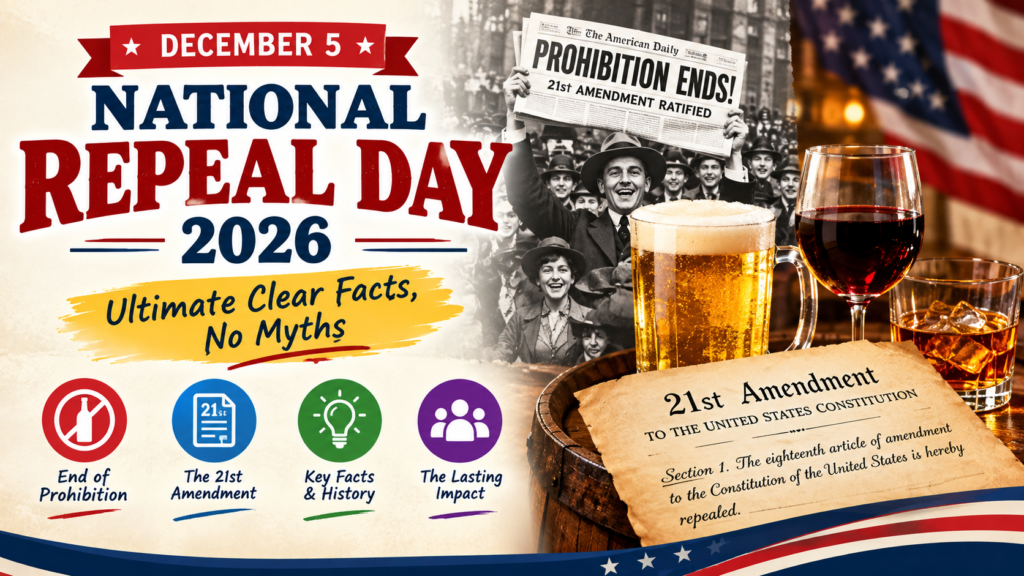
National Repeal Day 2026 is Saturday, December 5. The date commemorates December 5, 1933, when the 21st Amendment was ratified by the required number of states, repealing the 18th Amendment and ending nationwide Prohibition.
- Date: Saturday, December 5, 2026
- Frequency: Every December 5
- Commemorates: The ratification of the 21st Amendment on December 5, 1933
- Status: A historical observance, not a federal public holiday
December 5 is also International Volunteer Day, which is covered in our International Volunteer Day 2026 guide.
What Is National Repeal Day?
National Repeal Day commemorates the end of nationwide Prohibition in the United States. It is a day to remember a major constitutional change and to study how laws, enforcement, public opinion and economic conditions interact.
What Does “Repeal” Mean?
To repeal is to formally cancel a law or constitutional provision. In this case, the 21st Amendment repealed the 18th Amendment, which had established nationwide Prohibition.
Why Is Repeal Day Remembered?
- It marks the end of nationwide constitutional Prohibition.
- It highlights a major change in U.S. law and public policy.
- It offers a chance to study the political, economic and social effects of Prohibition.
What Was Prohibition in the United States?
Prohibition was the period when the Constitution banned the manufacture, sale and transportation of intoxicating liquors across the United States. It grew out of decades of effort by the temperance movement, including groups such as the Woman’s Christian Temperance Union and the Anti-Saloon League.
When Did Prohibition Begin?
The 18th Amendment was ratified in January 1919, and nationwide Prohibition took effect in January 1920. The amendment prohibited the manufacture, sale and transportation of intoxicating liquors, and Congress passed legislation to put it into practice. For a broader overview, see Wikipedia’s article on Prohibition in the United States.
The Volstead Act and Enforcement
The National Prohibition Act, commonly called the Volstead Act, provided the framework for enforcement. It defined what counted as an intoxicating beverage, set penalties and allowed certain exceptions, such as alcohol used for religious and medicinal purposes.
Everyday Life During Prohibition
Prohibition changed daily life in visible ways:
- Speakeasies: illegal bars that operated discreetly.
- Bootlegging: the illegal production and distribution of alcohol.
- Enforcement challenges: agencies struggled to police a vast country.
- Shifting attitudes: many people grew skeptical of the ban.
Prohibition did not make every aspect of alcohol illegal. The 18th Amendment and the Volstead Act targeted making, selling and transporting alcohol, not drinking it.
Why Was Prohibition Repealed?
No single factor explains repeal. Historians point to a combination of enforcement problems, economic hardship and changing public opinion. Reasonable people still disagree about how much weight each factor deserves, and about Prohibition’s overall social impact.
Enforcement Challenges
Enforcing a national ban was difficult. Illegal alcohol markets grew, and organized crime became associated with bootlegging. Many Americans came to believe that Prohibition was creating new problems rather than solving old ones.
Economic Pressures During the Great Depression
As the Great Depression deepened, supporters of repeal argued that legal alcohol production and sales could generate tax revenue and create jobs. That argument gained force during a period of widespread economic hardship.
Changing Public and Political Opinion
By the early 1930s, attitudes had shifted, and repeal became a major political issue in 1932 and 1933. Congress proposed the 21st Amendment in February 1933. In April 1933, an amendment to the Volstead Act allowed low-alcohol beer to be sold while the states considered the repeal amendment.
What Happened on December 5, 1933?
Ratification of the 21st Amendment
On December 5, 1933, three states approved the 21st Amendment at their ratifying conventions: Pennsylvania, Ohio and Utah. Utah became the 36th state to ratify, reaching the three-fourths threshold required by the Constitution. That put the amendment into effect and ended nationwide Prohibition.
Congress chose to send the amendment to special state conventions rather than state legislatures. This makes the 21st Amendment the only constitutional amendment ratified by state conventions.
How the 21st Amendment Repealed the 18th Amendment
The 21st Amendment has three sections:
- Section 1 repeals the 18th Amendment.
- Section 2 prohibits transporting or importing alcohol into a state in violation of that state’s laws.
- Section 3 sets the ratification process, requiring state conventions within seven years.
It is the only constitutional amendment that repeals another amendment. You can read more in Wikipedia’s article on the Twenty-first Amendment.
Did Alcohol Become Legal Everywhere?
No. Repeal ended nationwide constitutional Prohibition, but states and local governments kept the authority to regulate alcohol. Some states and counties stayed “dry” for years, and Mississippi did not end statewide Prohibition until 1966. Even today, alcohol laws vary by state and community.
The Difference Between the 18th and 21st Amendments
| Feature | 18th Amendment | 21st Amendment |
|---|---|---|
| Key date | Ratified in January 1919 | Ratified December 5, 1933 |
| Main effect | Established nationwide constitutional Prohibition | Repealed the 18th Amendment |
| Historical significance | Began the Prohibition era | Ended nationwide constitutional Prohibition |
| State authority | Created a national prohibition framework | Explicitly addressed alcohol shipments that violate state laws |
| Ratification method | State legislatures | State conventions |
Important National Repeal Day 2026 Facts
- National Repeal Day is observed on December 5.
- Nationwide Prohibition ended in 1933.
- The 21st Amendment repealed the 18th Amendment.
- Utah was the 36th state to ratify the 21st Amendment.
- Pennsylvania, Ohio and Utah all ratified on December 5, 1933.
- The 21st Amendment is the only amendment to repeal an earlier amendment.
- It is also the only amendment ratified by state conventions instead of state legislatures.
- State and local alcohol laws continued after repeal.
- In 2026, December 5 falls on a Saturday.
How Is National Repeal Day Observed?
Repeal Day looks different for different people. This section focuses on learning about the history, and drinking is not necessary to recognize it.
Read About Prohibition and the Constitution
Read the text of the 18th and 21st Amendments, along with historical photographs, newspaper reports and primary sources. For other milestones in constitutional history, see our September holidays 2026 guide, which includes Constitution Day on September 17.
Explore Museums and Historical Resources
Visit a local history museum, or explore the educational resources offered by national archives and state historical societies. Many museums feature photographs, posters and artifacts from the 1920s and 1930s.
Discuss the Legacy of Prohibition
Prohibition raises questions that are still relevant: How do laws change behavior? What happens when enforcement is difficult? How do public opinion and economic conditions affect policy? Teachers and families can use the story to explore civics and history.
If you choose to mark the day in other ways, follow your local laws and the legal drinking age, and never drink and drive.
Frequently Asked Questions About National Repeal Day 2026
What is Repeal Day?
Repeal Day commemorates the end of nationwide Prohibition in the United States on December 5, 1933.
When was Prohibition repealed?
Prohibition was repealed on December 5, 1933, when the 21st Amendment was ratified by the required number of states.
What amendment ended Prohibition?
The 21st Amendment repealed the 18th Amendment, ending nationwide constitutional Prohibition.
Why was Prohibition repealed?
Repeal followed growing opposition, enforcement difficulties, the expansion of illegal alcohol markets and economic and political pressures during the Great Depression.
Did the 21st Amendment make alcohol legal in every state?
No. It ended nationwide constitutional Prohibition, but states and local jurisdictions kept the authority to regulate alcohol, and some continued prohibitions or restrictions.
Is National Repeal Day 2026 a federal holiday?
No. December 5 is a historical observance, not a federal public holiday.
Countdown to National Repeal Day 2026
📜 National Repeal Day Countdown: National Repeal Day is Saturday, December 5, 2026.
Conclusion: Why National Repeal Day Matters
December 5, 1933, marked a major constitutional change in American history. The 21st Amendment ended nationwide Prohibition, returned much of the control over alcohol laws to the states and remains the only amendment to repeal another.
National Repeal Day 2026, on Saturday, December 5, is a good opportunity to look at primary sources and understand both why Prohibition began and why it ended. For more history and observances, visit the National Days & Events Guide.