National Science Fiction Day 2027 is a chance to celebrate the stories that take readers beyond the familiar world and into imagined futures. From journeys across the galaxy to thought-provoking tales about artificial intelligence and human society, science fiction invites us to ask, “What if?” Observed on January 2, the day is a great opportunity to discover a new author, revisit a classic novel, enjoy a favorite sci-fi film or share imaginative ideas with fellow fans.
This guide covers the date, the history behind the observance, what science fiction is, the best books for beginners and longtime fans, famous authors, screen picks, original quotes and ways to celebrate. National Science Fiction Day is an informal observance, not a U.S. federal holiday. If you are still in the new year mood, see our New Year’s Day 2027 guide.
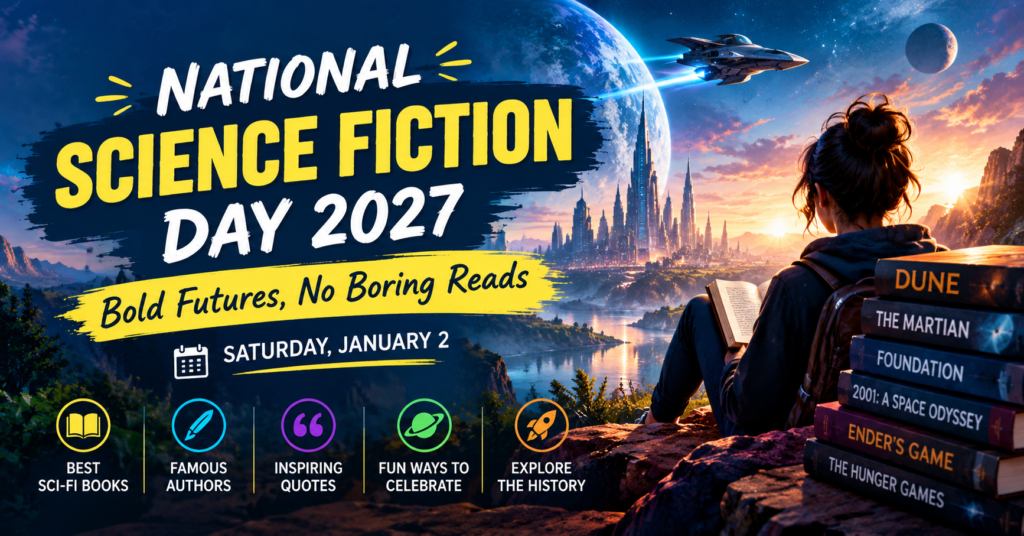
Quick answer: National Science Fiction Day 2027 is Saturday, January 2, 2027. The date is commonly associated with the birthday of author Isaac Asimov.
What Is National Science Fiction Day?
National Science Fiction Day celebrates science fiction in all its forms, including books, films, television, comics and games. The genre matters because it gives readers a safe place to explore big questions about technology, space, society and the future.
It is also a good day for newcomers. You do not need to know the genre well to take part. Reading a first chapter, watching a classic film or asking a friend for a recommendation is enough.
When Is National Science Fiction Day 2027?
National Science Fiction Day 2027 is on Saturday, January 2, 2027.
The observance is commonly associated with the January 2 birthday of science fiction author Isaac Asimov. Because the date falls on a Saturday, it is an easy day to settle in with a book or plan a movie marathon. It is an informal observance and has not been officially proclaimed as a national holiday.
History and Origin of National Science Fiction Day
The date is most often linked to Isaac Asimov’s birthday. Asimov is best known for his robot stories and the Foundation series, both of which shaped how readers think about artificial intelligence and the long sweep of history. One useful detail is that Asimov’s exact birth date was uncertain, and January 2 is the date he chose to celebrate.
No definitive founder or official founding year for the observance has been established, so it is best described as a popular, fan-driven celebration rather than an official one.
Science fiction itself is much older than the observance. Many scholars trace its roots to early works such as Mary Shelley’s Frankenstein. The genre then grew through pulp magazines, novels, cinema and television, and today it thrives across streaming, podcasts and games.
What Is Science Fiction?
Science fiction is imaginative storytelling that explores scientific ideas, technological developments, space, time, possible futures or their effects on individuals and society.
Common Science Fiction Themes
- Space travel and extraterrestrial life
- Artificial intelligence and robots
- Time travel and alternate timelines
- Genetic engineering and human evolution
- Dystopian and utopian societies
- Climate futures and environmental change
- First contact with alien civilizations
- Parallel universes and advanced technology
Science Fiction vs. Fantasy
| Science fiction | Fantasy |
|---|---|
| Often explores science, technology or speculative futures | Often centers on magic, mythology or supernatural forces |
| May use imagined but scientifically framed explanations | May use magical systems or supernatural rules |
| Examples include Dune and The Martian | Examples include The Lord of the Rings and A Wizard of Earthsea |
| Can examine the consequences of technological change | Can explore moral, cultural and personal themes through fantastical worlds |
These are general distinctions, not rigid rules. The two genres overlap often.
Best Science Fiction Books to Read
This list is a set of influential and accessible starting points, not a definitive ranking.
| Book | Author | Why readers may enjoy it |
|---|---|---|
| Dune | Frank Herbert | Political intrigue, ecology and a richly imagined future |
| Foundation | Isaac Asimov | Galactic civilization and large-scale historical change |
| Fahrenheit 451 | Ray Bradbury | Censorship, books and independent thought |
| The Left Hand of Darkness | Ursula K. Le Guin | Culture, identity and life on another world |
| Frankenstein | Mary Shelley | A foundational work exploring creation, responsibility and ambition |
| Kindred | Octavia E. Butler | Time travel intertwined with history and social questions |
| The Martian Chronicles | Ray Bradbury | Connected stories about Mars, exploration and humanity |
| Neuromancer | William Gibson | Cyberpunk, artificial intelligence and digital futures |
| Brave New World | Aldous Huxley | Technology, social control and engineered conformity |
| The Martian | Andy Weir | Problem-solving and survival in a hostile environment |
Best Sci-Fi Books for Beginners
Start with a book that matches your interests:
- Space and adventure: The Martian
- Robots and future societies: I, Robot
- Short, accessible storytelling: Selected Ray Bradbury stories
- Dystopian futures: Fahrenheit 451
- Large, immersive worlds: Dune
- Classic speculative fiction: Frankenstein
Reading difficulty, themes and content vary, so check a book’s synopsis before choosing.
Science Fiction Books for Teens and Younger Readers
Many science fiction titles suit younger readers, but not all do. Check the edition, reading level and themes before handing a book to a child or teen. A school or public librarian can point you to age-appropriate picks, and if you want to compare notes with other readers, communities such as r/printSF on Reddit are a friendly place to ask for suggestions.
Famous Science Fiction Authors
- Isaac Asimov: Robot fiction and the Foundation series.
- Arthur C. Clarke: Space exploration and technological speculation.
- Ursula K. Le Guin: Culture, politics, identity and imagined societies.
- Ray Bradbury: Imaginative storytelling and social criticism.
- Frank Herbert: Ecology, politics and power in Dune.
- Octavia E. Butler: Speculative fiction exploring power, change and humanity.
- Mary Shelley: An important early figure in science fiction through Frankenstein.
- William Gibson: A major influence on cyberpunk fiction.
Best Science Fiction Movies and TV Shows
If you would rather watch than read, these titles are popular entry points:
- 2001: A Space Odyssey: A landmark film about space exploration and artificial intelligence.
- Star Trek: A long-running franchise about exploration, diplomacy and optimism.
- Star Wars: A space fantasy that blends science fiction elements with mythic storytelling.
- Blade Runner: A moody look at artificial life and what it means to be human.
- The Twilight Zone: Classic anthology television with twist endings and social commentary.
- The Expanse: A grounded series about politics and survival across the solar system.
- Arrival: A thoughtful film about first contact and communication.
- Interstellar: An epic story of space travel, time and family.
Some of these, such as Star Wars, sit on the line between science fiction and fantasy, which is a good reminder that the genres overlap.
How to Celebrate National Science Fiction Day 2027
- Read the first chapter of a new sci-fi novel.
- Revisit a favorite science fiction book.
- Host a science fiction movie marathon.
- Start a science fiction book club.
- Share a favorite author or book recommendation.
- Visit a library or bookstore.
- Write a short story about the future.
- Create futuristic artwork or fan art.
- Discuss whether a technology from fiction could become real.
- Listen to a science fiction audiobook.
- Explore science fiction comics or graphic novels.
- Recommend a book to someone new to the genre.
- Make a themed reading list for the year.
- Organize a classroom discussion about science and imagination.
- Share a favorite sci-fi quote or original thought on social media.
Looking for more reading goals for the new year? Our New Year’s resolutions for 2027 section has simple ideas, like reading more books.
National Science Fiction Day Activities for Kids
- Draw an imaginary planet.
- Invent a helpful robot.
- Write a story about a journey to another world.
- Build a spaceship from recyclable materials.
- Discuss the difference between real science and fictional technology.
Ideas for Book Clubs, Libraries and Schools
Try a short reading session, an author spotlight, a themed display, a book swap, a science fiction trivia quiz or a discussion about the scientific concepts in a selected story.
Original Science Fiction Quotes for National Science Fiction Day
These quotes are original and were written for this article. They are not attributed to any famous author.
- “Every imagined future begins with a question about the present.”
- “Science fiction turns curiosity into a journey beyond the known.”
- “The universe is vast, but imagination can travel even farther.”
- “A story about tomorrow can help us understand today.”
- “Great science fiction explores not only what technology can do, but what humanity should do.”
- “Every new world begins with the courage to imagine one.”
- “The future is a story we are still learning to write.”
- “Beyond every star lies another possibility.”
- “Fiction asks us to dream; science invites us to investigate.”
- “The best imagined worlds leave us thinking differently about our own.”
Short Sci-Fi Captions for Social Media
- “Celebrating the power of imagination this National Science Fiction Day.”
- “One book, a thousand possible futures.”
- “Today’s destination: another galaxy.”
- “Reading beyond the limits of the known.”
- “Happy National Science Fiction Day 2027!”
Suggested hashtags: #NationalScienceFictionDay, #ScienceFiction, #SciFiBooks, #SciFiReaders and #BookRecommendations.
Why Science Fiction Matters
Science fiction does more than entertain. The genre can:
- Encourage curiosity about science and technology.
- Explore the social consequences of innovation.
- Raise ethical questions about AI, privacy and human responsibility.
- Imagine alternative societies and possible futures.
- Help readers think critically about the present.
It is worth remembering that science fiction is imaginative storytelling, not a reliable forecast. Not every prediction comes true, and that is part of the fun.
Frequently Asked Questions About National Science Fiction Day 2027
Why Is Science Fiction Day Celebrated?
It celebrates science fiction books, authors, films, television and the imaginative ideas that explore possible futures, scientific discoveries and human society.
When Is National Science Fiction Day 2027?
National Science Fiction Day 2027 falls on Saturday, January 2. The date is commonly associated with Isaac Asimov’s birthday.
Who Started National Science Fiction Day?
The observance is widely associated with Isaac Asimov’s January 2 birthday, but there is no documented founder or official founding year.
What Are the Best Sci-Fi Books?
Popular starting points include Dune, Foundation, Frankenstein, Fahrenheit 451, The Martian and The Left Hand of Darkness. The best choice depends on whether you prefer adventure, dystopia, space exploration or social speculation.
Is National Science Fiction Day an Official Holiday?
No. It is an informal observance, not a U.S. federal public holiday.
How Can I Celebrate National Science Fiction Day?
Read a sci-fi book, watch a science fiction film, recommend a favorite author, host a book club, write a futuristic story or share an original quote online.
What Is the Difference Between Science Fiction and Fantasy?
Science fiction often explores imagined science, technology and possible futures, while fantasy commonly uses magic or supernatural elements. Some works combine features of both genres.
Countdown to National Science Fiction Day 2027
Saturday, January 2, 2027
74 days to go (calculated from October 20, 2026).
January 2 is also World Introvert Day 2027, which pairs nicely with a quiet day of reading. Browse more seasonal guides on our homepage. To learn more about the genre’s history, you can also read the science fiction article on Wikipedia.