
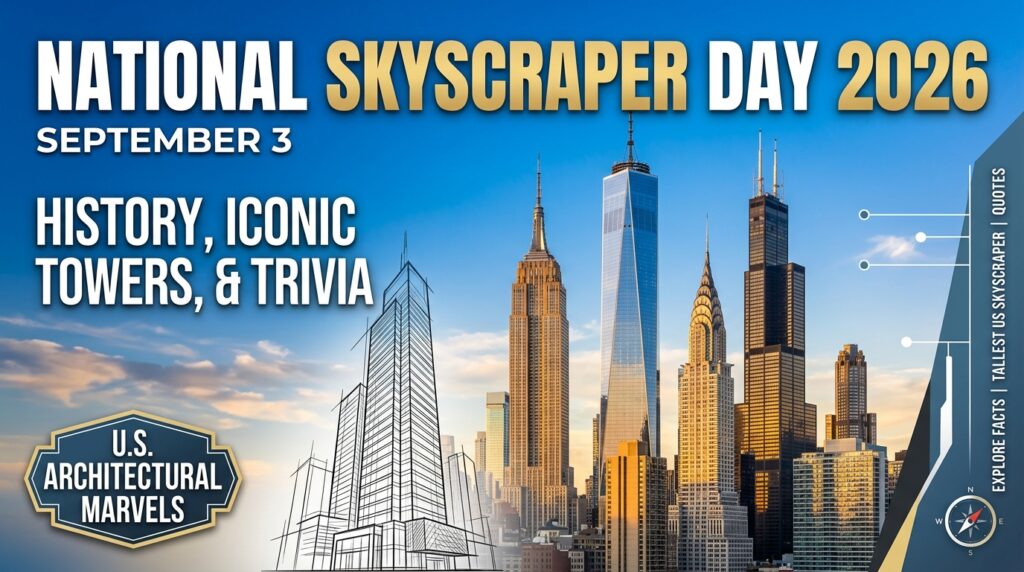
National Skyscraper Day 2026 will be observed on Thursday, September 3, 2026. The day gives architecture fans, engineers, city dwellers, and travelers a reason to look up and appreciate the design, history, and sheer ambition behind the world’s tallest buildings. This guide covers the origins of Skyscraper Day, who is credited with shaping the modern skyscraper, the tallest towers in the US today, iconic American skyscrapers, fun facts, quotes, and answers to the most common questions people ask about the day.
Looking for more things to mark this week? Check our September 2026 holidays calendar or browse our full list of national observance days.
When Is National Skyscraper Day 2026?
National Skyscraper Day 2026 falls on Thursday, September 3, 2026. It’s observed annually on September 3, and the date celebrates the architecture, engineering, and cultural impact of tall buildings in cities across the country and the world.
What Is National Skyscraper Day?
National Skyscraper Day is an informal observance dedicated to appreciating skyscraper architecture and the engineering breakthroughs that made tall buildings possible. It’s not a US federal holiday, so it doesn’t come with a day off work or school — it’s a cultural and educational observance embraced mainly by architecture enthusiasts, engineers, students, and city explorers. The day is often used to highlight famous towers, learn about the history of high-rise construction, and recognize how skyscrapers reshaped city skylines and urban life.
Why Do We Celebrate Skyscraper Day?
Skyscraper Day exists to celebrate the architectural innovation and engineering advances that allow buildings to rise hundreds of stories into the sky. It’s a chance to recognize how structural steel, safe passenger elevators, and modern foundation techniques transformed dense cities, created iconic skylines, and turned once-unthinkable heights into everyday landmarks. The day also honors the architects, engineers, and construction workers whose work quite literally shaped the skylines of Chicago, New York, and cities around the world.
National Skyscraper Day History
September 3 was chosen for this observance because it’s the birthday of Louis H. Sullivan, the American architect widely known as the “father of the modern skyscraper,” who was born on September 3, 1856.<sup>[1]</sup> Sullivan is credited with helping define the aesthetic and structural principles of early tall buildings and famously championed the idea that “form follows function.” He also mentored Frank Lloyd Wright and helped shape the influential Chicago School of architecture.
The exact origin of Skyscraper Day as a named annual observance isn’t clearly documented by any single official organization, so it should be treated as an informal, community-driven tradition rather than one with a confirmed founder. What is well documented is the broader history it celebrates: many historians point to Chicago’s Home Insurance Building, completed in 1884–85 and designed by engineer William Le Baron Jenney, as the world’s first skyscraper, thanks to its early use of a load-bearing iron and steel frame.<sup>[1]</sup>
Who Invented the Skyscraper?
There’s no single person credited with inventing the skyscraper. Instead, the modern skyscraper emerged from a combination of technological breakthroughs in the late 19th century, brought together by multiple architects and engineers working largely out of Chicago and New York.
The Role of the Elevator
Safe, reliable passenger elevators made it practical for people to work and live many stories above street level, removing the physical limits that once kept buildings low enough to climb by stairs.
The Steel Skeleton
Structural steel framing allowed the weight of a building to be carried by an internal skeleton rather than thick masonry walls, freeing up floor space and enabling buildings to rise far higher than traditional stone construction ever could.
Together, these innovations — plus advances in fireproofing and deep foundation engineering — made the modern skyscraper possible, with figures like William Le Baron Jenney and Louis Sullivan playing foundational roles in the shift.
How Did Skyscrapers Change American Cities?
Skyscrapers reshaped American cities by dramatically increasing usable space in already-dense urban cores, allowing more offices, homes, and businesses to fit onto the same footprint of land. They redefined central business districts in cities like Chicago and New York, created instantly recognizable skylines, and became symbols of a city’s economic strength and technological progress. The rise of the skyscraper also influenced transportation planning and urban design more broadly, as cities adapted to support taller, denser development.
Iconic Skyscrapers in the United States
Empire State Building — New York City
Completed in 1931, the Empire State Building is one of the most recognizable Art Deco skyscrapers in the world and remained the tallest building on Earth for roughly four decades. It continues to be a defining feature of the Manhattan skyline and a major tourist attraction.
One World Trade Center — New York City
Located at the site of the original World Trade Center in Lower Manhattan, One World Trade Center opened in 2014 and stands as the tallest building in the United States, built as both a functional office tower and a symbol of renewal.
Willis Tower — Chicago
Formerly known as the Sears Tower, Willis Tower was completed in 1973 and held the title of the world’s tallest building for nearly 25 years. It remains one of Chicago’s most iconic structures and a defining piece of the city’s skyline.
Chrysler Building — New York City
Completed in 1930, the Chrysler Building is celebrated for its distinctive Art Deco spire and ornamentation, and it’s frequently cited as one of the most beautiful skyscrapers ever built.
875 North Michigan Avenue — Chicago
Formerly known as the John Hancock Center, this tapered, cylindrical tower is a landmark of Chicago architecture and one of the city’s most photographed buildings.
Building names, rankings, and heights can shift as new towers top out, so verify current figures against an authoritative source such as the Council on Tall Buildings and Urban Habitat (CTBUH) before publishing time-sensitive rankings.
What Is the Tallest Skyscraper in the US?
As of 2026, One World Trade Center in New York City is the tallest skyscraper in the United States, standing at an architectural height of 1,776 feet (541 meters) across 104 stories, a height chosen to reference the year of the Declaration of Independence.<sup>[2]</sup> It has held this title since its completion in 2014, when the Council on Tall Buildings and Urban Habitat officially ruled that its rooftop spire counted as a permanent architectural feature rather than a removable antenna, settling a heavily debated height ruling at the time.
| Building | City | Architectural Height | Floors | Completed |
|---|---|---|---|---|
| One World Trade Center | New York, NY | 1,776 ft (541 m) | 104 | 2014 |
| Central Park Tower | New York, NY | 1,550 ft (472 m) | 98 | 2020 |
| Willis Tower | Chicago, IL | 1,450 ft (442 m) | 108 | 1973 |
| 111 West 57th Street | New York, NY | 1,428 ft (435 m) | 84 | 2021 |
| One Vanderbilt | New York, NY | 1,401 ft (427 m) | 58 | 2020 |
Note that rankings can vary depending on whether a source measures architectural height (including permanent spires), roof height, or highest occupied floor — always confirm the measurement standard being used, and check current data before publishing, since new supertall towers are regularly under construction in cities like New York.
Interesting Skyscraper Facts and Statistics
- Many historians credit Chicago’s Home Insurance Building (1884–85) as the world’s first skyscraper, thanks to its early iron-and-steel load-bearing frame.
- Louis H. Sullivan, born September 3, 1856, is widely known as the “father of the modern skyscraper” and coined the principle “form follows function.”
- A building generally needs to reach roughly 150 meters (492 feet) to be classified as a skyscraper, though definitions vary by source.
- Willis Tower held the title of world’s tallest building from 1974 until 1998.
- One World Trade Center’s height of 1,776 feet was deliberately chosen to reference 1776, the year of the US Declaration of Independence.
Always double-check “tallest,” “fastest,” or “largest” claims against a current authoritative source such as CTBUH before publishing, since new construction can change rankings.
How Are Skyscrapers Designed to Handle Wind and Weather?
Skyscrapers rely on a combination of engineering strategies to safely handle wind, weather, and even earthquakes. A strong structural core, often made of steel or reinforced concrete, anchors the building and resists lateral forces. Engineers use wind-tunnel testing during the design phase to understand how a specific tower shape will behave in real-world wind conditions, and many supertall buildings are engineered to sway slightly rather than resist wind rigidly, since some flexibility helps distribute stress. Tuned mass dampers — large counterweights installed high in a building — are sometimes used to reduce sway and improve comfort for occupants. Foundations are engineered based on local soil conditions, often extending deep underground to bedrock to support the building’s enormous weight safely.
How to Celebrate National Skyscraper Day 2026
Visit a Famous Skyscraper
Head to an observation deck or architectural landmark in your city, or plan a trip around visiting one you’ve always wanted to see.
Take a Skyscraper Photography Tour
Photograph tall buildings from different angles and distances — street level, a nearby park, or another rooftop.
Learn About Architectural History
Read about the architects and engineers behind famous towers and how their designs shaped the buildings we recognize today.
Watch a Documentary About Architecture
Look for documentaries covering skyscraper engineering, architectural history, or the construction of a specific iconic tower.
Share Your Favorite Skyline
Post a photo of your city’s skyline or a favorite skyscraper on social media using #SkyscraperDay.
Visit an Observation Deck
If you’re planning to visit an observation deck, book tickets in advance where possible and check current hours, since popular decks can sell out on busy days.
National Skyscraper Day 2026 Quotes
A few short lines to mark the day:
“Form follows function — and few ideas have shaped city skylines as much as that one.”
“Every skyscraper is really two stories: the one you can see, and the one buried in its foundation.”
“Cities don’t just grow outward anymore — they grow up.”
Verify attribution carefully before sharing any quote as belonging to a specific well-known architect, since many circulating “architecture quotes” online are misattributed or paraphrased.
National Skyscraper Day 2026 Trivia
Question: Which US city is famous for its historic skyscraper architecture? Answer: Chicago and New York City are particularly notable, both for pioneering early skyscraper construction and for their iconic modern skylines.
Question: Who is considered the “father of the modern skyscraper”? Answer: Louis H. Sullivan, born on September 3, 1856, is widely given that title.
Question: What two technologies made the modern skyscraper possible? Answer: The safe passenger elevator and the structural steel frame.
Frequently Asked Questions About National Skyscraper Day 2026
Why do we celebrate Skyscraper Day? Skyscraper Day gives people a chance to appreciate the architecture, engineering, and history behind tall buildings, and to recognize how they’ve shaped modern city skylines.
When is National Skyscraper Day 2026? National Skyscraper Day 2026 is observed on Thursday, September 3, 2026.
Who invented the skyscraper? No single person invented the skyscraper. It developed from advances in structural steel framing, safe passenger elevators, and foundation engineering in the late 19th century, with figures like William Le Baron Jenney and Louis Sullivan playing key roles.
What is the tallest skyscraper in the US? As of 2026, One World Trade Center in New York City is the tallest skyscraper in the United States, at an architectural height of 1,776 feet.
What are some famous skyscrapers in America? Notable examples include the Empire State Building, One World Trade Center, Willis Tower, and the Chrysler Building.
Is Skyscraper Day an official holiday? No. National Skyscraper Day 2026 is an informal observance rather than a US federal public holiday, so schools, banks, and offices remain open as usual.
How can I celebrate Skyscraper Day? Visit a famous skyscraper or observation deck, photograph your city’s skyline, learn about architectural history, or share skyscraper facts and photos online.
Conclusion
National Skyscraper Day 2026 falls on Thursday, September 3, 2026, marking the birthday of Louis Sullivan and giving everyone a reason to appreciate the towers that define our cities. From the Home Insurance Building’s early steel frame to today’s supertall towers like One World Trade Center, skyscrapers represent more than a century of architectural ambition and engineering progress. Take a moment on September 3 to look up at the skyline near you and consider the story behind its tallest buildings.
Want to plan ahead for more observances like this one? Browse our 2026 holiday calendar or explore more fun and cultural observance days on our site.