
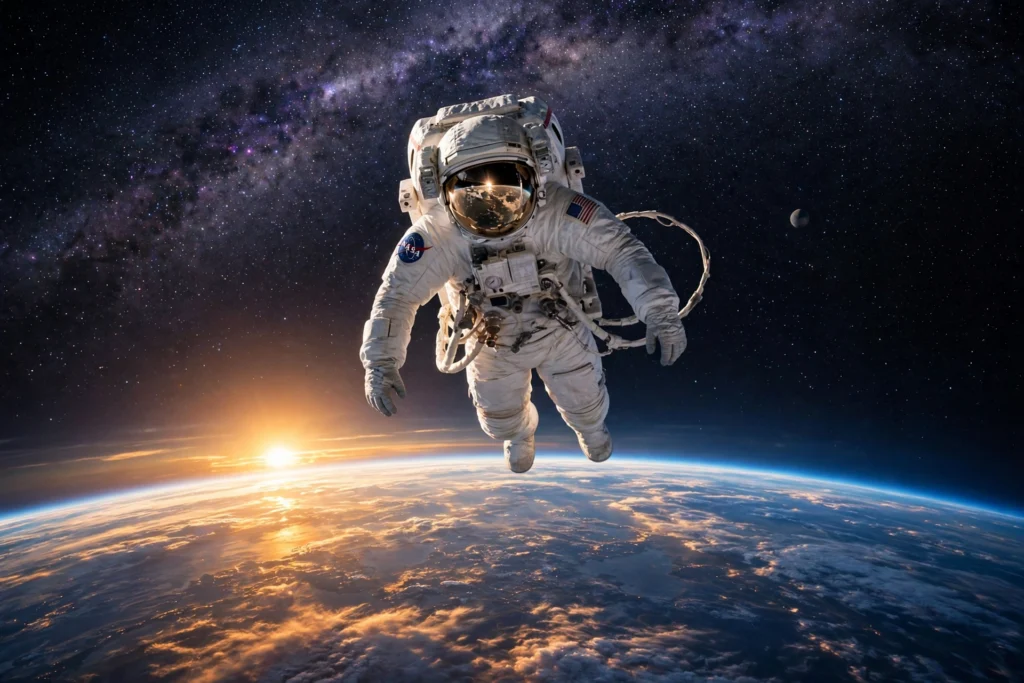
National Space Day 2027 falls on Friday, May 7, 2027. It is the first Friday in May, the day the United States sets aside every year to celebrate space exploration and to get young people excited about science, technology, engineering and mathematics. It is not a day off work and it is not a parade holiday. It is a working day with a telescope pointed at the sky: schools run space lessons, planetariums and science museums hold special events, and NASA and the aerospace industry use the moment to show what exploring beyond Earth actually takes. This guide has the exact date and a live countdown, the story of how a one-day Lockheed Martin event in 1997 grew into an international observance, what is happening in space in 2027, and 25 ways to celebrate it at home, at school or under the stars.
Countdown to National Space Day 2027
Loading…
until Friday, May 7, 2027 at 12:00 AM Eastern Time
When Is National Space Day 2027?
National Space Day 2027 is on Friday, May 7, 2027. The date is set by a rule, not a fixed calendar day: it is always the first Friday in May. May 1, 2027 is a Saturday, so the first Friday of the month lands on May 7.
| Year | National Space Day date | Weekday |
|---|---|---|
| 2025 | May 2 | Friday |
| 2026 | May 1 | Friday |
| 2027 | May 7 | Friday |
| 2028 | May 5 | Friday |
| 2029 | May 4 | Friday |
| 2030 | May 3 | Friday |
One warning if you are checking dates online: several holiday calendars still show the wrong 2027 date, listing May 2 or May 3, even on pages that state the first-Friday rule in the same breath. May 2, 2027 is a Sunday and May 3 is a Monday, so neither can be the first Friday. Trust the rule, not the stale listing: the first Friday in May 2027 is May 7.
How Many Days Until National Space Day 2027?
The live countdown at the top of this page ticks down to midnight at the start of Friday, May 7, 2027, Eastern Time, the moment National Space Day 2027 begins in the United States. At the time this article was published (November 18, 2026), there were 170 days remaining until National Space Day 2027. That is a long planning window for teachers: a space unit, a model rocket build or a planetarium trip takes weeks to organise, and May is still months away.
What Is National Space Day?
National Space Day is a celebration of space exploration and the people who make it happen: astronauts, engineers, scientists, technicians and the students who will follow them. It has two jobs. The first is to look back at what exploring space has already achieved, from the first satellite to the Moon landings to a space station that has been lived in without a break for more than 25 years. The second is to look forward and pull young people into the field, which is why the day was created as an education event in the first place.
The day is observed across the United States, and since 2001 it has had an international version too, International Space Day, which grew out of the same event. Schools, museums, planetariums and space centres mark it with activities, and space companies and NASA use it to talk about current missions. It is an observance, not a federal holiday: schools, offices and government agencies all run normally, and no shops close for it.
The History of National Space Day: From One Company Event to a Global Observance
National Space Day is young by holiday standards. It began in 1997, when the Lockheed Martin Corporation created it as a one-day event to inspire students to take an interest in space and in the aerospace careers behind it. The idea was simple: if children could meet the people who build rockets and see what a career in space looked like, more of them would study science and maths. The first celebration was a local, education-focused event, and it worked well enough to grow.
The turning point came in 2001. Former astronaut and U.S. Senator John Glenn, the first American to orbit the Earth, expanded the celebration into International Space Day, taking the same idea worldwide. Glenn's involvement gave the day real weight: he had flown in space twice, first in 1962 on Friendship 7 and again in 1998 aboard the Space Shuttle Discovery at the age of 77, and his name connected the new observance to the whole history of American spaceflight.
Congress has since recognised the day in resolutions. Senators Jerry Moran and John Hickenlooper introduced Senate resolutions recognising National Space Day, S.Res. 665 in the 118th Congress and S.Res. 228 in the 119th, honouring NASA, federally funded research centres, private aerospace companies, universities and the workforce behind them. A House resolution, H.Res. 370 in the 119th Congress, likewise backed the observance, naming May 2, the 2025 date, as National Space Day. None of these resolutions made it a federal holiday, and it remains an observance rather than a day off, but the bipartisan backing shows how widely the day is now recognised.
Space in 2027: Why This Year Matters
National Space Day 2027 arrives at a busy moment for spaceflight. The biggest recent milestone is already in the books: in April 2026, NASA's Artemis II mission carried four astronauts, Reid Wiseman, Victor Glover, Christina Koch and Jeremy Hansen, around the Moon and home again over nine days, from April 1 to April 10, 2026. It was the first crewed lunar mission since Apollo 17 in 1972, and the crew flew farther from Earth than any humans before them, breaking a record that had stood since Apollo 13 in 1970. Artemis II was a flyby, not a landing, but it proved the Orion spacecraft and the Space Launch System rocket with people aboard.
What comes next is scheduled around Space Day 2027 itself. Artemis III is now planned as a crewed test flight in Earth orbit in mid-2027, where an Orion crew will practise rendezvous and docking with the commercial lunar landers, and the first crewed landing has moved to Artemis IV, targeted for early 2028. Schedules in spaceflight slip, and these dates are planning targets rather than promises, but the direction is clear: after more than half a century, astronauts are heading back toward the Moon, and 2027 is the year the programme is tested in flight.
Meanwhile, the International Space Station keeps its own record going. People have lived aboard it without a break since November 2, 2000, when the first resident crew, Expedition 1, floated through the hatch. It passed 25 years of continuous human presence on November 2, 2025. More than 290 people from 26 countries have visited it, and it has hosted more than 4,000 experiments from over 5,000 researchers in 110 countries, circling the Earth about every 90 minutes. NASA plans to operate the station through 2030. So on National Space Day 2027, there will be people living and working in orbit, as there have been every single day for more than 26 years.
A Short Timeline of American Spaceflight
National Space Day celebrates the whole arc of exploration, not just the latest mission. These are the milestones that built it:
| Date | Milestone |
|---|---|
| October 4, 1957 | The Soviet Union launches Sputnik 1, the first artificial satellite, and the space race begins |
| July 29, 1958 | President Eisenhower signs the National Aeronautics and Space Act, creating NASA |
| April 12, 1961 | Yuri Gagarin becomes the first human in space |
| May 5, 1961 | Alan Shepard becomes the first American in space, on Freedom 7 |
| February 20, 1962 | John Glenn becomes the first American to orbit the Earth, on Friendship 7 |
| July 20, 1969 | Apollo 11 lands on the Moon; Neil Armstrong and Buzz Aldrin walk on its surface |
| April 12, 1981 | Space Shuttle Columbia makes the first shuttle flight |
| April 24, 1990 | The Hubble Space Telescope launches |
| November 20, 1998 | Assembly of the International Space Station begins with the Zarya module |
| November 2, 2000 | Expedition 1 arrives; people have lived in space without a break ever since |
| December 25, 2021 | The James Webb Space Telescope launches |
| April 1 to 10, 2026 | Artemis II flies four astronauts around the Moon, the first crewed lunar mission since 1972 |
Two numbers from that history are worth remembering. Only 24 people have ever flown to the Moon, and only 12 have walked on it, all of them Americans on the six Apollo landings between 1969 and 1972. And the crew of the space station sees about 16 sunrises and 16 sunsets every day, one per 90-minute orbit, which is why astronauts say living in space rewires your sense of a day.
25 Ways to Celebrate National Space Day
You do not need a telescope or a ticket to Florida to take part. Here are 25 ideas, grouped so you can pick what fits your day.
Look up
- Go stargazing after dark, away from street lights if you can, and find the Moon, Jupiter or the constellations with a free sky-map app.
- Watch for the International Space Station passing overhead. It looks like a bright, steady star gliding across the sky, and NASA's Spot the Station service lists sighting times for your town.
- Watch a sunrise or sunset and remember that the station's crew sees 16 of each every day.
- Set up a backyard telescope, or borrow one from a library. Many public libraries lend telescopes now.
- Photograph the Moon through binoculars or a phone held to a telescope eyepiece.
Learn something
- Watch a documentary about Apollo 11, the Hubble telescope or the Artemis programme.
- Read about the Artemis II crew and the Artemis III test flight planned for mid-2027.
- Follow NASA's social media and mission pages for the day to see what the agency is highlighting.
- Learn the names of the planets in order and one fact about each, then test yourself.
- Read a biography of an astronaut, from John Glenn and Sally Ride to the Artemis II crew.
With kids
- Build a model rocket from a kit, or a paper rocket launched with a straw.
- Make a scale model of the solar system with fruit or balls, so the distances feel real.
- Draw or paint your own planet and give it a name, a weather system and a flag.
- Do a kitchen science experiment, like a baking-soda volcano or a balloon rocket race.
- Read a space picture book together, then act out a Moon landing in the living room.
At school or work
- Teachers: run a space quiz, a rocket-building challenge or a debate on whether humans should return to the Moon.
- Ask students to design a mission patch, the way real NASA crews do for every flight.
- Invite a local astronomer, engineer or science teacher to talk about their work.
- Hold a lunchtime screening of a space launch or a station tour video.
- Start a space club, even a one-day one, with a shared reading list and a stargazing plan.
Go somewhere
- Visit a planetarium, science museum or observatory. Check its website nearer May 7, 2027 for Space Day events, as programmes are announced closer to the date.
- Visit a science centre's space gallery and try the simulators and hands-on exhibits.
- Take a trip to a dark-sky park or reserve if one is within reach, and stay for the Milky Way.
- Attend a local astronomy club's public observing night, which many clubs run on the first Friday in May.
- Walk a planet trail, if your town has one, and feel the scale of the solar system on foot.
No events, ticket prices or opening times are listed here, because none had been announced for 2027 as of November 18, 2026. Check the planetarium, museum or observatory you plan to visit nearer the date.
National Space Day vs International Space Day: What Is the Difference?
They are the same observance at different scales. National Space Day is the American version, created in 1997 by Lockheed Martin and still celebrated on the first Friday in May in the United States. International Space Day is the worldwide version John Glenn created from it in 2001, observed on the same day. In practice, most people use the two names interchangeably, and the date, the first Friday in May, is identical for both.
Do not confuse either of them with India's National Space Day, which is a different observance on a different date: August 23, marking the day India's Chandrayaan-3 mission landed on the Moon's south pole in 2023. India first celebrated it on August 23, 2024. Same name, different country, different date, different story.
Is National Space Day a Federal Holiday?
No. National Space Day is an observance, not a federal holiday, and Congress has never made it one. Federal offices, schools, banks and businesses all open as usual on Friday, May 7, 2027. That is part of the point: it was created as a school and workplace day, a day for lessons and activities rather than a day off, so the celebrating happens inside ordinary classrooms and offices.
National Space Day 2027: Frequently Asked Questions
When is National Space Day 2027?
Friday, May 7, 2027. It is always the first Friday in May.
How many days are left until National Space Day 2027?
Use the live countdown at the top of this page. At publication on November 18, 2026, there were 170 days remaining.
Who created National Space Day?
The Lockheed Martin Corporation created it in 1997 as a one-day event to inspire students toward science and aerospace careers. In 2001, astronaut and Senator John Glenn expanded it into International Space Day.
Is National Space Day the same as International Space Day?
Almost. International Space Day is the worldwide version of the same observance, created from National Space Day in 2001, and both fall on the first Friday in May.
Is National Space Day a public holiday?
No. It is an observance. Schools and workplaces stay open, and the day is marked with lessons, events and activities rather than time off.
What is happening in space in 2027?
NASA's Artemis III crewed test flight is planned for mid-2027, testing the Orion spacecraft with the commercial lunar landers in Earth orbit, ahead of a first crewed landing targeted for Artemis IV in early 2028. The International Space Station will also still be continuously occupied, as it has been since November 2000.
Can I see the International Space Station from where I live?
Often, yes. The station is visible to the naked eye as a bright, fast-moving point of light on clear nights, and NASA's Spot the Station service publishes sighting times by location.
More Days to Explore
National Space Day sits in the middle of a busy May. The day before it, National Nurses Day 2027 opens Nurses Week, and two days after it comes Mother's Day 2027 on Sunday, May 9. Earlier in the month, National Teacher Day 2027 falls on Tuesday, May 4, and Cinco de Mayo 2027 on Wednesday, May 5. Spring's other big dates include the First Day of Spring 2027 on Saturday, March 20 and Earth Day 2027 on Thursday, April 22, and the year's biggest observance is still ahead: Memorial Day 2027 on Monday, May 31.
External sources: Calendarr: National Space Day, NASA: Artemis II mission, NASA: 25 years of continuous human presence aboard the International Space Station.