
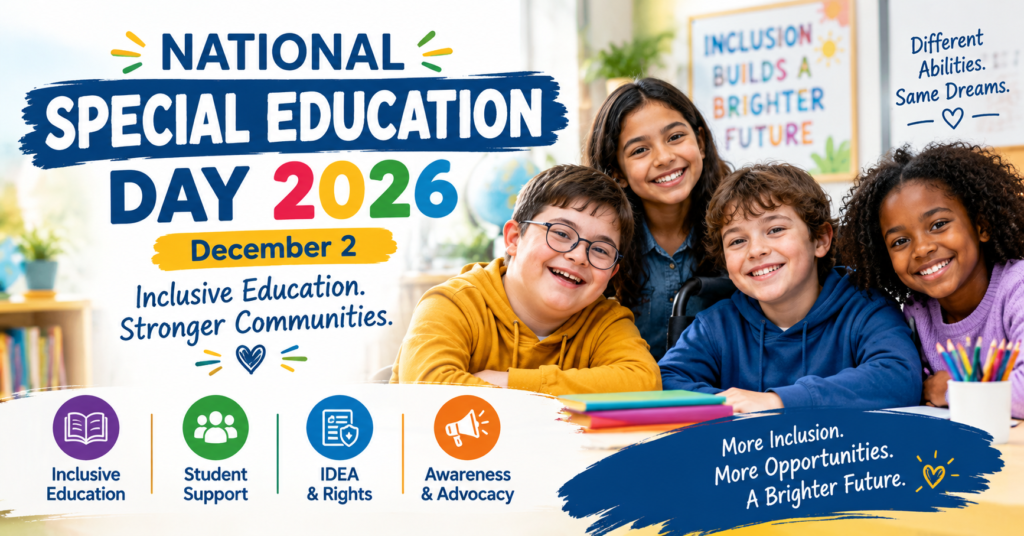
National Special Education Day 2026 is observed on Wednesday, December 2, 2026. The day recognizes the educational rights of students with disabilities, the work of special education professionals, and the importance of access, individualized support and inclusion in every school.
Not long ago, many children with disabilities were turned away from public schools or given little meaningful instruction. Today, federal law in the United States protects their right to an appropriate education, and families, teachers and communities continue to work toward classrooms where every learner can take part. This guide covers the date, history, meaning and importance of the day, along with practical ways for schools, families and communities to take part.
If you follow awareness days across the calendar, you can find more observances and education-related reads on MemorialDay2026.com.
When Is National Special Education Day 2026?
National Special Education Day 2026 falls on Wednesday, December 2, 2026.
The observance takes place every year on December 2, and it is closely tied to the history of U.S. special education law. It is an awareness observance, not a federal holiday, so schools and workplaces generally remain open. Many schools use the day to share information, thank staff and review how well their programs serve all students.
In short, National Special Education Day 2026 is Wednesday, December 2. It recognizes the importance of special education, the educational rights of students with disabilities, and the educators and families who help students access appropriate learning and support.
What Is National Special Education Day?
National Special Education Day is an annual observance that highlights the importance of education that meets the individual needs of students with disabilities. It reminds communities that every child has the right to learn, and that learning looks different for different students.
The day recognizes several groups:
- Students with disabilities, whose learning and goals are at the center of every plan
- Families, who advocate for their children and work closely with schools
- Special education teachers, who adapt instruction and track progress
- Related-service professionals, such as speech-language pathologists, occupational therapists and counselors
- School staff, from paraprofessionals to administrators, who help schools function
Greater awareness helps schools build more inclusive learning environments, and it helps families understand the supports that may be available to their children.
National Special Education Day History
For much of the twentieth century, children with disabilities faced serious barriers to education. Many were excluded from public schools altogether, and others were placed in settings with limited instruction and few opportunities to learn alongside their peers. Families often had to look for help on their own, with little legal protection.
That began to change in the 1970s. On November 29, 1975, President Gerald Ford signed the Education for All Handicapped Children Act. The law set up a federal framework for providing a free appropriate public education to eligible children with disabilities. It also required schools to create individualized plans and gave families a voice in decisions about their children’s education.
It is worth being clear about the dates. National Special Education Day is observed on December 2, but the law was signed on November 29, 1975. The two should not be confused.
In 1990, the law was renamed the Individuals with Disabilities Education Act (IDEA). Later amendments expanded early-intervention services for infants and toddlers, strengthened individualized planning and added further protections. You can read a broader overview of how the law developed in the Wikipedia article on the Individuals with Disabilities Education Act.
Why Is Special Education Day Celebrated?
The day serves several purposes:
- To recognize the educational rights of students with disabilities
- To raise awareness of different learning needs and the supports that help students succeed
- To honor special education teachers and related-service professionals
- To encourage collaboration among students, families, teachers and schools
- To promote accessible materials, appropriate accommodations and meaningful participation in school life
Because rights on paper only matter if they are carried out well, the day also asks schools and communities to look at how those rights work in practice.
What Is the Individuals with Disabilities Education Act (IDEA)?
IDEA is the U.S. federal law that governs special education and related services for eligible children and youth with disabilities. It sets out what schools must provide and how families can take part in the process.
A few key ideas are central to the law:
- Free appropriate public education (FAPE): Eligible students are entitled to special education and related services at no cost to families, designed to meet their individual needs.
- Individualized Education Program (IEP): A written plan, developed by a team that includes the family, that describes a student’s needs, goals and the services the school will provide.
- Least restrictive environment (LRE): Students should be educated alongside peers without disabilities to the greatest extent appropriate for their needs.
- Early intervention: Eligible infants and toddlers can receive services that support their development before they reach school age.
Eligibility and services depend on the legal criteria and each child’s individual circumstances. For specific questions, families and educators should turn to official guidance from the U.S. Department of Education, their state education agency or their local school district.
The Importance of Inclusive Education
Inclusive education means giving students with disabilities real access to learning, alongside their peers where appropriate. It is about more than seating arrangements. For inclusion to work, schools need resources, training and a culture of respect.
Strong inclusive practice often includes:
- Accessible classrooms and learning materials, such as readable formats, captioning and clear layouts
- Assistive technology, from text-to-speech tools to communication devices
- Respect for different communication and learning styles
- Adapted instruction and assessments that measure what a student knows, not just how they take a test
- Collaboration between general education teachers, special educators and families
Inclusion requires appropriate support and planning, not simply placing students in the same room. When it is done well, it can benefit everyone, because accessible teaching often helps all learners. For more background on the concept, see the Wikipedia overview of inclusion in education.
How to Celebrate National Special Education Day 2026
- Organize an educational session about disability inclusion for students, staff or parents.
- Highlight the contributions of special education professionals in a newsletter or assembly.
- Review classroom accessibility and learning resources to find and fix barriers.
- Share verified information about IDEA and available student support.
- Invite students to suggest ways to make school activities more accessible.
- Recognize collaboration between families, educators and support staff.
- Promote respectful communication about disability, using the language that people prefer.
- Support reputable organizations that improve educational access.
The day also sits close to another important observance. The International Day of Persons with Disabilities is marked on December 3, the next day, so many schools and communities plan a two-day focus. You can explore related awareness days on our observances and awareness days pages.
National Special Education Day 2026 Activities for Schools and Students
Classroom Activities
Use age-appropriate lessons about accessibility, different ways of learning, assistive technology and respectful inclusion. Younger students might explore how people communicate in different ways. Older students could research accessibility in their own school and suggest practical improvements.
Activities for Teachers
Review lesson materials for accessibility and discuss appropriate accommodations with relevant colleagues. Take time to identify barriers that might keep students from participating, whether in the classroom, on field trips or in extracurricular activities.
Family and Community Activities
Host an information session, share available support resources or invite families to contribute ideas for improving access to school programs. A welcoming, two-way conversation often builds more trust than a one-way presentation.
Awareness Activities
Create posters or presentations that explain inclusion, accessibility and educational rights without stereotyping students with disabilities. Focus on access, dignity and shared community, and avoid portraying students as objects of pity or as inspirational simply because they have a disability.
The Role of Special Education Teachers
Special education teachers do far more than teach lessons. They:
- Provide individualized instruction and learning support based on each student’s goals
- Collaborate with general education teachers to adapt materials and strategies
- Work with families to set goals and track progress
- Coordinate with related-service professionals and school staff
- Keep learning through professional development in new methods and technologies
Their work depends on adequate resources, manageable workloads and access to accessible teaching tools. No single teacher or teaching method can meet the needs of every student, which is why collaboration across the school community matters so much.
Appreciation messages for educators:
- Thank you for seeing each student’s strengths and helping them grow.
- Your patience, skill and persistence make learning possible for so many.
- We are grateful for everything you do, in and beyond the classroom.
National Special Education Day 2026 Quotes and Messages
These are original messages for school newsletters, awareness posters and social media.
- “Every student deserves the opportunity to learn, participate and grow with the support they need.”
- “Inclusion means building a classroom where everyone belongs, not asking students to fit into one that was not built for them.”
- “Access is not a favor. It is the foundation of fair education.”
- “When families, teachers and schools work together, students have the best chance to thrive.”
- “Different ways of learning deserve different kinds of support.”
Short messages for social media:
- Today we celebrate students, families and educators who make inclusive learning possible. #SpecialEducationDay
- Accessible schools help every student learn.
- Thank you to every special education teacher and support professional.
National Special Education Day Facts
- National Special Education Day is observed on December 2.
- In 2026, December 2 falls on a Wednesday.
- The Education for All Handicapped Children Act was signed on November 29, 1975.
- The law was renamed the Individuals with Disabilities Education Act (IDEA) in 1990.
- IDEA establishes a federal framework for special education and related services for eligible children with disabilities.
- An Individualized Education Program (IEP) describes a student’s needs, goals and services where required.
- The observance is not a federal holiday.
Frequently Asked Questions About National Special Education Day 2026
When is National Special Education Day 2026?
It is observed on Wednesday, December 2, 2026.
Why is Special Education Day celebrated?
It raises awareness of special education, recognizes students’ educational rights and acknowledges the work of families, teachers and school professionals.
What is the history of National Special Education Day?
The observance is associated with the development of federal special education protections, including the Education for All Handicapped Children Act of 1975 and its later evolution into IDEA.
What is IDEA in special education?
IDEA is the Individuals with Disabilities Education Act, a U.S. federal law that governs special education and related services for eligible children with disabilities.
How can schools celebrate National Special Education Day?
Schools can share educational resources, review accessibility, recognize educators, promote respectful disability awareness and involve students in appropriate inclusion activities.
Is National Special Education Day a federal holiday?
No. It is an awareness observance, not a U.S. federal public holiday.
Countdown to National Special Education Day 2026
As of October 9, 2026, there are 54 days until National Special Education Day on Wednesday, December 2. That gives schools, families and community groups time to plan an information session, review accessibility or prepare a thank-you for the educators who support students every day.
Conclusion
National Special Education Day 2026 on Wednesday, December 2 is a reminder that education is a right, and that every student deserves access to learning that fits their needs. Individualized support, inclusion and strong partnerships between families and schools make that right real.
Use the day to learn, to thank the people who support students, and to ask how your own school or community can improve. The most lasting progress comes from the work we do throughout the year.