
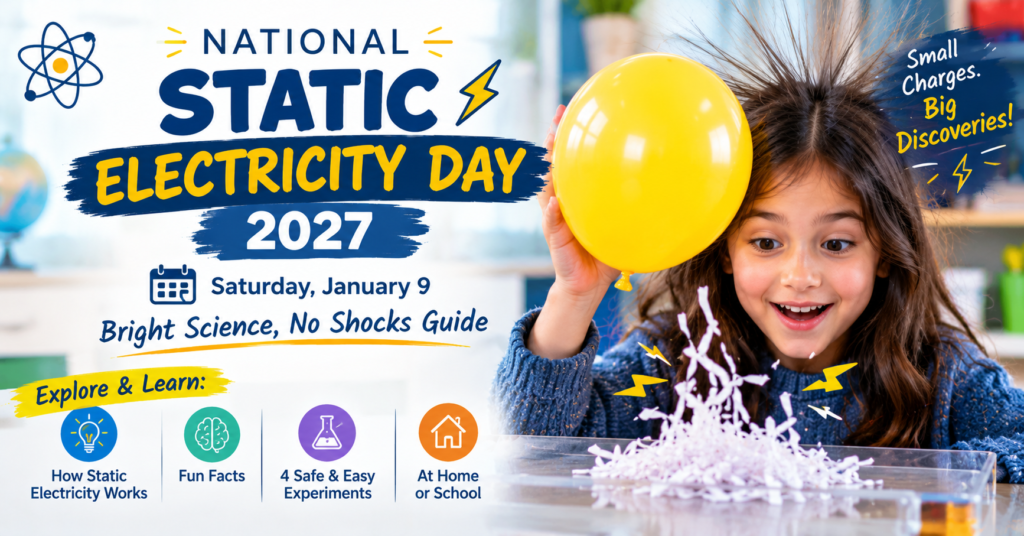
Have you ever pulled off a hat and watched your hair stand on end? Or rubbed a balloon on your sleeve and stuck it to a wall? Maybe you have felt a small zap from a doorknob after walking across a carpet. These are everyday examples of static electricity, and National Static Electricity Day 2027, on Saturday, January 9, is a perfect time to explore the science behind them.
This guide explains what static electricity is, why it happens, 10 interesting facts and four safe experiments you can try at home or in the classroom. It is an informal observance with no clearly documented origin, not a public holiday. If you are still enjoying the start of the year, see our New Year’s Day 2027 guide.
Quick answer: National Static Electricity Day is observed every January 9. In 2027, it falls on Saturday, January 9. Static electricity is a buildup of electric charge on an object.
When Is National Static Electricity Day 2027?
National Static Electricity Day 2027 is on Saturday, January 9, 2027.
- Date: Saturday, January 9, 2027
- Frequency: Listed annually on January 9
- Type: Informal science observance, not a federal holiday
Because it falls on a Saturday, it is ideal for a hands-on family science morning. Winter air is often dry, which makes static effects easier to see.
What Is National Static Electricity Day?
The day is a chance to learn about electric charges using simple, everyday materials. Easy experiments make physics accessible, whether at home, in a classroom or in a science club. You can also share your results on social media with the hashtag #StaticElectricityDay.
Its exact origin is not well documented, so it is best described as a popular, informal observance rather than something created by a named person or organization.
What Is Static Electricity?
Static electricity is a buildup of electric charge on the surface of an object. It is called “static” because the charge stays in place until it has somewhere to go, unlike the steady flow of current that powers household devices.
How Electric Charges Work
- Atoms contain positively charged protons, negatively charged electrons and neutral neutrons.
- An object becomes electrically charged when electrons move from one material to another.
- Opposite charges attract, and like charges repel.
- A discharge happens when built-up charge moves to another object or finds a path to dissipate. That is the small zap you feel.
Why Is It Called “Static” Electricity?
Static describes charge that builds up and stays put. Current electricity, by contrast, is charge flowing through a wire or circuit. Static charge can eventually discharge, which is why you sometimes feel a spark.
Why Does Static Electricity Happen?
- When two different materials touch and separate, or are rubbed together, electrons can transfer from one to the other.
- A charged object can attract neutral objects. It redistributes the charges inside them, so the near side has the opposite charge and is pulled closer.
- Dry air makes static shocks more noticeable, since moisture helps charge leak away.
- Rubbing is a common way to create static charge, but it is not the only way. Contact and separation are what matter.
This is also why static feels worse in winter. Indoor heating dries the air, so charge lingers instead of draining away. For a related look at how dry winter air affects us, see our National Winter Skin Relief Day 2027 guide.
10 Interesting Static Electricity Facts
- A rubbed balloon can stick to a wall.
- A charged comb can attract small pieces of paper.
- Hair strands can repel one another after picking up similar charges.
- Static electricity can bend a thin stream of water.
- Dry conditions often make static shocks more noticeable.
- Lightning involves large-scale charge separation and discharge.
- Photocopiers and laser printers use electrostatic processes to move toner.
- Static charge can attract dust and other small particles.
- Materials differ in how readily they gain, lose or hold charge.
- Static electricity is different from the steady current that powers household devices.
Easy Static Electricity Experiments to Try
Results depend on the materials and humidity, so try a few combinations. Dry days work best.
Experiment 1: Make a Balloon Stick to a Wall
Materials: Balloon, dry hair or wool fabric, smooth wall.
- Inflate and tie the balloon.
- Rub it against dry hair or wool for several seconds.
- Hold it against the wall and gently let go.
- Observe whether it stays in place.
The science: The charged balloon rearranges charges inside the wall, which creates attraction strong enough to hold it briefly.
Experiment 2: Pick Up Small Pieces of Paper
Materials: Plastic comb or ruler, small pieces of paper, dry cloth or hair.
- Tear paper into tiny pieces.
- Rub the plastic object against dry hair or fabric.
- Hold it close to the paper without touching.
- Watch whether the pieces move or jump toward it.
The science: The charged object attracts the lightweight paper by influencing how charge is distributed in it.
Experiment 3: Bend a Stream of Water
Materials: Balloon or plastic comb and a tap.
- Run a thin, steady stream of water.
- Charge the balloon or comb by rubbing it on dry hair or fabric.
- Bring it close to the stream without touching the water.
- Observe whether the stream bends toward the object.
The science: Water molecules are polar, so the electric field of the charged object pulls on them and bends the stream.
Experiment 4: Roll an Empty Can Without Touching It
Materials: Empty aluminum can, balloon, flat table.
- Lay the can on its side.
- Rub an inflated balloon against dry hair or fabric.
- Hold the balloon near the can without touching it.
- Move the balloon slowly and see whether the can follows.
The science: The charged balloon causes charges in the metal can to shift, which creates attraction and makes the can roll.
National Static Electricity Day 2027 Safety Tips
- Use ordinary household materials, with adult supervision for younger children.
- Keep experiments away from open flames, flammable vapors and fuel-handling areas.
- Never deliberately create sparks near gasoline, solvents, aerosols or other flammable substances.
- Do not experiment with electrical outlets, mains-powered equipment or high-voltage devices.
- Stop if an experiment involves damaged equipment or an unfamiliar electrical source.
Where Do We See Static Electricity in Everyday Life?
- Shocks from doorknobs and other metal objects
- Clothes clinging together after drying
- Hair standing up after combing
- Dust sticking to screens and surfaces
- Toner handling in photocopiers and laser printers
- Lightning, a large natural electrical discharge
How to Celebrate National Static Electricity Day
- Try one of the experiments above.
- Ask students to predict what will happen before testing each material.
- Record results in a simple science journal.
- Compare how different fabrics and humidity levels change your observations.
- Share a result or science fact with #StaticElectricityDay.
For another cozy winter activity afterward, our National Bubble Bath Day 2027 guide has relaxing ideas. If you have questions about your experiments, communities such as r/AskScienceDiscussion on Reddit are a friendly place to ask.
Frequently Asked Questions About National Static Electricity Day 2027
Why Does Static Electricity Happen?
Static electricity happens when electric charges become unbalanced on or within materials. Contact and separation between materials can transfer electrons, leaving objects with different charges.
How Can You Demonstrate Static Electricity?
Rub an inflated balloon against dry hair or wool, then hold it near small paper pieces. The paper may move toward the balloon because of electrostatic attraction.
When Is National Static Electricity Day 2027?
It is observed on Saturday, January 9, 2027. It is listed annually on January 9.
Why Is Static Electricity More Noticeable in Winter?
Indoor air is often drier in winter, especially when heating is on. Charge dissipates less readily in dry air, so shocks and clinging clothes become more noticeable.
Can Static Electricity Attract Water?
Yes. A charged balloon or plastic comb can attract a thin stream of water because the electric field interacts with the water molecules.
Is Static Electricity Dangerous?
Small everyday shocks are usually harmless, but sparks can ignite flammable vapors or materials in certain settings. Never run static experiments near fuel, open flames or flammable chemicals.
What Is the Difference Between Static Electricity and Current Electricity?
Static electricity is a buildup of charge, while current electricity is charge flowing through a conductor or circuit.
Who Established National Static Electricity Day?
Its exact origin is not clearly documented, so no founder or organization can be named with confidence.
Countdown to National Static Electricity Day 2027
National Static Electricity Day 2027,Saturday, January 9, 2027
77 days to go (calculated from October 24, 2026).
Browse more seasonal guides on our homepage, or see our National Law Enforcement Appreciation Day 2027 article, which falls on the same date. To read more about the science, the static electricity article on Wikipedia is a helpful starting point.