
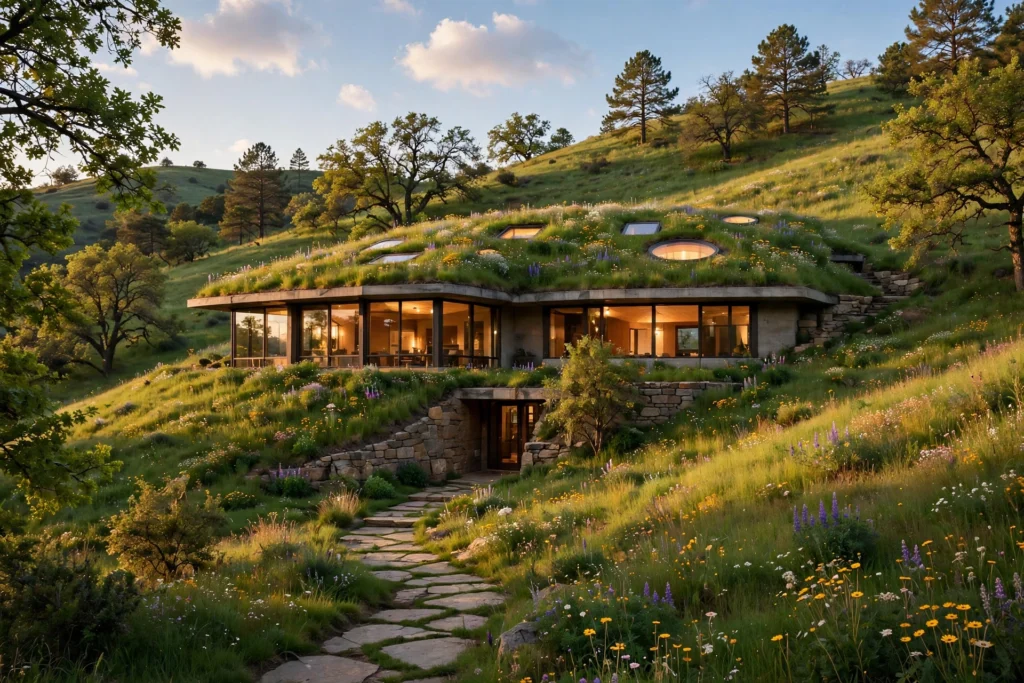
National Underground America Day 2027 falls on Friday, May 14, 2027. It is the one day of the year dedicated to the Americans who live beneath the surface, not on top of it. About 6,000 people across North America live in some form of underground architecture, in homes tucked into hillsides, bermed with earth, or dug entirely below grade. The day celebrates them, the architect who championed the idea, and a way of building that treats the land gently instead of paving over it. This guide has the exact date and a live countdown, the story of Malcolm Wells, the plain science of why underground homes stay comfortable, the honest trade-offs, four underground places worth visiting, and 12 ways to mark the day.
Countdown to National Underground America Day 2027
Loading…
until Friday, May 14, 2027 at 12:00 AM Eastern Time
When Is National Underground America Day 2027?
National Underground America Day is fixed on May 14 every year, so it never moves. In 2027 it lands on a Friday, in the middle of a busy stretch of May observances: Mother's Day falls five days earlier, on Sunday, May 9, and Armed Forces Day follows the next day, Saturday, May 15. The live countdown at the top of this page ticks down to midnight at the start of Friday, May 14, 2027, Eastern Time, the moment the day begins in the United States. At the time this article was published (November 20, 2026), there were 175 days remaining until National Underground America Day 2027, exactly 25 weeks. Check the countdown any time for the exact days, hours, minutes and seconds left.
| Year | Date | Day of the week |
|---|---|---|
| 2026 | May 14 | Thursday |
| 2027 | May 14 | Friday |
| 2028 | May 14 | Sunday |
| 2029 | May 14 | Monday |
| 2030 | May 14 | Tuesday |
| 2031 | May 14 | Wednesday |
How Many Days Until National Underground America Day 2027?
Use the live countdown at the top of this page. At publication on November 20, 2026, there were 175 days remaining until Friday, May 14, 2027. The countdown updates every second, so the number you see now is the exact time left. If you are planning a visit to an underground garden or a cave on the day itself, that countdown is also your planning clock: May is a popular month for cave tours, and the best-known sites book up on spring weekends.
What Is National Underground America Day?
National Underground America Day recognizes the approximately 6,000 people who live in some form of underground architecture across North America, and celebrates the lifestyle, the architecture, and the benefits of living underground. That is the definition used by the National Day Calendar, which lists the observance every May 14. The "underground" in the name is literal. It means houses built into hillsides, houses with earth banked against their walls, and houses dug entirely below grade with skylights and light wells bringing the sun in from above.
The day is not about bunkers, basements, or survivalism. It is about a design idea: a building can sit inside the landscape instead of on top of it, keep its occupants comfortable with far less energy, and leave the surface above it as living land, grass, wildflowers, and wildlife habitat. The idea is old. People have lived in earth-sheltered dwellings for thousands of years, from the cliff dwellings of the American Southwest to the cave homes of Cappadocia. What is new is the modern version, engineered, insulated, and sunlit, and the day exists to draw attention to it.
A Quick Clarification: It Is Not the Underground Railroad
Some listings confuse National Underground America Day with the Underground Railroad, the 19th-century network of routes and safe houses that helped enslaved African Americans escape to freedom. That is a different subject, and an important one, but it is not what May 14 celebrates. This day is about underground living and earth-sheltered architecture. The confusion is understandable, since both involve the word underground and both are part of American history, but the founder, the date, and the purpose all point to architecture, not to the escape network. If you want to learn about the Underground Railroad, the National Underground Railroad Freedom Center in Cincinnati is the place to start. On May 14, the celebration is about the houses under the hills.
The Man Who Started It: Malcolm Wells
National Underground America Day was created in 1974 by Malcolm Wells, an architect who is now regarded as the father of modern earth-sheltered architecture. Wells was born in Camden, New Jersey, on March 11, 1926, and grew up in Haddonfield during the Depression. After serving in the Marine Corps in World War II, he studied engineering, apprenticed at a small New Jersey firm, and passed the state architecture licensing examination in 1953 with a perfect score.
For the first ten years of his career, Wells designed conventional buildings, including the RCA pavilion for the 1964 New York World's Fair. Then came the turn that defined the rest of his life. As he later wrote, after ten years "spent spreading corporate asphalt on America in the name of architecture," he woke up to the fact that "the earth's surface was made for living plants, not industrial plants." The RCA pavilion was demolished when the fair closed, and the waste of it stayed with him. He resolved to build underground, and he never looked back.
His first experiments were his own offices in Cherry Hill, New Jersey, set below grade beside the Cooper River. He learned quickly that earth alone is not a good insulator and can actually pull heat out of a building, so he began insulating with foam, letting the earth moderate temperature without conducting heat away. His masterwork of the period was Solaria, completed in 1974-75 on the edge of the Pine Barrens in New Jersey, a house bermed into the earth on three sides and warmed by one of the region's earliest residential solar heating systems. It proved that an underground house could be bright, open, and beautiful.
In 1976, the New York Times called Wells "the leader of the burgeoning underground architecture movement." The same year he was already teaching and lecturing, and he went on to teach environmental design at Harvard and to lecture at architecture schools across the country. He wrote more than 20 books, all hand-lettered and hand-drawn, including Underground Designs and Gentle Architecture, both published in 1981, and How to Build an Underground House in 1991. His books have sold more than 120,000 copies.
Wells called his philosophy "gentle architecture," and his test for any building was simple: it should "leave the land no worse than you found it." He believed a building should consume its own waste, maintain itself, match nature's pace, provide wildlife habitat, moderate climate and weather, and be beautiful. He lived the idea himself, in a modern earth-sheltered home of his own design on Cape Cod, Massachusetts, and he kept advocating for underground living until his death on November 27, 2009, in Brewster, Massachusetts, at the age of 83. The day he founded in 1974 outlived him, and it is still observed every May 14.
Why Build Underground? The Science in Plain English
An earth-sheltered home works because the ground is a giant, free thermostat. A few feet below the surface, the temperature of the earth stays close to the average annual air temperature of the place, roughly 55 to 60 degrees Fahrenheit in much of the United States, and it barely changes between January and July. A house wrapped in that earth is insulated by it. In winter, the soil slows the loss of heat from the house. In summer, it slows the flow of heat into the house. The result is a home that needs far less heating and air conditioning than a conventional house.
The U.S. Department of Energy puts it plainly: the most obvious advantage of earth-sheltered buildings is energy efficiency, because they require less energy to heat and cool, with temperatures remaining around 55 to 60 degrees Fahrenheit year-round. A Department of Energy study published in 1982 found that earth-sheltered houses commonly achieved a thermal integrity of about 1 to 4 Btu per square foot per heating degree day, compared with 10 to 12 for traditional above-ground construction. In other words, the underground houses in the study used a fraction of the heating energy of a typical house of the time. Proponents of earth-sheltered construction estimate that families living in these homes can save up to 80 percent on heating and air-conditioning costs compared with a traditional above-ground house.
Energy is only part of the case. Earth-sheltered homes are also quiet, because the earth absorbs sound. They need almost no exterior maintenance, because there is little exterior to paint or repair. They are naturally protected from wind, fire, and storms. And a living roof, grass and wildflowers growing on top of the house, returns the building's footprint to nature, which is exactly what Wells meant by leaving the land no worse than he found it.
The Honest Trade-Offs
Underground living is not for everyone, and the day is worth celebrating honestly, trade-offs included. The same Department of Energy study that praised the energy performance also found that earth-sheltered houses, including land and site improvements, cost an estimated 10 to 35 percent more to build than comparable above-ground houses, and that the extra cost might not pay for itself over the life of the house at 1981 prices. Modern estimates are usually lower, around 10 to 20 percent more, but the gap is real: excavation, waterproofing membranes, and reinforced structure all cost money.
| Advantage | Trade-off |
|---|---|
| Far less heating and cooling energy | 10 to 35 percent higher construction cost, by the DOE's 1982 estimate |
| Stable indoor temperature year-round, around 55-60 F underground | Needs careful waterproofing and drainage, or moisture becomes a problem |
| Quiet, storm-resistant, fire-resistant | Fewer windows and less natural light unless designed with skylights and light wells |
| Almost no exterior maintenance | Harder to finance and resell, because lenders and buyers are less familiar with the style |
| Roof returns to living land and wildlife habitat | Needs the right site, ideally a well-drained hillside, and the right soil |
| Privacy and protection from outside noise | Humidity must be managed, usually with a dehumidifier and good ventilation |
Wells knew all of this. His own underground art gallery in Brewster was wrapped in a rubber membrane to prevent leaks, bolstered with steel beams to hold 100 tons of earth on the roof, and heated each year by burning just two cords of wood in a small stove. The lesson of the day is not that everyone should move underground. It is that building lightly on the land is possible, and that the people who do it have something to teach the rest of us about energy, durability, and restraint.
Four Underground Places in America Worth Seeing
If May 14 makes you want to go underground yourself, these four places are the best introduction, and all of them are open to visitors.
1. Forestiere Underground Gardens, Fresno, California. The single most remarkable underground home in America was built by one man with a pick, a shovel, and a wheelbarrow. Baldassare Forestiere was born in Sicily in 1879, arrived in America in 1901, and bought land near Fresno hoping to farm citrus. The land turned out to be a thin layer of topsoil over hardpan, rock-like soil that was useless for growing things. So in 1906 he started digging, and he kept digging for 40 years until his death in 1946. He excavated about 90 underground rooms, passages, and courtyards across 10 acres, 10 to 25 feet below the surface, with circular openings in the hardpan roof that let in light, air, and rain. Citrus trees grow from planters carved into the chambers, their branches reaching up through the roof. One tree was grafted to grow seven different kinds of citrus fruit. The gardens were listed in the National Register of Historic Places in 1977 and are a California Historical Landmark at 5021 W Shaw Ave, Fresno. Guided tours are the only way in, and they are worth booking ahead.
2. Mammoth Cave, Kentucky. The world's longest known cave system lies under the green hills of south-central Kentucky, with more than 420 miles of surveyed passageways, and explorers are still finding more. Mammoth Cave National Park offers tours for every level, from an easy walk through the vast historic entrance to a lantern-lit tour and a crawling wild cave tour for the adventurous. It is the closest most Americans will ever come to a true underground world, and it is a national park, so it is affordable and open year-round.
3. Carlsbad Caverns, New Mexico. Under the Chihuahuan Desert in southeastern New Mexico, Carlsbad Caverns holds the Big Room, one of the largest cave chambers in North America, a space so big that the trail through it is more than a mile long. Visitors can walk down on their own or take the elevator from the visitor center. In summer, the evening bat flight, when hundreds of thousands of Brazilian free-tailed bats pour out of the natural entrance at dusk, is one of the great wildlife sights in the country.
4. The Earthships of Taos, New Mexico. On the high desert mesa outside Taos, architect Michael Reynolds has spent decades building Earthships, off-grid homes made from recycled materials such as used tires packed with earth, cans, and bottles, with solar power, rainwater catchment, and greenhouses built into the design. They are the modern, desert cousin of Wells's earth-sheltered houses, and the Earthship Biotecture visitor center offers tours and overnight stays in a working Earthship, so you can sleep underground and see how it feels.
12 Ways to Celebrate National Underground America Day 2027
There are no parades for this day and no official merchandise. That is part of its charm. The best ways to mark it are to learn something, go somewhere underground, or look at your own home with new eyes.
Learn the story
- Read Malcolm Wells. Gentle Architecture (1981) is short, hand-drawn, and still the clearest introduction to the idea. Most libraries can get it through interlibrary loan.
- Watch a documentary or virtual tour of an earth-sheltered home. Seeing a skylit living room under a grass roof does more than any description.
- Learn the difference between the three main types: fully underground, earth-bermed (earth banked against the walls), and atrium-style (built around a sunlit courtyard below grade).
- Share one fact about underground living with someone who has never heard of it. The 6,000 people figure is a good opener.
Go underground
- Visit a cave. Mammoth Cave, Carlsbad Caverns, Luray Caverns in Virginia, or any show cave near you. May is a good month: mild weather above ground, a steady cool temperature below it.
- Tour the Forestiere Underground Gardens in Fresno if you are in California, or put it on your list. It is one man's 40-year answer to a hot climate and bad soil.
- Walk a green roof. Many cities now have rooftop gardens on libraries, museums, and convention centers. Standing on one is the closest most people will get to standing on top of a house.
- Take the kids to a cave or a garden tour. Underground places are the rare attraction that impresses children and adults equally.
At home
- Do a home energy check. Earth-sheltered homes use a fraction of the heating energy of a conventional house, but any home can borrow the idea: seal drafts, add insulation, and shade south-facing windows in summer.
- Plant something on a roof, a balcony, or a windowsill. Wells's idea was that every building should give land back. A pot of herbs is a small start.
- Sketch your own underground house. Where would the skylights go? Which rooms need sun, and which could live happily below grade? It is a better design exercise than it sounds.
- Spend an hour with the lights off and the windows open. Underground homes teach a simple lesson: comfort does not have to come from a machine.
Quotes About Living Lightly on the Land
These lines suit May 14. Where the record is uncertain, that is noted honestly.
- "Leave the land no worse than you found it." Malcolm Wells, the mantra of gentle architecture
- "A building should consume its own waste, maintain itself, match nature's pace, provide wildlife habitat, moderate climate and weather, and be beautiful." Malcolm Wells, from his 1971 Architectural Digest essay setting out 15 goals for new buildings
- "The earth's surface was made for living plants, not industrial plants." Malcolm Wells, on his turn from conventional architecture to underground building
- "The earth is the best insulation." Commonly said among earth-sheltered builders, and the practical heart of the whole idea
- "We do not inherit the earth from our ancestors, we borrow it from our children." Commonly attributed to a Native American proverb; the exact source is uncertain
- "In every walk with nature one receives far more than he seeks." John Muir
- "Look deep into nature, and then you will understand everything better." Commonly attributed to Albert Einstein
- "The best time to plant a tree was twenty years ago. The second best time is now." Commonly attributed to a Chinese proverb
Also on May 14, 2027
May 14 is a crowded day on the American calendar, and National Underground America Day shares it with three lighter observances. It is a good day for a balanced celebration: something thoughtful underground in the morning, something fun above ground in the afternoon.
| Observance | What it is |
|---|---|
| National Dance Like a Chicken Day 2027 | A joyful day built around the Chicken Dance, the novelty song and dance that has filled wedding receptions and Oktoberfests since the 1970s. |
| National Buttermilk Biscuit Day 2027 | A celebration of the tender, flaky Southern biscuit, with its history, recipe science and a classic recipe. |
| National Decency Day 2027 | A day for basic decency in conversation and action, founded on a button, a family argument, and 535 letters to Congress. |
| National Bond With Your Dog Day | A day to spend real, focused time with your dog, building the bond that makes a pet a companion. Founded by dog trainer Tina Elven, first observed May 14, 2021. |
Dog lovers get a bonus the same day: May 14 is also International Chihuahua Appreciation Day. Our guide to National Dog Mom's Day 2027, on May 8, covers the dog days of the month. The day after, Saturday, May 15, 2027, is Armed Forces Day, and Mother's Day falls five days earlier, on Sunday, May 9, 2027, so May 14 sits in the middle of a long stretch of American observances. Our guides to Mother's Day 2027 and the Memorial Day 2027 complete guide cover the rest of the month. May also brings National Teacher Day 2027 on May 4 and World Red Cross Day 2027 on May 8.
Frequently Asked Questions
When is National Underground America Day 2027?
Friday, May 14, 2027. The day is fixed on May 14 every year.
How many days are left until National Underground America Day 2027?
At publication on November 20, 2026, there were 175 days remaining. The live countdown at the top of this page shows the exact days, hours, minutes and seconds left, updating every second.
Who founded National Underground America Day?
Architect Malcolm Wells, the father of modern earth-sheltered architecture. He created the day in 1974.
How many people live underground in America?
About 6,000 people across North America live in some form of underground architecture, according to the National Day Calendar. The number counts earth-sheltered and underground homes, not basements or apartments below grade.
What is an earth-sheltered home?
A home built into a hillside, banked with earth against its walls, or dug below grade, using the soil as insulation. Underground temperatures stay around 55 to 60 degrees Fahrenheit year-round, so these homes need far less heating and cooling than conventional houses.
Is National Underground America Day about the Underground Railroad?
No. Some listings confuse the two, but this day celebrates underground living and earth-sheltered architecture. The Underground Railroad was the 19th-century escape network for enslaved African Americans, a separate and important part of American history.
Are underground homes dark?
Not if they are designed well. Wells broke the association with dark caves by using skylights, light wells, and south-facing glass. His own designs were bright and open, with living space washed in sunlight from above.
Is National Underground America Day a federal holiday?
No. It is an unofficial observance. Schools, businesses and government offices stay open, and no one gets the day off.
Can I visit an underground home?
Yes. The Forestiere Underground Gardens in Fresno, California, offer guided tours, and Earthship Biotecture near Taos, New Mexico, offers tours and overnight stays in a working Earthship. Many earth-sheltered homeowners also open their houses for green building tours.
How can I celebrate National Underground America Day?
Visit a cave or an underground garden, read Malcolm Wells, tour a green roof, or do a home energy check. The 12 ideas in this article cover learning, visiting, and small changes at home.
Sources and further reading: the National Day Calendar for the day's definition and the 6,000 figure; National Today for the day's history and dates; the U.S. Department of Energy for earth-sheltered home energy performance; and the California Office of Historic Preservation for the Forestiere Underground Gardens landmark listing. Malcolm Wells's life and work are documented in his New York Times obituary of December 5, 2009, and in Architectural Record. No 2027 deals or prices are listed in this article because none were verified from official sources as of November 20, 2026.