
Learn when POW/MIA Recognition Day 2026 is observed, its history and significance, and how Americans honor missing and captured U.S. service members.
Quick Facts
| Date | Friday, September 18, 2026 |
| Type | Military observance |
| Country | United States |
| Observed | Third Friday of September |
What Is POW/MIA Recognition Day?
National POW/MIA Recognition Day is an American observance dedicated to honoring U.S. service members who were held as prisoners of war and those who remain missing in action, along with their families. Held annually on the third Friday of September, the day is marked by ceremonies at military installations, government buildings, and communities across the country, all centered on a single message: the nation has not forgotten.
When Is POW/MIA Recognition Day 2026?
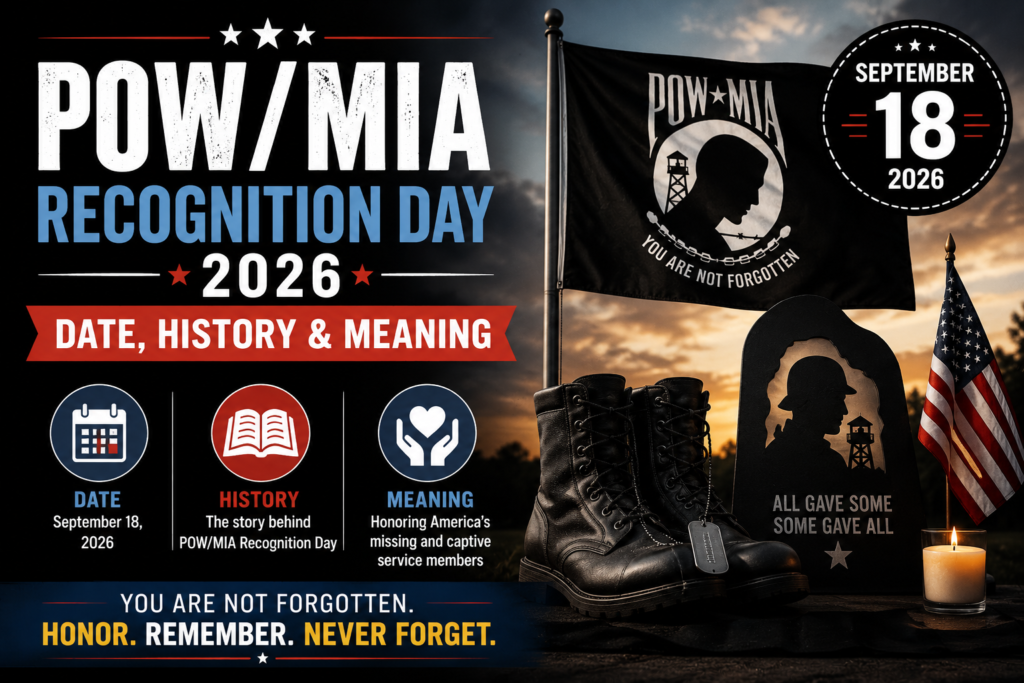
National POW/MIA Recognition Day 2026 falls on Friday, September 18, 2026.
The observance is always held on the third Friday of September, so the exact date shifts slightly from year to year depending on the calendar.
What Does POW/MIA Mean?
POW — Prisoner of War A POW is a member of the armed forces who has been captured by an enemy force during an armed conflict. POWs are meant to be protected under international law, including the Geneva Conventions, though history has shown that protection isn’t always honored.
MIA — Missing in Action MIA refers to a service member whose status is unknown following a military engagement — they are neither confirmed dead nor confirmed as a prisoner. Tens of thousands of American service members remain missing from World War II, the Korean War, the Vietnam War, and other conflicts.
History of POW/MIA Recognition Day
Origins in the Vietnam War Era The roots of POW/MIA Recognition Day trace back to the early 1970s, when families of missing and captured service members — particularly those from the Vietnam War — began organizing to push for greater government accountability. Mary Hoff, whose husband, Navy pilot Lt. Cmdr. Michael Hoff, had been missing since January 1970, was among the advocates who helped popularize what would become the POW/MIA flag as a national symbol of the cause.
Congressional Recognition (1979) In 1979, Congress passed a resolution authorizing the President to proclaim a National Day of Recognition for POWs and those missing in action. President Jimmy Carter issued the first such proclamation that year.
Moving to a Permanent Date (1986) For several years, the observance was held on different dates, without one fixed spot on the calendar. In 1986, the third Friday in September was adopted as the permanent date — chosen specifically because it wasn’t tied to any single war or organization’s convention, and because the weather nationwide tends to be mild at that time of year.
A Lasting Tradition Since 1989, every U.S. president has issued an annual proclamation marking National POW/MIA Recognition Day, and the observance has become a fixed part of the national calendar without requiring new legislation each year.
Why Is the Day Important?
POW/MIA Recognition Day 2026 serves as a reminder of the sacrifices made by service members who were captured or never returned home, and it reaffirms the nation’s commitment to accounting for those still missing. Tens of thousands of Americans remain unaccounted for across past conflicts, and the day keeps public attention on ongoing efforts to identify and recover remains, as well as to support the families who continue to wait for answers.
The POW/MIA Flag
The POW/MIA flag is a black-and-white banner featuring the silhouette of a man’s bust in front of a watchtower and barbed wire, along with the words “You Are Not Forgotten.” It was designed in 1972 and has since become one of the most recognized symbols associated with American military remembrance.
The flag holds a distinction shared by no other flag in the country: it is the only flag other than the American flag ever to fly over the White House, and the only flag other than the Stars and Stripes displayed in the U.S. Capitol rotunda. Under federal law, the POW/MIA flag must be flown on six specific days each year, including POW/MIA Recognition Day 2026, at prominent locations such as the White House, the U.S. Capitol, major military installations, national cemeteries, and all VA medical centers.
How Is POW/MIA Recognition Day Observed?
- Ceremonies — Formal remembrance events are held at military bases, government buildings, and veterans’ organizations nationwide
- Memorial events — Communities host events honoring former POWs and the families of the missing
- Flag displays — The POW/MIA flag is raised at federal buildings, military installations, and national cemeteries
- Educational programs — Schools and organizations use the day to teach about POW/MIA history and ongoing recovery efforts
- Military remembrance events — Moments of silence, wreath-layings, and flyovers are common at larger ceremonies
POW/MIA Recognition Day Across the USA
The observance is marked at locations throughout the country, including:
- Military bases — Installations across every branch hold formal ceremonies and flag displays
- Veterans’ organizations — Groups such as the American Legion and VFW frequently organize local remembrance events
- Communities — Cities and towns hold public ceremonies, often including moments of silence and flag-raising events
- Civic institutions — State capitols, courthouses, and post offices are among the federally designated sites required to fly the POW/MIA flag on this day
Frequently Asked Questions
When is POW/MIA Recognition Day 2026? National POW/MIA Recognition Day 2026 falls on Friday, September 18, 2026, the third Friday of the month.
What does POW/MIA stand for? POW stands for Prisoner of War, and MIA stands for Missing in Action.
Why is POW/MIA Recognition Day observed on the third Friday of September? The date was chosen in 1986 because it isn’t tied to any specific war or organization’s convention, and because the time of year tends to have mild weather nationwide for outdoor ceremonies.
What is the significance of the POW/MIA flag? The flag symbolizes the nation’s commitment to never forget service members who were captured or remain missing. It is one of the few flags legally required to be flown alongside the American flag on designated days.
How did POW/MIA Recognition Day begin? It grew out of advocacy by families of missing and captured Vietnam War service members in the early 1970s, leading to Congressional recognition in 1979 and a permanent September date in 1986.
How is the day observed? Through ceremonies, flag displays, memorial events, and educational programs held at military bases, veterans’ organizations, and communities across the country.
POW/MIA Recognition Day 2026 falls during a significant week on the national calendar. See the full September Holidays 2026 guide for everything observed this month, including Patriot Day 2026 and Constitution Day 2026, observed just one day earlier. For more upcoming U.S. observances, visit MemorialDay2026.com.