
On the evening of December 1, 1955, a seamstress named Rosa Parks refused to give up her seat on a city bus in Montgomery, Alabama. Her arrest that night set off a citywide boycott and became one of the defining moments of the American Civil Rights Movement.
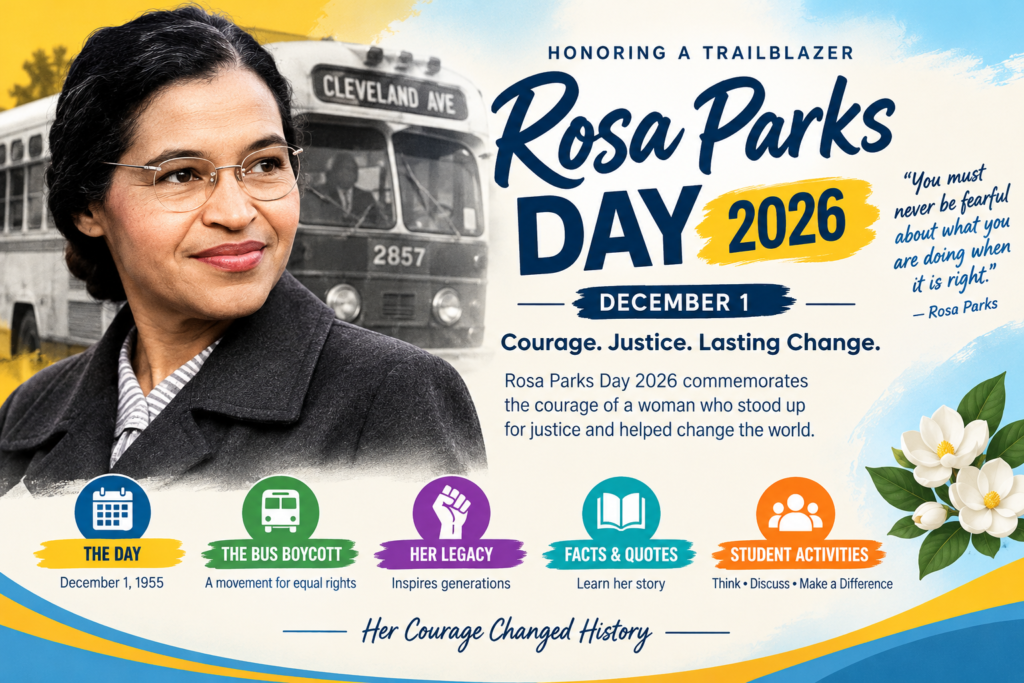
Rosa Parks Day 2026 is linked to Tuesday, December 1, 2026, the anniversary of that arrest. Observance dates vary, though. Some states and communities honor her on December 1, others on February 4, her birthday. This guide explains those differences and covers her life, what happened in 1955, the Montgomery Bus Boycott, her legacy and ways to commemorate her through learning.
If you follow history observances through the year, you can find more on MemorialDay2026.com.
When Is Rosa Parks Day 2026?
December 1, 2026 falls on a Tuesday. It is the anniversary of Rosa Parks’ arrest in Montgomery, Alabama, on December 1, 1955.
There is no single, nationwide date for Rosa Parks Day. Some states and communities mark December 1, the anniversary of her arrest. California and Missouri recognize February 4, her birthday. Some observance calendars list other dates tied to her story. Because December 1 is not a nationwide official observance, it is best to check your own state or school district for local details.
In short, Rosa Parks Day 2026 is listed on December 1 by some observance calendars. The date commemorates her arrest on December 1, 1955, while other states and communities recognize her legacy on different dates.
Who Was Rosa Parks?
Rosa Louise McCauley Parks was born on February 4, 1913, in Tuskegee, Alabama. She grew up in the segregated South, where schools, buses, restaurants and public spaces were divided by race. She experienced the daily indignities of that system from childhood.
She later married Raymond Parks, a barber and a civil rights activist, and worked as a seamstress. In the early 1940s, she joined the Montgomery branch of the NAACP and became its secretary. In that role she documented cases of racial violence and injustice, and she helped support people who needed legal help.
Her activism did not begin with the bus incident. In the summer of 1955, a few months before her arrest, she attended a workshop on civil rights organizing at the Highlander Folk School in Tennessee. By the time she boarded that bus, she had spent more than a decade working to challenge segregation. For a longer biography, see the Wikipedia article on Rosa Parks.
Rosa Parks Day History and Meaning
Rosa Parks Day is a day for remembering a pivotal act of resistance and learning the history behind it. Communities commemorate it for several reasons:
- To learn about racial segregation and how it shaped everyday life under Jim Crow laws.
- To understand civil rights history, including the organizing that made change possible.
- To honor civic participation, from boycotts to voting to community leadership.
- To reflect on the continuing importance of equality, dignity and fairness.
Because the observance has no single national founder or founding date, the day is shaped by local communities, schools and state governments. That is why dates and traditions differ from one place to another.
What Happened on December 1, 1955?
In 1955, Montgomery’s buses were segregated by law and by custom. Black passengers had to pay at the front, step off and re-enter through the back door, and sit in the rear. If the front rows filled up, drivers could order Black riders to give up seats to white passengers.
On Thursday, December 1, 1955, Parks boarded a Montgomery city bus after work and sat in the first row of the section for Black riders. When the bus filled up, the driver told her and three other passengers to move. The other three complied. Parks stayed in her seat and was arrested.
She was later fined, and she challenged the charges. Her arrest came at a moment when local leaders were already looking for the right case to challenge bus segregation. It is also important to remember that she was not the first to resist. Months earlier, a teenager named Claudette Colvin had been arrested in Montgomery for refusing to give up her seat, and others had challenged the system before them.
Parks later explained that she was not simply tired from her day. She was tired of giving in. Her calm, firm refusal, and her standing in the community, helped mobilize Montgomery’s Black residents in a way few events had before.
Rosa Parks and the Montgomery Bus Boycott
The boycott began on Monday, December 5, 1955, the day of Parks’ trial. It was far from spontaneous. The Women’s Political Council, led by Jo Ann Robinson, had been preparing for a bus protest for some time. When Parks was arrested, its members quickly printed and distributed thousands of flyers urging people to stay off the buses.
Local leaders such as E. D. Nixon, ministers and community organizers joined the effort. They formed the Montgomery Improvement Association and chose a young pastor, Martin Luther King Jr., as its president. The movement faced threats, arrests and violence, but it held together.
Black residents of Montgomery walked, carpooled and organized rides for 381 days. Meanwhile, a federal lawsuit challenged the constitutionality of bus segregation. In late 1956, the U.S. Supreme Court upheld a lower court’s ruling that bus segregation was unconstitutional. The boycott ended in December 1956, and Montgomery’s buses were desegregated.
The boycott showed what sustained, nonviolent collective action could achieve, and it inspired later campaigns across the country. You can read a detailed account in the Wikipedia article on the Montgomery bus boycott.
Why Is Rosa Parks Important?
Rosa Parks matters because of what she did, and also because of what she represented. Her importance rests on several things:
- She challenged segregation directly, at real personal risk.
- She helped launch the Montgomery Bus Boycott, one of the first large-scale mass movements of the era.
- She spent decades in civil rights work and community activism, before and after 1955.
- She inspired later generations of activists who learned from her example.
- She is a reminder that dignity, equality and civic participation are worth defending.
It is also worth avoiding the simplified story of a tired woman who happened to sit down. The historical record shows an experienced activist who made a deliberate choice, supported by a well-organized community.
The same spirit of courage and community runs through many other moments in American history. To explore it further, you can browse related stories on our Civil Rights history and observances pages.
How to Celebrate Rosa Parks Day 2026
The best way to honor Rosa Parks is to learn and to share what you learn. Here are some ideas:
- Read a reliable biography of Rosa Parks, including her own writings.
- Explore primary-source documents about her arrest, such as police records and court documents.
- Visit a civil rights museum or historic site in your area.
- Discuss civil rights history in a classroom, book club or community group.
- Read and discuss speeches, interviews or writings from the movement.
- Support a reputable organization that teaches civil rights history or works for equal access.
- Learn about other people involved in the boycott, such as Jo Ann Robinson, E. D. Nixon and Claudette Colvin.
- Share historically verified information about Parks’ life and legacy.
Rosa Parks Day 2026 Activities for Students
Rosa Parks Day Activities for Elementary Students
Read age-appropriate biographies together and build a simple timeline of key events. Use guided discussions to talk about fairness, rules and treating others with respect. Students can draw, write or act out what it means to stand up for what is right.
Activities for Middle and High School Students
Analyze primary sources, such as newspaper reports or arrest records, and compare different historical accounts. Create a timeline of the Montgomery Bus Boycott and map the roles of different activists and organizations. Older students can debate how movements are organized and sustained.
Classroom Discussion Questions
- What forms of segregation existed in Montgomery in 1955?
- Why was the Montgomery Bus Boycott significant?
- Which people and organizations helped sustain the boycott?
- How can primary sources help us understand historical events?
- How should communities preserve and teach civil rights history?
Rosa Parks Day 2026 Quotes
Many quotations attributed to Rosa Parks circulate online without a reliable source, so it is important to use only wording that can be verified. One well-documented line comes from her memoir, Quiet Strength:
- “I did not get on the bus to get arrested; I got on the bus to go home.”
The line is a reminder that her act was rooted in ordinary life. She was a working woman heading home, who chose not to accept an unjust rule. If you want more of her words, read her memoirs and verified interviews, and check each quotation against the original before you share it.
Rosa Parks Day 2026 Messages and Captions
These are original messages, not quotations from Rosa Parks.
- Remember Rosa Parks by learning the history behind the movement for equal rights.
- Rosa Parks’ legacy reminds us why dignity, fairness and civic participation matter.
- Honor Rosa Parks by learning from the many people who worked for civil rights.
- One act of courage can start a movement, but it takes a community to sustain it.
- Today we remember December 1, 1955, and the people who changed history.
Short messages for social media:
- Remembering Rosa Parks and the 381 days that changed Montgomery. #RosaParksDay
- Courage, dignity and community: lessons that still matter.
- Learn the history. Share the story. Honor the legacy.
Rosa Parks Facts
- Born February 4, 1913, in Tuskegee, Alabama.
- Arrested in Montgomery on December 1, 1955, which was a Thursday.
- Her arrest helped spark the Montgomery Bus Boycott, which began on December 5, 1955.
- The boycott lasted 381 days.
- She was active in the NAACP before her arrest.
- She received the Presidential Medal of Freedom in 1996.
- She died on October 24, 2005, in Detroit, Michigan.
Frequently Asked Questions About Rosa Parks Day 2026
When is Rosa Parks Day?
Rosa Parks Day is observed on different dates depending on the state or community. December 1 marks the anniversary of her 1955 arrest, and February 4 is her birthday. In 2026, December 1 falls on a Tuesday.
Why is Rosa Parks important?
Rosa Parks helped challenge racial segregation through her activism. Her 1955 arrest became a catalyst for the Montgomery Bus Boycott and a significant event in the Civil Rights Movement.
What happened on December 1, 1955?
Rosa Parks was arrested in Montgomery, Alabama, after refusing to give up her bus seat to a white passenger under the city’s segregation system.
How long did the Montgomery Bus Boycott last?
The boycott lasted 381 days, from December 1955 until December 1956.
Was Rosa Parks the first person to challenge bus segregation?
No. Other people had challenged segregation on Montgomery buses before her. Parks’ arrest became a major rallying point for an organized boycott.
How can students celebrate Rosa Parks Day?
Students can study her biography, examine historical documents, build a timeline of the boycott and learn about the broader Civil Rights Movement.
Countdown to December 1, 2026
As of October 9, 2026, there are 53 days until December 1, the anniversary of Rosa Parks’ arrest. That leaves time to plan a lesson, organize a discussion or visit a local historic site.
Conclusion
Rosa Parks was a lifelong activist whose quiet refusal on a Montgomery bus became a symbol of courage. Her story is one part of a larger movement, shaped by thousands of people who walked, organized and refused to give up.
Use December 1, 2026 to learn the history accurately, talk about it with others and think about what equality and dignity require today. Remembering her well means looking at the whole story, not just one moment.