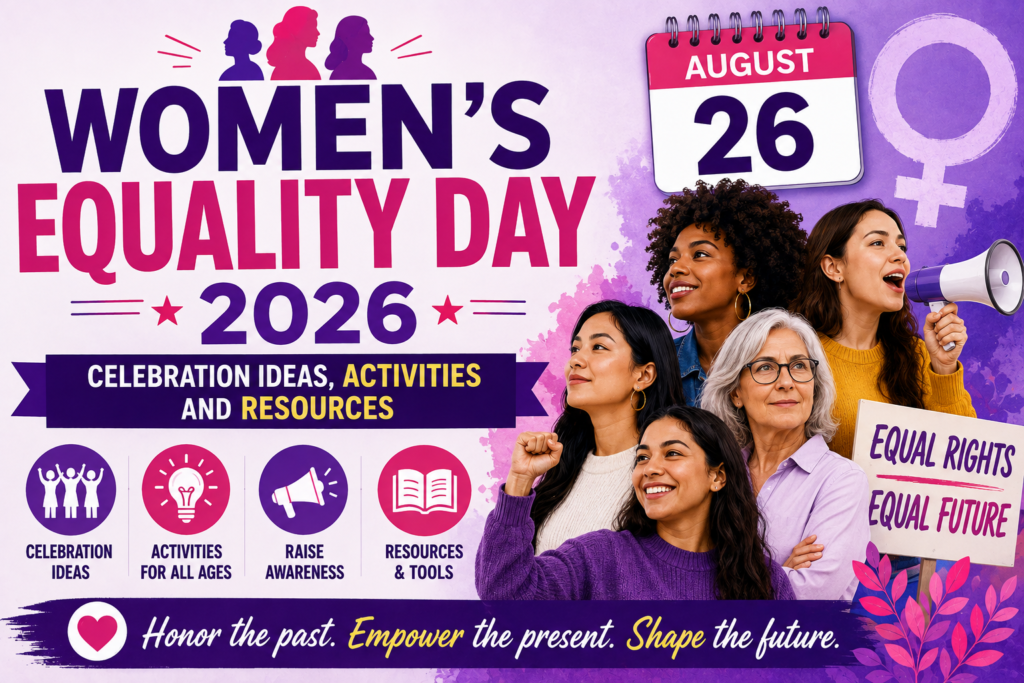
Women’s Equality Day , observed August 26, is best marked with substance rather than spectacle. It’s a day rooted in real history — the certification of the 19th Amendment and the decades-long suffrage movement that led to it — so the most meaningful ways to observe it tend to be educational, reflective, and community-focused rather than purely festive.
How to Celebrate Women’s Equality Day 2026
Five simple, meaningful ways to mark the day:
- Learn about voting-rights history, including the parts often left out of the standard story
- Visit a museum or historical site connected to the suffrage movement
- Recognize women making an impact in your local community
- Organize an educational discussion at work, school, or home
- Support women-led community programs or organizations
Meaningful Women’s Equality Day Activities
Read a biography of an influential woman
Pick a figure connected to the suffrage or equal rights movement — well-known or overlooked — and read a full biography rather than a summary.
Explore the original 19th Amendment
The certified amendment is on permanent public display at the National Archives Museum in Washington, D.C., alongside the Declaration of Independence and the Constitution. Digitized copies and transcripts are also available through the National Archives website.
Create a women’s-history timeline
Build a timeline — on paper, a whiteboard, or a shared document — tracing milestones from 1848 through today, including moments often left out of the standard narrative.
Visit a historical site or museum
Sites such as the Women’s Rights National Historical Park in Seneca Falls or the Belmont-Paul Women’s Equality National Monument in Washington, D.C. offer in-person context that’s hard to get from reading alone.
Attend a public lecture or virtual program
Libraries, universities, and museums frequently host talks around August 26; many are also livestreamed for remote attendance.
Record local women’s oral histories
Interview mothers, grandmothers, or long-time community members about the changes they’ve witnessed firsthand in education, work, and civic life.
Organize a civic-education session
Host a short, informal session on how voter registration works today, aimed at first-time voters or those newly eligible.
Highlight overlooked women from different communities
Use the day to spotlight suffragists and activists whose contributions have historically received less attention — including Black, Native American, Asian American, and Latina organizers.
Women’s Equality Day Activities for Schools
Elementary-school activities
- A coloring or poster activity themed around fairness and equality
- A simplified voting-rights timeline for young readers
- A classroom discussion about what fairness means in everyday situations
Middle-school activities
- A historical profile project on a suffragist or activist
- Analysis of a primary source, such as a suffrage-era newspaper clipping or photograph
- A mock campaign or classroom vote to illustrate the democratic process
High-school activities
- A close reading and analysis of the 19th Amendment’s constitutional language
- A structured debate on the history and legacy of voting rights
- A research project focused on an overlooked activist
- A comparison between historical and modern equality movements
Women’s Equality Day Workplace Ideas
- Host an educational lunch-and-learn on the history of the observance
- Invite a historian, local leader, or subject-matter expert to speak
- Highlight the professional achievements of women within the organization
- Review and share information on existing mentorship opportunities
- Create a simple internal resource guide with historical background and links
- Organize a book or documentary discussion group
- Support a relevant community or advocacy organization
Keep workplace messaging educational and grounded in verifiable facts. Avoid making unsupported claims about an organization’s own record on equality — the day works best as a moment for genuine reflection and learning, not self-promotion.
Community Event Ideas
- A historical walking tour of local suffrage-related sites
- A library exhibition on women’s history
- A panel discussion featuring local historians, educators, or activists
- A voter education and registration session
- A showcase of women-owned small businesses
- A local-history storytelling event
- An essay, poster, or photography competition open to students or residents
Virtual Women’s Equality Day Ideas
- An online history quiz covering the suffrage movement and the 19th Amendment
- A virtual museum tour of a suffrage-related historical site
- A livestreamed panel discussion
- A shareable digital timeline of key milestones
- An educational social-media series posted throughout the week of August 26
- An online book discussion focused on women’s history
Women’s Equality Day Quotes
Use only accurately verified quotations with correct attribution — many “suffrage quotes” circulating online are misattributed or altered from their original wording.
Historical quotes about voting rights
- “Failure is impossible.” — Susan B. Anthony, from her final public speech at her 86th birthday celebration in 1906
- “There will never be a new world order until women are a part of it.” — Alice Paul
Quotes about equality and opportunity
- “I never doubted that equal rights was the right direction.” — Alice Paul
Short quotes for posters
- “Failure is impossible.” — Susan B. Anthony
Quotes for workplace messages
- “There will never be a new world order until women are a part of it.” — Alice Paul
If you’d like additional quotes for a specific figure, verify wording and attribution against a primary source or a reputable archive (such as the Library of Congress or the National Archives) before publishing, since many popular “suffrage quotes” online are paraphrased or incorrectly attributed.
Women’s Equality Day Social-Media Captions
Short captions
- “August 26: honoring the fight for equal rights, then and now.”
- “Women’s Equality Day — history worth remembering.”
Educational captions
- “On this day in 1920, the 19th Amendment was certified. Today, we reflect on how far the fight for equal rights has come — and what’s still ahead.”
- “Women’s Equality Day isn’t just about 1920. It’s about the ongoing pursuit of equal opportunity in every field.”
Workplace captions
- “Today we’re recognizing the history behind Women’s Equality Day and the women shaping our workplace and industry today.”
School captions
- “Students are learning about the suffrage movement and the 19th Amendment this Women’s Equality Day.”
Community-event captions
- “Join us this August 26 for a community conversation on the history and legacy of Women’s Equality Day.”
Women’s Equality Day Hashtags
- #WomensEqualityDay
- #EqualityDay
- #WomensHistory
- #VotingRights
- #August26
Women’s Equality Day Messages
General awareness “Women’s Equality Day marks the certification of the 19th Amendment and reminds us that the pursuit of equal rights and opportunity continues today.”
For employees and colleagues “On Women’s Equality Day, we’re grateful for the contributions of the women on our team and mindful of the work still ahead in building equitable workplaces.”
For students and teachers “Today’s lesson connects to Women’s Equality Day — a chance to learn how the 19th Amendment came to be, and why the fight for equal rights didn’t end there.”
For community organizations “Our community is marking Women’s Equality Day with programs that honor the history of the suffrage movement and support ongoing equity work locally.”
For friends and family “Thinking today about the women in our own family history who lived through, or fought for, the changes we now often take for granted.”
What Not to Do When Observing Women’s Equality Day
- Don’t treat the day as only a commercial promotion or marketing opportunity
- Don’t present an incomplete version of suffrage history that skips the barriers many women of color continued to face after 1920
- Don’t use unverified or misattributed quotations
- Don’t ignore the contributions of women from underrepresented communities
- Don’t confuse Women’s Equality Day (August 26, U.S.-specific) with International Women’s Day (March 8, global)
- Don’t claim that all equality issues were resolved in 1920 — the observance is as much about unfinished work as historical achievement
Reliable Educational Resources
- National Archives — Digitized primary sources and the certified 19th Amendment
- Library of Congress — Suffrage-era newspapers, photographs, and exhibition materials
- National Park Service — Resources on Women’s Rights National Historical Park and Belmont-Paul Women’s Equality National Monument
- Smithsonian museums — Collections and educational materials on women’s history
- Official state historical archives — State-specific ratification and suffrage records
- Local libraries and museums — Often hold community-specific historical materials not available elsewhere
Frequently Asked Questions
How can I celebrate Women’s Equality Day? Learn about the history of the 19th Amendment and the suffrage movement, visit a relevant historical site, and support or recognize women in your community.
What are good Women’s Equality Day activities for students? Age-appropriate options include timelines and coloring activities for younger students, and primary-source analysis, research projects, or debates for middle and high schoolers.
How can workplaces observe Women’s Equality Day? Host an educational session, invite a speaker, highlight employee achievements, and share resources — while keeping the focus on genuine education rather than unverified claims.
What can families do on August 26? Read about the suffrage movement together, visit a local historical site, or record and share family stories about changes in women’s rights across generations.
What should be included in a Women’s Equality Day event? A clear historical framing, verified facts and quotes, and space for reflection or discussion on both progress made and work still ahead.
What colors are associated with women’s suffrage? Purple, white, and gold were used by the National Woman’s Party in the U.S.; gold alone traces back to Kansas suffrage campaigns in the 1860s.
What should I post on social media? Educational, historically accurate content works best — a fact, a verified quote, or a note about a related event, rather than a generic celebratory graphic.
Is “Happy Women’s Equality Day” an appropriate message? Because the day carries historical and civic weight, many people prefer framing messages around recognition and reflection rather than purely festive language — though a simple “Happy Women’s Equality Day” alongside educational content is also widely used and appropriate.
Are there official Women’s Equality Day 2026 events? Presidential proclamations are typically issued each year, and various museums, parks, and civic organizations host their own public programming; check local listings closer to August 26.
Where can teachers find primary sources? The Library of Congress and National Archives both offer free, searchable digitized collections of suffrage-era documents, photographs, and newspapers suitable for classroom use.
Internal linking: Link back to the pillar page and history article using natural anchors such as Women’s Equality Day 2026, history of Women’s Equality Day, and when Women’s Equality Day is observed.