
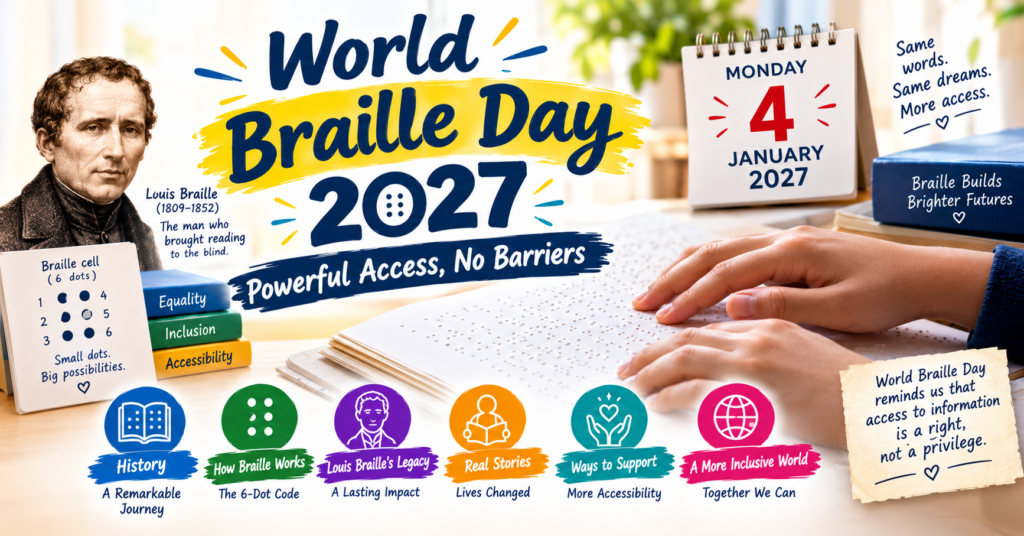
World Braille Day 2027 will be observed on Monday, January 4, to recognize the importance of Braille in communication, education and accessibility. Named after its inventor, Louis Braille, this tactile reading and writing system lets people access letters, numbers, punctuation and other information through raised dots. The observance is also a reminder that inclusive communities must make information available in formats that people with different access needs can use. From learning how Braille works to understanding Louis Braille’s legacy, World Braille Day is a chance to promote literacy, independence and equal access to information.
This guide explains the date, the history, the six-dot system, everyday uses of Braille, original quotes and practical ways to take part.
What Is World Braille Day?
World Braille Day is an international observance that highlights Braille as a means of communication and its role in the rights and inclusion of blind and partially sighted people. It is a United Nations observance, not a U.S. federal public holiday.
The day focuses on a few key ideas:
- Braille remains important for literacy and communication.
- Accessible education and information help people take part fully in daily life.
- Accessibility benefits communities, schools, workplaces and public services.
If you’re planning the first week of January, our New Year’s Day 2027 guide covers the holiday that comes just before.
When Is World Braille Day 2027?
World Braille Day 2027 is Monday, January 4, 2027.
It is observed every year on January 4, the birthday of Louis Braille. The United Nations General Assembly proclaimed January 4 as World Braille Day in November 2018, and the first official observance took place in 2019.
History of World Braille Day
Why the United Nations Established the Observance
The United Nations created World Braille Day to raise awareness of Braille as a means of communication and of its role in the human rights of blind and partially sighted people. Reading and writing are tied to education, freedom of expression and access to information, so the observance links Braille to broader questions of inclusion.
The First World Braille Day
The first observance took place in 2019, following the General Assembly’s 2018 proclamation. Since then, schools, libraries and organizations around the world have used the date to share information and promote accessibility.
Why the Date Is January 4
January 4 marks the anniversary of Louis Braille’s birth in 1809. Choosing his birthday connects the observance to the person whose invention made independent reading and writing possible for many blind people.
Who Was Louis Braille?
Louis Braille was a French educator whose tactile code is still used around the world. You can read a longer biography on Wikipedia’s Louis Braille page.
- Full name: Louis Braille
- Born: January 4, 1809, in Coupvray, France
- Early life: He lost his sight after an accident in early childhood.
- Education: He studied at a school for blind children in Paris.
- Invention: As a teenager, he developed a tactile code based on raised dots.
- Legacy: His system became a widely used method for reading and writing by touch.
Braille’s system built on an earlier “night writing” code created by Charles Barbier. Braille simplified the idea and developed a more practical six-dot code, which is the basis of the Braille used today.
What Is Braille and How Does It Work?
Braille is a tactile code that represents letters, numbers, punctuation and other symbols through patterns of raised dots. Readers feel the dots with their fingertips. For a broader overview, see Wikipedia’s Braille page.
Understanding the Six-Dot Braille Cell
A standard Braille cell has six dot positions arranged in two columns of three. Dots are numbered from top to bottom: 1, 2 and 3 on the left, and 4, 5 and 6 on the right.
| Left column | Right column |
|---|---|
| Dot 1 | Dot 4 |
| Dot 2 | Dot 5 |
| Dot 3 | Dot 6 |
Different combinations of raised dots represent different characters or symbols. There are 64 possible patterns when the empty cell is included.
Here are the first five letters as a beginner example:
| Letter | Raised dots |
|---|---|
| A | 1 |
| B | 1, 2 |
| C | 1, 4 |
| D | 1, 4, 5 |
| E | 1, 5 |
Braille is a code, not a separate language, and it can represent many languages.
How People Read and Write Braille
People use several methods:
- Reading raised dots with the fingertips
- Using a slate and stylus
- Writing with a Braillewriter
- Reading digital Braille through refreshable Braille displays
- Using Braille in books, labels, signs and educational materials
Is Braille the Same in Every Language?
No. Braille is adapted to different languages and writing systems. Symbols and conventions can differ, so learners should use resources designed for the language they want to read.
Why Is World Braille Day Celebrated?
World Braille Day is celebrated for five main reasons:
- Promoting literacy: Braille provides access to written language.
- Supporting education: Students can read, spell, write and study using tactile text.
- Improving access to information: Accessible materials help people take part in daily life.
- Encouraging independence: Braille can support personal organization and access to information.
- Promoting inclusion and equal rights: Accessibility helps reduce barriers in education, employment and public services.
In short, Braille supports education, freedom of expression, access to information and social inclusion.
The Importance of Braille in Everyday Life
Braille shows up in many ordinary settings:
- Education: Textbooks, worksheets, exams and classroom materials
- Public spaces: Braille signs and room labels
- Healthcare: Accessible labels and patient information where available
- Technology: Refreshable Braille displays and compatible digital tools
- Personal life: Notes, calendars, household labels and reading for pleasure
Braille is not the only accessible format. Audio, screen readers, large print and other tools can also be important, depending on a person’s needs and preferences. The goal is to offer choices so each person can use what works best for them.
World Braille Day Quotes and Messages
These are original messages written for this article. They are not quotations from Louis Braille or any other historical figure.
- “Accessibility begins when information is created for everyone.”
- “Every person deserves the opportunity to read, learn and participate.”
- “Inclusion means making knowledge accessible in more than one way.”
- “Braille turns raised dots into pathways to literacy.”
- “A more accessible world begins with thoughtful everyday choices.”
- “Equal access to information helps open doors to opportunity.”
- “Different ways of reading can lead to the same world of knowledge.”
- “Inclusion is not a favor; it is part of respecting human dignity.”
- “Accessible information helps people make informed choices.”
- “World Braille Day reminds us that literacy should leave no one behind.”
Short World Braille Day Messages
- Happy World Braille Day 2027! Let’s support literacy and accessible information for all.
- Today, we celebrate Louis Braille’s legacy and the importance of inclusive communication.
- May World Braille Day inspire more accessible schools, workplaces and communities.
- Let’s recognize the role of Braille in education, independence and inclusion.
How to Celebrate World Braille Day 2027
Individuals, schools, libraries and organizations can all take part in simple, meaningful ways:
- Learn how a six-dot Braille cell works.
- Read about Louis Braille’s life and invention.
- Invite an accessibility professional or Braille reader to share their experience, with their consent.
- Explore Braille resources at a local library.
- Review whether school or workplace materials are accessible.
- Learn about screen readers and refreshable Braille displays.
- Share factual awareness messages on social media.
- Promote accessible digital documents and websites.
- Encourage inclusive reading activities.
- Support organizations led by blind and partially sighted people.
Starting something new is also a good fit for the beginning of the year. Our New Year’s Day activities include ideas for learning new skills, and our family and lifestyle section has more ways to learn together.
World Braille Day Activities for Students
- Make a paper model of a six-dot Braille cell.
- Research Louis Braille’s biography.
- Discuss different ways people access written information.
- Review a website for accessibility barriers.
- Create an awareness poster using readable text and accessible digital descriptions.
A note on respectful activities: Blindfolding yourself or briefly simulating blindness is not the same as understanding the lived experience of blind people. Prioritize learning from people with relevant experience and expertise.
How to Make Information More Accessible
Accessibility goes beyond Braille. Websites, schools and businesses can use this checklist:
- Use meaningful headings and a logical document structure.
- Add descriptive alternative text to informative images.
- Make sure websites can be navigated with a keyboard.
- Provide accessible digital documents.
- Avoid communicating essential information through images alone.
- Offer information in formats suited to different users’ needs.
- Consult people with disabilities when evaluating accessibility.
A website is not accessible just because it includes a Braille option. Accessibility means considering a range of needs, devices and assistive technologies.
Frequently Asked Questions
Why is World Braille Day celebrated?
World Braille Day raises awareness of Braille’s role in communication, literacy, education, human rights and inclusion for blind and partially sighted people.
Who invented Braille?
Louis Braille, a French educator who was blind, developed the tactile reading and writing system as a teenager in the 1820s. His system is based on combinations of raised dots.
When is World Braille Day 2027?
World Braille Day 2027 is on Monday, January 4. The date is observed annually because it is Louis Braille’s birthday.
What is Braille used for?
Braille can represent letters, numbers, punctuation and specialized symbols. It is used in reading, writing, education, public signage and compatible digital devices.
Is Braille a language?
No. Braille is a tactile code used to read and write languages. Different languages use their own Braille conventions.
How many dots are in a Braille cell?
A standard Braille cell contains six dot positions arranged in two columns of three. Different combinations of the dots represent characters and other symbols.
When was World Braille Day first celebrated?
The United Nations proclaimed January 4 as World Braille Day in November 2018, and the first official observance took place in 2019.
Countdown to World Braille Day 2027
Monday, January 4, 2027
76 days to go (calculated from October 20, 2026)
For more holiday and awareness guides, visit our upcoming days and events page or browse the latest posts on our blog.
Checks done: Jan 4, 2027 is a Monday (Jan 1 is a Friday). The countdown from Oct 20 is 76 days. The proclamation (November 2018) and first observance (2019) match the outline. There are 2 external links (both Wikipedia), 5 internal links to pages confirmed live on your blog, and no sources section, source names or divider lines.