
World Mental Health Day 2026 falls on Saturday, October 10, 2026. The official theme this year is “Lived experiences heard: real voices, real change,” a campaign that calls for people who have personally experienced mental health conditions to play a genuine, decision-making role in how mental health policies, services, and support systems are designed. Rather than treating personal stories as a one-off feature, the 2026 campaign asks governments, health systems, and communities to let lived experience shape real outcomes.
When Is World Mental Health Day 2026?
World Mental Health Day 2026 Date
| Detail | 2026 Information |
|---|---|
| Date | October 10, 2026 |
| Day of the week | Saturday |
| Event | World Mental Health Day |
| 2026 theme | Lived experiences heard: real voices, real change |
| Main focus | Meaningful involvement of people with lived experience |
World Mental Health Day is observed on October 10 every year, regardless of which day of the week it falls on. In 2026, that date lands on a weekend, which many workplaces and schools use as a reason to schedule related activities on the Friday before or the Monday after so more people can take part.
What Is World Mental Health Day?
World Mental Health Day is an annual global observance dedicated to raising awareness about mental health, reducing the stigma that still surrounds mental illness, and encouraging governments, organizations, and individuals to invest in better mental health support. It brings together health authorities, nonprofits, schools, workplaces, and everyday people around a single shared conversation each October.
The day is coordinated internationally, with national mental health associations and community groups building local activities around a central annual theme. The broader goal each year is the same: get more people talking openly about mental health, and turn that awareness into tangible support for people who need it.
What Is the World Mental Health Day 2026 Theme?
“Lived Experiences Heard: Real Voices, Real Change”
The 2026 theme puts people with direct, personal experience of mental health conditions at the center of the conversation, rather than treating them only as an audience for awareness campaigns.
What Does the 2026 Theme Mean?
“Lived experience” refers to the first-hand knowledge someone gains from actually living through a mental health condition, navigating treatment, or supporting a loved one through one. This year’s theme argues that this kind of knowledge is a form of expertise in its own right — one that complements clinical training rather than competing with it.
Simply listening to personal stories isn’t the goal of the campaign. Meaningful engagement means giving people with lived experience real opportunities to influence policy decisions, help design services, strengthen peer-support programs, and hold institutions accountable for how they treat mental health patients.
Why Lived Experience Matters in Mental Health Care
People who have actually navigated a mental health system often see gaps that professionals miss: long wait times, confusing referral processes, stigma from providers, or services that don’t reflect the realities of daily life. Involving these voices in service design tends to produce care that’s more practical, more respectful, and more likely to be used.
“Nothing About Us Without Us”
This idea — long used in disability rights and health advocacy — captures the spirit of the 2026 theme. It’s a reminder that decisions affecting people with mental health conditions should never be made entirely without their input.
Why Is World Mental Health Day Celebrated?
World Mental Health Day exists to:
- Raise public awareness of mental health conditions
- Challenge stigma and harmful stereotypes
- Encourage open, judgment-free conversations
- Promote access to appropriate mental health care
- Support people currently experiencing mental health difficulties
- Push governments and organizations to strengthen mental health services
- Give people with lived experience a stronger, more consistent voice
Why Is Mental Health Important?
Mental health affects nearly every part of daily life — how people think, feel, handle stress, relate to others, and make decisions. Poor mental health can strain relationships, reduce productivity at work or school, and make ordinary tasks feel overwhelming.
Mental health conditions don’t discriminate by age, background, or circumstance; they can affect anyone. Early support — whether through a conversation with a trusted person, a primary care provider, or a mental health professional — often makes a meaningful difference in how someone copes and recovers over time.
World Mental Health Day History
World Mental Health Day was first observed in 1992, established to raise awareness of mental health issues worldwide and encourage open discussion at a time when the topic was rarely addressed publicly. Since then, the observance has grown into one of the most widely recognized global health awareness days, with each year built around a specific theme reflecting current priorities in mental health care.
Previous World Mental Health Day Themes
| Year | Theme |
|---|---|
| 2026 | Lived experiences heard: real voices, real change |
| 2025 | Mental health in humanitarian emergencies |
| 2024 | Mental health is a universal human right |
| 2023 | Mental health is a universal human right |
Themes in past years have covered topics like workplace mental health, mental health for all, and access to care in crisis settings — each one building on growing global attention to the issue. You can read more about the observance’s origins and evolution on Wikipedia.
What Does “Lived Experience” Mean in Mental Health?
“Lived experience” describes the personal, first-hand understanding someone develops from directly living with a mental health condition, going through treatment, or caring for a family member with one. It’s distinct from — and complementary to — clinical or academic knowledge.
People with lived experience often include former or current patients, peer support workers, caregivers, and advocates. Their insight is considered valuable precisely because it reflects what actually happens outside a clinical setting: how stigma shows up in daily life, how hard it can be to access care, and what genuinely helps during recovery.
Meaningful engagement means inviting these voices into real decision-making spaces — advisory boards, service design panels, and policy consultations — rather than only featuring their stories in awareness campaigns.
World Mental Health Day 2026 and Community-Based Mental Health Care
A major thread running through the 2026 campaign is the shift away from long-stay psychiatric institutions and toward community-based, person-centred mental health care.
What Is Community-Based Mental Health Care?
Community-based care means support delivered close to where people live — through local clinics, peer networks, and outpatient services — rather than in large, isolated institutions.
Why Is Person-Centred Care Important?
Person-centred care treats each individual’s preferences, history, and goals as central to their treatment plan, rather than fitting people into a single standardized approach.
What Is Deinstitutionalization?
Deinstitutionalization refers to the ongoing global effort to move mental health care away from long-term institutional settings and toward community-based alternatives that respect patients’ rights and independence.
Why Should People With Lived Experience Be Involved?
Because they understand, first-hand, what dignity, autonomy, and genuine support look like in practice — making their input essential to designing care systems that actually work for the people using them.
How Can We Observe World Mental Health Day 2026?
- Start a respectful, open conversation about mental health with friends or coworkers
- Listen without judgment when someone shares their experience
- Learn about common mental health conditions from credible sources
- Challenge stigma and harmful stereotypes when you encounter them
- Support local or national mental health organizations
- Attend an awareness event, webinar, or community talk
- Share reliable, accurate mental health information rather than myths
- Support peer-led initiatives and lived-experience advocacy groups
- Encourage workplaces and institutions to genuinely listen to people with lived experience
World Mental Health Day 2026 Activities
For workplaces: Host a mental health awareness session, an employee listening circle, or manager training focused on psychological safety.
For schools: Run a myth-vs-fact discussion, a student-led awareness campaign, or a peer-support initiative — while being careful not to position students as informal counselors for one another.
For communities: Organize a storytelling or lived-experience panel, a mental health resource fair, or a local discussion session paired with information from trusted health organizations.
Each activity works best when it includes a clear takeaway — a resource, a next step, or a way to keep the conversation going after the day itself. If you’re organizing a broader calendar of awareness events throughout the year, our event planning resources can help you build a simple, repeatable structure.
World Mental Health Day 2026 Messages and Quotes
Short, original awareness messages tend to resonate more than recycled quotes. A few examples:
- “Your story matters — and so does your voice in the decisions that shape your care.”
- “Mental health support works best when it’s built with people, not just for them.”
- “Listening is a start. Real change means acting on what we hear.”
Avoid attributing quotes to public figures unless the attribution can be verified — misattributed quotes are common and easy to accidentally spread.
World Mental Health Day 2026 Facts
| Fact | 2026 Information |
|---|---|
| Date | October 10, 2026 |
| Theme | Lived experiences heard: real voices, real change |
| Main focus | Meaningful engagement of people with lived experience |
| Key concept | Lived experience as a form of expertise |
| Related focus | Community-based, person-centred mental health care |
Recent global surveys on mental health systems have found that a substantial share of countries report some form of ongoing collaboration with people with lived experience and caregiver advocacy groups in planning or monitoring mental health services — though there’s broad agreement that this collaboration still has considerable room to deepen.
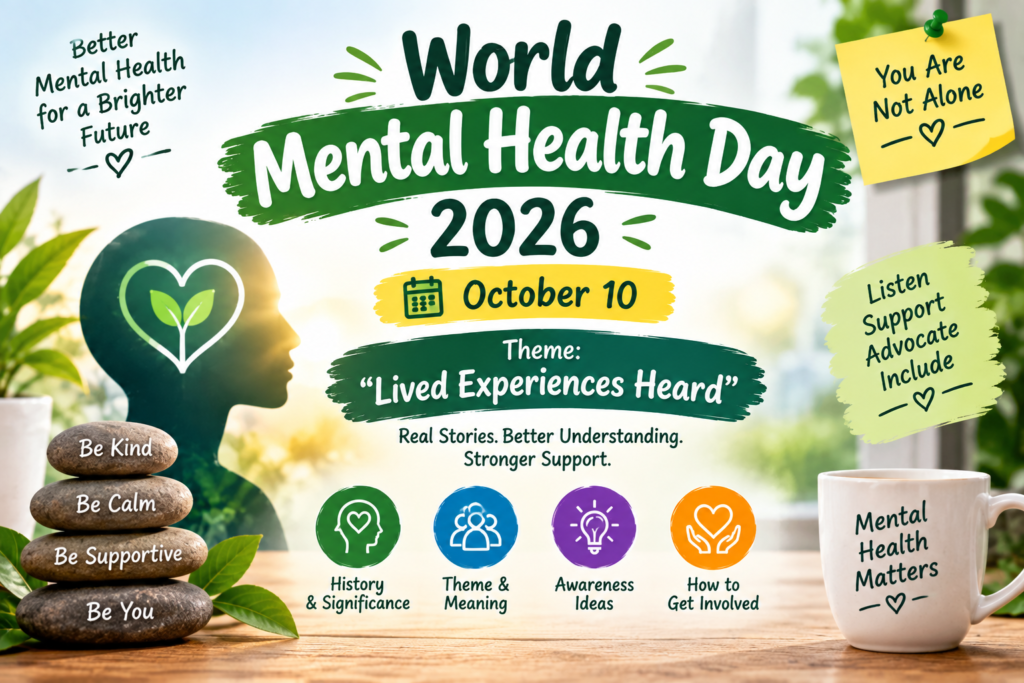
World Mental Health Day 2026 Global Campaign
This year’s global campaign centers on meaningful engagement, with related programming — including public discussions and webinars — scheduled around the observance in early-to-mid October 2026. Health organizations, advocacy groups, and community networks typically publish their own local events and resources in the weeks leading up to the day, so it’s worth checking with regional mental health organizations for events near you.
Frequently Asked Questions About World Mental Health Day 2026
When is World Mental Health Day 2026? World Mental Health Day 2026 falls on Saturday, October 10, 2026.
What is the theme of World Mental Health Day 2026? The theme is “Lived experiences heard: real voices, real change,” focused on giving people with lived experience a genuine role in shaping mental health policy and services.
Why is World Mental Health Day celebrated? It’s observed to raise awareness, reduce stigma, encourage open conversations, and push for better access to mental health care worldwide.
What does the 2026 theme mean? It means moving beyond simply sharing personal stories and instead giving people with lived experience real influence over decisions, service design, and accountability.
What is lived experience in mental health? It’s the first-hand knowledge someone gains from personally living with a mental health condition or supporting someone who has one.
Why is lived experience important in mental health care? Because it reveals practical gaps and needs that clinical training alone often can’t capture, leading to more effective, person-centred services.
How can we observe World Mental Health Day 2026? By starting respectful conversations, learning about mental health, challenging stigma, and supporting organizations and peer-led initiatives.
What activities can schools do for World Mental Health Day? Discussion sessions, myth-vs-fact activities, student-led awareness campaigns, and peer-support initiatives, handled with care and appropriate adult guidance.
What can workplaces do for World Mental Health Day? Awareness sessions, employee listening circles, manager training, and clear communication about available mental health resources.
How can I support someone experiencing mental health difficulties? Listen without judgment, avoid offering diagnoses, encourage them to seek professional support, and check in consistently rather than just once.
What is community-based mental health care? Care delivered close to where people live — through local clinics and peer networks — rather than in large, isolated institutions.
What is the history of World Mental Health Day? It was first observed in 1992 and has grown into a globally recognized awareness day, with a different theme highlighted each year. General background on mental health as a broader topic is available on Wikipedia.
Key Takeaways From World Mental Health Day 2026
- World Mental Health Day 2026 takes place on Saturday, October 10, 2026.
- The official theme is “Lived experiences heard: real voices, real change.”
- The campaign emphasizes lived experience as genuine expertise, not just a personal story.
- People with lived experience should be meaningfully involved in shaping mental health policies and services.
- This year’s campaign highlights the shift toward person-centred, community-based mental health care.
- The day remains an important opportunity to raise awareness, challenge stigma, and turn conversation into real support.
For more awareness-day guides and yearly observance calendars, visit MemorialDay2026.com.